




- Animal Feed & Additives
- Poultry Feed Market
Poultry Feed Market Size, Share, Growth, and Regional Forecast, 2026 to 2033
Poultry Feed Market by Livestock (Broilers, Layers, Turkeys, Ducks), Nature (Organic, Conventional), Ingredient (Corn, Wheat, Barley, Soybean, Other Grains), Form (Mash, Pellets, Granules, Crumbles, Liquid) and Regional Analysis, 2026 - 2033

Poultry Feed Market Share and Trends Analysis
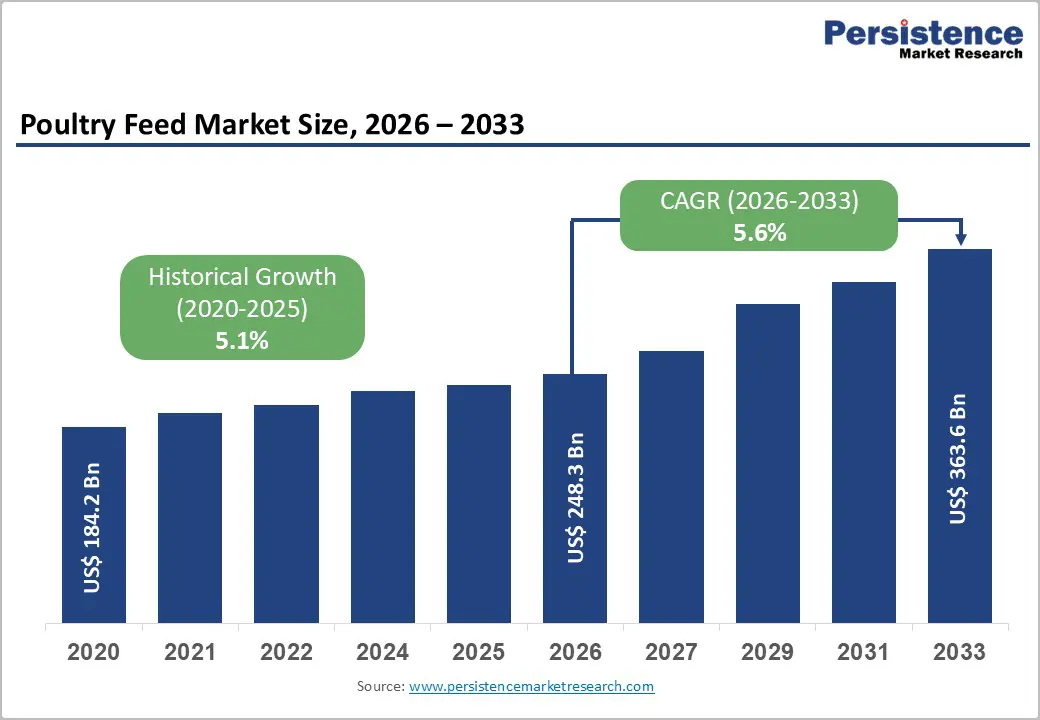
The global poultry feed market size is estimated to grow from US$ 248.3 billion in 2026 to US$ 363.6, projected to record a CAGR of 5.6% during the forecast period from 2026 to 2033. Global poultry feed demand is evolving rapidly as commercial poultry farming becomes increasingly technology-driven, efficiency-focused, and nutrition-oriented across major agricultural economies. Feed manufacturers are moving beyond conventional grain formulations toward precision nutrition systems that improve bird growth, immunity, and production efficiency.
The rise in protein consumption, industrial poultry integration, and expanding quick-service restaurant industries is strengthening demand for specialized poultry feed worldwide. At the same time, sustainability concerns and regulatory pressure on antibiotic usage are encouraging innovation in natural feed additives, probiotics, and enzyme-based formulations. Emerging markets are becoming major growth engines due to expanding poultry production infrastructure and rising affordability of poultry meat. Investments in automated feed mills, climate-resilient feed ingredients, and scientifically balanced formulations continue to reshape competitive dynamics across the global poultry feed industry.
Key Industry Highlights:
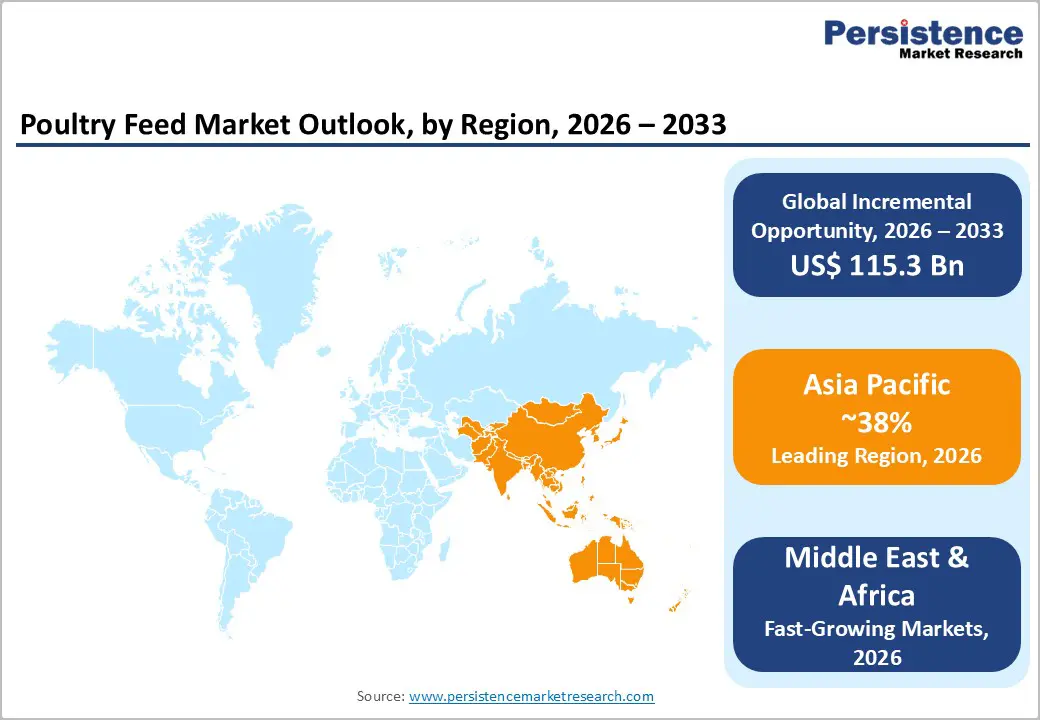
- Leading Region: Asia Pacific, holding approximately 38% market share, supported by expanding poultry production, rising meat consumption, and rapid modernization of commercial feed manufacturing infrastructure.
- Fast-Growing Market: Middle East & Africa, driven by increasing poultry self-sufficiency initiatives, rising protein demand, and investments in climate-controlled poultry farming systems.
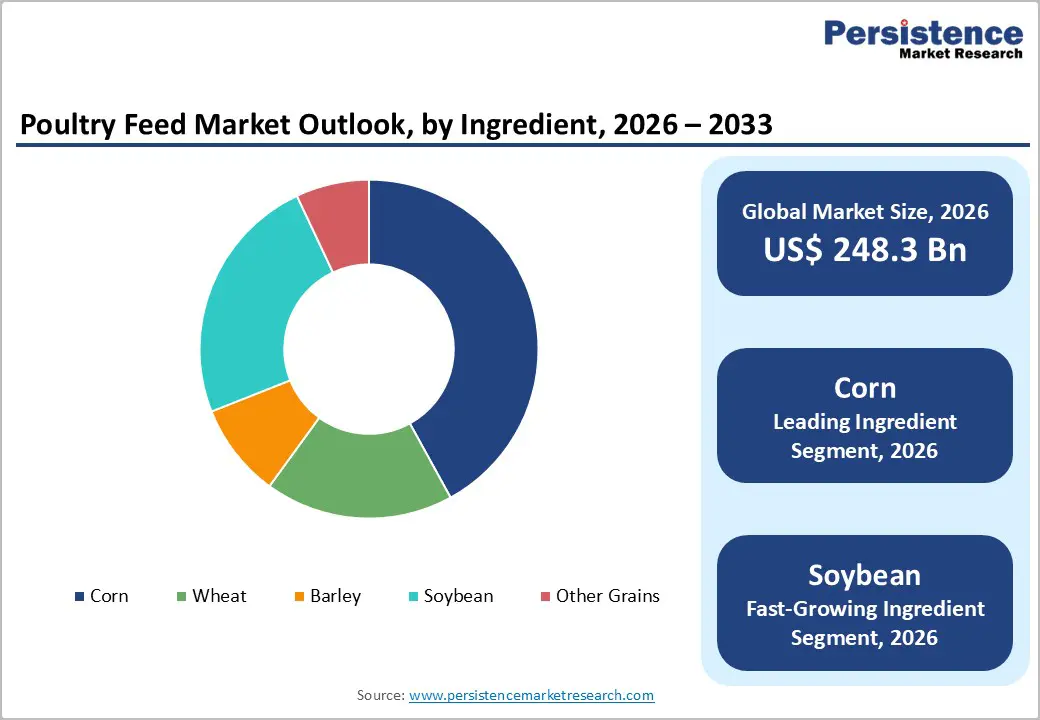
- Leading Ingredient Segment: Corn, accounting for 42% market share in 2025, supported by high energy value, strong digestibility, widespread availability, and efficient poultry feed conversion performance.
- Fastest-Growing Livestock Segment: Broilers, expected to grow at a CAGR of 5.4% during the forecast period, fueled by rising global consumption of affordable poultry meat and processed chicken products.
- Growth Indicators: Rising poultry meat consumption and increasing demand for nutritionally balanced feed formulations are accelerating growth across the global poultry feed market.
- Consumer Trends: Growing preference for antibiotic-free poultry products is encouraging feed manufacturers to adopt probiotics, enzymes, and plant-based nutritional additives.
- Opportunities: Expanding adoption of organic and antibiotic-free poultry feed solutions is creating significant growth opportunities across premium poultry production industries globally.
Market Dynamics
Driver: Rising Demand for Animal Protein and Broiler Consumption
Rapid transformation in global food consumption patterns is accelerating demand for poultry-based protein, creating strong momentum for the poultry feed industry. Consumers are increasingly shifting toward chicken products due to affordability, shorter production cycles, and wider availability compared to other meat categories. According to the Food and Agriculture Organization (FAO), global poultry production is projected to reach 154 million tonnes by 2031, highlighting the expanding scale of commercial poultry farming worldwide. This growth directly increases the requirement for nutritionally balanced feed formulations that support faster bird growth and higher feed conversion efficiency.
Broiler farming remains highly dependent on scientifically formulated feed to maximize meat yield, maintain flock health, and reduce production losses. Expanding urbanization, rising disposable incomes, and growing consumption of processed and ready-to-cook poultry products are encouraging producers to modernize feeding practices. Feed manufacturers are therefore developing protein-rich, performance-oriented feed solutions tailored for intensive broiler production systems.
Restraint: Volatility in Raw Material Prices and Supply Chain Risks
Sharp fluctuations in agricultural commodity markets are creating persistent cost pressures across the global poultry feed industry. Essential feed ingredients such as corn and soybeans are heavily influenced by adverse weather conditions, export restrictions, geopolitical instability, and transportation disruptions. According to World Bank commodity reports, interruptions in grain supply chains can trigger double-digit increases in feed ingredient prices, significantly affecting feed manufacturers and poultry producers worldwide.
Feed expenses account for nearly 60% to 70% of overall poultry production costs, making profitability highly vulnerable to raw material inflation. Sudden price increases often reduce purchasing power for small and medium poultry farms, forcing them to adopt lower-cost feed alternatives that may compromise bird performance and health. Unstable ingredient availability also complicates long-term procurement planning and increases operational uncertainty throughout the poultry supply chain.
Opportunity: Growing Preference for Organic and Antibiotic-Free Feed
Changing consumer attitudes toward food transparency and animal welfare are creating strong growth opportunities in the poultry feed sector. Demand for organic and antibiotic-free poultry products is increasing as consumers seek safer, naturally produced protein sources with clean-label positioning. According to the United States Department of Agriculture (USDA), certified organic poultry operations continue to expand steadily, encouraging feed manufacturers to develop specialized formulations that align with organic farming standards and sustainable livestock production practices.
Feed producers are increasingly investing in natural additives such as probiotics, enzymes, essential oils, and plant-based ingredients to improve bird health and productivity without antibiotic growth promoters. Regulatory restrictions on AGPs across Europe and North America are accelerating the transition toward high-performance natural feed solutions. This trend is enabling companies to strengthen premium product portfolios and capture higher-value consumer segments globally.
Category-wise Analysis
By Ingredient, Corn dominates the global poultry feed market
Corn is a dominant ingredient likely to account for 42% share in 2026, forming the nutritional backbone of the global poultry feed market due to its high energy content, digestibility, and widespread availability. Poultry producers extensively utilize corn in broiler, layer, and breeder feed formulations because it supports faster weight gain, improved feed conversion ratios, and consistent bird performance. Its balanced carbohydrate composition and palatability make it highly suitable for large-scale commercial poultry operations across both developed and emerging markets. Strong global cultivation volumes and established grain trading networks further strengthen corn’s position within feed supply chains.
Rising poultry meat and egg consumption worldwide continues to accelerate demand for corn-based feed formulations. Feed manufacturers increasingly prefer corn because it blends efficiently with soybean meal, vitamins, minerals, and amino acid additives to create nutritionally balanced poultry diets supporting productivity and flock health.
By Livestock, Broilers Are Expected to Reveal Lucrative Growth
Broilers are expected to show promising growth of CAGR 5.4% during the forecast period in the global market, driven by the growing worldwide consumption of affordable poultry meat and expanding commercial poultry farming operations. Rapid urbanization, population growth, and changing dietary preferences are increasing demand for high-protein animal nutrition, encouraging large-scale broiler production across emerging and developed economies.
Broiler feed formulations rich in proteins, amino acids, vitamins, and energy ingredients are increasingly optimized to improve feed conversion efficiency, bird growth rates, and overall meat quality. Advancements in precision nutrition and feed additives are further supporting productivity gains across industrial poultry systems.
Growing investments in automated poultry farming infrastructure and integrated feed production are accelerating segment expansion globally. Rising quick-service restaurant demand, processed chicken consumption, and export-oriented poultry production continue to strengthen long-term demand for specialized broiler feed solutions across international markets.
Regional Insights
Asia Pacific Poultry Feed Market Trends
Asia Pacific poultry feed market holds approximately 38% share in the global poultry feed market, supported by expanding poultry production, rising protein consumption, and rapid modernization of commercial farming operations across regional economies. Increasing demand for chicken meat and eggs is encouraging feed manufacturers to develop nutritionally balanced formulations containing corn, soybean meal, amino acids, enzymes, and feed additives that improve bird performance and feed efficiency. Growth in integrated poultry farming systems and expanding feed mill infrastructure is further strengthening regional market expansion.
China Poultry Feed Market Trends
China poultry feed market is witnessing strong demand driven by industrial poultry farming, advanced feed technologies, and rising consumption of processed chicken products. Feed producers are increasingly investing in precision nutrition, disease-control additives, and high-performance formulations to improve poultry productivity and operational efficiency across large-scale farming systems.
India Poultry Feed Market Trends
India poultry feed market is gaining momentum due to rising rural and urban poultry consumption, improving farm commercialization, and increasing awareness regarding scientifically balanced animal nutrition. Feed companies are expanding production of protein-rich formulations containing maize, soybean meal, and micronutrient additives to improve flock performance and disease resistance. Growth in contract farming models, expanding hatchery networks, and rising demand for affordable chicken products are further strengthening poultry feed consumption across major agricultural and livestock-producing states.
Middle East & Africa Poultry Feed Market Trends
The Middle East & Africa poultry feed market is expected to grow at a CAGR of 6.8%, driven by rising poultry meat consumption, expanding commercial farming operations, and increasing investments in feed production infrastructure across regional markets. Growing population levels, urban dietary shifts, and rising demand for affordable animal protein are encouraging poultry producers to adopt nutritionally balanced feed formulations containing grains, soybean meal, vitamins, and performance-enhancing additives. Government initiatives supporting domestic poultry production and food security are further strengthening market development.
Egypt Poultry Feed Market Trends
The Egypt poultry feed market is witnessing steady expansion due to increasing broiler production, improving feed manufacturing capacity, and rising consumption of poultry products among urban households. Feed producers are focusing on cost-efficient formulations and improved nutritional performance to support commercial poultry farming growth.
GCC Poultry Feed Market Trends
The GCC poultry feed market is experiencing strong growth due to increasing government focus on reducing dependence on imported poultry products and strengthening regional food self-sufficiency programs. Large-scale investments in climate-controlled poultry farms, advanced feed processing facilities, and precision nutrition technologies are accelerating feed demand across Saudi Arabia, the UAE, and Oman. Feed manufacturers are increasingly developing high-efficiency formulations enriched with enzymes, amino acids, and performance additives to improve poultry productivity under harsh climatic conditions. Rising consumption of halal-certified poultry products and expanding quick-service restaurant chains are further supporting long-term market expansion across the GCC region.
Competitive Landscape
The global poultry feed market is highly competitive, shaped by multinational agribusiness companies, regional feed mill operators, and vertically integrated poultry producers competing through nutritional innovation, raw material sourcing efficiency, and production scale. Leading companies are increasingly investing in precision feed formulations enriched with amino acids, enzymes, probiotics, and immune-support additives to improve feed conversion efficiency and poultry performance. Demand for antibiotic-free and sustainable poultry production is also encouraging manufacturers to expand clean-label and natural feed additive portfolios.
Competition is intensifying across emerging markets where producers focus on localized feed solutions tailored to regional grain availability, climatic conditions, and poultry breeds. Companies are strengthening farmer partnerships, digital feed monitoring systems, and automated feed manufacturing technologies to improve operational efficiency and supply consistency. Expansion of contract farming networks and investments in climate-resilient feed ingredients are further reshaping competitive strategies across the evolving global poultry feed industry.
Key Developments:
- In April 2026, VNU Europe, in partnership with the Poultry Federation of India, organized VIV Select India, strengthening industry collaboration and accelerating innovation across India’s feed-to-food poultry value chain.
- In April 2026, the Ministry of Agriculture and Rural Affairs of the People's Republic of China launched the 2026 “Livestock Feed Grain-Saving China Tour” in Nanchang to promote feed efficiency, reduce grain dependency, and enhance sustainable livestock production and national food security initiatives.
- In April 2025, ANDRITZ AG secured an order from Alwadi Poultry Farms Company in Riyadh to supply a high-capacity feed mill for poultry and ruminant feed production, supporting the expansion of advanced feed manufacturing infrastructure in the Middle East.
Poultry Feed Market - Key Insights & Details
| Key Insights | Details |
|---|---|
| Historical Market Value (2020) | US$ 184.2 Bn |
| Projected Market Value (2026) | US$ 248.3 Bn |
| Projected Market Value (2033) | US$ 363.6 Bn |
| CAGR (2026 - 2033) | 5.6% |
| Leading Region | Asia Pacific, 38% share |
| Dominant Ingredient | Corn, 42% share |
| Top-ranking Livestock | Broiler |
| Incremental Opportunity | US$ 115.3 Bn |
Companies Covered in Poultry Feed Market
- ADM
- Charoen Pokphand Foods PCL
- Tyson Foods, Inc.
- Cargill, Incorporated
- Alltech
- New Hope Liuhe Co., Ltd.
- Evonik Industries AG
- Wen's Food Group Co., Ltd.
- Associated British Foods plc
- PT Japfa Comfeed Indonesia Tbk
- MBRF
- ForFarmers UK
- Venkys India
- Astral Foods (Pty) Ltd
- Others
Frequently Asked Questions
The global poultry feed market is projected to be valued at US$ 248.3 Bn in 2026.
Rising demand for animal protein and broiler consumption is driving the global poultry feed market.
The global poultry feed market is poised to witness a CAGR of 5.6% between 2026 and 2033.
Rising demand for organic and antibiotic-free poultry feed formulations is creating significant growth opportunities in the global poultry feed market.
ADM, Charoen Pokphand Foods PCL, Cargill, Incorporated, Alltech, New Hope Liuhe Co., Ltd., Associated British Foods plc, PT Japfa Comfeed Indonesia Tbk, MBRF.


