




- Specialty & Fine Chemicals
- Polythiols Market
Polythiols Market Size, Share, and Growth Forecast 2026 - 2033
Polythiols Market by Chemistry (Polymeric Polythiols, Mercaptans/Monothiols, Dithiols, Others), by Application (Coatings & Adhesives, Optical Lenses & Ophthalmic, Others), by End-use Industry (Construction, Automotive, Others), and Regional Analysis, 2026 - 2033

Polythiols Market Size and Trends Analysis
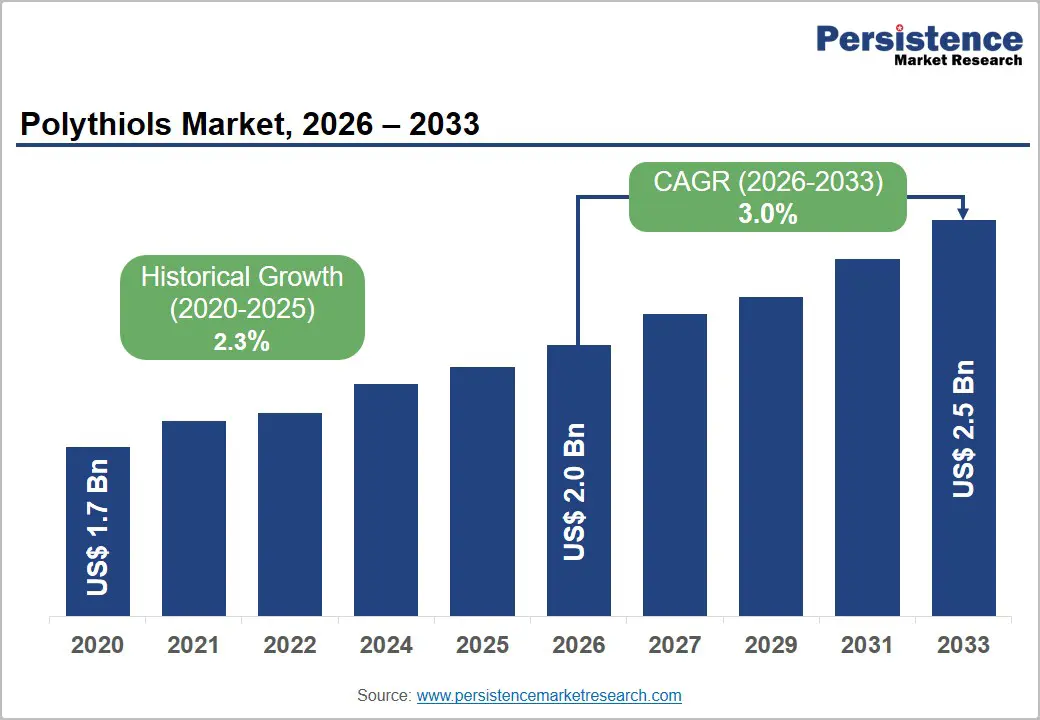
The global polythiols market size is likely to be valued at US$2.0 billion in 2026 and projected to reach US$2.5 billion by 2033, growing at a CAGR of 3.0% during the forecast period from 2026 to 2033, driven by the expanding use of polythiols as essential cross-linkers and chain extenders in high-performance coatings, optical lens polymers, and sealant formulations.
Rising demand for high-refractive-index ophthalmic lenses, supported by the growing burden of vision impairment, affecting more than 2.2 billion people globally, according to the World Health Organization (WHO), along with expanding construction and automotive production across Asia Pacific, is expected to sustain steady market growth.
Key Industry Highlights:
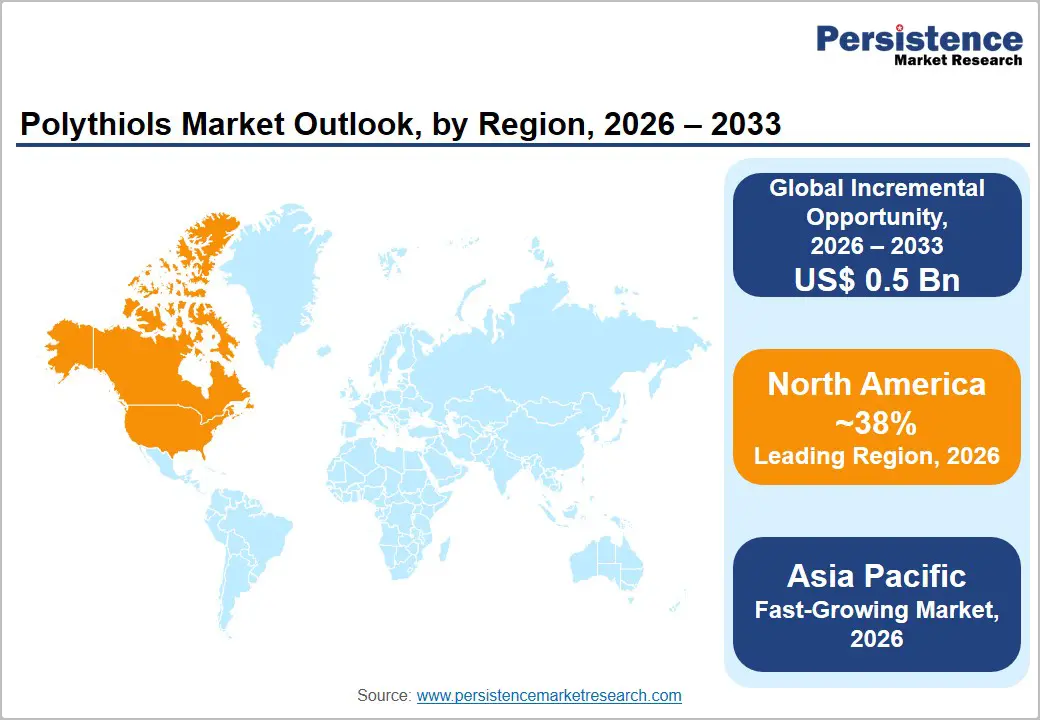
- Leading Region: North America is expected to lead with approximately 38% market share in 2026, driven by aerospace sealant demand, IIJA-funded infrastructure coatings, and a robust U.S. industrial coatings ecosystem with tightening VOC compliance standards.
- Fastest-growing Region: Asia Pacific is expected to be the fastest-growing region at an estimated CAGR of 5.0% through 2033, propelled by Japan's ophthalmic lens monomer output, China's electronics manufacturing growth, and India's PLI-driven electronics and automotive expansion.
- Dominant Chemistry Segment: Polymeric polythiols are projected to account for approximately 72% of total market revenue in 2026, driven by their multifunctional role as crosslinkers and curing agents in coatings, adhesives, sealants, electronic encapsulants, and high-refractive-index optical lens materials.
- Fastest-growing Application Segment: Optical lenses and ophthalmic applications are expected to register the highest growth during the forecast period, supported by rising global myopia prevalence, increasing demand for premium high-refractive-index lenses, and broader adoption of thiourethane-based lens materials.
- Key Market Opportunity: The transition to UV-curable, low-VOC coating formulations under EU and EPA regulations, combined with rising aerospace sealant demand from Airbus and Boeing record order backlogs, offers a high-value, durable growth opportunity for polythiol compound suppliers.
DRO Analysis
Driver - Growth in High-Performance Coatings and Adhesives for Construction and Automotive
Polythiols function as efficient room-temperature curing agents for epoxy and polyurethane coatings, offering superior chemical resistance, adhesion, and fast cure times at ambient conditions, properties highly valued in the construction and automotive sectors. The American Chemistry Council (ACC) reports that the U.S. coatings industry ships over US$33 billion worth of products annually, while the global coatings market continues to expand, driven by infrastructure investment.
In 2024, the European Commission committed over €392 billion (approximately US$459 billion) in infrastructure spending under its Cohesion Policy 2021-2027 framework, supporting robust demand for structural coatings where polythiol-cured systems offer performance advantages. Additionally, automotive OEM and refinish coatings are increasingly adopting polythiol-epoxy systems for their low-VOC profiles and compliance with EU REACH and U.S. EPA VOC regulations, adding a regulatory tailwind to volume growth.
Restraint - Handling Hazards and Stringent Occupational Safety Regulations
Polythiols carry an intensely unpleasant sulfurous odor and pose occupational health risks, including respiratory sensitization and skin irritation, requiring stringent workplace controls. The U.S. Occupational Safety and Health Administration (OSHA) and the European Chemicals Agency (ECHA) impose strict handling and storage requirements under REACH and CLP regulations.
Compliance with these regulations increases the cost of production, storage, and transportation, particularly for smaller specialty chemical producers. These handling constraints also limit adoption in cost-sensitive applications and geographies where occupational health enforcement is strengthening, creating a structural barrier to market penetration in new end-use segments.
Opportunity - Expanding Polythiol Use in UV-Curable and Low-VOC Formulations
The global coatings and adhesives industry is undergoing a significant transition toward UV-curable and radiation-curable systems, driven by tightening VOC emission regulations across the European Union (EU Directive 2004/42/EC) and U.S. EPA guidelines. Polythiols as highly reactive thiol-ene and thiol-epoxy curing agents are ideally suited to these formulations, enabling rapid ambient curing without heat and delivering outstanding adhesion to difficult substrates.
The European Coatings Journal has highlighted thiol-ene photo polymerization as one of the most promising platforms for next-generation sustainable coatings. Industry investment in bio-based polythiol monomers is also accelerating, with academic programs at Ghent University and CNRS, France, demonstrating thiol-ene systems derived from renewable feedstocks. Companies that position polythiol-based UV-cure product lines will benefit from both regulatory compliance tailwinds and the growing preference for solvent-free industrial coating solutions.
Category-wise Analysis
Chemistry Insights
Polymeric polythiols are expected to remain the largest chemistry segment, accounting for approximately 72% of total market revenue in 2026. Their strong market position is attributed to their ability to function as efficient crosslinking agents, chain extenders, and curing agents in epoxy, polyurethane, and thiol-ene systems. Their capability to facilitate ambient-temperature curing while enhancing flexibility, toughness, and chemical resistance supports widespread adoption across coatings, adhesives, sealants, and electronic encapsulation applications.
Application Insights
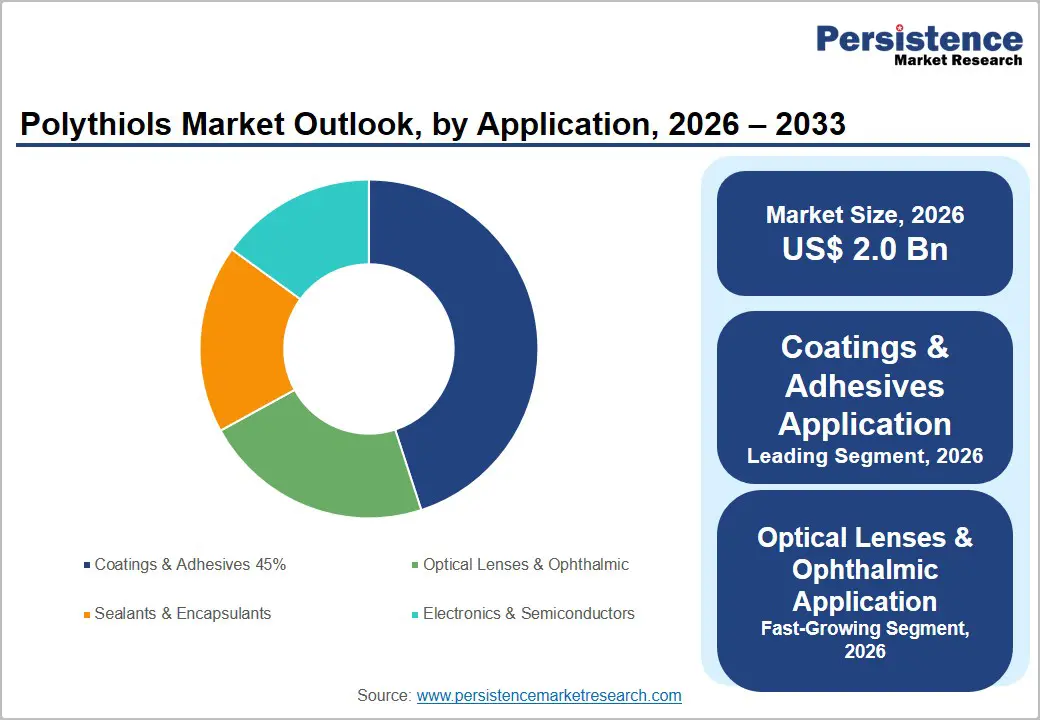
Coatings and adhesives are projected to remain the largest application segment, accounting for approximately 45% of the total market revenue in 2026. Their leading position is supported by the extensive use of polythiol-based curing agents in ambient-cure epoxy systems utilized for industrial flooring, marine coatings, protective infrastructure coatings, and high-performance adhesive formulations. These materials are valued for enabling rapid, solvent-free curing at room temperature without the need for elevated processing temperatures. A notable example is CAPCURE® 3-800 from Huntsman Corporation, a mercaptan-terminated polythiol curing agent widely used in epoxy coatings and adhesives to deliver fast cure speeds, particularly in low-temperature and thin-film applications.
The optical lenses and ophthalmic segment is anticipated to register the fastest growth during the forecast period, driven by the increasing prevalence of myopia worldwide and growing demand for high-refractive-index (HRI) lens materials. Polythiol-based monomers play a critical role in the production of advanced thiourethane lens substrates that enable thinner, lighter, and more durable prescription lenses. Mitsui Chemicals’ MR™ Series, including MR-174™ with a refractive index of 1.74, illustrates this trend by supporting the manufacture of ultra-thin, lightweight eyewear with enhanced optical performance. Rising consumer preference for premium lenses, combined with expanding vision-correction needs, is expected to accelerate the adoption of these advanced materials and drive robust growth in the ophthalmic application segment.
End-use Industry Insights
The construction sector is expected to lead, accounting for approximately 38% of total market revenue in 2026. This dominance is driven by the extensive use of polythiol-cured epoxy coatings, adhesives, and sealants in commercial buildings, industrial flooring, residential developments, and civil infrastructure projects such as bridges and tunnels. These materials are widely valued for their rapid curing capabilities, strong adhesion, and long-term durability in demanding environments. A notable example is Sikadur®-52 from Sika AG, an epoxy injection and bonding system commonly used for concrete crack repair, structural reinforcement, bridge rehabilitation, tunnel maintenance, and other critical infrastructure applications.
The automotive industry is anticipated to be the fastest-growing end-use segment during the forecast period, supported by increasing adoption of polythiol-based adhesive technologies in electric vehicles (EVs) and lightweight vehicle construction. These materials play an important role in battery encapsulation, battery pack assembly, and structural bonding applications where high performance, durability, and efficient manufacturing are required. Henkel’s LOCTITE® portfolio of battery and structural adhesives exemplifies this trend, providing advanced solutions used extensively in EV production to enhance battery protection, improve structural integrity, reduce vehicle weight, and support greater energy efficiency. The accelerating transition toward vehicle electrification and lightweight design is expected to further strengthen demand within the automotive sector.
Regional Insights
North America Polythiols Market Trends
North America is projected to lead, accounting for 38% of the global market share in 2026. The region benefits from strong demand for high-performance adhesives, coatings, sealants, and electronic encapsulation materials across aerospace, automotive, construction, and semiconductor industries. Growing investments in advanced manufacturing and sustainable formulations are accelerating the adoption of specialty polythiol-based products.
U.S. Polythiols Market Trends
The U.S. is expected to account for approximately 82% of the regional market revenue in 2026, maintaining its position as the largest market within North America. This leadership is underpinned by the country’s well-established aerospace, defense, electronics, and automotive industries, all of which are significant consumers of polythiol-based curing agents, specialty coatings, and advanced adhesive systems.
Continued innovation in high-performance materials, robust research and development activity, and the strong presence of major specialty chemical manufacturers further support market expansion. The growing demand for lightweight composites, electronic encapsulation materials, and advanced bonding technologies is expected to reinforce the U.S. market’s dominant position throughout the forecast period.
Canada Polythiols Market Trends
Canada is anticipated to account for approximately 18% of the regional market share in 2026 and remains a strategically important contributor to regional growth. Demand is primarily driven by infrastructure development, construction chemicals, protective coatings, and industrial manufacturing applications. The country's expanding focus on sustainable building materials and advanced coating technologies is creating new opportunities for specialty chemical suppliers.
Europe Polythiols Market Trends
Europe is expected to account for approximately 28% of the market share in 2026. The region's leadership is driven by its highly developed automotive, aerospace, electronics, and industrial coatings sectors, where demand for high-performance curing agents and specialty adhesives remains strong. Increasing emphasis on sustainable manufacturing, low-VOC formulations, and advanced material innovation is accelerating the adoption of polythiol-based technologies.
Germany Polythiols Market Trends
Germany is expected to hold approximately 32% of the regional market share in 2026, supported by its strong automotive industry, advanced engineering sector, and well-established specialty chemicals market. Continued demand for high-performance adhesives, coatings, and industrial composites is driving the adoption of polythiol-based formulations across key industrial applications.
U.K. Polythiols Market Trends
The U.K. is projected to account for approximately 16% of the regional market revenue in 2026, maintaining its position as an important hub for specialty chemicals and advanced materials innovation. Market growth is being driven by the country's well-established aerospace, electronics, construction, and high-value manufacturing industries, all of which increasingly rely on high-performance adhesive, coating, and sealant technologies. Continued investment in sustainable manufacturing practices, advanced material research, and next-generation industrial applications is further expanding the use of polythiols across a diverse range of end-use sectors. As industries prioritize performance, durability, and environmental efficiency, demand for polythiol-based solutions is expected to strengthen steadily throughout the forecast period.
Asia Pacific Polythiols Market Trends
Asia Pacific is likely to be the fastest-growing regional market, projected at a CAGR of approximately 5.0% through 2026 - 2033. The region dominates due to its extensive manufacturing base, rapid industrialization, expanding construction activities, and growing demand for advanced adhesives, coatings, and sealants. Strong growth in electronics, automotive production, renewable energy infrastructure, and specialty chemicals continues to accelerate polythiol consumption.
China Polythiols Market Trends
China is expected to command approximately 52% of the Asia Pacific polythiols market, making it the undisputed regional leader. Its dominance stems from its vast industrial manufacturing ecosystem, strong electronics and automotive production base, and large-scale infrastructure development projects. The country serves as a major global hub for specialty chemicals, creating sustained demand for high-performance curing agents, coatings, and adhesive technologies.
India Polythiols Market Trends
India is expected to account for approximately 15% share in 2026 and represents one of the fastest-growing country markets in the region. Growth is being fueled by rapid urbanization, infrastructure expansion, increasing automotive production, and rising demand for industrial coatings and specialty adhesives.
Competitive Landscape
The global polythiols market is moderately consolidated, with a small group of specialized chemical companies controlling the majority of technical-grade polythiol production. Toray Fine Chemicals Co., Ltd., Bruno Bock Chemische Fabrik, and Evonik Industries are the dominant global suppliers of high-purity polymeric polythiols for ophthalmic and coatings applications. Arkema S.A. and Solvay S.A. maintain strong positions in mercaptan-based derivatives and specialty thiol chemistry.
Key competitive differentiators include application-specific product grade development, technical service support for formulation optimization, and regulatory expertise in REACH and EPA substance registrations. Emerging trends include investment in bio-based polythiol R&D, development of low-odour grades through molecular encapsulation, and geographic expansion into Asia Pacific through joint ventures and local manufacturing partnerships.
Companies Covered in Polythiols Market
- Toray Fine Chemicals Co., Ltd.
- Bruno Bock Chemische Fabrik GmbH & Co. KG
- Merck KGaA
- Solvay S.A.
- Arkema S.A.
- Evonik Industries AG
- BASF SE
- Efirm New Materials Co., Ltd.
- Shin-Etsu Chemical Co., Ltd.
- Thiol-Chemistry Inc.
- Chevron Phillips Chemical Company
Frequently Asked Questions
The global polythiols market is estimated to be valued at US$2.0 billion in 2026.
The polythiols market is primarily driven by the expanding demand for high-performance adhesives, sealants, and coatings (CASE), alongside the need for lightweight materials in automotive and aerospace manufacturing.
The polythiols market is poised to witness a CAGR of 3% from 2026 to 2033.
The most significant market opportunities lie in the rapid adoption of UV-curable and thiol-ene photopolymerization systems for low-VOC industrial coatings, driven by EU Directive 2004/42/EC and U.S. EPA guidelines, and in the growing demand for aerospace-grade polythiol sealants, supported by record Airbus and Boeing combined order backlogs exceeding 14,000 aircraft. The expanding 5G electronics and LED packaging segments also represent a high-growth downstream opportunity for electronics-grade polythiol encapsulants.
Leading companies include Toray Fine Chemicals Co., Ltd., Bruno Bock Chemische Fabrik GmbH & Co. KG, Evonik Industries AG, Arkema S.A., Solvay S.A., Merck KGaA, BASF SE, Shin-Etsu Chemical Co., Ltd., and Mitsui Chemicals, Inc.


