




- Plastics, Polymers & Resins
- Polybutadiene Rubber Market
Polybutadiene Rubber Market Size, Share, and Growth Forecast, 2026 - 2033
Polybutadiene Rubber Market by Product Type (High Cis PBR, High Vinyl PBR, Others), Application (Tire, Industrial Rubber Goods, Others), End-use Industry, and Regional Analysis for 2026 - 2033

Polybutadiene Rubber Market Size and Trends Analysis
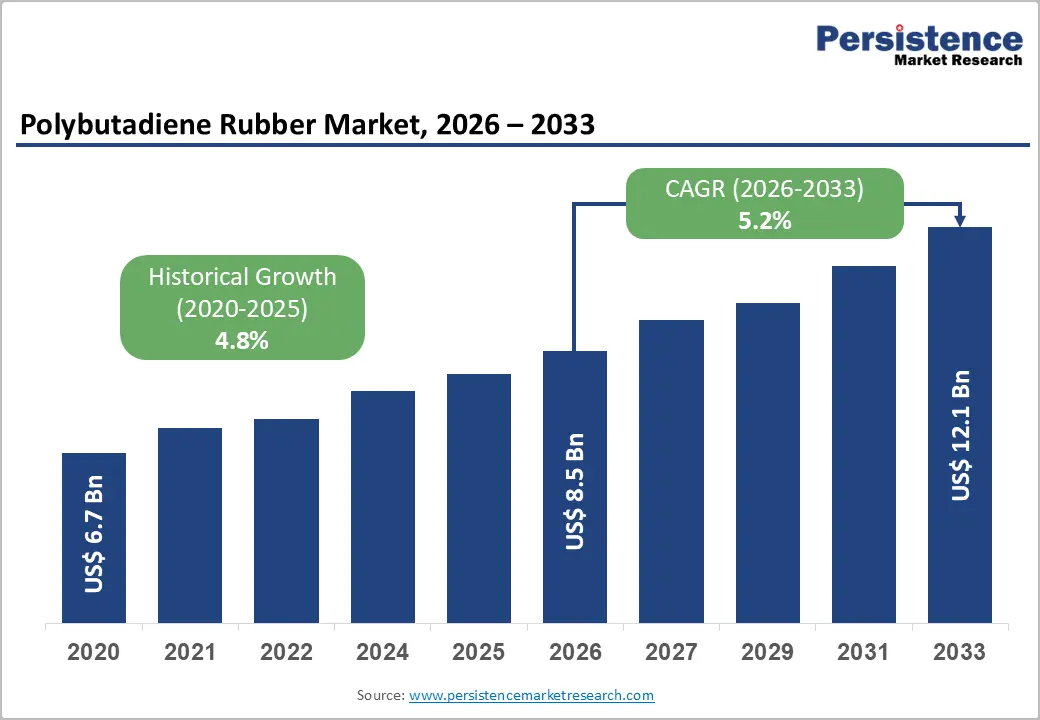
The global polybutadiene rubber market size is likely to be valued at US$8.5 billion in 2026 and is expected to reach US$12.1 billion by 2033, growing at a CAGR of 5.2% between 2026 and 2033, driven by sustained demand from the tire industry, where performance attributes such as rolling resistance, abrasion resistance, and durability are critical.
Growth is further supported by increasing vehicle production, rising adoption of electric vehicles, and expanding applications in polymer modification and industrial rubber goods. Regulatory emphasis on fuel efficiency and sustainability continues to reinforce the importance of high-performance elastomers such as polybutadiene rubber (PBR).
Key Industry Highlights:
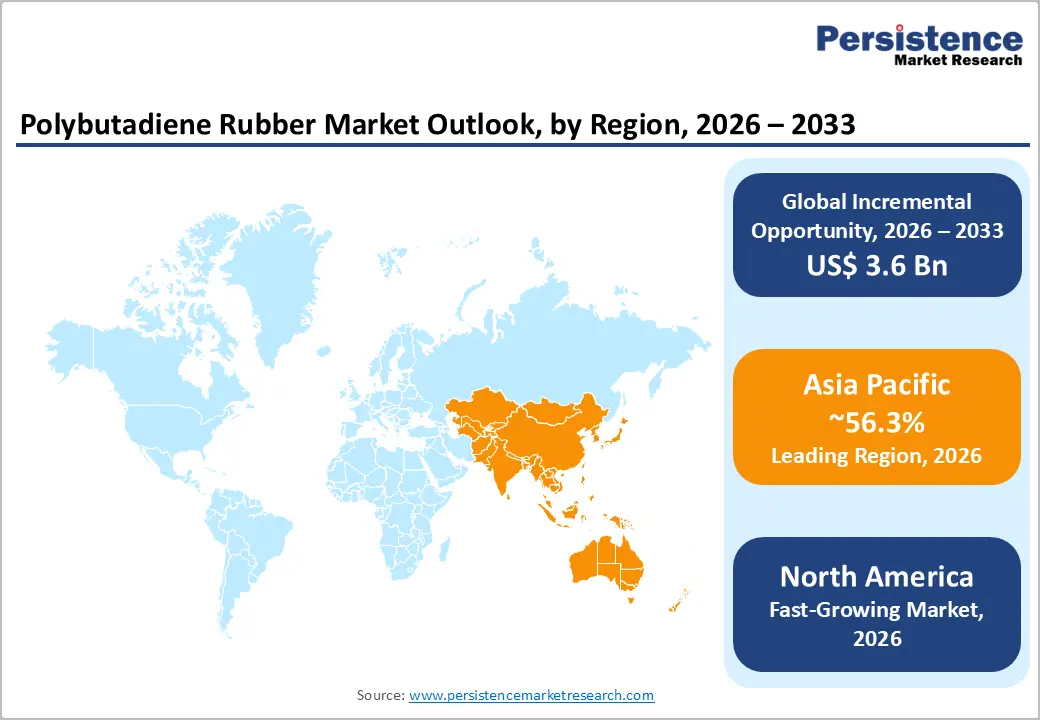
- Leading Region: Asia Pacific is projected to account for approximately 56.3% of the market share, supported by strong automotive production and cost-efficient manufacturing ecosystems.
- Fastest-growing Region: North America is the fastest-growing region, driven by increasing electric vehicle adoption, advanced tire technologies, and rising demand for high-performance elastomers, contributing to a steady growth rate above the global average.
- Investment Plans: Major industry players are focusing on capacity expansions, sustainable feedstock development, and regional localization, with increasing investments in bio-based butadiene, neodymium catalyst technologies, and advanced polymer modification capabilities.
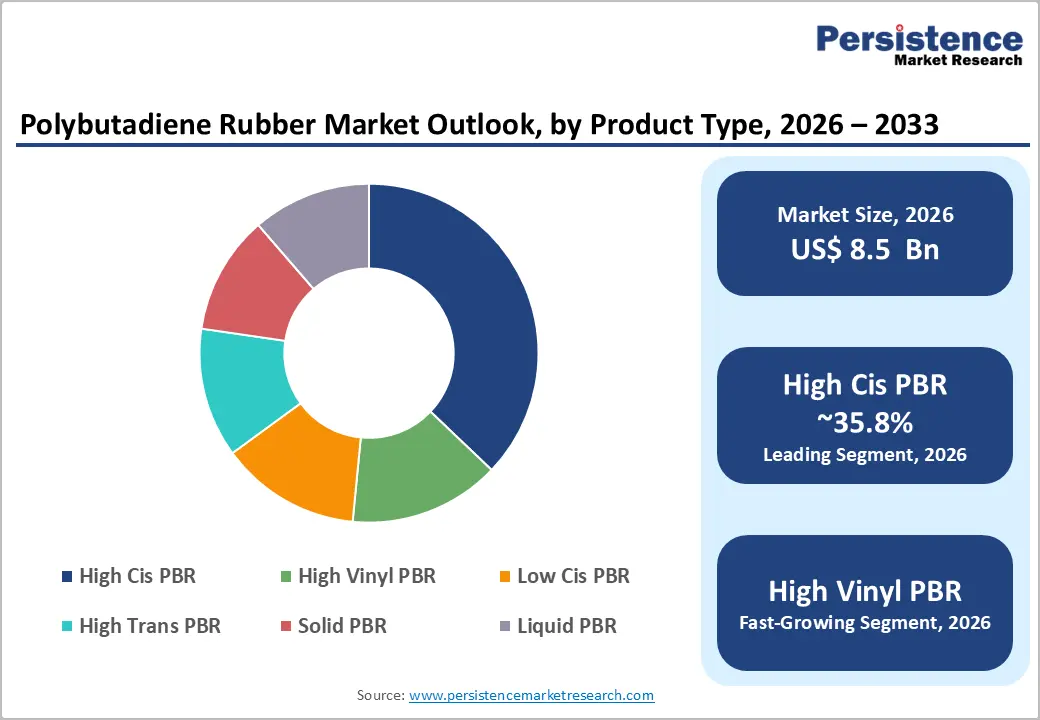
- Dominant Product Type: High cis polybutadiene rubber leads, holding an anticipated market share of over 35.8%, primarily due to its superior abrasion resistance and extensive use in tire manufacturing.
- Leading Application: The tire application segment remains dominant, accounting for more than 64.7% of market share, driven by strong automotive production and consistent replacement tire consumption globally.
| Key Insights | Details |
|---|---|
| Polybutadiene Rubber Market Size (2026E) | US$8.5 Bn |
| Market Value Forecast (2033F) | US$12.1 Bn |
| Projected Growth (CAGR 2026 to 2033) | 5.2% |
| Historical Market Growth (CAGR 2020 to 2025) | 4.8% |
DRO Analysis
Driver Analysis - Strong Demand from Tire Manufacturing and Replacement Cycles
The tire segment remains the dominant demand driver for polybutadiene rubber, supported by global vehicle production exceeding 90 million units annually in recent years. Automotive manufacturers increasingly require advanced rubber compounds that enhance wear resistance, traction, and energy efficiency. Polybutadiene rubber plays a critical role in tire treads and sidewalls due to its low hysteresis and high resilience. Replacement tire demand further stabilizes consumption, as tires require periodic replacement regardless of new vehicle sales cycles. This dual-channel demand, original equipment and aftermarket, ensures consistent volume growth and supports long-term market stability.
Electrification and Fuel Efficiency Requirements
The global transition toward electric mobility is reshaping material requirements in tire manufacturing. Electric vehicles require tires that reduce rolling resistance to maximize battery efficiency and extend driving range. Polybutadiene rubber is well-suited for these applications due to its ability to minimize heat buildup while maintaining durability. Regulatory frameworks emphasizing fuel efficiency and emissions reduction further accelerate the adoption of advanced rubber compounds. Manufacturers are increasingly investing in high-CIS and neodymium-catalyzed PBR grades to meet evolving performance standards, positioning the material as a key component in next-generation tire technologies.
Advancements in Material Innovation and Application Expansion
Technological advancements in polymer chemistry are expanding the application scope of polybutadiene rubber beyond traditional tire usage. Innovations in catalyst systems and functionalization techniques have enabled the development of specialty grades tailored for industrial rubber goods, adhesives, coatings, and polymer modification. These advancements improve mechanical properties, processing efficiency, and compatibility with other materials. As industries demand higher-performance materials, polybutadiene rubber is gaining traction in sectors such as construction, industrial manufacturing, and consumer goods, contributing to diversified revenue streams for manufacturers.
Restraint Analysis - Volatility in Raw Material Prices and Supply Chain Dependence
Polybutadiene rubber production relies heavily on butadiene, a petrochemical derivative subject to fluctuations in crude oil prices and refinery output. Variability in feedstock availability and pricing directly impacts production costs and profit margins. Supply disruptions, geopolitical factors, and shifts in petrochemical demand can further exacerbate price instability. This volatility poses challenges for manufacturers in maintaining consistent pricing strategies and managing inventory, particularly in highly competitive markets where cost sensitivity is significant.
Stringent Regulatory Compliance and Certification Requirements
Increasing regulatory scrutiny related to environmental impact, product performance, and sustainability is raising compliance costs for polybutadiene rubber producers. Manufacturers must adhere to stringent testing, certification, and documentation standards, particularly in regions with advanced regulatory frameworks. These requirements often necessitate investment in research, quality control, and process optimization. Smaller players may face barriers to entry or expansion due to the high cost of compliance, limiting market participation and intensifying competition among established manufacturers.
Opportunity Analysis - Growth of High-Vinyl and Specialty PBR Grades
High-vinyl polybutadiene rubber represents a significant growth opportunity due to its increasing use in polymer modification and specialty applications. These grades offer enhanced compatibility, improved processing characteristics, and tailored mechanical properties, making them suitable for advanced materials and engineered products. As industries seek customized solutions, demand for high-performance and application-specific rubber compounds is expected to rise. This shift enables manufacturers to move up the value chain and achieve higher margins compared to conventional grades.
Adoption of Sustainable and Bio-Based Feedstocks
Sustainability is emerging as a key focus area in the polybutadiene rubber market. The development of bio-based and mass-balance feedstocks presents an opportunity to reduce carbon emissions and align with global environmental goals. Innovations in alternative raw materials, such as ethanol-derived butadiene, are gaining attention as viable substitutes for traditional petrochemical sources. As end-use industries increasingly prioritize sustainable sourcing, manufacturers investing in environmentally friendly production methods are likely to gain a competitive advantage.
Expansion in Emerging Markets and Localized Production
Rapid industrialization and urbanization in emerging economies are driving demand for polybutadiene rubber across automotive, construction, and industrial sectors. Countries in Asia Pacific, particularly China and India, are witnessing significant growth in vehicle production and infrastructure development. Establishing localized production facilities near key demand centers can reduce logistics costs, enhance supply chain efficiency, and improve customer responsiveness. This regional expansion strategy presents substantial growth opportunities for global and regional manufacturers.
Category-wise Analysis
Product Type Insights
High cis polybutadiene rubber is anticipated to account for more than 35.8% of the market share in 2026, driven by its superior performance characteristics in tire applications. Its high resilience, excellent abrasion resistance, and low heat buildup make it the preferred material for tire treads and sidewalls, particularly in passenger and commercial vehicle tires where durability and rolling efficiency are critical. The segment’s dominance is further reinforced by its widespread use in conveyor belts, footwear soles, and industrial rubber components such as V-belts and hoses.
For example, high cis PBR is extensively used in truck and bus radial tires to improve mileage performance. Manufacturers continue to prioritize neodymium-based high-cis grades to meet evolving automotive standards, ensuring sustained demand across both OEM and replacement markets.
High vinyl polybutadiene rubber is anticipated to be the fastest-growing product type segment, supported by its expanding use in polymer modification and specialty applications. This material offers improved compatibility with thermoplastics and other polymers, enabling enhanced mechanical strength, flexibility, and processing efficiency. Its adoption is increasing in industries such as plastics, adhesives, coatings, and impact-resistant materials. For instance, high vinyl PBR is widely used in ABS plastic modification to improve toughness in automotive interiors and consumer electronics housings.
As demand for advanced and lightweight materials grows, particularly in automotive and electronics sectors, high vinyl PBR is expected to experience accelerated growth, driven by innovation and increasing application diversification.
Application Insights
The tire segment is anticipated to account for more than 64.7% of market share in 2026, maintaining its position as the dominant application for polybutadiene rubber. PBR is a critical component in tire manufacturing due to its ability to enhance wear resistance, traction, and fuel efficiency. Its low rolling resistance properties are especially important in modern tire designs aimed at improving fuel economy and extending electric vehicle range. The increasing production of passenger cars, commercial vehicles, and electric vehicles, combined with strong replacement tire demand, continues to drive this segment.
For example, premium tire manufacturers incorporate high cis PBR in tread compounds to achieve an optimal balance between grip and durability, reinforcing its indispensable role in tire performance engineering.
Industrial rubber goods are anticipated to be the fastest-growing application segment, driven by rising demand across construction, manufacturing, and heavy industries. Products such as seals, gaskets, hoses, conveyor belts, and vibration-damping components require materials with high elasticity, abrasion resistance, and long service life, making polybutadiene rubber an ideal choice. For instance, PBR-based compounds are increasingly used in mining conveyor belts and construction seals to withstand harsh operating conditions and reduce maintenance frequency.
As industries focus on improving operational efficiency, equipment longevity, and cost optimization, the demand for high-performance rubber components is expected to increase significantly, supporting the growth of this segment.
Regional Insights
North America Polybutadiene Rubber Market Trends - EV Tire Innovation and Domestic Supply Chain Strength Driving Growth
North America is the fastest-growing region in the polybutadiene rubber market, driven by strong demand from the automotive and industrial sectors. The U.S. leads the region, supported by a well-established automotive manufacturing base and a robust replacement tire market. High adoption of electric vehicles and an increasing focus on fuel efficiency are accelerating the demand for advanced rubber compounds with low rolling resistance and enhanced durability. Tire manufacturers such as Goodyear Tire & Rubber Company and Bridgestone Americas are actively developing next-generation tire technologies that rely heavily on high-performance PBR grades, particularly for EV-compatible tires.
The region benefits from a strong innovation ecosystem, with significant investments in research and development aimed at improving material performance and sustainability. For instance, ExxonMobil continues to expand its synthetic rubber and elastomer research capabilities, focusing on advanced polymer solutions for mobility applications. Regulatory frameworks emphasizing emissions reduction and energy efficiency are pushing automakers and tire manufacturers to adopt high-performance materials.
Localized production and supply chain resilience have also become strategic priorities, with companies strengthening domestic manufacturing to reduce dependency on imports. This combination of innovation, regulation, and localization is enhancing market stability and supporting sustained growth in North America.
Europe Polybutadiene Rubber Market Trends - Sustainability Regulations and Premium Automotive Demand Shaping Market
Europe represents a mature yet high-value market for polybutadiene rubber, characterized by stringent regulatory standards and a strong focus on sustainability. Countries such as Germany, the U.K., France, and Spain play a significant role in driving demand, supported by their advanced automotive industries and strong presence of premium vehicle manufacturers. Leading tire companies such as Michelin and Continental AG are at the forefront of developing energy-efficient and sustainable tire solutions, which directly increases demand for high-quality PBR.
Regulatory harmonization across the region simplifies compliance and facilitates market access for manufacturers. The emphasis on low rolling resistance, reduced emissions, and improved safety standards drives the adoption of high-performance rubber materials.
For example, Michelin has been investing in sustainable materials and circular economy initiatives, including bio-based and recycled inputs for tire production, which indirectly supports innovation in PBR feedstocks. Similarly, Continental has focused on developing tires with reduced environmental impact, increasing the need for advanced elastomers. These developments are shaping a competitive landscape where sustainability and performance are key differentiators, encouraging suppliers to invest in cleaner technologies and specialty-grade polybutadiene rubber.
Asia Pacific Polybutadiene Rubber Market Trends - Large-Scale Production and Automotive Expansion Driving Market Dominance
Asia Pacific is projected to dominate the market, accounting for approximately 56.3% of the market share. The region’s leadership is driven by high vehicle production, expanding industrial activities, and cost-effective manufacturing capabilities. Key contributors include China, Japan, India, and ASEAN economies. China leads in both production capacity and consumption, supported by its large-scale automotive and tire manufacturing ecosystem. Major domestic tire manufacturers such as Zhongce Rubber Group are expanding production capacity, which directly increases demand for PBR.
Japan is recognized for its advanced material technologies, with companies such as Zeon Corporation and ENEOS Materials Corporation investing in high-performance and sustainable polybutadiene production. A notable development includes Zeon’s work on bio-based butadiene derived from ethanol, which aligns with global sustainability trends and positions the region as a leader in green innovation. India is emerging as a significant growth market due to rapid urbanization and increasing automotive production, with companies like Reliance Industries Limited strengthening petrochemical integration and supporting domestic rubber supply.
ASEAN countries are also gaining importance as alternative manufacturing hubs, attracting investments from global tire and automotive companies seeking supply chain diversification. The region’s strong manufacturing base, combined with continuous investments in capacity expansion and sustainable technologies, ensures its continued dominance in the global polybutadiene rubber market.
Competitive Landscape
The global polybutadiene rubber market is moderately fragmented, with a mix of global and regional players competing across various segments. Leading companies hold significant market shares due to their integrated production capabilities, technological expertise, and strong customer relationships. While large players dominate high-performance and specialty segments, smaller manufacturers compete primarily in cost-sensitive markets. Barriers to entry include capital-intensive production processes, advanced catalyst technologies, and stringent customer qualification requirements.
Key market players are focusing on innovation, regional expansion, and sustainability initiatives to strengthen their competitive positions. Investments in advanced catalyst technologies, specialty product development, and localized manufacturing are common strategies. Companies are also prioritizing environmentally friendly production methods and supply chain optimization to meet evolving customer and regulatory requirements.
Key Industry Developments:
- In June 2025, Evonik announced the expansion of its silane-functionalized polybutadiene production capacity and the localization of POLYVEST® ST-E 60 production in Shanghai, China, aiming to enhance supply security and strengthen its presence in the Asian market.
Companies Covered in Polybutadiene Rubber Market
- ARLANXEO
- Kumho Petrochemical
- LG Chem
- Zeon Corporation
- ENEOS Materials Corporation
- JSR Corporation
- UBE Corporation
- Versalis S.p.A.
- Synthos S.A.
- SIBUR
- Reliance Industries Limited
- Indian Oil Corporation Limited
- Kuraray Co., Ltd.
- TSRC Corporation
- PetroChina Company Limited
- China Petroleum & Chemical Corporation (Sinopec)
Frequently Asked Questions
The global polybutadiene rubber market is estimated to be valued at US$8.5 billion in 2026.
The polybutadiene rubber market is projected to reach US$12.1 billion by 2033.
Key trends include rising demand for low rolling resistance tires, increasing adoption of electric vehicles, advancements in high-performance and high-vinyl PBR grades, and growing focus on sustainable and bio-based feedstocks.
The tire application segment is the leading segment, accounting for over 64.7% of market share, supported by strong automotive production and replacement cycles.
The polybutadiene rubber market is expected to grow at a CAGR of 5.2% from 2026 to 2033.
Major players include ARLANXEO, Kumho Petrochemical, LG Chem, Zeon Corporation, and SIBUR.


