




- Medical Devices
- North America Healthcare Biometrics Market
North America Healthcare Biometrics Market Size, Share, and Growth Forecast 2026 - 2033
North America Healthcare Biometrics Market by Technology (Face Recognition, Fingerprint Recognition, Iris Recognition, Vein Recognition, Palm Recognition, Behavioral Recognition, Others), Authentication Type (Single Factor, Multi Factor, Multimodal), Application, End-user, and Country-wise Analysis, 2026 - 2033

North America Healthcare Biometrics Market Size and Trend Analysis
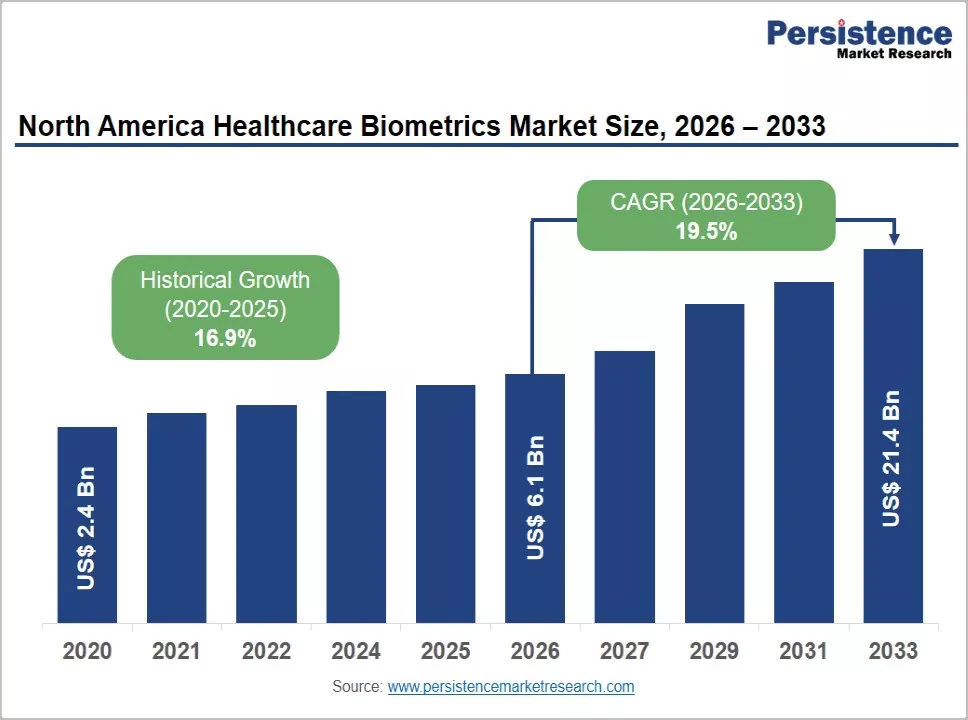
The North America healthcare biometrics market is expected to reach US$6.1 billion in 2026 and is projected to reach US$21.4 billion by 2033, expanding at a CAGR of 19.5% during 2026 - 2033.
The region represents a highly developed market for biometric authentication because of widespread electronic health record adoption, advanced hospital IT infrastructure, increasing healthcare cybersecurity investments, and growing concerns surrounding medical identity theft and patient misidentification.
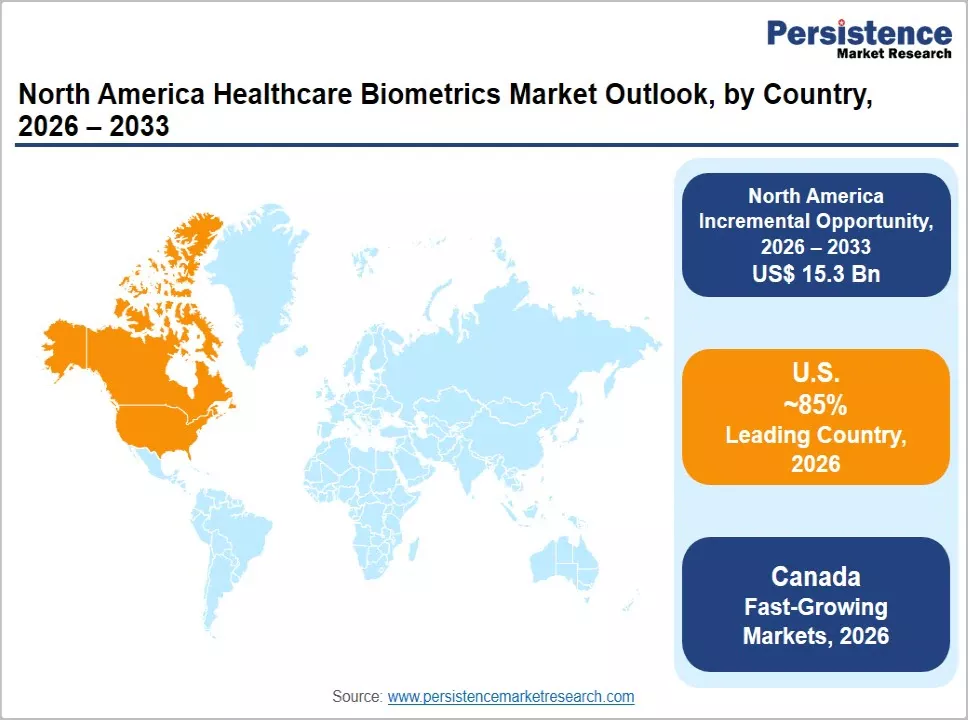
The U.S. accounts for the majority of regional revenue, supported by large hospital networks, stringent healthcare data-protection requirements, and substantial investments in digital identity and access management. Canada is also witnessing increasing adoption as healthcare organizations modernize digital health infrastructure and strengthen patient identification and cybersecurity capabilities. Growing use of telehealth, remote patient monitoring, and connected medical devices is expected to further accelerate biometric adoption across North American healthcare settings.
Key Industry Highlights:
- Leading Country: U.S. led the North America healthcare biometrics market with an estimated 84% share in 2026, supported by strong HIPAA-driven security requirements, mature hospital IT infrastructure, and a dense presence of established biometric technology vendors across the region.
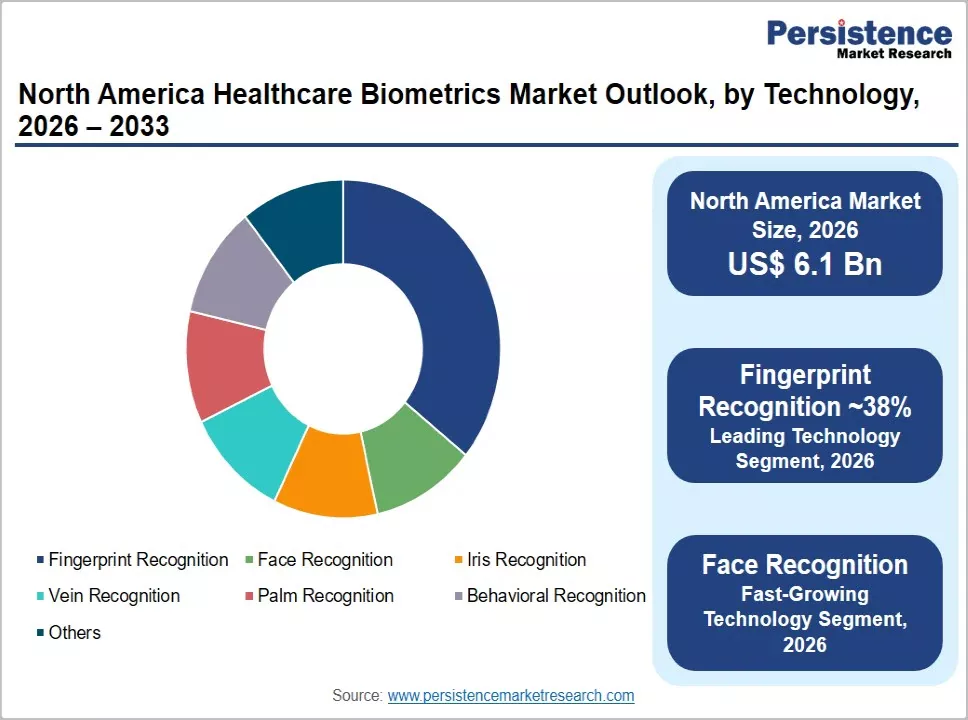
- Leading Segment: Fingerprint recognition led the technology category with an estimated 37% share in 2026, reflecting its cost-effective, proven reliability across hospital workforce-management, patient-identification, and pharmacy-dispensing applications worldwide.
- Fast-Growing Segment: Face recognition is expected to be the fastest-growing technology segment through 2033, driven by rising demand for contactless patient check-in and rapid identity verification across hospitals and diagnostic laboratories.
- Key Opportunity: Expanding government-led multimodal biometric enrollment within national health insurance programs presents a significant opportunity, enabling accurate beneficiary verification and reducing fraud across government and public health agencies worldwide.
Market Dynamics
Drivers - Increasing Medical Identity Theft and Patient Misidentification
Medical identity theft, duplicate patient records, insurance fraud, and patient-matching errors are increasing the need for reliable identity verification across North American healthcare organizations. Hospitals and integrated health systems are adopting biometric technologies such as fingerprint, facial, and multimodal recognition to accurately link patients with their medical records and reduce identification errors during registration, admission, billing, and treatment. Biometric authentication provides a more reliable identity layer than traditional identifiers such as names, dates of birth, passwords, or identification numbers, particularly when patients have incomplete or inconsistent information. The growing focus on patient safety and accurate medical-record management is therefore creating sustained demand for healthcare biometrics across the region.
The increasing digitization of healthcare workflows is further strengthening this driver. As patients interact with multiple providers, pharmacies, laboratories, insurers, and digital health platforms, maintaining a consistent identity across different systems becomes increasingly important. Biometric identification can help healthcare organizations reduce duplicate records, strengthen fraud prevention, and improve authentication throughout the patient journey. Large U.S. hospital networks are particularly positioned to adopt these solutions because of their extensive patient databases, sophisticated IT infrastructure, and growing investments in digital identity management.
Increasing Adoption of Digital Health Infrastructure
The rapid expansion of digital health infrastructure across North America is creating numerous authentication points that require secure and convenient identity verification. Hospitals and healthcare providers are increasingly adopting cloud-based EHR platforms, patient portals, connected medical devices, telehealth systems, mobile health applications, and remote patient monitoring technologies. This interconnected environment increases the volume of sensitive patient information being accessed electronically and creates greater demand for technologies capable of verifying patients and healthcare professionals securely. Biometric authentication can provide a frictionless security layer across these increasingly digital healthcare environments.
The integration of biometric authentication with healthcare IT infrastructure is also becoming more attractive as providers seek to balance cybersecurity with operational efficiency. Fingerprint and facial recognition can facilitate faster access to EHR systems, clinical applications, and digital patient services while reducing reliance on conventional passwords. In addition, connected medical devices and remote-care platforms require stronger mechanisms for authenticating authorized users and enrolled patients.
As North American healthcare organizations continue investing in interoperable digital ecosystems, cloud infrastructure, and connected care models, biometric technologies are expected to become increasingly integrated into identity, access-control, and patient-management systems.
Restraints - High Implementation and Integration Costs
High implementation and integration costs remain a significant barrier to healthcare biometric adoption across North America, particularly among small and mid-sized hospitals, independent clinics, and outpatient facilities. Deploying biometric systems can require investments in scanning devices, cameras, enrollment infrastructure, authentication software, cybersecurity controls, cloud or on-premise infrastructure, and ongoing system maintenance. Healthcare providers may also need to customize biometric solutions to accommodate existing workflows and integrate them with EHR platforms, hospital information systems, patient registration systems, and workforce-management applications. These requirements can increase the total cost of ownership and extend deployment timelines.
Integration complexity becomes particularly challenging for healthcare organizations operating legacy IT environments or multiple disconnected clinical systems. Replacing or modifying existing infrastructure solely to support biometric authentication may not be financially attractive for smaller providers with constrained technology budgets. In addition, organizations require employee training, system testing, cybersecurity assessments, and continuous software updates following implementation.
Consequently, although biometric technologies can provide long-term benefits through improved security and operational efficiency, high initial capital requirements and integration expenses can delay adoption, especially among healthcare facilities with limited financial and technical resources.
Opportunities - Expansion of Facial Recognition for Contactless Patient Identification
The growing demand for contactless healthcare experiences presents a significant opportunity for facial recognition technology across North America. Hospitals, outpatient clinics, diagnostic laboratories, and ambulatory care centers are increasingly seeking faster and more convenient methods of patient registration and identity verification. Facial recognition can enable patients to authenticate themselves through cameras or compatible devices without repeatedly presenting physical identification documents or interacting with shared registration equipment.
When integrated with patient identity-management platforms and EHR systems, the technology can potentially streamline check-in, reduce administrative workload, and improve the consistency of patient identification across healthcare facilities.
The opportunity is particularly significant in high-volume healthcare environments where long registration processes can create operational bottlenecks. Facial recognition can also support digital patient journeys, including appointment check-in, access to patient portals, telehealth authentication, and identity verification for remote services. Improvements in AI-based facial matching, liveness detection, camera technology, and edge processing are expected to enhance the reliability of these applications.
As North American healthcare organizations increasingly prioritize convenience, automation, and contactless services, facial recognition is positioned to expand from selected deployments toward broader use across hospitals, clinics, laboratories, and digital healthcare platforms.
Growth of Multimodal Authentication
The increasing need for high-assurance identity verification is creating substantial opportunities for multimodal biometric authentication across North American healthcare. Multimodal solutions combine two or more biometric characteristics, such as fingerprint, facial, iris, palm, or behavioral recognition, to strengthen authentication accuracy and reduce dependence on a single biometric modality. Such systems can be particularly valuable in environments where identity assurance is critical, including hospitals, pharmacies, laboratories, health insurance organizations, government healthcare programs, and high-security clinical facilities. Combining multiple biometric characteristics can also provide alternative authentication options when one modality is difficult to capture.
Multimodal authentication is expected to gain momentum as healthcare organizations increasingly connect EHRs, patient portals, medical devices, workforce systems, and remote-care platforms. These interconnected environments require authentication solutions capable of supporting different users and security levels across multiple workflows. For example, fingerprint and facial recognition could be combined for workforce authentication, while facial and behavioral biometrics could support remote patient verification.
Growing cybersecurity investments, digital health expansion, and demand for passwordless authentication are expected to create additional opportunities for vendors offering interoperable multimodal biometric platforms across North America.
Category-wise Insights
Technology Analysis
Fingerprint recognition is expected to remain the leading technology segment in the North American healthcare biometrics market, accounting for an estimated 37% share in 2026. Its established technology base, relatively affordable implementation, fast authentication, and compatibility with existing healthcare IT and access-control infrastructure support widespread adoption. Healthcare organizations use fingerprint biometrics to authenticate employees, secure EHR access, verify patients, and control access to restricted clinical areas.
Fingerprint recognition is particularly valuable in hospitals and clinics where healthcare professionals require rapid and repeated authentication across multiple workstations and clinical systems. The technology is also applied in pharmacy dispensing, medication-management workflows, workforce attendance, and facility security. Meanwhile, face recognition is projected to be the fastest-growing technology through 2033, supported by increasing demand for contactless patient check-in, remote identity verification, digital health authentication, and automated registration across North American healthcare facilities.
Authentication Type Analysis
Multi-factor authentication (MFA) is expected to remain the leading authentication type in the North American healthcare biometrics market as healthcare organizations strengthen cybersecurity and protect sensitive patient information. MFA combines biometric verification with additional credentials such as passwords, PINs, smart cards, mobile authentication applications, or security tokens, creating multiple security layers. This approach reduces the risk associated with compromised passwords and stolen credentials while supporting secure access to EHRs, clinical applications, medical devices, and administrative systems.
Multimodal authentication is also gaining importance across high-security healthcare environments because it combines multiple biometric characteristics, such as fingerprint, facial, or iris recognition. This approach can improve authentication reliability and provide alternative verification methods when one biometric modality cannot be captured effectively. Adoption is particularly relevant among large hospitals, health insurance companies, government healthcare programs, pharmacies, and organizations managing highly sensitive patient and beneficiary information.
End-user Analysis
Hospitals & clinics represent the dominant end-user segment in the North American healthcare biometrics market because they manage large patient populations, extensive EHR databases, numerous healthcare professionals, and multiple systems requiring secure identity verification. Biometric technologies are increasingly incorporated into patient registration, EHR authentication, workforce management, medication administration, pharmacy workflows, and physical access control. Large hospital networks also benefit from centralized biometric platforms that can standardize authentication across multiple facilities and departments.
Diagnostic laboratories and pharmacies are increasingly adopting biometric solutions for patient verification, employee authentication, medication dispensing, and secure transaction management. Health insurance companies represent another important opportunity, particularly for beneficiary authentication and fraud prevention. Government and public health agencies can also use biometrics to verify beneficiaries, secure access to healthcare programs, and strengthen identity management. As healthcare organizations across North America continue digitizing clinical and administrative processes, biometric adoption is expected to expand across these end-user categories.
Regional Insights
U.S. Healthcare Biometrics Market Size
The U.S. is the dominant country in the North American healthcare biometrics market, accounting for an estimated 84% of regional revenue in 2026. Its leadership is supported by a large healthcare ecosystem, high healthcare IT spending, widespread EHR adoption, increasing cybersecurity expenditure, and strong demand for patient identity management.
Major U.S. hospitals and integrated healthcare networks are adopting biometric authentication for EHR access, patient registration, workforce authentication, pharmacy workflows, and facility security. The country's large technology vendor ecosystem and growing adoption of cloud-based identity management and passwordless authentication further support market expansion.
Canada Healthcare Biometrics Market Size
Canada represents the fastest growing country market in North America. Adoption is being supported by healthcare digitization, increasing cybersecurity requirements, electronic medical record adoption, and modernization of hospital information systems.
Biometric applications include healthcare-worker authentication, patient identification, secure access to digital health platforms, and identity verification across healthcare facilities. Increasing integration of digital health services and remote healthcare delivery is expected to create additional opportunities for biometric technology providers.
Competitive Landscape
The healthcare biometrics market remains moderately fragmented, with established identity-technology providers competing alongside specialized healthcare IT vendors. Companies such as NEC Corporation, Thales, Fujitsu Limited, and IDEMIA leverage decades of experience in government and border-security biometric deployments to expand into hospital and health-insurance applications, while healthcare-focused vendors including Imprivata, Inc. and Daon concentrate on workflow-specific authentication tailored to clinical environments.
Strategic partnerships with electronic health record vendors, continued investment in artificial-intelligence-driven face and behavioral recognition algorithms, and expansion into emerging markets through government health-identity programs represent the dominant growth strategies. Differentiation increasingly centers on interoperability with existing hospital IT infrastructure, regulatory compliance support, and multimodal accuracy rather than hardware cost alone.
Key Developments
- In July 2026, Regula launched an enhanced biometric verification service integrating liveness detection to strengthen remote identity verification, enabling secure onboarding, authentication, and high-risk transaction processing across regulated and digital-first industries.
- In February 2026, Introduced advanced Enterprise Access Management capabilities featuring context-aware passwordless authentication, biometric identity verification, facial authentication, and AI-powered behavioral analytics to improve secure access for healthcare organizations.
- In August 2025, Launched Face Authentication technology enabling passwordless biometric login for frontline healthcare workers across shared and personal devices.
Companies Covered in North America Healthcare Biometrics Market
- NEC Corporation
- Thales
- Fujitsu Limited
- IDEMIA
- HID North America Corporation
- Imprivata, Inc.
- BIO-key International, Inc.
- Aware, Inc.
- Suprema Inc.
- Hitachi, Ltd.
- Daon
- Clear
- M2SYS Technology
- Fingerprint Cards AB
- Others
Frequently Asked Questions
The North America healthcare biometrics market is expected to be valued at US$ 6.1 billion in 2026.
Rising incidents of medical identity theft and data breaches, alongside the expansion of telehealth and remote patient monitoring ecosystems, are key factors driving growth in the healthcare biometrics market.
U.S. leads the healthcare biometrics market, accounting for an estimated 84% share in 2025.
Expanding government-led multimodal biometric enrollment within national health insurance programs presents a significant opportunity for market participants.
Key players in the healthcare biometrics market include NEC Corporation, Thales, Fujitsu Limited, IDEMIA, HID North America Corporation, and Imprivata, Inc., among others.


