




- Medical Devices
- Non-Surgical Skin Tightening Market
Non-Surgical Skin Tightening Market Size, Share, and Growth Forecast 2026 - 2033
Non-Surgical Skin Tightening Market by Treatment Type (Ultrasound, Radiofrequency, Laser Skin Tightening, IPL/Radiofrequency Combination), End-User (Hospitals, Dermatology Clinics, Beauty Clinics), and Regional Analysis, 2026 - 2033

Non-Surgical Skin Tightening Market Size and Trends Analysis
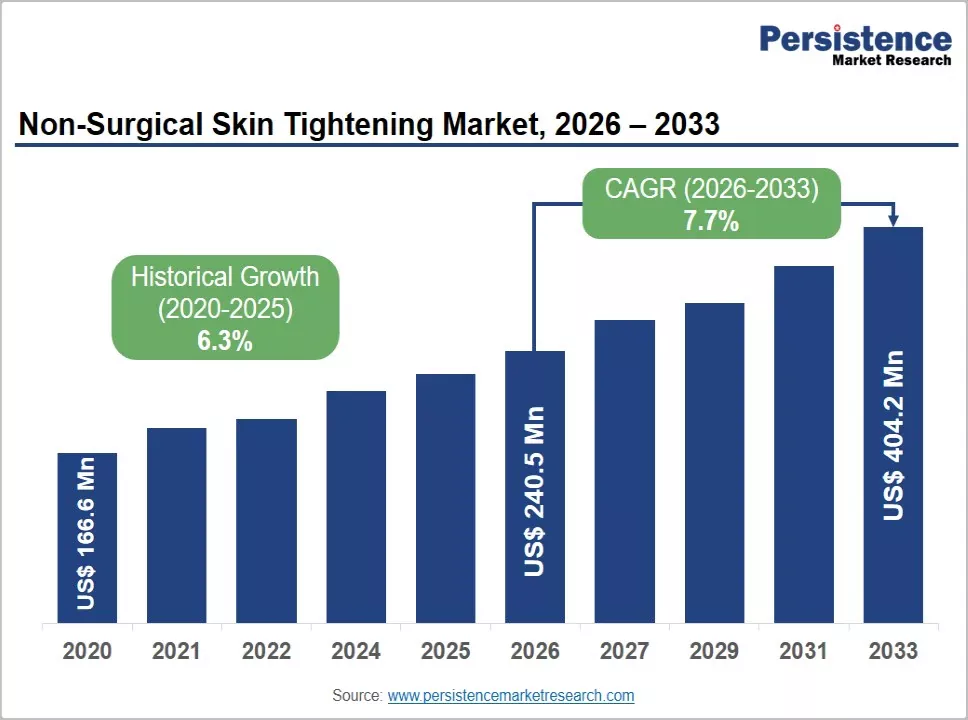
The global non-surgical skin tightening market size is likely to be valued at US$240.5 million in 2026 and is estimated to reach US$404.2 million by 2033, growing at a CAGR of 7.7% during the forecast period from 2026 to 2033, driven by the surging preference for minimally invasive aesthetic procedures with short recovery periods. Rising demand for natural-looking facial rejuvenation is encouraging the adoption of ultrasound and radiofrequency technologies.
Key Industry Highlights:
- Leading Treatment Type: Ultrasound, about 35.6% share in 2026, as it delivers focused energy to deeper skin layers, stimulating collagen production and providing lifting effects without surgical intervention.
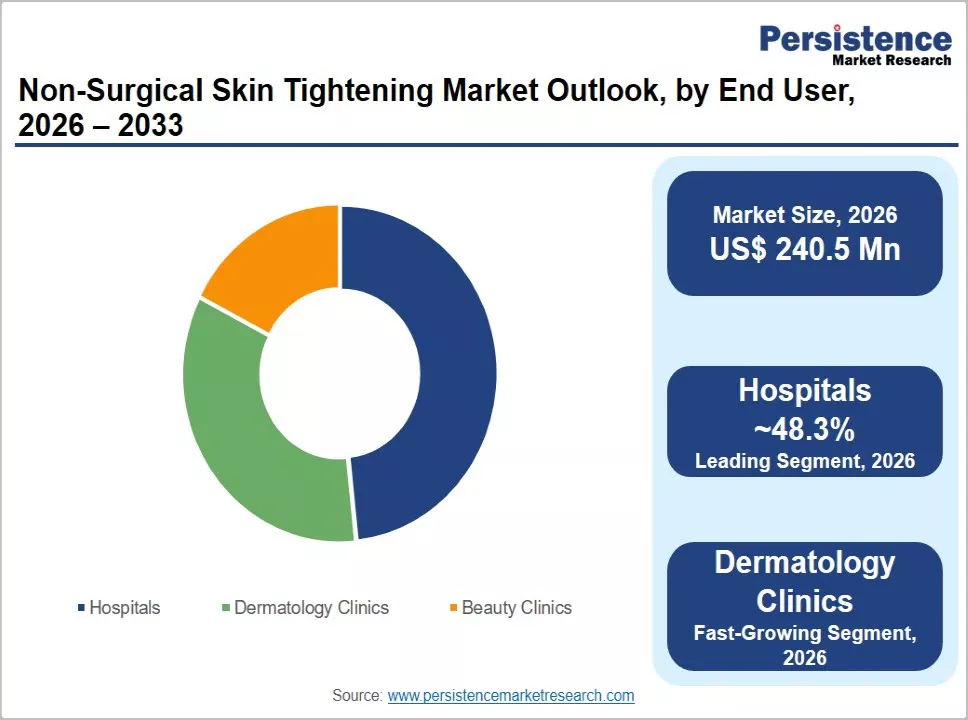
- Dominant End-User: Hospitals, around 48.3% share in 2026, due to their access to specialized medical professionals, advanced treatment infrastructure, and facilities for managing complex aesthetic procedures.
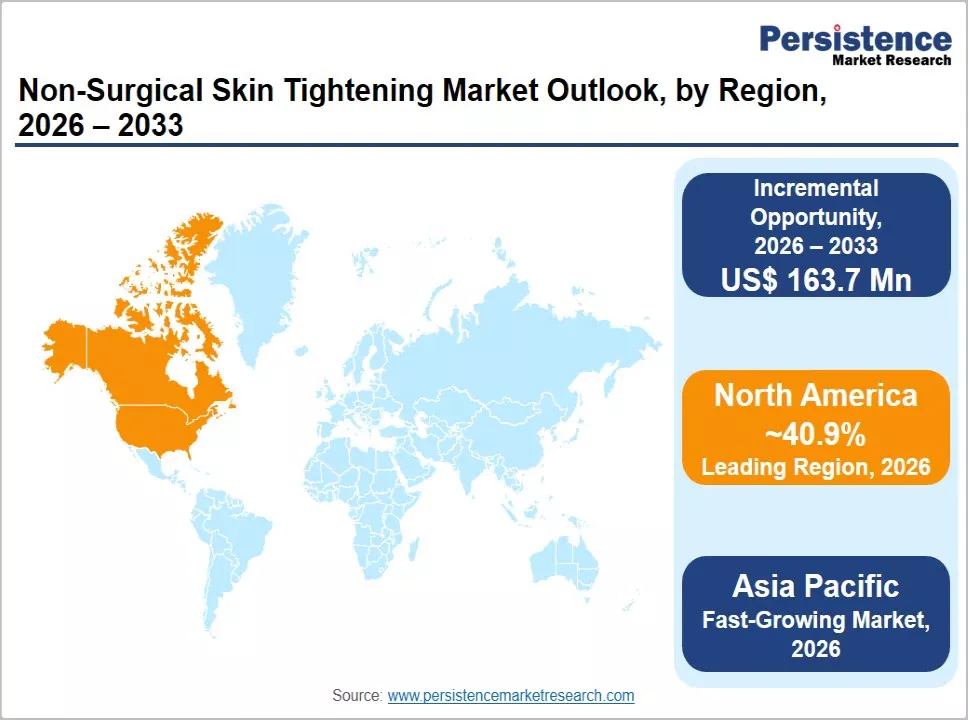
- Leading Region: North America, with about a 40.9% share in 2026, backed by high aesthetic treatment adoption, strong purchasing power, advanced medical infrastructure, and the presence of leading device manufacturers.
- Fast-growing Region: Asia Pacific, owing to growing beauty consciousness, increasing medical tourism, and the expansion of aesthetic clinics.
- Clinical Trial: In February 2026, a multicenter randomized clinical trial published in Lasers in Medical Science evaluated YOUMAGIC, a monopolar RF device, against Thermage CPT. The study included 230 participants, of whom 212 were included in the final analysis. At 90 days, the reported wrinkle-improvement response rates were 100% for YOUMAGIC and 98.1% for Thermage CPT. No serious adverse events were reported. The findings provide clinical evidence supporting the development of alternative RF platforms.
DRO Analysis
Driver - Less Recovery Time to Encourage More Patients to Consider Treatment
Non-surgical skin tightening is attracting patients who want firmer skin without undergoing a facelift or other invasive procedures. Ultrasound, RF, and certain laser treatments can improve skin laxity without surgical incisions. This allows suitable patients to avoid the longer recovery associated with surgery. The convenience of outpatient treatment also makes these procedures easier to fit into regular schedules.
According to the ASPS, the U.S. recorded 439,032 nonsurgical skin tightening procedures in 2024, showing an established patient base for these treatments. Manufacturers are also developing systems that improve treatment speed and comfort. These factors are encouraging more people to consider non-surgical procedures for early signs of aging and mild to moderate skin laxity.
Collagen Stimulation to Drive Demand for Gradual Skin Improvement
Surging interest in natural-looking rejuvenation is supporting demand for technologies that stimulate collagen remodeling. Ultrasound and RF treatments deliver controlled energy into targeted tissue layers. This encourages the body's repair response and can gradually improve skin firmness. Unlike procedures that produce an immediate structural change, these treatments aim to deliver progressive improvements over time.
This appeals to patients who prefer subtle changes rather than a dramatic alteration in facial appearance. Clinical research is also strengthening interest in this approach. A 2026 study published in Scientific Reports evaluated microfocused ultrasound and microneedle RF, both separately and in combination. Its findings have encouraged further investigation into multi-technology treatment protocols.
Restraint - Repeated Treatment Expenses May Limit Wide Adoption
The need for multiple sessions or periodic maintenance can make non-surgical skin tightening expensive over time. Although individual treatments generally cost less than surgery, the total expense can increase when patients undergo repeated procedures to maintain their results. The cost also varies according to the technology used, treatment area, practitioner expertise, and geographic location.
Premium ultrasound and RF systems may involve higher treatment charges due to equipment costs and specialized training requirements. In addition, most cosmetic skin tightening procedures are elective and are not routinely covered by health insurance. This means patients must pay directly for treatment. Price sensitivity can therefore discourage budget-conscious consumers, particularly in emerging markets, and may lead some patients to postpone or discontinue maintenance sessions.
Opportunity - Better Imaging to Improve Treatment Accuracy and Clinical Confidence
The development of ultrasound systems with real-time visualization creates opportunities to improve treatment planning and energy placement. These systems allow practitioners to view underlying tissue layers and select appropriate treatment depths. For example, Merz Aesthetics' Ultherapy PRIME incorporates real-time visualization to guide microfocused ultrasound delivery.
Such features can support more individualized treatment protocols and help practitioners avoid unsuitable treatment areas. Further improvements in imaging, depth selection, and treatment monitoring could strengthen confidence among both patients and providers. Manufacturers can also differentiate their devices through better operator interfaces and training support. However, visualization does not eliminate treatment risks, and appropriate patient selection and practitioner expertise remain essential.
Combining Energy Technologies to Broaden Treatment Possibilities
Combining ultrasound and RF technologies offers an opportunity to address different tissue depths within a coordinated treatment plan. Ultrasound can target deeper structural layers, while RF can deliver controlled heating to dermal tissue. This approach may help practitioners address multiple signs of skin aging without relying on one energy source.
A prospective randomized split-face trial published in Scientific Reports in August 2026 evaluated microfocused ultrasound, microneedle RF, and their combination. The combined approach produced greater early lower-face contour changes than either treatment alone, although larger studies are still required to establish the best treatment protocols. Device manufacturers can use this research direction to develop integrated platforms and combination-based treatment offerings.
Category-wise Analysis
Treatment Type Insights
Ultrasound is predicted to lead with a share of about 35.6% in 2026, as microfocused ultrasound can deliver controlled energy to deeper skin layers, including the superficial muscular aponeurotic system (SMAS), without surgical incisions. Real-time visualization in systems such as Ultherapy PRIME also helps practitioners identify the treatment depth and target tissue more precisely.
Laser skin tightening is estimated to be the fastest-growing type over the forecast period, because improvements in fractional and infrared laser technologies allow practitioners to address skin laxity, fine lines, and surface irregularities in the same treatment plan. Its established use in dermatology and cosmetic practices also supports continued adoption.
End-User Insights
Hospitals are anticipated to dominate with a share of around 48.3% in 2026, as they have access to specialist dermatologists, plastic surgeons, advanced imaging facilities, and emergency support, making them suitable for patients requiring comprehensive assessment and treatment of more pronounced skin laxity.
Dermatology clinics are expected to be the fastest-growing application over the forecast period, because they offer specialized skin assessments, personalized treatment protocols, and convenient outpatient procedures, attracting patients who prefer non-surgical rejuvenation without hospital admission.
Regional Insights
North America Non-Surgical Skin Tightening Market Trends
North America is predicted to lead in 2026 globally with a share of approximately 40.9%, as it has a mature aesthetic medicine ecosystem, strong demand for minimally invasive procedures, and early access to advanced energy-based devices. The region also has a large base of dermatologists, plastic surgeons, and dedicated aesthetic clinics that can adopt new ultrasound, RF, and laser platforms quickly. The U.S. is particularly important because major device companies develop and launch technologies there before expanding into other markets. FDA clearances also provide an important commercial pathway for manufacturers.
U.S. Non-Surgical Skin Tightening Market Trends
A share of nearly 66.2% is expected to be held by the U.S. in 2026 in North America, as consumers have broad access to dermatology and aesthetic medicine providers and are increasingly familiar with non-surgical alternatives to cosmetic surgery. Treatments such as ultrasound, RF, and laser tightening can be performed in outpatient settings, which fits the country's well-developed private aesthetic-care model. Another important factor is the rapid introduction of new technologies. U.S. regulatory clearance gives manufacturers a route to commercialize devices with new treatment areas or technical improvements.
Asia Pacific Non-Surgical Skin Tightening Market Trends
Asia Pacific is anticipated to be the fastest-growing region globally in 2026 with a share of around 25.7%, as aesthetic procedures become more accessible across China, South Korea, Japan, India, Australia, and Southeast Asia. The region combines a large potential patient population with growing urban incomes and strong interest in facial rejuvenation. Importantly, Asia Pacific is not dependent only on Western device manufacturers. South Korea and China have developed substantial domestic medical-aesthetics industries, creating more competition in ultrasound and RF technologies.
China Non-Surgical Skin Tightening Market Trends
China will likely lead in Asia Pacific in 2026 with a share of about 38.6%, as medical aesthetics has expanded from a relatively specialized service into a broader consumer healthcare and beauty category. Large urban centers have multiple dermatology and aesthetic clinics, while domestic manufacturers are developing their own energy-based platforms. This gives providers more choices across different price levels and treatment technologies. China is also becoming important from a technology-development perspective, rather than simply being a consumer market.
India Non-Surgical Skin Tightening Market Trends
In 2026, India is projected to account for a share of just about 23.2% in Asia Pacific, as aesthetic procedures become more available through dermatology practices, cosmetic clinics, and hospitals in major cities. Patients are increasingly interested in treatments that improve facial firmness without surgery, hospitalization, or lengthy recovery. This is particularly relevant for younger and middle-aged consumers who may want to address early skin laxity without undergoing a facelift. Another important factor is the increasing availability of international and Asian technologies. Device manufacturers are working with Indian distributors and clinic networks to expand access to ultrasound and RF platforms.
Europe Non-Surgical Skin Tightening Market Trends
Europe will likely see steady growth over the forecast period with a share of roughly 19.8% in 2026 globally, as it has a well-established dermatology and aesthetic medicine infrastructure. Germany, France, Italy, Spain, and the U.K. have sizeable specialist provider networks and consumers who are familiar with non-surgical cosmetic procedures. Demand is also supported by an aging population and interest in maintaining a natural appearance without immediately opting for surgery.
Germany Non-Surgical Skin Tightening Market Trends
Germany is predicted to register a substantial share of approximately 32.5% in 2026 in Europe, as it has a mature aesthetic medicine sector supported by specialist plastic surgeons, dermatologists, private clinics, and medical practices.
The country also has a strong preference for medically supervised aesthetic treatment, which fits the non-surgical skin-tightening category because many ultrasound and RF procedures require trained practitioners and controlled energy delivery. The 2025 DGÄPC patient survey provides evidence of continued demand for aesthetic treatment. The nationwide survey covered 4,548 participants during October 2024-October 2025. More than half of reported treatments were focused on the face.
U.K. Non-Surgical Skin Tightening Market Trends
A share of nearly 26.1% is predicted to be held by the U.K. in 2026 in Europe, as non-surgical cosmetic procedures become increasingly normalized and accessible through private clinics. The government's 2025 consultation response states that the sector has expanded through greater accessibility, new technologies, and growing consumer demand. It also notes that most non-surgical cosmetic procedures are performed by private providers. For skin tightening specifically, HIFU, RF, and non-ablative lasers are relevant because they are explicitly covered in the government's proposed procedure categories. This creates both an opportunity and a constraint.
Competitive Landscape
The global non-surgical skin tightening market is moderately consolidated, with a few established medical aesthetics companies holding strong positions alongside several emerging technology providers. Competition is mainly based on treatment precision, clinical evidence, device safety, patient comfort, and the ability to address different levels of skin laxity. Companies are expanding their portfolios across ultrasound, radiofrequency (RF), and laser-based technologies to serve both facial and body-tightening applications.
Leading players include Merz Aesthetics, InMode, Cynosure Lutronic, Solta Medical, Alma Lasers, and BTL Aesthetics. Merz Aesthetics has strengthened its position through Ultherapy PRIME, which uses microfocused ultrasound with real-time visualization. Technology differentiation is becoming an important competitive factor. InMode offers radiofrequency-based platforms such as Morpheus8, while Solta Medical competes through its Thermage FLX system.
Key Industry Developments:
- In July 2026, Cynosure Lutronic announced the European launch of its XERF monopolar RF platform. The system combines 6.78 MHz and 2 MHz frequencies in a single treatment shot to address multiple tissue depths. It also offers three depth settings and ten energy levels. The launch expands the company's presence in the European non-invasive skin tightening market.
- In August 2026, Scientific Reports published a prospective split-face randomized trial comparing microfocused ultrasound, microneedle radiofrequency, and their combination for facial tightening. The study involved 30 participants. Combined treatment produced greater early lower-face contour changes than either treatment alone, although the researchers noted that further studies with larger populations and longer follow-up are needed. The findings support further investigation of combination-based skin tightening.
- In November 2025, Merz Aesthetics announced FDA clearance for additional Ultherapy PRIME indications covering skin laxity on the anterior and posterior arms and abdomen. The expansion builds on the device's existing facial, neck, and décolleté applications. It also creates opportunities for the company to reach patients seeking non-surgical body tightening.
Companies Covered in Non-Surgical Skin Tightening Market
- Merz Aesthetics
- InMode Ltd.
- Cynosure Lutronic
- Solta Medical
- Alma Lasers
- BTL Aesthetics
- Cutera, Inc.
- Venus Concept
- Lumenis
- Candela Medical
- Classys Inc.
- Sofwave Medical
- Fotona
- Jeisys Medical
- Sciton, Inc.
- Others
Frequently Asked Questions
The global non-surgical skin tightening market is projected to be valued at US$240.5 million in 2026.
The non-surgical skin tightening market is expected to reach US$404.2 million by 2033.
Key market trends include the development of real-time imaging systems and personalized energy delivery.
Ultrasound is expected to be the leading treatment type with a share of around 35.6% in 2026, as it allows practitioners to target specific tissue depths.
The non-surgical skin tightening market is expected to grow at a CAGR of 7.7% from 2026 to 2033.
Merz Aesthetics, InMode Ltd., and Cynosure Lutronic are a few key market players.


