




- Telecommunications
- Next Generation Wireless Network Market
Next Generation Wireless Network Market Size, Share, and Growth Forecast, 2026 - 2033
Next Generation Wireless Network Market by Product Type (Fixed, Mobile, Portable, IR), Technology (Wireless LAN, 3G, 4G LTE, 5G), End-user (Telecommunication, Consumer Electronics, Manufacturing, Others), and Regional Analysis for 2026 - 2033

Next Generation Wireless Network Market Size and Trends Analysis
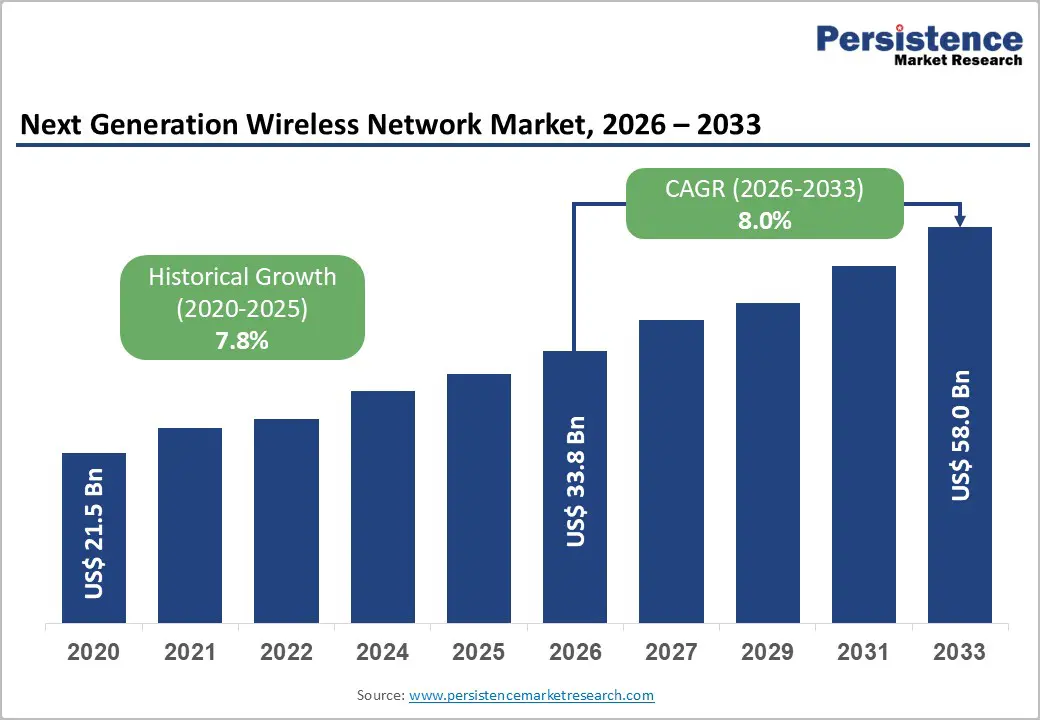
The global next generation wireless network market size is likely to be valued at US$33.8 billion in 2026 and is expected to reach US$58.0 billion by 2033, growing at a CAGR of 8.0% during the forecast period from 2026 to 2033, driven by the growing need for high-speed, low-latency, and reliable connectivity across both consumer and enterprise environments.
The transition toward advanced wireless technologies such as 5G and the early development of 6G is enabling a new generation of data-intensive applications, including Internet of Things ecosystems, cloud computing platforms, smart infrastructure, and immersive digital experiences. Increasing mobile data consumption, fueled by widespread smartphone adoption and the proliferation of connected devices, continues to place significant demand on network capacity and performance. Telecom operators and technology providers are focusing on network modernization through virtualization, open architectures, and edge computing to improve efficiency, scalability, and service delivery.
Key Industry Highlights:
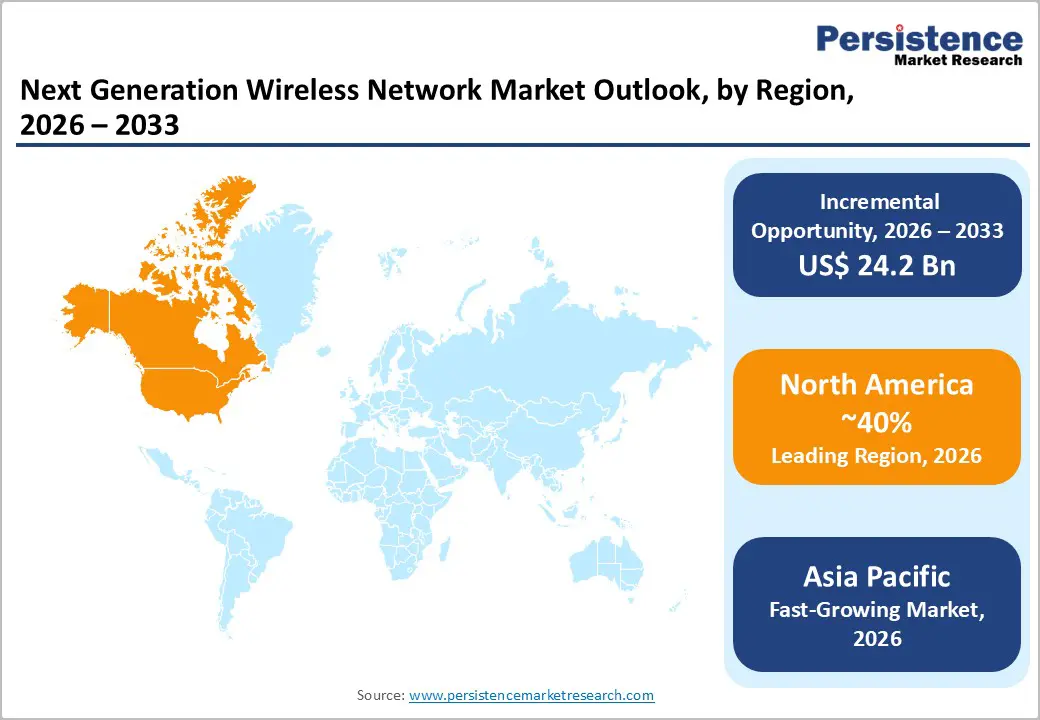
- Leading Region: North America is anticipated to be the leading region, accounting for a market share of 40% in 2026, driven by advanced infrastructure, strong 5G adoption, high IoT penetration, and continuous innovation supported by a favorable regulatory environment.
- Fastest-growing Region: Asia Pacific is likely to be the fastest-growing region, supported by rapid digital adoption, expanding mobile data usage, strong manufacturing capabilities, and increasing investments in 5G and IoT infrastructure.
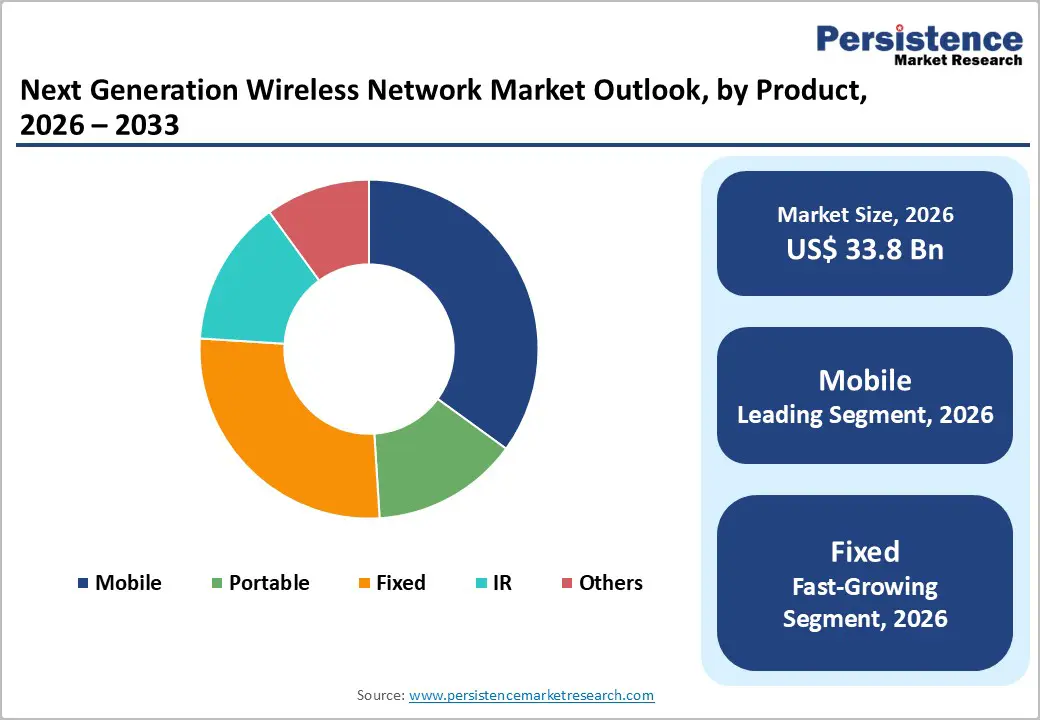
- Leading Product Type: Mobile wireless is projected to represent the leading product type in 2026, accounting for 47% of the revenue share, driven by high smartphone penetration and demand for seamless connectivity.
- Leading Technology: 5G is anticipated to be the leading technology, accounting for over 44% of the revenue share in 2026, supported by its superior speed, capacity, and low latency capabilities.
| Key Insights | Details |
|---|---|
|
Next Generation Wireless Network Market Size (2026E) |
US$33.8 Bn |
|
Market Value Forecast (2033F) |
US$58.0 Bn |
|
Projected Growth (CAGR 2026 to 2033) |
8.0% |
|
Historical Market Growth (CAGR 2020 to 2025) |
7.8% |
Market Factors - Driver, Restraint, and Opportunity Analysis
Driver Analysis - Rising Demand for High-Speed Data and 5G Deployments
The rapid increase in data consumption across mobile devices, cloud platforms, and connected ecosystems is significantly accelerating the need for high-speed wireless networks. Applications such as video streaming, online gaming, virtual collaboration, and real-time analytics require seamless connectivity with minimal latency. As enterprises and consumers increasingly rely on digital services, network providers are under pressure to deliver enhanced bandwidth and reliability. This demand is amplified by the proliferation of smart devices and IoT endpoints, which continuously generate and transmit large volumes of data across networks, necessitating robust and scalable wireless infrastructure.
The deployment of advanced wireless technologies is playing a crucial role in addressing these evolving requirements. Enhanced network capabilities enable faster data transfer, improved user experiences, and support for mission-critical applications across industries such as healthcare, manufacturing, and automotive. Telecom operators are investing heavily in infrastructure upgrades, including small cells and network densification, to ensure consistent coverage and performance.
Technological Advancements and Cloud Computing Growth
Continuous innovation in wireless communication technologies is transforming the way networks operate and deliver services. Advancements in areas such as network virtualization, software-defined networking, and edge computing are enhancing flexibility and efficiency. These technologies enable dynamic allocation of network resources, improving overall performance while reducing operational complexity. The integration of intelligent systems within network infrastructure allows for automated management, predictive maintenance, and optimized traffic handling, which are essential for meeting the demands of modern digital environments.
The growth of cloud computing is closely linked with the evolution of next generation wireless networks. As organizations migrate workloads to cloud platforms, the need for reliable and high-speed connectivity becomes critical. Wireless networks facilitate seamless access to cloud services, enabling real-time data processing and remote operations. This synergy supports emerging applications such as artificial intelligence, big data analytics, and remote monitoring systems.
Restraint Analysis - Regulatory and Spectrum Allocation Challenges
The development and deployment of advanced wireless networks are heavily influenced by regulatory frameworks and spectrum availability. Governments and regulatory bodies play a crucial role in allocating frequency bands required for network operations. Delays in spectrum auctions, inconsistent policies across regions, and high licensing costs can hinder timely deployment and expansion. These challenges create uncertainty for telecom operators, impacting investment decisions and slowing down infrastructure development in certain markets.
The increasing demand for spectrum from various industries intensifies competition for limited resources. Efficient spectrum management becomes essential to ensure optimal utilization without causing interference between services. Regulatory complexities also arise from the need to balance innovation with fair competition and consumer protection. Differences in international standards and policies complicate cross-border network integration, making it challenging for players to implement uniform strategies. Addressing these issues requires collaborative efforts between governments, industry stakeholders, and standardization bodies.
Interoperability Issues with Legacy Systems
The transition to advanced wireless technologies often involves integrating new infrastructure with existing legacy systems. Many organizations and telecom operators still rely on older network architectures, which are not fully compatible with modern technologies. This creates challenges in ensuring seamless communication between different network generations, leading to inefficiencies and potential service disruptions. The complexity of upgrading or replacing legacy systems can also result in increased costs and extended deployment timelines.
Interoperability issues can impact the overall performance and reliability of wireless networks, particularly in environments where multiple technologies coexist. Ensuring compatibility requires extensive testing, standardization, and the development of flexible solutions that can bridge the gap between old and new systems. Legacy systems may lack the scalability and security features required for modern applications, complicating integration efforts. Overcoming these challenges is essential for achieving a smooth transition toward a more advanced and efficient wireless network ecosystem.
Opportunity Analysis - Innovations in Security, Latency, and Specialized Applications
Advancements in wireless network technologies are creating significant opportunities for innovation in security, latency reduction, and specialized applications. As networks become more complex and interconnected, ensuring data security and privacy becomes increasingly important. New security frameworks and encryption techniques are being developed to protect sensitive information and prevent cyber threats. Improvements in network architecture are enabling ultra-low latency communication, which is critical for applications such as autonomous systems, remote surgery, and real-time industrial automation.
These technological improvements are also supporting the development of specialized applications tailored to specific industry needs. Sectors such as healthcare, manufacturing, and transportation are leveraging advanced wireless networks to enhance efficiency and enable new capabilities. Smart factories rely on real-time data exchange for process optimization, while connected vehicles require reliable communication for safety and navigation. The ability to customize network performance for different use cases is driving innovation and expanding the potential applications of next generation wireless technologies.
AI-Driven Network Optimization
The integration of artificial intelligence into wireless networks is transforming how they are managed and optimized. AI-driven solutions enable real-time monitoring, predictive analytics, and automated decision-making, improving network performance and efficiency. These systems can identify patterns in network traffic, detect anomalies, and proactively address potential issues before they impact users. This level of automation reduces the need for manual intervention and enhances the overall reliability of network operations.
AI technologies also support dynamic resource allocation, allowing networks to adapt to changing demand conditions. This is particularly important in environments with fluctuating traffic patterns, such as urban areas or large-scale events. By optimizing bandwidth usage and minimizing congestion, AI-driven networks can deliver consistent performance and improved user experiences. The use of machine learning algorithms enables continuous improvement, as networks learn from historical data and refine their operations over time, creating a more intelligent and responsive connectivity ecosystem.
Category-wise Analysis
Smartphones Product Type Insights
Mobile wireless is expected to lead the next-generation wireless network market, accounting for approximately 47% of revenue in 2026, driven by the widespread adoption of smartphones, tablets, and connected devices requiring seamless, high-mobility connectivity across consumer and enterprise environments. For example, the large-scale deployment of mobile broadband networks in urban regions, where telecom operators provide high-speed connectivity to millions of users, enables smart services and digital ecosystems that rely heavily on mobile wireless infrastructure.
Fixed wireless is likely to represent the fastest-growing segment, supported by rising demand for cost-effective broadband solutions and expanding connectivity in underserved and rural areas. The integration of advanced wireless technologies enhances its performance, making it a viable alternative for last-mile connectivity. For example, the deployment of fixed wireless access solutions in remote regions, where service providers deliver high-speed internet to households and businesses without extensive wired infrastructure, improves digital inclusion and supports regional economic development.
Technology Insights
5G is projected to lead the market, capturing around 44% of the revenue share in 2026, supported by its superior speed, ultra-low latency, and ability to support massive device connectivity across diverse applications. It plays a critical role in enabling advanced use cases such as smart cities, industrial automation, connected healthcare, and immersive digital experiences. For example, the implementation of 5G-enabled smart city projects, where high-speed connectivity supports intelligent traffic systems, energy management, and real-time monitoring, demonstrates the transformative impact of advanced wireless technology on urban infrastructure.
4G LTE is likely to be the fastest-growing application, driven by its widespread adoption, cost efficiency, and critical role in expanding network coverage, particularly in emerging and rural markets. It continues to serve as a reliable backbone for mobile communication, supporting a large user base and ensuring consistent connectivity where newer technologies are still developing. For example, the expansion of 4G LTE networks in developing regions, where telecom providers extend affordable high-speed internet access to growing populations, enabling digital services such as online education, mobile banking, and e-commerce while supporting ongoing connectivity needs.
Regional Insights
North America Next Generation Wireless Network Market Trends
North America is anticipated to be the leading region, accounting for a market share of 40% in 2026, driven by advanced telecom infrastructure, strong digital adoption, and continuous investments in next generation connectivity solutions. High demand for low-latency, high-speed networks is supporting the expansion of edge computing, IoT ecosystems, and enterprise digital transformation. Telecom operators are focusing on network densification, virtualization, and private wireless deployments to enhance performance and scalability.
The region also benefits from strong collaboration between technology providers, enterprises, and government bodies, enabling faster commercialization of innovative solutions across industries such as healthcare, manufacturing, and smart infrastructure. The presence of leading companies such as Cisco Systems, Inc. is accelerating advancements in cloud-managed networking and software-defined architectures. These innovations support efficient network operations and enable seamless connectivity across distributed environments. Increasing investments in advanced wireless technologies, along with a favorable regulatory environment, are strengthening the region’s leadership position.
Europe Next Generation Wireless Network Market Trends
Europe is likely to be a significant market for next generation wireless networks in 2026, due to strong regulatory frameworks, emphasis on data security, and increasing focus on sustainable and energy-efficient network infrastructure. The region is actively promoting digital transformation through initiatives supporting smart cities, industrial automation, and cross-border connectivity. Telecom operators are investing in modernizing existing infrastructure to support advanced wireless technologies while ensuring compliance with strict privacy regulations.
The demand for reliable and secure connectivity is particularly strong in sectors such as manufacturing, automotive, and public services. The competitive landscape includes key players, for example, Ericsson AB, which is contributing to the deployment of advanced network solutions and enhancing regional connectivity capabilities. Europe is also witnessing growth in open network architectures and collaborative innovation models, enabling interoperability and reducing dependency on single vendors. Increasing investments in research and development, along with government-backed digital initiatives, are supporting steady market growth while maintaining a balance between technological advancement and regulatory compliance.
Asia Pacific Next Generation Wireless Network Market Trends
The Asia Pacific region is likely to be the fastest-growing region, driven by rapid urbanization, high population density, and increasing adoption of digital technologies. The expansion of smartphone usage, rising mobile data consumption, and growing IoT ecosystems are driving demand for advanced wireless networks. Governments across the region are actively investing in smart city projects, rural connectivity programs, and digital infrastructure development, creating a strong foundation for market growth.
The region also benefits from cost-effective manufacturing capabilities, which support large-scale deployment of wireless equipment. For example, Huawei Technologies Co., Ltd. plays a significant role in advancing next-generation network infrastructure across the region. Investments in network densification, spectrum utilization, and emerging technologies are accelerating adoption across both urban and rural areas. Increasing focus on industrial automation, connected devices, and digital services is creating new opportunities.
Competitive Landscape
The global next-generation wireless network market exhibits a moderately fragmented structure, driven by the presence of multiple global telecom equipment providers, chipset manufacturers, and network operators competing across different layers of the value chain. The market is characterized by rapid technological evolution, particularly with the transition toward 5G and emerging 6G ecosystems, which is intensifying competition among established players and new entrants.
With key leaders including Huawei, Cisco, Qualcomm, Ericsson, Nokia, and AT&T, the market demonstrates strong competition centered on innovation, service portfolio expansion, and global deployment capabilities. These players compete through continuous investment in advanced wireless technologies, strategic partnerships, and development of scalable network solutions such as Open RAN, edge computing, and AI-driven network management.
Key Industry Developments:
- In March 2026, Booz Allen Hamilton announced a strategic investment in O-RAN Development Company to accelerate AI-powered NextG wireless technologies, focusing on AI-native Open RAN solutions that enhance 5G capabilities and support the development of future 6G infrastructure, particularly for mission-critical and defense applications.
- In March 2026, Rakuten Mobile extended its partnership with Netcracker Technology to deploy an AI-enabled, cloud-native Digital BSS platform, enhancing automation, customer experience, and scalability across its nationwide 4G and 5G network in Japan.
- In January 2026, Airspan Networks Holdings LLC enabled the commercial launch of Gogo Inc.’s next-generation 5G air-to-ground communication network following successful in-flight testing, marking a key milestone in delivering high-speed and low-latency connectivity for aviation across the U.S. and parts of Canada.
Companies Covered in Next Generation Wireless Network Market
- Huawei Technologies Co. Ltd.
- Samsung Electronics Co. Ltd.
- Nokia Corporation
- Ericsson AB
- Qualcomm Technologies, Inc.
- Cisco Systems, Inc.
- Intel Corporation
- ZTE Corporation
- AT&T Inc.
- IBM Corporation
Frequently Asked Questions
The global next generation wireless network market is projected to reach US$33.8 billion in 2026.
Rising demand for high-speed, low-latency connectivity driven by increasing mobile data traffic, IoT expansion, and advanced digital applications is driving the next generation wireless network market.
The next generation wireless network market is expected to grow at a CAGR of 8.0% from 2026 to 2033.
Key market opportunities include advancements in AI-driven network optimization, expansion of 5G and emerging 6G technologies, growth of IoT ecosystems, and increasing adoption of smart city and industry-specific wireless applications.
Huawei Technologies Co., Ltd., Samsung Electronics Co., Ltd., Nokia Corporation, and Ericsson AB are the leading players.


