




- Telecommunications
- Load Bank Resistors Market
Load Bank Resistors Market Size, Share, and Growth Forecast, 2026 - 2033
Load Bank Resistors Market by Category (Resistive, Reactive, Resistive-Reactive Hybrid), Application (Battery Systems Testing, Generators Testing, UPS Testing, Turbines Testing, Data Centers and Renewables Testing), and Regional Analysis 2026 - 2033

Load Bank Resistors Market Size and Trends Analysis
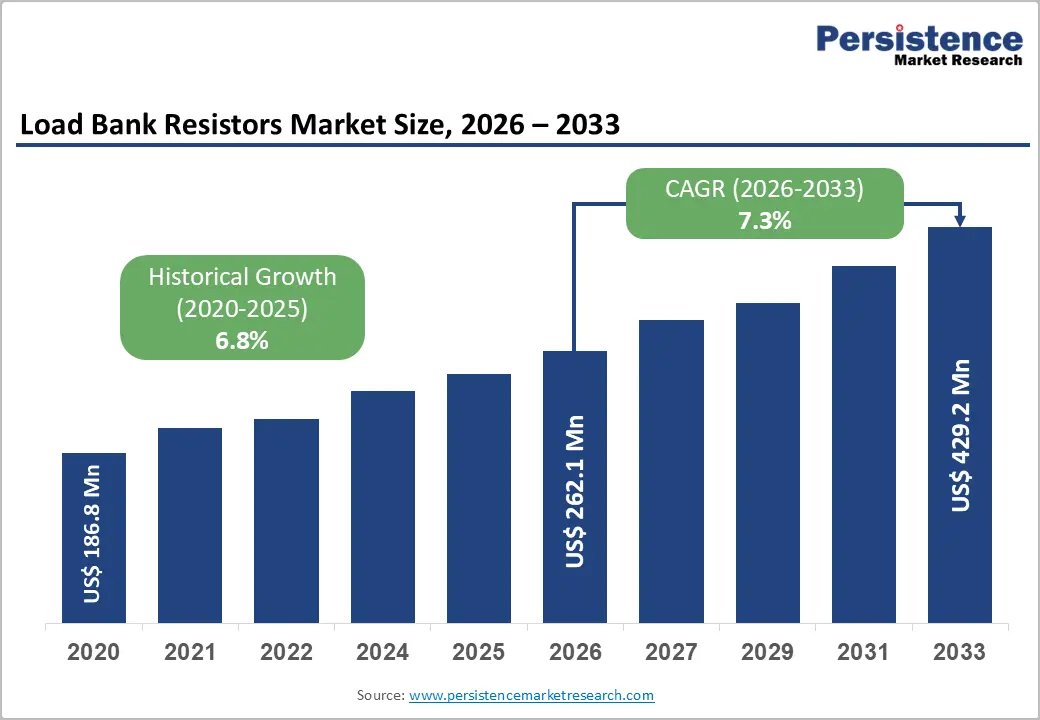
The global load bank resistors market size is likely to be valued at US$262.1 million in 2026 and is expected to reach US$429.2 million by 2033, growing at a CAGR of 7.3% during the forecast period from 2026 to 2033, driven by the ongoing digital transformation of industrial electrical systems, which is increasing the need for accurate and reliable power validation. Expanding demand for power testing across data centers and renewable energy installations is further accelerating market adoption.
Advanced resistive-reactive hybrid systems enable precise load simulation under dynamic operating conditions, thereby improving grid stability. At the same time, manufacturers are incorporating enhanced monitoring and control capabilities to meet stringent uptime and performance requirements in industrial environments. High-capacity energy validation remains essential for ensuring operational reliability in mission-critical facilities.
Additionally, infrastructure modernization in emerging economies is broadening the adoption of load simulation technologies, while innovations in thermal management are improving system efficiency and durability. Together, these factors, aligned with evolving regulatory and safety standards, continue to drive sustained market growth.
Key Industry Highlights:
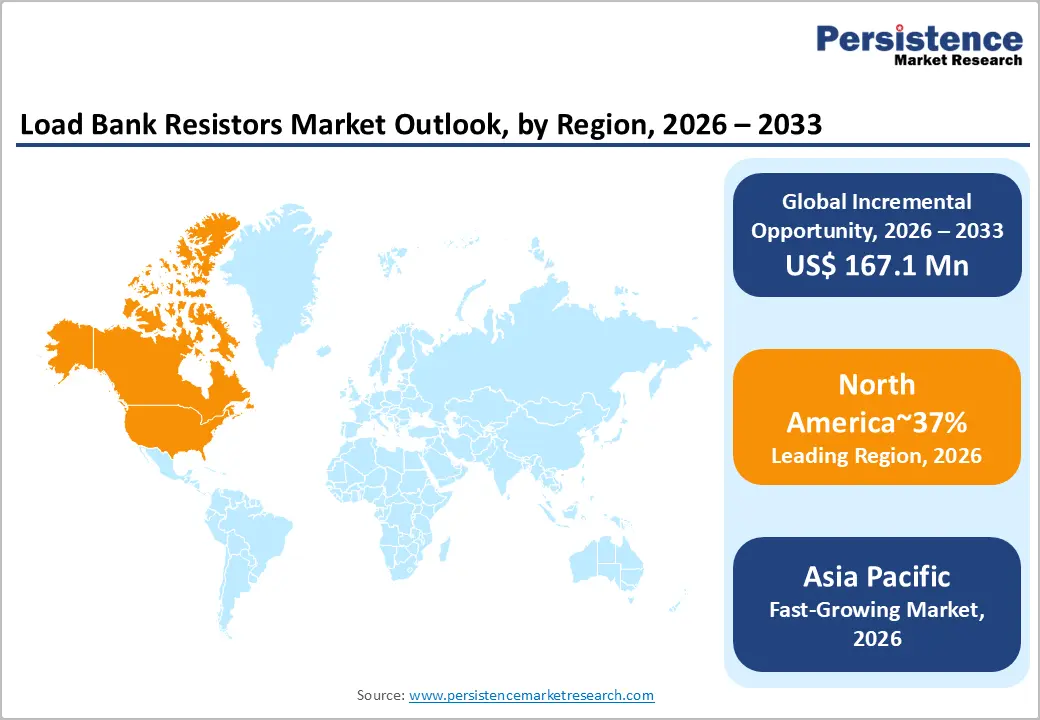
- Leading Region: North America is projected to lead, accounting for approximately 37% share in 2026, supported by dense data center infrastructure, stringent grid reliability standards, and established testing protocols in power generation.
- Fastest-growing Region: Asia Pacific is anticipated to grow fastest, driven by rapid renewable energy deployment, expanding manufacturing bases, and infrastructure investments in urban power networks.
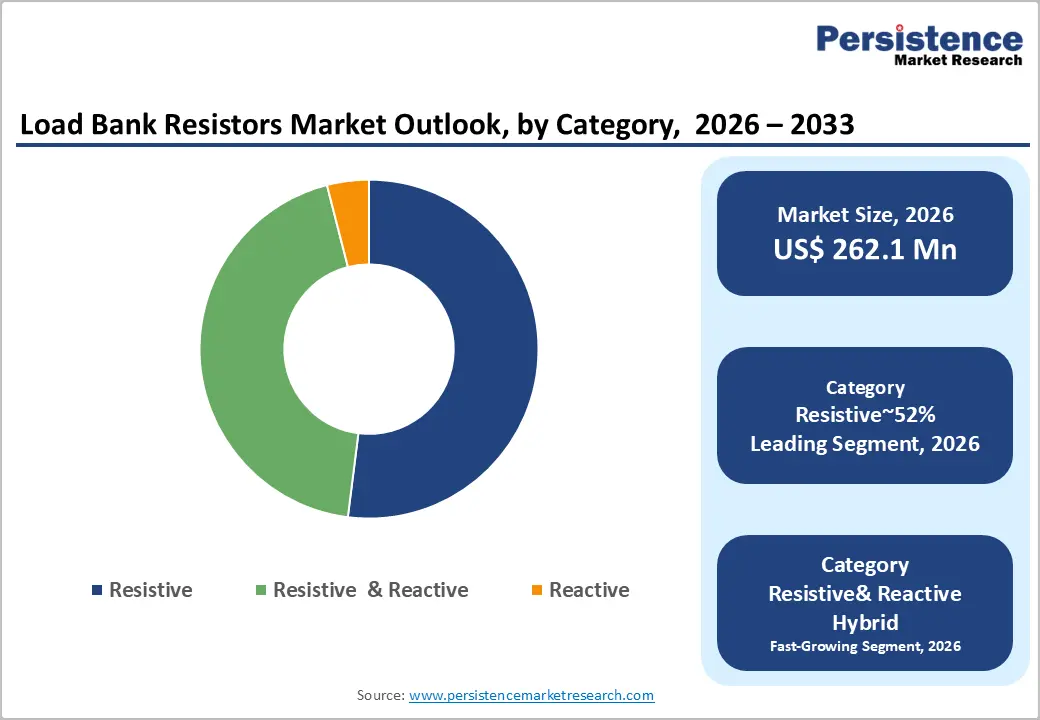
- Leading Category: Resistive is expected to lead, accounting for approximately 52% share in 2026, anchored by simplicity in deployment, cost-effective power dissipation, and broad compatibility with generator sets.
- Leading Application: The generators testing segment is anticipated to dominate, accounting for approximately 40% of the market in 2026, driven by frequent maintenance cycles, regulatory compliance requirements, and high-volume use in backup power validation.
| Key Insights | Details |
|---|---|
|
Load Bank Resistors Market Size (2026E) |
US$262.1 Mn |
|
Market Value Forecast (2033F) |
US$429.2 Mn |
|
Projected Growth (CAGR 2026 to 2033) |
7.3% |
|
Historical Market Growth (CAGR 2020 to 2025) |
6.8% |
DRO Analysis
Driver Analysis – Expansion of Hyperscale Data Center Infrastructure and Load Validation Requirements
The rapid expansion of hyperscale computing infrastructure is intensifying thermal management validation requirements across high-density server environments worldwide. Elevated rack power densities necessitate continuous electrical load simulation to verify cooling system performance under realistic operating conditions. This operational dependency shifts procurement toward advanced load bank systems capable of replicating dynamic computing stress profiles. ASCO Power Technologies, in partnership with Avtron LC35, addresses these requirements through integrated liquid-cooled architectures, enabling precise thermal load validation. Consequently, infrastructure operators prioritize high-capacity, thermally optimized equipment to maintain operational continuity and system efficiency.
Regulatory and operational reliability standards are increasingly mandating full-capacity discharge testing for backup power systems across facilities. Compliance with these frameworks requires the deployment of advanced resistive and reactive load bank configurations for validation. Standardized testing protocols mitigate operational risks associated with unexpected outages and unstable grid supply conditions. Enhanced monitoring and data acquisition capabilities improve the accuracy and traceability of commissioning and compliance reporting outputs. These integrated validation mechanisms strengthen infrastructure resilience while aligning operational practices with evolving regulatory performance benchmarks.
Integration of Variable Renewable Energy and Grid Stability Testing Requirements
Global decarbonization frameworks are accelerating the deployment of solar and wind energy conversion infrastructures across diverse geographies. Intermittent generation profiles require inverter systems to maintain stability under continuously fluctuating electrical input conditions. This variability increases reliance on advanced load-simulation equipment capable of replicating dynamic current and voltage behavior. Cressall Resistors with Power Probe enable validation of conversion efficiency under varying environmental and operational conditions. Such validation ensures optimal inverter response and minimizes performance degradation across renewable energy generation assets. Consequently, testing infrastructure becomes integral to maintaining long-term operational reliability within decentralized energy ecosystems.
Grid operators are strengthening stability protocols through comprehensive site acceptance testing of distributed energy resource installations. Accurate simulation of resistive and inductive loads ensures proper response of storage systems during sudden demand fluctuations. These technical evaluations mitigate the risks of voltage instability and unexpected system failures during peak load conditions. Flexible configurations enable efficient deployment across remote renewable installations, including solar farms and wind generation sites. These capabilities reinforce grid resilience while aligning operational performance with evolving regulatory and energy transition requirements.
Restraint Analysis – Reactive Component Complexity and Integration Constraints in Hybrid Load Systems
Hybrid load systems incorporating reactive components introduce calibration challenges due to their inductive behavior, which requires precise phase synchronization. Accurate phase alignment during simulation is critical to reliably replicate real-world electrical load conditions. Facilities encounter interoperability issues when integrating these systems with legacy generator and control infrastructure architectures. Such incompatibility extends commissioning timelines and increases engineering dependency for configuration and validation processes. Limited technical expertise in maintaining reactive systems further amplifies operational risks across non-specialist user environments. These constraints collectively restrict seamless deployment across heterogeneous power ecosystems with varying infrastructure maturity levels.
Commercial implications intensify as Simplex with Titan requires extended user training for effective system operation and calibration. Ka Load Banks' hybrid models face service bottlenecks in regions lacking specialized technical support infrastructure. Manufacturers experience increased warranty claims due to operational misconfigurations and inadequate field-level expertise. These service inefficiencies elevate lifecycle costs and place pressure on after-sales support and maintenance networks. Procurement decisions are delayed because integration complexity outweighs the incremental performance benefits of hybrid configurations. This dynamic constrains broader market penetration despite technological advancements in combined resistive and reactive load systems.
Urban Thermal Dissipation and Acoustic Compliance Constraints
Operation of high-capacity load banks in dense urban environments introduces significant thermal management and acoustic-compliance challenges. Elevated heat output from testing equipment requires controlled dissipation to prevent adverse impacts on surrounding infrastructure systems. Municipal regulations impose strict limits on permissible noise levels generated by fan-assisted cooling mechanisms during operation. These regulatory constraints necessitate the adoption of low-noise or passive cooling architectures, which require enhanced thermal engineering. Cressall Resistors with Convection-Cooled Banks addresses these limitations through a silent, convection-based cooling system. Such specialized configurations increase design complexity and elevate initial procurement costs for urban deployment contractors.
Thermal discharge from large resistor assemblies requires structured airflow management to ensure safe operation within confined installation environments. Inadequate ventilation planning can lead to localized overheating, impacting adjacent systems and reducing operational safety margins. Site preparation demands specialized ducting, clearance optimization, and compliance with building-level thermal and safety regulations. These logistical requirements extend commissioning timelines while increasing installation complexity and total ownership cost structures. The spatial limitations and ventilation dependencies continue to restrict widespread adoption across high-density metropolitan infrastructure settings.
Opportunity Analysis – Portable Load Bank Adoption for Decentralized Field Testing Environments
Portable load bank systems address on-site validation gaps across remote renewable installations and mobile power generation assets. Compact and transportable designs enable deployment in offshore platforms and rural locations lacking permanent testing infrastructure. Decentralized energy architectures increase reliance on field-based validation, shifting workflows away from centralized testing facilities. Operators prioritize ruggedized equipment that can withstand environmental stressors, including temperature variations and mechanical exposure. These systems support real-time commissioning and maintenance activities, improving operational flexibility across distributed energy networks. Portability enhances responsiveness while reducing logistical dependency on fixed-site testing infrastructure within evolving energy ecosystems.
Commercial deployment expands as Simplex with Mobile Load Trailers targets wind farm validation through transportable resistive testing configurations. Penta Power with PBL supports the validation of uninterruptible power systems across distributed data center environments. Service providers expand rental fleets to address episodic testing requirements without necessitating permanent capital investment commitments. This rental-driven model aligns cost structures with project-based demand patterns across infrastructure and industrial applications. Flexible deployment capabilities enable rapid mobilization, improving service efficiency in geographically dispersed operational environments.
Liquid Cooling for Artificial Intelligence Clusters
The rapid shift toward liquid cooling in high-performance computing is creating a niche for specialized testing hardware. Conventional air-cooled units are becoming insufficient for validating the thermal performance of high-density AI server racks. This technological inflection is driving demand for resistive systems that integrate directly into facility cooling loops. Avtron Power Solutions with LC20 captures this opportunity by providing a realistic heat load simulation for liquid-cooled sites. This evolution positions simulation hardware as an essential tool for future-ready computing centers.
Integrating testing equipment into the facility’s primary thermal management system during commissioning improves energy efficiency. This approach reduces the need for massive portable fan arrays that consume significant auxiliary power. Development of these high-performance models is likely to accelerate as hyperscale operators prioritize sustainability. Mosebach Manufacturing with Water Cooled Series reinforces this trajectory through specialized designs for modern facilities. Advanced cooling integration represents a significant growth vector within the high-capacity hardware segment.
Category–wise Analysis
Category Insights
Resistive is expected to lead, accounting for approximately 52% of the market share in 2026, underpinned by its fundamental role in simulating unity power factor loads. These systems remain indispensable for testing the kilowatt capacity of prime movers and standby generator sets. Adoption remains anchored in the simplicity and reliability of resistive elements for verifying engine cooling and fuel systems. Mosebach Manufacturing’s X100L Series and Simplex with Radiator-Mounted Load Banks exemplify the widespread utility of these components. Facilities prioritize resistive testing to ensure that emergency power sources can maintain their rated output during outages. Ongoing refinements in the durability of resistor materials further strengthen the long-term use of these standard testing units. This structural alignment with routine maintenance cycles and regulatory safety standards sustains the segment's leadership within industrial frameworks.
The resistive and reactive hybrid segment is anticipated to be the fastest-growing segment, driven by the increasing complexity of modern electrical distribution systems. Advanced facilities now require comprehensive validation of both real and reactive power to simulate actual motor and transformer loads. This technological shift encourages the procurement of integrated units that allow for precise power factor adjustments during commissioning. Integration of digital control systems supports automated testing of complex grid-interactive inverters and smart protection relays. As industrial operators prioritize total system reliability, these multi-functional units are gaining significant traction across evolving energy ecosystems.
Application Insights
Generators testing is projected to lead, accounting for approximately 40% of the market in 2026, supported by mandatory compliance with national fire and safety codes. Periodic full-load assessments are required for standby power systems in healthcare, government, and commercial buildings. This regulatory pressure focuses procurement on dedicated hardware designed to prevent "wet stacking" in diesel engines. Simplex with Stationary Load Banks and Post Glover with Custom Resistor Banks provide the necessary infrastructure for these critical audits. Enterprises prioritize these assessments to eliminate potential failure points in emergency power delivery during utility blackouts. Consistent investment in standby power resilience ensures a steady replacement cycle for high-capacity resistive units. This convergence of safety mandates and operational risk management reinforces the segment's dominant market position.
Data center & renewable energy testing is forecast to be the fastest-growing segment, driven by the explosive expansion of hyperscale computing and green energy. The emergence of high-density AI server environments necessitates specialized thermal validation to prevent catastrophic cooling failures. Similarly, integrating solar and wind energy into the grid requires rigorous testing of the inverter and the discharge of battery storage. ASCO Power Technologies with Avtron LC35 and Cressall Resistors with Renewable Testing Units exemplify the hardware adaptation for these specialized fields. Advanced data logging and remote monitoring capabilities allow operators to manage complex simulations across distributed infrastructure. As the global economy transitions toward digital and sustainable energy models, demand for these application-specific units continues to accelerate.
Regional Insights
North America Load Bank Resistors Market Trends
North America is expected to remain the leading regional market, accounting for approximately 37% share in 2026, supported by high concentrations of mission-critical facilities. The region's dominance is anchored in a mature data center ecosystem and a robust industrial sector requiring continuous power validation. Stringent electrical safety regulations and building codes mandate regular testing of standby generator systems across commercial properties. Eagle Eye Power Solutions with LB-Series and Mosebach Manufacturing with XLHV Series address these rigorous domestic testing standards. Regional operators prioritize hardware with advanced digital interfaces to streamline compliance reporting and operational audits. This alignment between regulatory density and high-value infrastructure investment sustains the market's leading position within the global framework.
The U.S. is expected to anchor regional momentum through sustained investments in hyperscale server facilities and national grid resilience projects. Government-led initiatives aimed at domestic energy security are expected to accelerate the adoption of advanced resistive and reactive testing systems. Schneider Electric, with the ASCO 4000 Series, is forecast to benefit from strategic infrastructure investments focused on power stability and AI readiness. Regulatory tightening on standby power compliance for hospitals and government buildings is expected to increase demand for portable units. The integration of renewable energy sources further reinforces the need for sophisticated discharge testing across regional utility networks.
Asia Pacific Load Bank Resistors Market Trends
Asia Pacific is expected to register the fastest growth trajectory, driven by rapid infrastructure development and industrial expansion, which are accelerating market procurement. The region’s expansion is driven by massive investments in manufacturing clusters and the rollout of large-scale renewable energy installations. Urbanization and digital transformation are creating a burgeoning demand for reliable backup power validation in commercial and residential developments. High-volume export manufacturing requires continuous quality assurance of power systems to maintain global competitiveness and production efficiency. This focus on reliability and infrastructure scaling is poised to sustain the region's accelerated momentum.
India is expected to remain a mature and structurally stable regional market, with demand primarily anchored in the expansion of green energy and smart city projects. National policies promoting domestic manufacturing and quality compliance are anticipated to drive the uptake of advanced simulation hardware across industrial hubs. Cressall Resistors with Power Probe is expected to benefit from localization strategies that enhance availability within cost-sensitive manufacturing environments. Regulatory updates on wind and solar grid integration are expected to increase the use of resistive-reactive units for inverter testing. Sustained focus on energy security and electrical safety continues to reinforce the domestic market's growth path.
Europe Load Bank Resistors Market Trends
Europe is expected to remain a mature and structurally stable regional market, with demand primarily anchored in renewable integration and maritime testing. The region’s trajectory is influenced by strict environmental regulations and a strong focus on energy efficiency across industrial sectors. Modernization of shipyard power systems and expansion of offshore wind farms require specialized load-simulation hardware. Adoption of digital twin technology and remote monitoring is becoming common to optimize testing workflows in distributed energy networks. This convergence of sustainability goals and technical sophistication continues to underpin regional procurement cycles.
Germany is expected to lead regional activity through extensive investments in industrial automation and grid stability for green energy. The country’s focus on high-precision engineering and manufacturing excellence necessitates rigorous testing of specialized electrical components. Mosebach Manufacturing with the XL2000 Series is poised to address the demand for high-capacity validation within the national utility framework. Regulatory mandates regarding the periodic testing of emergency standby generators in critical infrastructure remain a core driver for local vendors. Continued advancement in the automotive and aerospace sectors further expands the application scope for specialized resistive simulation hardware.
Competitive Landscape
The global load bank resistors market is moderately consolidated, with leadership concentrated among established engineering firms with strong portfolios. Incumbent participants maintain dominance through proprietary designs, certified safety compliance, and established procurement relationships across industries. These firms influence purchasing decisions by integrating modular architectures and digital control capabilities into load bank systems. Cressall Resistors with Power Prove reinforces performance standards through advanced thermal management and validation capabilities. Their global service networks and brand positioning enable consistent contract acquisition across utility, maritime, and data center sectors.
The market remains moderately fragmented, with specialized vendors and regional players addressing diverse application-specific requirements. Avtron with Load Cube and Crestchic with ActiveCube shape modular scalability trends. Simplex with Titan and Comark with Powerwave advance hybrid and digital integration strategies. Competitive positioning emphasizes vertical differentiation, with premium vendors prioritizing precision, analytics, and high-capacity system configurations. Value-focused participants such as Eagle Eye Power Solutions with LB-Series target portability-driven applications.
Key Industry Developments:
- In February 2026, Crestchic Limited announced the expansion of its U.K. manufacturing capacity with a new Midlands facility. This strategic move addresses the soaring global demand for load testing equipment and significantly reduces lead times for international clients in the power generation and maritime sectors.
- In October 2025, Legrand finalized the strategic acquisition of Avtron Power Solutions from Hidden Harbor Capital Partners. This US$1.125 billion deal integrates the global leader in load banks into Legrand’s data center and energy transition portfolio, strengthening the parent company's grip on the critical power testing market.
Companies Covered in Load Bank Resistors Market
- Simplex
- ASCO Power Technologies
- Cressall Resistors
- Avtron
- Crestchic
- Comark
- Eagle Eye Power Solutions
- Ka Load Banks
- Rentaload
- Penta Power
- Load Bank Europe
- Mosebach Manufacturing
- Metal Deploye Resistor
- Northbridge Industrial Services
- Hillstone Load Banks
- Serveron Corporation
Frequently Asked Questions
The global load bank resistors market is likely to be valued at US$262.1 million in 2026. By 2033, it is expected to reach approximately US$429.2 million.
Growth is primarily driven by the rapid expansion of hyperscale data centers and the global integration of renewable energy. These sectors require rigorous power validation to ensure grid stability and operational uptime.
The global load bank resistors market is projected to grow at a CAGR of 7.3% throughout the forecast period. This follows a historical growth rate of 6.8% recorded between 2020 and 2025.
North America is expected to lead the market, accounting for approximately 37% share in 2026. This dominance is supported by a high concentration of mission-critical facilities and strict regulatory standards.
Key industry participants include ASCO Power Technologies, Avtron Power Solutions, Simplex, Cressall Resistors, and Mosebach Manufacturing. These companies provide a wide range of resistive and reactive testing solutions globally.


