




- Power Generation, Transmission, & Distribution
- Micro Turbine Market
Micro Turbine Market Size, Share, and Growth Forecast 2026 - 2033
Micro Turbine Market by Power Rating (Up to 50 kW, 51–250 kW, 251–500 kW, 501–1,000 kW), Fuel Type (Natural Gas, Biogas, Hydrogen & Hydrogen Blends, Renewable Natural Gas, Associated & Flare Gas, Liquid Fuels), Technology (Recuperated Microturbines, Unrecuperated Microturbines, Intercooled Microturbines), Combined Heat & Power (CCHP, Standby Power, Prime Power, Distributed Power Generation, Renewable Energy Integration), End-User (Commercial, Industrial, Residential), and Regional Analysis for 2026 - 2033

Micro Turbine Market Size and Trends Analysis
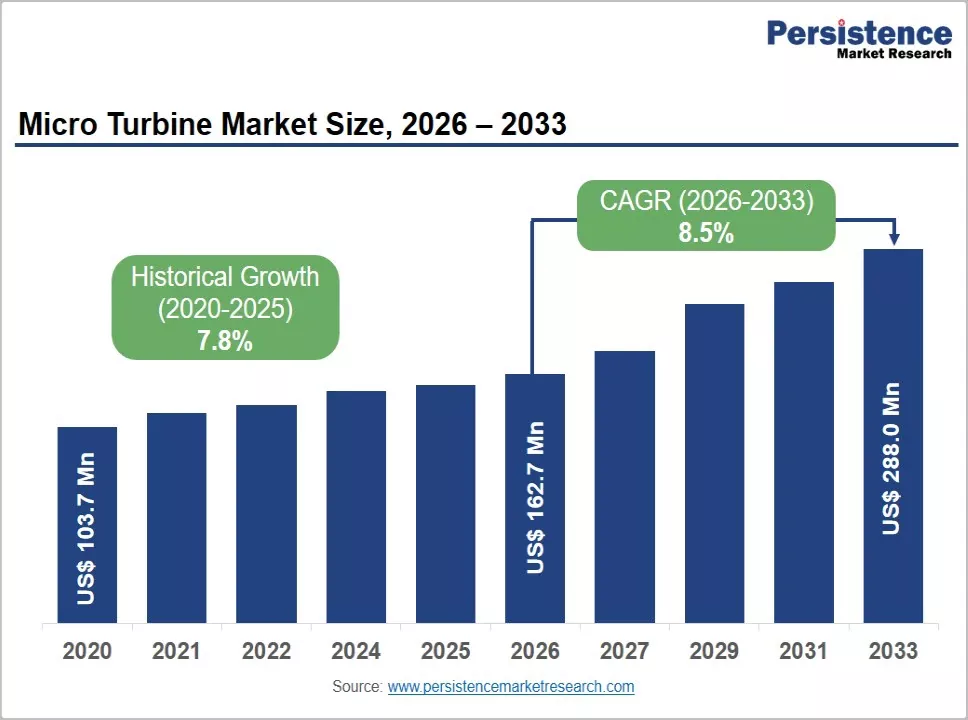
The global micro turbine market is expected to be valued at US$ 162.7 million in 2026 and is projected to reach US$ 288.0 million by 2033, growing at a CAGR of 8.5% between 2026 and 2033. Distributed power generation adoption remains the primary factor expanding microturbine deployment worldwide.
Industrial facilities increasingly install microturbines to secure reliable, low-emission backup power. Rising natural gas availability and falling equipment costs support wider commercial uptake. The International Energy Agency reports steadily growing distributed generation capacity across major economies. Combined heat and power applications further reinforce demand as facilities pursue operational efficiency gains.
Key Industry Highlights
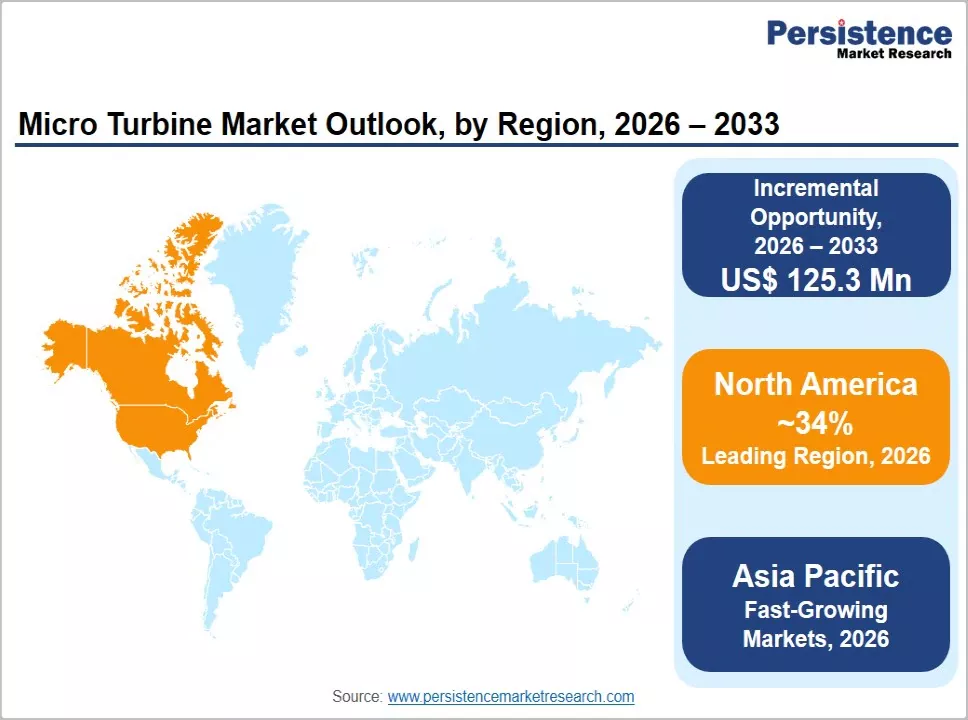
- Leading Region: North America is likely to lead the global market with around 34% share in 2026, supported by extensive natural gas pipeline infrastructure, mature distributed generation incentive programs, and strong commercial backup power adoption.
- Fastest-Growing Region: Asia Pacific represents the fastest-growing market, expanding at a CAGR of 11.8% from 2026 to 2033, driven by expanding industrial power demand, frequent grid curtailment episodes, and rising government support.
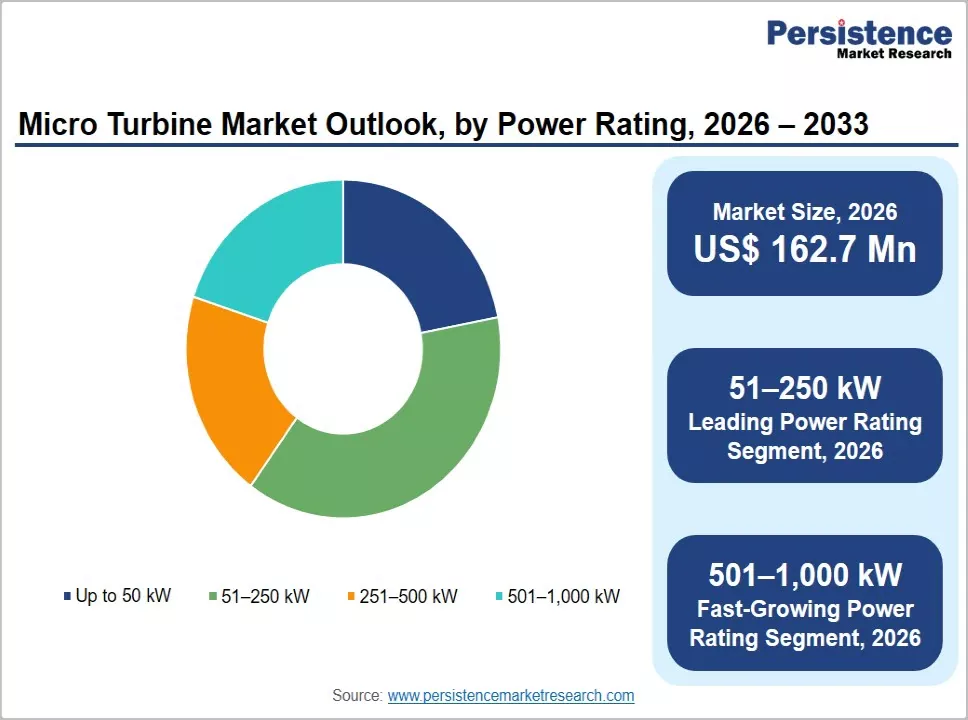
- Dominant Segment: 51–250 kW is the leading power rating segment, holding around 38% market share in 2026, supported by strong commercial and light industrial adoption across facilities requiring balanced output and footprint.
- Fastest-Growing Segment: Hydrogen & hydrogen blends represent the fastest-growing fuel type, driven by expanding decarbonization mandates, national blending targets, and growing utility pilot program investment.
- Key Market Opportunity: Growing demand for hydrogen-ready microturbine configurations offers manufacturers a durable, policy-linked competitive advantage as utilities and industrial operators prepare for expanding blending mandates.
Market Dynamics
Drivers - Growing Demand for Grid-Resilient Distributed Power Generation
Grid reliability concerns are encouraging facility operators to adopt on-site power generation solutions. Frequent and extended outages associated with extreme weather events are increasing demand for distributed backup power capacity. The U.S. Department of Energy has documented rising grid disturbance frequency across several regional transmission territories. Microturbines provide a compact, low-maintenance solution for continuous and standby power generation, supporting their use across commercial and industrial facilities. Fuel-flexible microturbine systems also enable facilities to switch feedstocks during localized fuel supply disruptions. Manufacturers investing in modular and scalable configurations are well positioned to address growing procurement demand for grid resilience.
Facility operators are increasingly deploying multiple microturbine units to create generation redundancy without oversizing a single asset. Insurance underwriters have also shown greater preference for facilities equipped with validated backup generation assets when assessing business interruption risks. As a result, facility engineering teams increasingly view distributed generation capacity as an integral component of resilience planning rather than a discretionary infrastructure upgrade.
Rising Adoption of Combined Heat and Power in Industrial Facilities
Industrial facilities are increasingly adopting combined heat and power (CHP) systems to lower overall energy costs and improve fuel utilization. Microturbines generate electricity and usable heat from a single fuel input, improving overall energy efficiency and supporting CHP adoption across facilities with consistent thermal requirements. The U.S. Environmental Protection Agency continues to promote CHP adoption through its efficiency partnership programs. Facilities operating continuous thermal processes can achieve fuel savings through microturbine-based cogeneration, particularly in food processing and chemical manufacturing, where constant thermal loads support stronger project economics.
Equipment suppliers offering integrated heat-recovery packages are gaining greater relevance among industrial buyers seeking higher energy utilization. Utilities in several states also provide CHP incentive rebates, further improving project economics for adopters. Facilities integrating microturbines with absorption chillers can extend fuel utilization to cooling applications during warmer operating seasons. These benefits support continued microturbine demand across process industries with year-round thermal requirements.
Restraints - High Upfront Costs Limiting Adoption
Microturbine systems involve higher upfront capital costs than conventional backup generators, creating a significant barrier for small-scale commercial applications. Smaller commercial buyers frequently defer investment despite favorable long-term operating economics. Installation, grid interconnection, and permitting expenses further increase the total cost of ownership. Facilities operating under tight capital budgets often select diesel generators instead, despite their higher fuel and emissions costs. Longer equipment financing approval timelines can also delay procurement during periods of constrained capital availability.
Manufacturers offering flexible financing and leasing arrangements are better positioned to address price-sensitive buyer segments. Vendors that bundle maintenance contracts with financing packages can further reduce perceived ownership risks for first-time buyers. Energy-as-a-service models are gradually gaining traction among commercial buyers seeking to reduce upfront capital requirements. Smaller facilities without dedicated engineering teams also face greater challenges in evaluating technical specifications, project economics, and vendor proposals, limiting adoption.
Limited Natural Gas Infrastructure Restricting Emerging Market Deployment
Uneven natural gas infrastructure remains a key constraint on microturbine deployment across emerging economies. Facilities located outside established pipeline networks face higher fuel logistics costs and greater supply uncertainty. Liquid fuel alternatives can address part of the infrastructure gap but increase operating costs and maintenance requirements. Grid-constrained regions without reliable gas access frequently favor diesel or solar-battery systems as alternative distributed power solutions. Premium pricing for fuel supply contracts in remote locations can further reduce projected operating savings from microturbine deployment.
Suppliers developing dual-fuel and liquid-fuel-compatible systems are positioned to address demand in underserved markets. Regional distributors with established liquid fuel logistics networks also benefit from existing supply capabilities and customer relationships. Facilities without pipeline access often delay electrification projects until commercially viable fuel supply arrangements are established. Remote industrial sites face additional transportation costs for liquid fuel delivery, further widening the cost differential between microturbines and alternative power systems.
Opportunities - Increasing Demand for Hydrogen-Ready Microturbine Systems
Utilities and industrial operators are increasingly seeking power generation equipment compatible with emerging hydrogen blending requirements. Manufacturers offering validated hydrogen-blend combustion systems can secure long-term supply opportunities as gas networks transition toward lower-carbon fuels. Several European national hydrogen strategies now target hydrogen blending in existing gas networks by 2030. Demonstrated hydrogen-blend combustion performance can support early utility partnerships and equipment qualification. Pilot deployments across European industrial parks are also validating higher blend ratios and providing operational data for commercial applications.
Companies investing in flexible-fuel and hydrogen-compatible technologies are positioned to address evolving fuel requirements as blending initiatives expand. Utility procurement standards increasingly reference hydrogen-blend readiness as a qualification criterion for new equipment. Manufacturers collaborating with gas network operators on blending trials can also gain technical data and field experience that support broader commercial deployment.
Growing Adoption of Waste Gas and Flare Gas Recovery Systems
Oil and gas operators face increasing regulatory pressure to reduce routine flaring and improve the utilization of associated gas. Microturbines configured for associated gas and flare gas recovery convert previously wasted gas into usable onsite power, creating an additional value stream while reducing fuel waste. Regulatory bodies across several producing nations have introduced flaring reduction targets linked to emissions reporting requirements. Operators adopting flare gas recovery systems can reduce onsite power costs while supporting compliance with emissions reduction requirements. Upstream operators in shale-producing basins have reported reductions in flaring volumes following equipment installation, supporting the potential for broader adoption.
Manufacturers offering dedicated flare-gas-compatible microturbine systems are positioned to address demand from upstream energy operations. Vendors providing turnkey flare-capture and power-generation solutions can further differentiate by reducing project implementation timelines. Operators facing near-term compliance deadlines increasingly prioritize suppliers capable of rapid deployment and reliable operational performance, creating opportunities for specialized microturbine providers.
Category-wise Analysis
Power Rating Insights
The 51–250 kW segment is expected to lead the micro turbine market with around 38% share in 2026. This mid-power range aligns with the typical electricity requirements of commercial and light industrial facilities, supporting broad application across these end users. Facility operators favor this range because it balances power output, installation footprint, and capital expenditure. Equipment suppliers have also concentrated engineering and production capabilities around the mid-power range due to its broad application base and standardized system configurations. Higher production volumes and standardized component sourcing further support shorter lead times for mid-range units.
The 501–1,000 kW segment is projected to expand at the fastest rate during the forecast period, supported by increasing adoption across energy-intensive industrial facilities and large commercial sites seeking higher-capacity onsite power generation. This power range provides sufficient output for facilities with substantial and relatively consistent electricity demand, including manufacturing plants, processing facilities, commercial complexes, and data centers. Growing emphasis on energy resilience and uninterrupted power supply is encouraging larger facilities to invest in onsite generation capacity that reduces dependence on grid electricity during outages or periods of supply constraints.
Fuel Type Insights
Natural gas represents the leading fuel type segment, accounting for around 46% of the market share in 2026. Extensive pipeline infrastructure across developed economies supports reliable fuel availability and predictable operating costs. Established emissions performance and extensive operating experience further reinforce natural gas as a widely adopted fuel for new microturbine installations. Utilities frequently provide favorable interconnection conditions for natural-gas-fired distributed generation assets, supporting project development. Long-term fuel supply contracts also provide greater cost predictability, reinforcing natural gas adoption in continuous-duty applications.
Hydrogen and hydrogen blends represent the fastest-growing fuel type segment, supported by expanding decarbonization policies, hydrogen blending initiatives, and investment in hydrogen-compatible distributed power technologies. Utilities and industrial operators are increasingly evaluating hydrogen as a lower-carbon fuel option for distributed generation, particularly in regions developing hydrogen infrastructure and blending targets. Microturbines offer fuel flexibility that enables selected systems to operate with hydrogen-natural gas blends, supporting their integration into evolving energy systems without requiring an immediate transition away from existing gas infrastructure.
Technology Insights
Recuperated microturbines represent the leading technology segment, holding around 61% share of the market in 2026. Recuperation technology improves fuel-to-electricity conversion efficiency by recovering heat from the turbine exhaust and using it to preheat incoming combustion air. This efficiency advantage supports adoption in facilities where fuel consumption and operating costs are key considerations. Facilities with continuous-duty requirements frequently select recuperated configurations to improve power generation efficiency. Higher electrical efficiency across comparable output ranges also strengthens the value proposition of recuperated systems. The resulting fuel savings can help offset the higher initial equipment cost over several years of continuous operation.
Combined Heat and Power Insights
Distributed power generation represents the leading segment, accounting for nearly 33% market share in 2026. Manufacturing and processing facilities increasingly deploy microturbines for continuous onsite electricity generation, particularly where grid reliability and power cost management are important considerations. Grid reliability concerns and demand charge management further support investment in distributed generation systems. Facility operators increasingly identify demand charge reduction as a key economic benefit of onsite power generation. Manufacturing facilities operating multiple shifts are particularly suited to distributed generation because consistent baseline electricity demand improves asset utilization.
End-User Insights
The commercial segment is expected to dominate the market with about 52% share in 2026. Office complexes, hospitals, and data centers increasingly deploy microturbines for resilient, low-emission onsite and backup power generation. Facility managers value the lower maintenance requirements of microturbines compared with reciprocating engine systems, supporting their adoption in commercial facilities. Healthcare facilities, in particular, prioritize reliable power availability and quality due to the critical nature of medical equipment and operations. Commercial property owners also increasingly consider emissions reporting capabilities when selecting onsite generation technologies, supporting demand for lower-emission microturbine systems that align with corporate sustainability reporting requirements.
Regional Analysis
North America Micro Turbine Market Size and Trend Analysis
North America is expected to dominate the global micro turbine market with around 34% share in 2026, supported by extensive natural gas infrastructure, mature distributed generation programs, and established demand for resilient onsite power. Utility incentive programs across the region continue to support onsite generation adoption among commercial and industrial facilities. Data center operators increasingly specify microturbines for resilient backup power due to rising concerns over grid reliability and power availability.
Expanding data center construction across several states further reinforces demand for reliable and scalable onsite generation capacity. Growing adoption of combined heat and power systems across industrial facilities also supports regional demand, particularly where continuous electricity and thermal loads improve microturbine utilization.
U.S. Micro Turbine Market Size
The U.S. accounts for 72% of the North American micro turbine market revenue, supported by extensive natural gas pipeline infrastructure, established distributed generation programs, and a large commercial and industrial customer base. Data center and healthcare facility operators increasingly specify microturbines for resilient backup and onsite power due to the need for reliable electricity supply.
The Department of Energy continues supporting distributed generation research through dedicated energy efficiency programs, supporting technology development and deployment. Industrial facilities across the country are also expanding combined heat and power adoption to improve fuel utilization and manage energy costs. Growth is expected to continue as CHP deployment expands across manufacturing and other energy-intensive industries nationwide.
Europe Micro Turbine Market Size and Trend Analysis
Europe is projected to hold about 27% share of the micro turbine market in 2026, supported by strong decarbonization policies, industrial energy-efficiency initiatives, and expanding hydrogen blending programs. Industrial operators across the region are increasingly adopting microturbines to reduce emissions while maintaining reliable onsite power generation. National hydrogen strategies across several member states continue to support investment in flexible-fuel and hydrogen-compatible equipment.
Regulatory pressure related to industrial emissions reporting is also encouraging manufacturing facilities to evaluate lower-emission onsite generation technologies. Growing integration of renewable and low-carbon gases further creates opportunities for microturbines capable of operating with diversified fuel sources.
Germany Micro Turbine Market Size
Germany accounts for about 24% of the European micro turbine market revenue, supported by strong industrial energy-efficiency programs, a large manufacturing base, and an ambitious national hydrogen strategy. Manufacturing facilities increasingly adopt combined heat and power systems to reduce energy costs and improve fuel utilization. Germany's chemical and automotive manufacturing industries provide a substantial application base for cogeneration equipment due to their consistent electricity and thermal energy requirements.
Germany's Federal Ministry for Economic Affairs continues supporting industrial decarbonization through dedicated funding programs, encouraging investment in energy-efficient technologies. Growth is expected to strengthen as hydrogen infrastructure and hydrogen-compatible distributed generation capabilities expand nationwide through 2033.
U.K. Micro Turbine Market Size
The U.K. is anticipated to hold a significant share of the European micro turbine market in 2026, supported by distributed generation investment, energy infrastructure development, and growing interest in lower-emission onsite power. Expanding offshore energy infrastructure and flare gas recovery initiatives support demand for microturbine applications within the energy sector. Government support for distributed generation and emissions reduction continues to reinforce market adoption across commercial and industrial facilities.
The Department for Energy Security and Net Zero continues supporting emissions reduction through dedicated grant programs, supporting investment in cleaner energy technologies. Growth is expected to continue as flare gas recovery and distributed generation applications expand through 2033.
France Micro Turbine Market Size
France is expected to hold a considerable share of the European micro turbine market in 2026, supported by industrial cogeneration adoption, energy-efficiency initiatives, and expanding renewable gas integration. Government investment in low-carbon industrial infrastructure further supports market development and technology adoption. Food processing and chemical clusters across several French industrial regions continue to adopt cogeneration equipment due to their steady electricity and thermal energy requirements.
France's national low-carbon strategy supports industrial energy-efficiency investment and emissions reduction initiatives nationwide. Growth is expected to continue as renewable natural gas integration and microturbine-compatible applications expand through 2033.
Asia Pacific Micro Turbine Market Size and Trend Analysis
Asia Pacific represents the fastest-growing market, supported by expanding industrial power infrastructure, rising electricity demand, and grid reliability initiatives. Government support for distributed generation and energy infrastructure development continues to reinforce regional demand. Manufacturing expansion across Southeast Asian industrial corridors is broadening the addressable installation base for onsite power generation systems. The region's diverse industrial landscape also creates opportunities for suppliers offering modular systems adapted to different facility sizes and fuel availability.
Companies seeking to expand across Asia Pacific can benefit from partnerships with established regional power equipment distributors due to the fragmented nature of industrial markets across the region. China's National Energy Administration continues supporting distributed generation deployment through dedicated infrastructure programs, further supporting regional market development.
India Micro Turbine Market Size
India accounts for 19% of the Asia Pacific micro turbine market revenue, supported by expanding industrial power demand, grid reliability concerns, and growing interest in onsite generation. Rising electricity requirements across manufacturing facilities are increasing demand for reliable captive and distributed power solutions. Government support for distributed generation further supports investment in onsite power equipment. Frequent industrial grid curtailment episodes across several states continue to reinforce captive power investment, particularly among facilities with continuous production requirements. India's Ministry of Power continues reporting growth in industrial captive power adoption, supporting the development of the country's distributed generation market.
Japan Micro Turbine Market Size
Japan is projected to hold a substantial share of the Asia Pacific micro turbine market in 2026, supported by its mature industrial base, energy security priorities, and established focus on energy efficiency. Industrial and commercial facilities continue to evaluate distributed generation systems to strengthen power resilience and improve energy utilization. Manufacturers maintain extensive research into hydrogen-compatible combustion technologies, supporting the development of lower-carbon microturbine applications. Japan's Ministry of Economy, Trade and Industry continues reporting distributed generation investment, supporting the country's transition toward diversified and resilient energy systems.
Competitive Landscape
The global micro turbine market is highly competitive, with established equipment manufacturers differentiating primarily through fuel flexibility, energy efficiency, system reliability, and long-term service capabilities. The market remains moderately consolidated among leading global manufacturers, while specialized companies maintain strong positions in niche applications and regional markets. Hydrogen-blend compatibility has emerged as a key strategic focus, with manufacturers increasingly validating combustion systems to support future fuel flexibility requirements and low-carbon power applications.
New entrants without proprietary recuperation technologies, established manufacturing capabilities, and comprehensive service networks face significant barriers to securing large industrial contracts. Vertical integration of long-term maintenance, remote monitoring, and technical support services has become an important competitive differentiator as suppliers seek to strengthen customer retention and recurring revenue.
Emerging shifts toward performance- and outcome-based service contracts are also reshaping supplier business models by linking service revenues more closely to system availability, efficiency, and operational performance. Regional distributors with established relationships across flare-gas recovery and upstream energy applications continue to defend specialized market positions against larger global competitors.
Key Industry Developments
- In August 2026, the Council of Scientific and Industrial Research-National Aerospace Laboratories (CSIR-NAL) unveiled three indigenous micro and small gas turbine engines designed to meet critical defense technology requirements for tactical UAVs and missiles.
- In July 2026, Nabhdrishti Aerospace announced its development of fuel-flexible small gas turbines and microturbines using a shared core design to power drones, aircraft, and decentralized industrial applications.
- In July 2026, Capstone Energy+ highlighted its lubricant-free, air-bearing microturbines as a clean, quiet, and reliable behind-the-meter energy solution designed to help facility managers overcome increasing utility grid capacity constraints.
Companies Covered in Micro Turbine Market
- Capstone Green Energy
- Ansaldo Energia S.p.A.
- Aurelia Turbines Oy
- FlexEnergy Solutions, Inc.
- Bladon Technologies Limited
- Brayton Energy, LLC
- ICR Turbine Engine Corporation
- Micro Turbine Technology B.V. (MTT)
- Calnetix Technologies, LLC
- Turbotech Precision Engineering Pvt. Ltd.
- Toyota Turbine and Systems
- Eneftech Innovation SA
- Bowman Power Group
- Advanced Microturbines Srl
- UAV Turbine, Inc.
- Ener-Core Inc.
- Kawasaki Heavy Industries Ltd.
Frequently Asked Questions
The global micro turbine market is expected to be valued at US$ 162.7 million in 2026.
Rising demand for resilient distributed power generation remains the primary driver, supported by growing combined heat and power adoption across industrial facilities.
North America is likely to lead the micro turbine market with around 34% share in 2026, supported by extensive natural gas infrastructure.
Growing demand for hydrogen-ready microturbine configurations offers manufacturers a significant opportunity.
Key players in the market include Capstone Green Energy, Ansaldo Energia S.p.A., Aurelia Turbines Oy, FlexEnergy Solutions, and Micro Turbine Technology B.V. (MTT).


