




- Power Generation, Transmission, & Distribution
- Dynamic Line Rating Market
Dynamic Line Rating Market Size, Share, and Growth Forecast 2026 - 2033
Dynamic Line Rating Market by Component (Hardware, Software, Services), Measurement Technology (Weather-based Rating, Conductor Temperature Monitoring, Sag Monitoring, Tension Monitoring, Line Current Monitoring), Application (Transmission Lines, Distribution Lines), End-User (Utilities, Renewable Energy Developers, Industrial Users, Commercial Users), and Regional Analysis, 2026-2033

Dynamic Line Rating Market Size and Trends Analysis
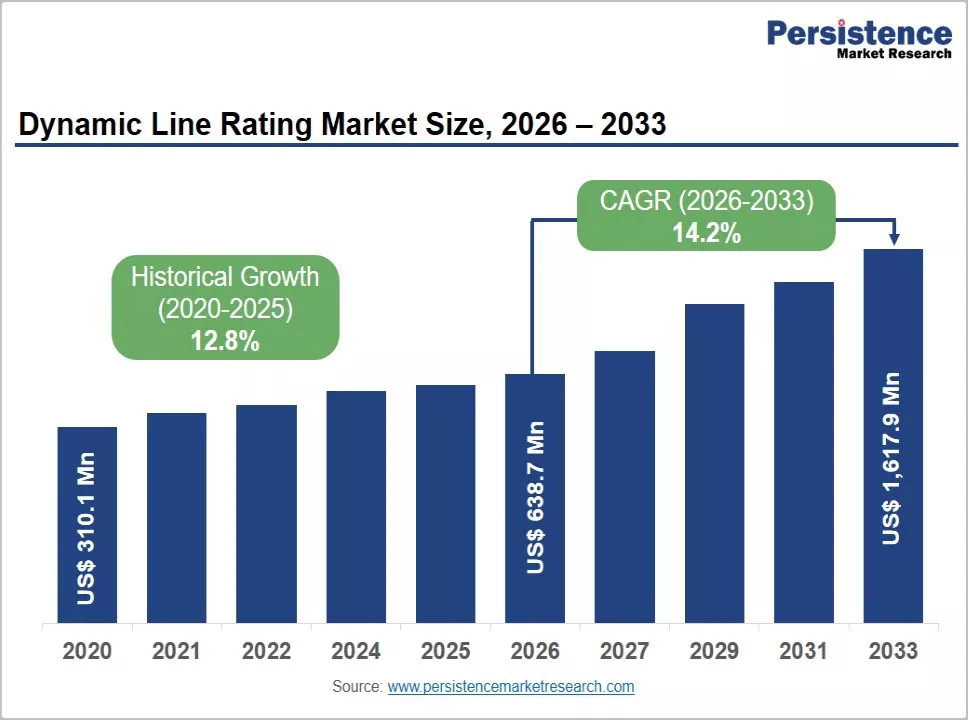
The global dynamic line rating market size is expected to be valued at US$638.7 million in 2026 and reach US$1,617.9 million by 2033, expanding at a CAGR of 14.2% during the forecast period from 2026 to 2033, driven by rising renewable energy integration, which is increasing the need for real-time monitoring of transmission line capacity.
Utilities are also seeking to maximize existing grid infrastructure instead of relying only on costly new transmission construction. Dynamic line rating systems help operators improve line utilization based on changing weather and operating conditions. Expanding grid modernization programs across North America, Europe, and Asia Pacific are further supporting adoption. Rising electricity demand and the need for flexible transmission capacity are expected to sustain market growth through 2033.
Key Industry Highlights:
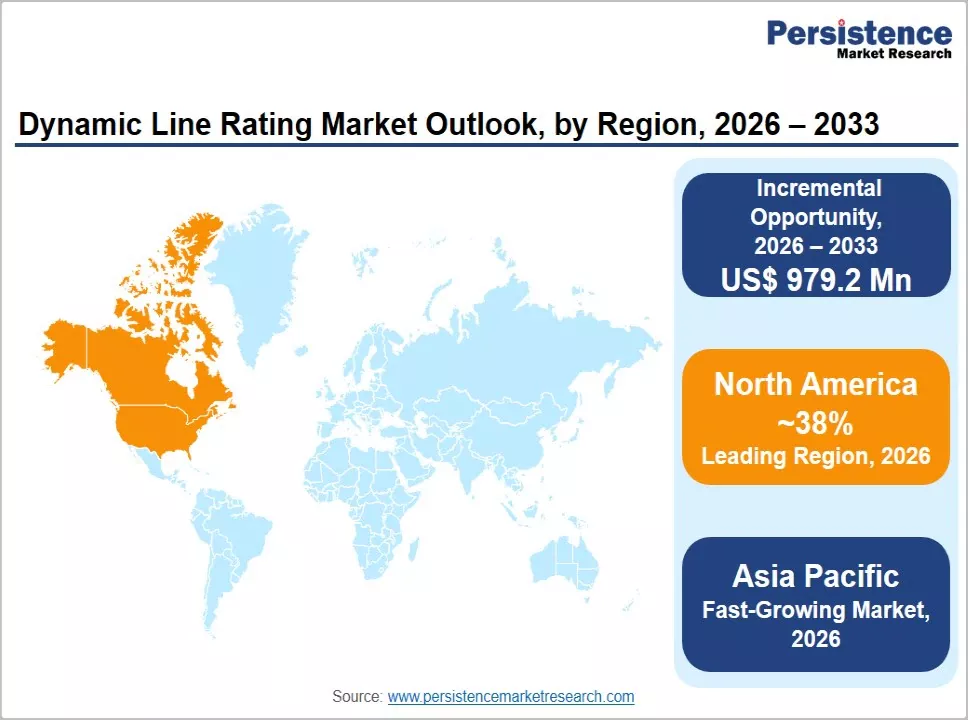
- Leading Region: North America is expected to lead with a 38% share in 2026, driven by extensive transmission infrastructure and rising renewable energy interconnection needs across the region.
- Fastest-Growing Region: Asia Pacific is likely to be the fastest-growing region through 2033, supported by rapid renewable energy expansion and rising grid modernization investment across China and India.
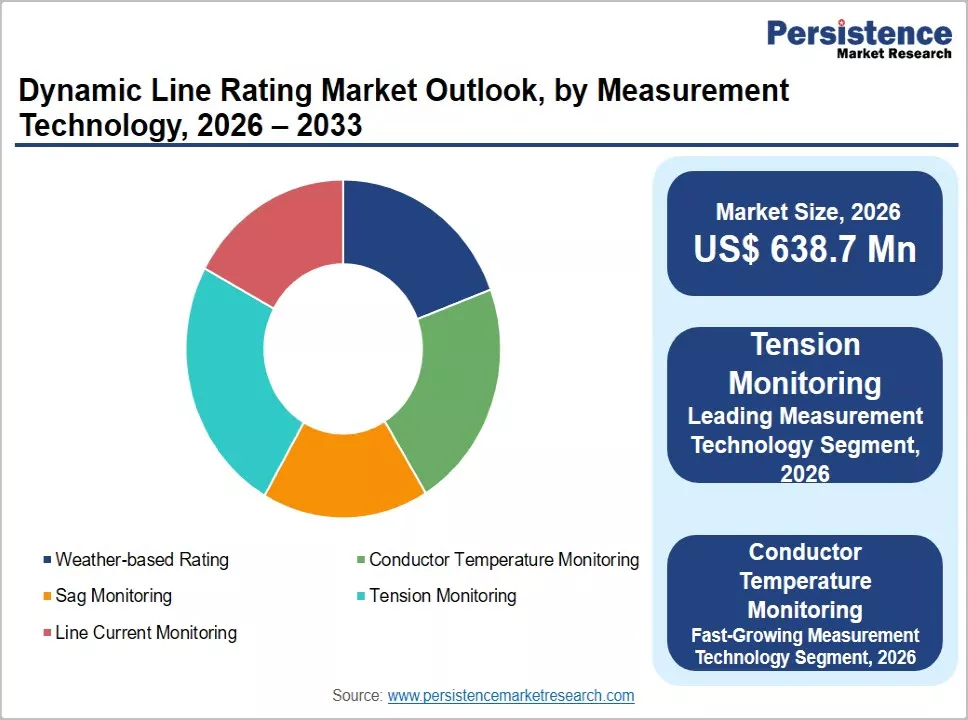
- Dominant Measurement Technology: Tension monitoring is expected to dominate measurement technology with a 32% share in 2026, favored for reliable, direct indication of conductor sag and thermal condition.
- Fastest-Growing Measurement Technology: Conductor temperature monitoring is likely to be the fastest-growing measurement technology, driven by advances in fiber optic and direct sensing accuracy.
- Key Market Opportunity: Expanding grid modernization and smart grid investment programs offer technology providers a clear opportunity to integrate dynamic rating into broader digitalization projects.
Market Dynamics
Drivers - Rising Renewable Energy Integration into Transmission Grid Networks
Growing additions of wind and solar power are creating variable and weather-dependent power flows across transmission networks. Static line ratings may not capture the higher capacity available under favorable weather conditions. Dynamic line rating systems use real-time conditions to determine safe transmission capacity. This can help grid operators move more renewable electricity through existing transmission corridors and reduce renewable energy curtailment. The need is increasing as renewable generation takes a larger share of power supply.
Grid operators connecting large wind farms and solar projects are adopting dynamic rating systems to manage bottlenecks during high-generation periods. Renewable energy developers also seek faster grid connections without waiting for new transmission construction. Dynamic rating can improve the use of existing lines during suitable operating conditions. As renewable capacity continues expanding worldwide, the need to manage variable power flows and improve transmission utilization is expected to remain a major driver of market growth.
Need to Defer Costly Transmission Infrastructure Upgrades
Utilities face growing pressure to meet rising electricity demand while controlling spending on new transmission infrastructure. Building new lines often requires high capital investment, lengthy permitting, and complex project planning. Dynamic line rating technology can allow existing conductors to carry more power when weather and operating conditions support higher capacity. This can help utilities improve transmission use without immediately adding new infrastructure.
Regulators and grid operators are giving greater attention to technologies that can improve network efficiency at lower capital costs. Utilities facing congested transmission corridors and long construction timelines can use dynamic rating as an alternative or interim solution. The technology can also provide faster capacity improvements than major line upgrades. As electricity demand and grid congestion increase, utilities are expected to assess dynamic rating more often as part of transmission planning. This trend can support wider deployment across existing power networks.
Restraints - High Initial Investment in Sensors and Monitoring Infrastructure
Dynamic line rating deployment requires upfront spending on sensors, communication networks, data platforms, and monitoring software. These costs can limit adoption among smaller utilities, cooperatives, and grid operators with restricted modernization budgets. The financial challenge is greater in regions where transmission assets are widely distributed or utility ownership is fragmented. High installation costs can therefore slow deployment, even when the technology can improve network capacity and efficiency.
Installing monitoring equipment on existing transmission lines also requires specialized systems and coordination with ongoing grid operations. Utilities may need additional communication infrastructure to collect and transmit real-time data from remote assets. Integrating these systems with existing control platforms can add software and engineering costs. These expenses increase the total project investment and may extend deployment timelines. As a result, some utilities are delaying large-scale adoption until equipment costs, integration expenses, and project risks become easier to manage.
Integration Complexity with Legacy Grid Management Systems
Many utilities still operate grid management systems that were designed before real-time dynamic rating data became widely available. These systems may require upgrades to process sensor data, weather inputs, and changing transmission capacity information. Integrating new monitoring platforms with older supervisory control systems can require custom software and engineering work. This increases project complexity and may extend implementation timelines.
Utilities with fragmented data systems often face additional challenges when connecting dynamic line rating platforms across multiple transmission assets and control centers. Differences between vendor technologies can also make data exchange more difficult. Limited standardization in communication protocols may require additional integration work and testing before systems can operate reliably. These challenges can increase project costs and operational risk. Without stronger interoperability and simpler integration methods, utilities with aging infrastructure may continue to delay dynamic line rating deployment, limiting adoption across some transmission networks.
Opportunities - Expansion of Grid Modernization and Smart Grid Investment
Growing investment in smart grid modernization is creating opportunities for dynamic line rating technology providers. Utilities are upgrading aging transmission infrastructure with digital monitoring, automated control, and real-time data systems. Dynamic line rating can fit within these programs by adding continuous information on line capacity and operating conditions. This makes grid modernization spending an important route for wider technology adoption.
Government funding and utility capital programs are supporting broader investment in transmission efficiency and digital grid operations. Regulatory attention toward improved network utilization can also encourage utilities to include dynamic rating in modernization plans. Providers can benefit by offering integrated sensor, communication, software, and analytics solutions rather than standalone monitoring equipment. Growing demand for data-driven grid management is expanding the addressable market for these systems. As smart grid programs increase across major power markets, dynamic line rating suppliers can align their solutions with wider transmission digitalization and efficiency initiatives.
Growing Demand for Faster Renewable Energy Grid Interconnection
The rapid development of wind and solar projects is creating larger interconnection queues for transmission networks. Grid operators must assess available capacity before connecting new renewable generation, which can delay project development when existing lines appear constrained. Dynamic line rating provides real-time information on transmission capacity and can help operators identify additional capacity under suitable operating conditions. This can support faster and more efficient grid connection decisions.
Renewable energy developers are seeking solutions that can reduce delays without waiting for major transmission upgrades. Dynamic rating can improve the use of existing corridors and provide additional capacity during favorable weather conditions. Growing investment in renewable generation is therefore creating a larger customer base for technology providers serving utilities and project developers. As interconnection queues expand across major renewable markets, demand for accurate capacity assessment is expected to increase. This creates opportunities for dynamic line rating providers offering systems that support faster grid planning and renewable integration.
Category-wise Insights
Which Component Leads the Dynamic Line Rating Market?
The hardware segment is expected to lead the component segment with a 61% share in 2026, supported by the essential role of sensors, monitoring devices, and communication equipment in collecting real-time line condition data. Utilities prioritize hardware because accurate field data provides the foundation for dynamic rating systems. Established sensor technologies and proven field reliability further support demand. Hardware is also required for new installations and upgrades across transmission and distribution networks.
Software is likely to be the fastest-growing component segment through 2033, driven by rising demand for analytics platforms that convert sensor data into useful grid capacity insights. Utilities are investing in software that can combine weather, conductor, and network data to support faster decisions. Automated alerts and capacity calculations are also improving grid operations. As utilities adopt more data-driven management systems, software deployment is expected to increase alongside existing hardware installations.
Which Measurement Technology Leads the Dynamic Line Rating Market?
Tension monitoring is expected to lead the measurement technology segment with a 32% share in 2026, supported by its ability to provide direct information on conductor sag and thermal conditions. Utilities value tension monitoring because it can deliver reliable real-time data without depending heavily on complex weather models. Proven field performance across different transmission environments further supports adoption. Its established use also gives utilities greater confidence when upgrading monitoring systems.
Conductor temperature monitoring is likely to be the fastest-growing measurement technology through 2033, supported by advances in fiber optic and direct sensing technologies. These systems provide more direct information on conductor temperature, helping utilities improve capacity calculations. Growing demand for accurate thermal data is encouraging utilities to add temperature monitoring to existing systems. As grid operators modernize monitoring infrastructure, improved sensing accuracy and better real-time data are expected to support faster adoption across transmission networks.
Which Application Leads the Dynamic Line Rating Market?
Transmission lines are expected to lead the application segment with a 72% share in 2026, reflecting the high economic value of improving capacity across high-voltage power corridors. Grid operators use dynamic rating technology on transmission networks, as even modest capacity gains can support major improvements in power transfer and network efficiency. The established use of monitoring technologies at the transmission level also supports adoption. Utilities are prioritizing these systems where congestion and renewable integration create capacity constraints.
Distribution lines are likely to be the fastest-growing application through 2033, driven by rising distributed renewable generation and electric vehicle charging infrastructure. Utilities are managing more local power flows and need better visibility across distribution networks. Dynamic rating can provide real-time information to support capacity management under changing operating conditions. Growing deployment of distributed energy resources is therefore encouraging utilities to extend dynamic rating capabilities beyond high-voltage transmission networks.
Which End-User Leads the Dynamic Line Rating Market?
Utilities are expected to lead the end-user segment with a 74% share in 2026, reflecting their central role in operating and maintaining transmission and distribution networks. Utilities adopt dynamic line rating to improve grid reliability, increase existing network capacity, defer infrastructure spending, and support efficiency targets. Their direct ownership of grid assets also gives them greater control over technology deployment. Long-term transmission planning and grid modernization programs further support their leading position.
Renewable energy developers are likely to be the fastest-growing end-user segment through 2033, driven by rising demand for faster grid interconnection and reduced renewable energy curtailment. Developers of wind and solar projects are seeking technologies that can help improve access to available transmission capacity. Growing project pipelines are increasing interest in real-time line monitoring and capacity assessment. As renewable generation expands, developers are expected to work more closely with utilities to use dynamic rating solutions for faster and more efficient grid connections.
Regional Insights
Which Region Is Leading the Dynamic Line Rating Market?
North America is anticipated to lead the dynamic line rating market with a 38% share in 2026. The region benefits from extensive transmission infrastructure, rising renewable energy integration, and growing grid congestion. Utilities are increasingly adopting real-time monitoring systems to improve transmission capacity without relying only on new infrastructure construction. Grid modernization programs and increasing investment in renewable power connections are further supporting regional demand. Growing requirements for flexible electricity transmission are also encouraging technology adoption across major utility networks. North America is expected to maintain strong demand through 2033 as utilities focus on improving existing grid utilization and managing changing power flows.
- U.S. Dynamic Line Rating Market Size
The U.S. is forecast to account for 84% of North America's dynamic line rating market in 2026, making it the region's largest national market. Extensive transmission infrastructure, rising renewable generation, and growing interconnection requirements are supporting demand for real-time line monitoring systems. Utilities are increasingly evaluating technologies that can improve transmission capacity without depending solely on new infrastructure construction. Grid modernization programs and investments in renewable integration are also creating opportunities for dynamic rating deployment. The U.S. market is expected to expand steadily as wind and solar projects increase transmission requirements and utilities seek more flexible methods to manage network capacity.
Europe Dynamic Line Rating Market Trends and Insights
Europe is likely to account for a 28% share of the global dynamic line rating market in 2026. Strong renewable energy targets, transmission congestion, and grid modernization programs are supporting adoption across the region. Utilities are using dynamic rating systems to improve the utilization of existing transmission infrastructure as wind and solar generation increases. Rising electricity flows between countries are also creating greater demand for real-time capacity monitoring and improved network management. Offshore wind development is adding further transmission requirements in several markets. Europe is expected to record steady growth through 2033 as grid operators seek flexible technologies to support renewable integration and improve transmission efficiency.
- Germany Dynamic Line Rating Market Size
Germany is expected to account for 31% of Europe's dynamic line rating market in 2026, supported by extensive wind generation, transmission network upgrades, and strong renewable integration requirements. Increasing electricity flows from northern wind-producing areas toward industrial regions are creating greater demand for efficient transmission capacity management. Utilities are evaluating dynamic rating systems to improve network utilization and reduce pressure on congested transmission corridors. Grid modernization programs and continued renewable energy deployment are further supporting adoption. Germany's market is expected to grow steadily as transmission operators seek real-time information to manage changing network conditions and accommodate additional renewable generation across the country.
- U.K. Dynamic Line Rating Market Size
The U.K. is likely to represent 23% of Europe's dynamic line rating market in 2026, supported by offshore wind expansion, transmission constraints, and increasing renewable electricity flows. Growing offshore wind capacity is creating additional requirements for efficient transmission management and faster grid connections. Utilities are adopting monitoring technologies that can provide real-time information on line conditions and available capacity. Grid investment programs are also supporting deployment across important transmission corridors. The U.K. market is expected to expand as offshore wind projects increase and network operators seek to improve existing infrastructure utilization while managing variable renewable generation and regional transmission constraints.
- France Dynamic Line Rating Market Size
France is set to account for 18% of Europe's dynamic line rating market in 2026, supported by renewable energy expansion, transmission modernization, and rising requirements for efficient network management. Increasing solar and wind generation is creating additional demand for technologies that provide real-time information on transmission capacity. Grid operators are also seeking to improve existing infrastructure utilization as electricity flows become more variable across regions. Investments in network modernization are supporting adoption of advanced monitoring systems. France's market is expected to grow steadily as renewable generation expands and transmission operators seek flexible solutions for managing capacity while supporting broader European decarbonization objectives.
Which Region Is Growing Fastest in the Dynamic Line Rating Market?
Asia Pacific is likely to be the fastest-growing region in the dynamic line rating market, accounting for a 24% share of the global market in 2026. Rapid renewable energy expansion, rising electricity demand, and growing transmission requirements are driving adoption across the region. Utilities are investing in monitoring systems to improve the use of existing transmission networks and manage changing electricity flows. Large-scale wind and solar projects are creating additional pressure on grid capacity, particularly in rapidly industrializing economies. Government investment in grid modernization is also supporting deployment. Asia Pacific is expected to maintain the fastest growth through 2033 as renewable generation and transmission infrastructure continue expanding.
- China Dynamic Line Rating Market Size
China is expected to account for 52% of Asia Pacific's dynamic line rating market in 2026, supported by its extensive transmission network and rapid expansion of wind and solar generation. Large-scale renewable projects are increasing the need for efficient transmission capacity management across major electricity corridors. Utilities are investing in grid modernization and monitoring technologies to improve network utilization and support changing power flows. Strong government focus on renewable integration is also creating favorable conditions for adoption. China's market is expected to expand rapidly as renewable capacity additions continue and grid operators seek real-time visibility into transmission conditions across the country's large and interconnected power network.
- India Dynamic Line Rating Market Size
India is likely to represent 22% of Asia Pacific's dynamic line rating market in 2026, supported by rapid renewable capacity growth, expanding transmission infrastructure, and rising electricity demand. Increasing solar and wind generation is creating greater pressure on transmission networks and strengthening the need for real-time capacity monitoring. Grid modernization programs and investments in renewable power corridors are supporting technology adoption among utilities. Dynamic rating systems can help improve transmission utilization as power flows become more variable across regions. India's market is expected to grow strongly through 2033 as renewable capacity expands and grid operators seek efficient solutions for managing congestion and improving network flexibility.
- Japan Dynamic Line Rating Market Size
Japan is expected to account for 11% of Asia Pacific's dynamic line rating market in 2026, supported by its focus on grid resilience, renewable integration, and efficient transmission management. Increasing renewable generation is creating a need for better visibility into available network capacity, particularly across constrained transmission corridors. Utilities are investing in advanced monitoring systems as part of broader grid modernization efforts. Dynamic rating technology can support more efficient use of existing infrastructure while helping operators manage changing electricity flows. Japan's market is expected to expand steadily as renewable deployment continues and grid operators seek reliable methods to improve transmission capacity and network flexibility.
Competitive Landscape
The global dynamic line rating market is moderately fragmented, with competition centered on technical differentiation, system integration, sensing accuracy, and analytics capabilities. Vendors are combining sensor hardware with proprietary software to provide real-time transmission capacity insights. Established grid technology providers benefit from utility relationships and proven deployment experience, while specialized companies compete through advanced monitoring solutions.
Leading participants are increasingly developing software-driven offerings and forming strategic partnerships with utilities to secure long-term deployment opportunities. Integration with existing grid management systems is becoming an important competitive factor as utilities modernize networks. New entrants are finding opportunities through specialized sensing technologies, analytics platforms, and flexible solutions targeting specific transmission requirements.
Key Industry Developments:
- In May 2025, LineVision, Inc. expanded deployment of its non-contact sensing technology with several North American utilities, supporting renewable energy interconnection and transmission capacity management. The expansion strengthened real-time visibility into overhead transmission lines and supported utilities seeking to improve existing network utilization.
- In September 2024, Hitachi Energy advanced its grid monitoring portfolio through continued investment in real-time transmission capacity analytics. These developments supported utilities in improving network visibility, managing changing operating conditions, and making more informed decisions regarding transmission capacity and renewable energy integration.
- In February 2024, GE Vernova strengthened its grid software offerings by enhancing dynamic line rating integration capabilities for transmission operators. The improvements supported real-time network monitoring, improved transmission capacity assessment, and more efficient management of changing electricity flows across modernized grid infrastructure.
Companies Covered in Dynamic Line Rating Market
- LineVision
- Heimdall Power
- Ampacimon
- Nexans
- Prysmian Group
- GE Vernova
- Siemens Energy
- Hitachi Energy
- ABB
- Schneider Electric
- Smart Wires
- Sentient Energy
- Southwire
- CTC Global
- Lindsey Manufacturing
Frequently Asked Questions
The global dynamic line rating market is likely to be valued at US$638.7 million in 2026, supported by rising renewable energy integration and grid capacity optimization needs worldwide.
Rising integration of renewable energy into transmission grids is the main demand driver, as utilities need real-time capacity data to manage variable power flows.
North America is expected to lead the market with a 38% share in 2026, supported by extensive transmission infrastructure and rising renewable interconnection needs.
Expanding grid modernization and smart grid investment programs is the key opportunity, as utilities increasingly include real-time monitoring in digitalization projects.
Key players include LineVision, Inc., Nexans, Hitachi Energy, GE Vernova, and Siemens Energy, competing through sensing technology and analytics integration.


