




- Metalworking & Fabrication
- Mass Finishing Consumables Market
Mass Finishing Consumables Market Size, Share, and Growth Forecast 2026 - 2033
Mass Finishing Consumables Market by Media Type (Ceramic Media, Plastic Media, Steel Media, Aluminum Oxide Media, Others), Product Type (Abrasive Media, Non-Abrasive Media, Compounds, Additives & Lubricants, Thickeners), Industry (Automotive, Aerospace, General Manufacturing, Machine Tooling, Construction, Jewelry & Accessories, Healthcare), Distribution Channel (Online, Offline), and Regional Analysis, 2026 - 2033

Mass Finishing Consumables Market Size and Trend Analysis
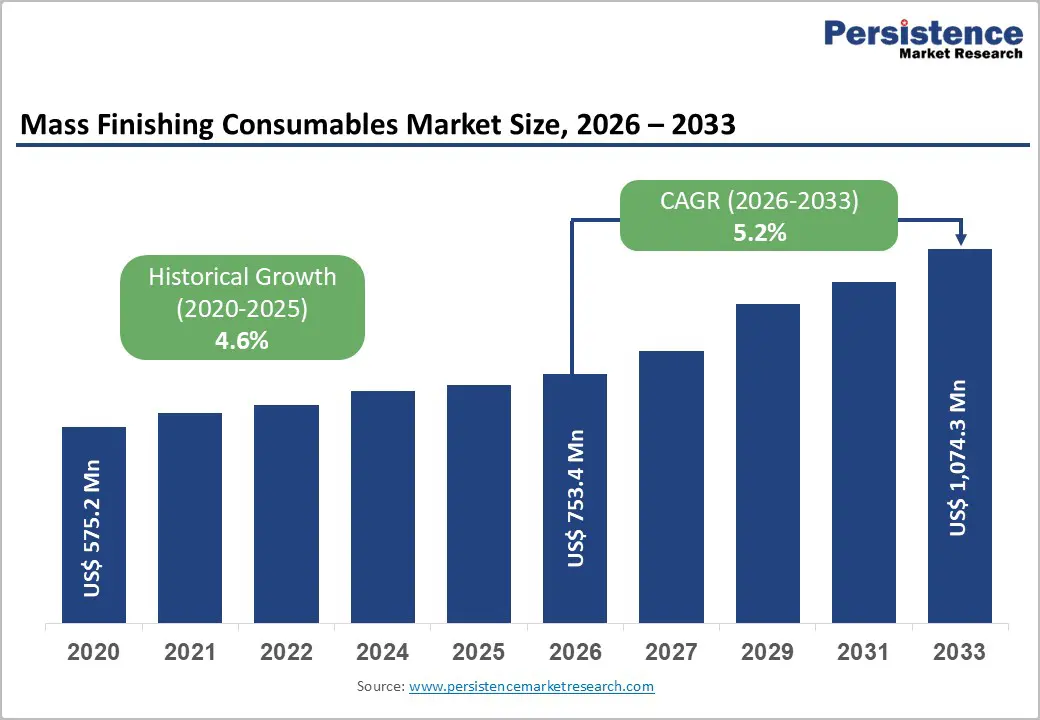
The global mass finishing consumables market size is expected to be valued at US$ 753.4 million in 2026 and projected to reach US$ 1,074.3 million by 2033, growing at a CAGR of 5.2% between 2026 and 2033.
The market is driven by rising demand for precision surface finishing in high-volume manufacturing, particularly across automotive and aerospace sectors, where flawless components are critical for safety and performance. The integration of automation in finishing processes enhances throughput, reduces operational costs, and ensures consistent quality across production batches.
Key Industry Highlights:
- Leading Region: Asia Pacific leads the market with 32% share in 2025, driven by strong manufacturing expansion in China and India.
- Fastest Growing Region: Asia Pacific emerges as the fastest-growing region, supported by rapid industrialization and rising demand across the automotive and electronics sectors.
- Leading Media Type: Ceramic Media dominates with 42% share in 2025, owing to its superior durability and precision in heavy-duty finishing applications.
- Leading Product Type: Abrasive Media leads with 38% share in 2025, driven by its high efficiency in material removal and surface finishing.
- Key Market Opportunity: Eco-friendly consumables present a major opportunity, supported by sustainability regulations and increasing adoption of low-emission finishing solutions.
Market Dynamics
Drivers - Increasing Automation Accelerates Demand for Finishing Consumables
Automation is transforming manufacturing, significantly boosting demand for reliable mass finishing consumables such as durable media and specialized compounds. Advanced vibratory and centrifugal systems enable faster processing of components, improving operational efficiency across industries. According to U.S. Bureau of Labor Statistics data, automated automotive production lines contributed to approximately 2.5% output growth in 2024, highlighting the expanding role of automation in scaling production.
This shift reduces manual intervention by nearly 40% in ISO 9001-certified facilities, while maintaining consistent product quality and precision. Consumables play a critical role in preserving part integrity during high-speed finishing processes. Additionally, stringent aerospace standards, including NASA specifications, emphasize superior surface quality, driving continuous replacement and usage of finishing media in high-performance applications.
Growing Aerospace and Automotive Output Drives Consumables Usage
Rising production levels in aerospace and automotive industries are significantly increasing the need for high-quality finishing consumables to achieve burr-free, polished components. Aircraft manufacturers such as Boeing and Airbus collectively delivered over 1,300 aircraft in 2024, requiring precise deburring and surface finishing to meet strict safety and performance standards across critical components.
Similarly, global vehicle production reached around 92 million units in 2023, as reported by OICA, intensifying demand for consumables in engine parts and electric vehicle components. Lightweight, corrosion-resistant finishes enhance durability and efficiency, but also increase consumable usage in high-throughput operations. This growing production volume ensures sustained demand for finishing media, compounds, and additives across manufacturing ecosystems.
Restraints - Raw Material Price Volatility Impacts Production Stability
Fluctuations in raw material prices, particularly ceramics and steel, create significant challenges for mass finishing consumables manufacturers by disrupting cost structures and pricing consistency. According to World Bank indices, steel prices rose by nearly 15% in 2024 due to geopolitical tensions and supply chain disruptions, leading to a 10–20% increase in production costs for consumable manufacturers.
This cost pressure compresses profit margins, especially for small and mid-sized players with limited procurement flexibility. Inconsistent pricing also leads to supply chain uncertainties, creating delays in consumable availability. Such disruptions directly affect finishing operations in industries like automotive, where strict production timelines depend on consistent supply of media and compounds.
Stringent Environmental Regulations Increase Operational Burden
Strict environmental compliance requirements are posing challenges for manufacturers by increasing operational complexity and costs associated with mass finishing consumables. Regulations such as the EU REACH framework mandate the use of safer chemical compounds, with non-compliance penalties exceeding €1 million in 2024, emphasizing the importance of regulatory adherence across production processes.
Additionally, wastewater treatment requirements significantly raise operational expenses, with Environmental Protection Agency guidelines indicating up to a 25% increase in processing costs. These added financial and procedural burdens discourage adoption, particularly in highly regulated regions. As a result, companies must invest in sustainable formulations and advanced treatment systems, impacting profitability and slowing market expansion.
Opportunities- Sustainable Consumables Innovation Unlocks New Growth Potential
Advancements in eco-friendly consumables are creating strong growth opportunities as industries increasingly prioritize sustainability in manufacturing processes. Innovations aligned with ASTM green standards have enabled the development of biodegradable plastic media that can reduce waste generation by up to 50%, supporting environmentally responsible finishing operations across industries.
Government initiatives such as the U.S. Inflation Reduction Act, which allocates $369 billion toward clean technologies, are accelerating the adoption of low-VOC and sustainable compounds. Additionally, research from institutions like Fraunhofer highlights up to 30% efficiency improvements in advanced steel media, attracting automotive manufacturers aiming to align with green production goals while maintaining high performance.
Emerging Manufacturing Economies Drive Consumables Demand Growth
Rapid industrialization in emerging markets, particularly in Asia Pacific, is significantly boosting demand for cost-effective and versatile mass finishing consumables. Initiatives such as India’s “Make in India” program have increased manufacturing contribution to approximately 17% of GDP by 2025, driving the need for efficient finishing solutions like ceramic media across diverse industries.
Furthermore, the Asian Development Bank projects ASEAN manufacturing output to grow at a CAGR of around 5.5% through 2030, supported by expanding electronics and industrial sectors. This growth is creating strong demand for adaptable consumables capable of handling varied applications, positioning emerging economies as key growth hubs for the market.
Category-wise Analysis
Media Type Insights
Ceramic media dominates the media type segment, accounting for 42% share in 2025 due to its superior toughness and efficiency in heavy-duty finishing applications. Widely used across automotive and aerospace industries, it delivers nearly 20% faster cutting performance as per SAE standards. Its durability reduces replacement frequency by around 35%, while U.S. commerce insights highlight its strong role in achieving precision-driven surface finishing.
Plastic media is emerging as the fastest-growing segment, driven by its suitability for delicate components requiring minimal surface damage. Its lightweight structure and flexibility make it ideal for precision applications in electronics and medical devices, where controlled finishing and surface integrity are critical, supporting broader adoption across high-precision industries.
Product Type Insights
Abrasive media leads the product type segment with a 38% share in 2025, driven by its effectiveness in material removal and surface refinement aligned with ISO 4287 standards. It plays a crucial role in improving manufacturing efficiency, with UNIDO linking its use to nearly 15% output gains. Its application is particularly vital in producing high-performance components such as turbine blades.
Compounds are the fastest-growing category, supported by rising demand for enhanced finishing quality and process optimization. They improve cleaning, lubrication, and surface smoothness during finishing operations, making them increasingly essential in advanced manufacturing setups focused on consistency, efficiency, and superior surface outcomes.
Industry Insights
The automotive sector dominates the Industry segment, holding a 35% share in 2025 due to stringent safety and performance requirements. Regulatory standards such as those from NHTSA emphasize defect-free components, while global vehicle production reaching 93 million units drives large-scale demand for finishing consumables, particularly for corrosion-resistant and precision-engineered parts in both conventional and electric vehicles.
Healthcare is emerging as the fastest-growing end-use segment, driven by increasing demand for precision-finished medical devices and implants. The need for smooth, contamination-free surfaces in surgical instruments and components is accelerating adoption of specialized finishing consumables, supporting growth in high-precision and regulated manufacturing environments.
Distribution Channel Insights
Offline channels dominate the distribution landscape with a 65% share in 2025, supported by strong B2B networks and direct supplier relationships. Platforms like ThomasNet indicate that nearly 80% of bulk industrial transactions occur offline, as industries such as aerospace and automotive prioritize product demonstrations, technical validation, and long-term procurement agreements.
Online distribution is the fastest-growing segment, driven by increasing digitalization of procurement processes. Manufacturers are adopting e-commerce platforms for convenience, wider product access, and faster purchasing cycles, particularly benefiting small and medium enterprises seeking cost efficiency and streamlined sourcing solutions.
Regional Insights
North America Mass Finishing Consumables Market Trends and Insights
North America accounts for around 28% share in 2025, driven by strong aerospace and automotive sectors. The U.S. dominates regional demand due to strict standards from NASA and FAA requiring high-quality surface finishing. Adoption of IoT-enabled monitoring systems is improving operational efficiency, while sustainability initiatives supported by NIST are reducing waste and enhancing process optimization across advanced manufacturing facilities.
- U.S. Mass Finishing Consumables Market Size
The U.S. market is projected to grow at US$ 220 million in 2026, registering a CAGR of 5%. Growth is supported by advanced industrial infrastructure and rising automation across production lines. Aerospace and defense sectors continue to demand precision finishing, while EV manufacturing further boosts consumables usage. Increasing focus on quality standards ensures steady replacement demand for media and compounds. Strong R&D investments also enhance product innovation.
Europe Mass Finishing Consumables Market Trends and Insights
Europe is a technology-driven market, expected to grow at a CAGR of 5.5% through 2033. The region benefits from strong adoption of Industry 4.0, particularly in Germany, along with robust automotive and aerospace sectors. Environmental regulations such as EU RoHS are pushing adoption of eco-friendly consumables, while advanced engineering capabilities support demand for high-precision finishing solutions across industries.
- Germany Mass Finishing Consumables Market Size
Germany’s market is expected to increase to US$ 130 million by 2033. The country leads due to strong industrial automation and engineering expertise. Industry 4.0 adoption is enhancing efficiency in finishing processes. Automotive and machinery sectors remain key demand drivers. Export-oriented manufacturing further supports consumable demand. Continuous innovation strengthens its leadership in Europe.
- U.K. Mass Finishing Consumables Market Size
The U.K. market is valued at US$ 55 million in 2026. Growth is driven by aerospace and automotive production. Increasing investments in advanced manufacturing technologies are boosting efficiency. Demand for precision components is rising across industries. Sustainable finishing solutions are gaining traction. Strong industrial base supports steady market expansion.
- France Mass Finishing Consumables Market Size
France is forecast to expand from US$ 45 million in 2026 to US$ 65 million by 2033. Aerospace and luxury goods sectors are key growth drivers. High emphasis on product quality supports finishing demand. Automotive manufacturing also contributes to market growth. Adoption of eco-friendly consumables is increasing steadily. Government support for industrial innovation further strengthens the market
Asia Pacific Mass Finishing Consumables Market Trends and Insights
Asia Pacific leads the market with 32% share in 2025 and is the fastest-growing region. Growth is driven by large-scale manufacturing in China and India, supported by cost advantages and industrial policies. Government initiatives and infrastructure expansion are boosting production capacity, while electronics and automotive industries are increasing demand for efficient and versatile finishing consumables.
- China Mass Finishing Consumables Market Size
China’s market is projected to grow at a CAGR of 6%. The country dominates due to its massive manufacturing base. Government policies like the 14th Five-Year Plan support industrial expansion. Automotive and electronics sectors drive demand. High production volumes increase consumable usage. Continuous capacity expansion strengthens growth outlook.
- India Mass Finishing Consumables Market Size
India is expected to grow from US$ 70 million in 2026 driven by initiatives like Make in India. Expanding automotive and engineering sectors boost demand. Rising industrialization increases adoption of finishing solutions. Cost advantages attract manufacturing investments. Infrastructure development further supports market expansion.
- Japan Mass Finishing Consumables Market Size
Japan’s market is projected to expand to US$ 115 million by 2033. The country is known for precision manufacturing. High demand for quality components drives consumable usage. Automotive and electronics sectors remain key contributors. Advanced technologies enhance finishing efficiency. Stable industrial base ensures consistent market demand.
Competitive Landscape
The competitive landscape of the mass finishing consumables market is moderately consolidated, with key players focusing on strengthening their positions through continuous innovation, product development, and strategic integration across the value chain. Companies are increasingly investing in research and development to enhance product durability, efficiency, and environmental compliance, aligning with evolving industry requirements for high-performance and sustainable finishing solutions.
Additionally, the adoption of advanced technologies such as digital twins is transforming operational strategies by enabling predictive maintenance and process optimization. These technologies help manufacturers improve equipment performance, reduce downtime, and ensure consistent finishing quality. Sustainability initiatives and smart manufacturing practices are further shaping competition, pushing companies to differentiate through innovation and efficiency.
Key Developments:
- In March 2025, Rosler Group introduced EU Green Deal-compliant ceramic media, focusing on sustainable finishing solutions. The launch supports reduced environmental impact while maintaining high performance, aligning with stricter European regulations and growing demand for eco-friendly industrial consumables.
- In July 2024, Almco expanded its U.S. operations by establishing a new steel media manufacturing plant dedicated to automotive applications. This move strengthens domestic supply capabilities and supports rising demand for durable, high-efficiency finishing solutions in vehicle production.
- In November 2023, Vibra Finish developed ASTM-tested biodegradable consumables designed to reduce environmental footprint in finishing processes. These products offer improved sustainability without compromising performance, addressing increasing regulatory pressure and industry demand for greener manufacturing alternatives.
Companies Covered in Mass Finishing Consumables Market
- Washington Mills Ceramics
- Sinto Group
- Rösler Group
- Norican Group
- Innovance (Mass Finishing)
- OTEC Precision Finish, Inc.
- Zhejiang Humo Polishing Grinder Manufacture
- SPALECK GmbH & Co. KG
- KROMAS
- Sharmic Engineering
- Walther Trowal
- Tipton Corp.
- Abrasive Finishing, Inc.
- Kramar Industries Inc.
- Vibra Finish Company
Frequently Asked Questions
The mass finishing consumables market is projected to reach US$ 753.4 million in 2026 globally.
Rising automation and strong demand from automotive (35% share) and aerospace industries are key drivers.
Asia Pacific leads with 32% share in 2025, driven by manufacturing growth in China and India.
Eco-friendly consumables present a major opportunity supported by sustainability policies and regulations.
Key players in the Mass Finishing Consumables market include Rosler Group, Almco, Vibra Finish.


