




- Communication Infrastructure & Services
- Local Area Network Market
Local Area Network Market Size, Share, and Growth Forecast, 2026 - 2033
Local Area Network Market by Component (Hardware, Software, Others), Network Type (Wired LAN, Wireless LAN (WLAN), Others), End-user, Hardware Type, and Regional Analysis for 2026 - 2033

Local Area Network Market Size and Trends Analysis
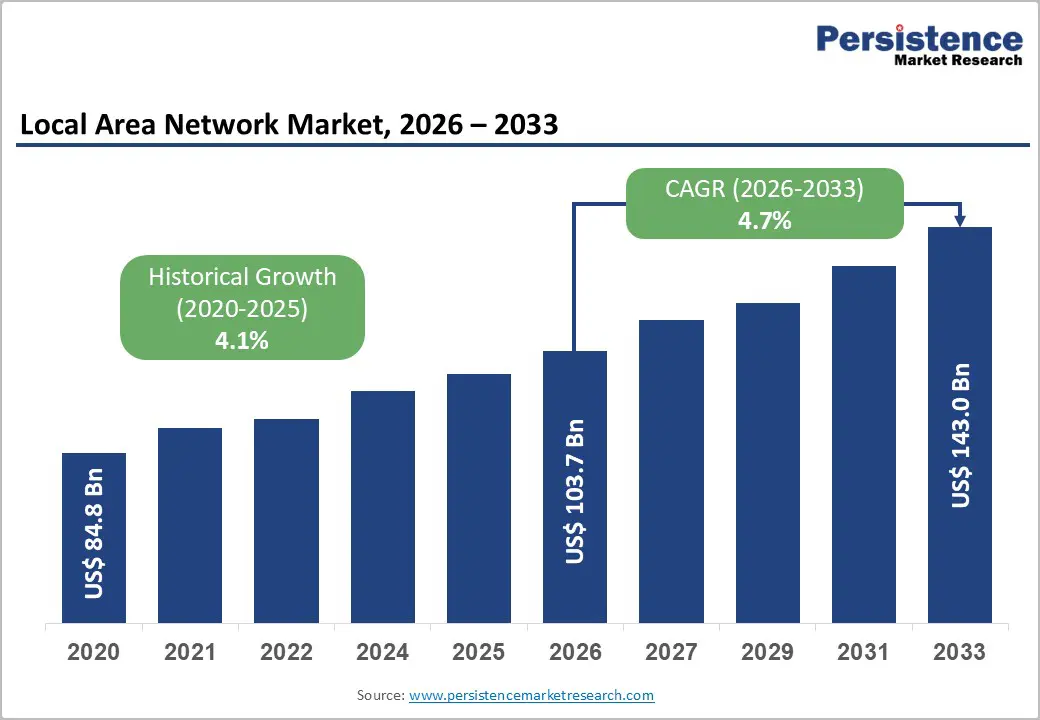
The global local area network market size is likely to be valued at US$103.7 billion in 2026 and is expected to reach US$143.0 billion by 2033, growing at a CAGR of 4.7% between 2026 and 2033, driven by enterprise network modernization, increasing adoption of Wi-Fi 7, and the rising need for secure and centrally managed connectivity across campus, branch, and industrial environments.
Organizations are shifting toward platform-based networking architectures that integrate hardware, software, and security. This transition reflects the growing role of LAN infrastructure as a strategic enabler of digital operations, rather than a standalone utility.
Key Industry Highlights:
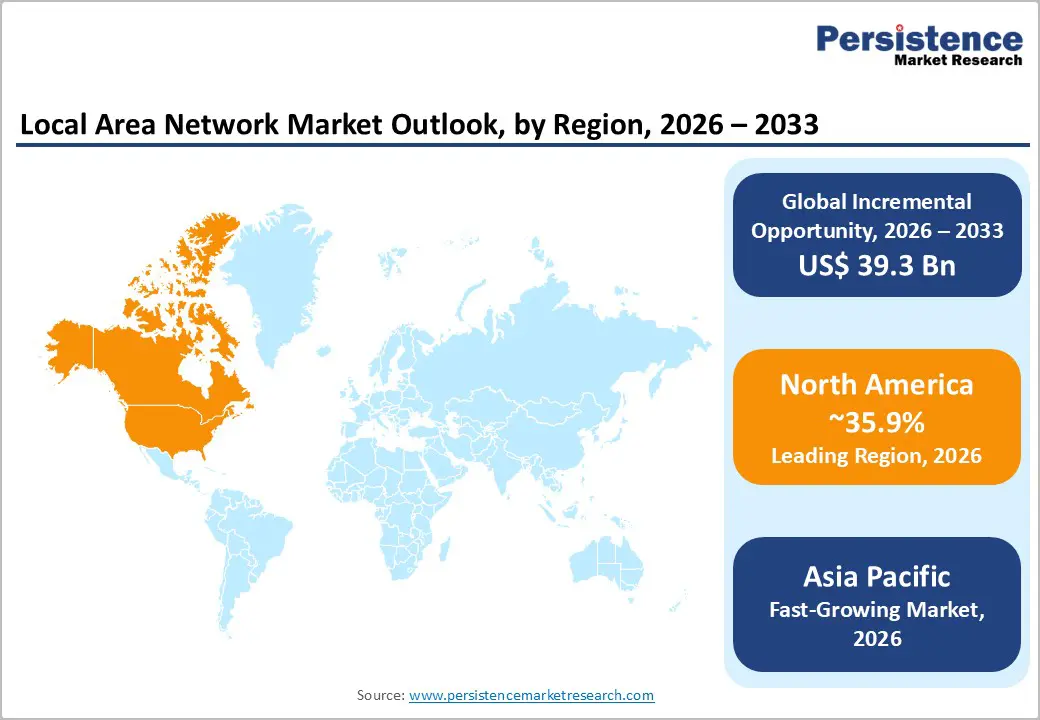
- Leading Region: North America is projected to account for 35.9% of the market share, driven by advanced IT infrastructure, early adoption of Wi-Fi 7, and strong enterprise investment in AI-enabled networking solutions.
- Fastest-growing Region: Asia Pacific is the fastest-growing region, supported by rapid digitalization, expanding cloud infrastructure, and increasing adoption of IoT-driven enterprise networks across China, India, Japan, and Southeast Asia.
- Investment Plans: Enterprises and governments are increasingly investing in cloud-managed LAN systems, AI-driven network automation, and secure infrastructure, with large-scale funding directed toward broadband expansion, smart cities, and campus network modernization.
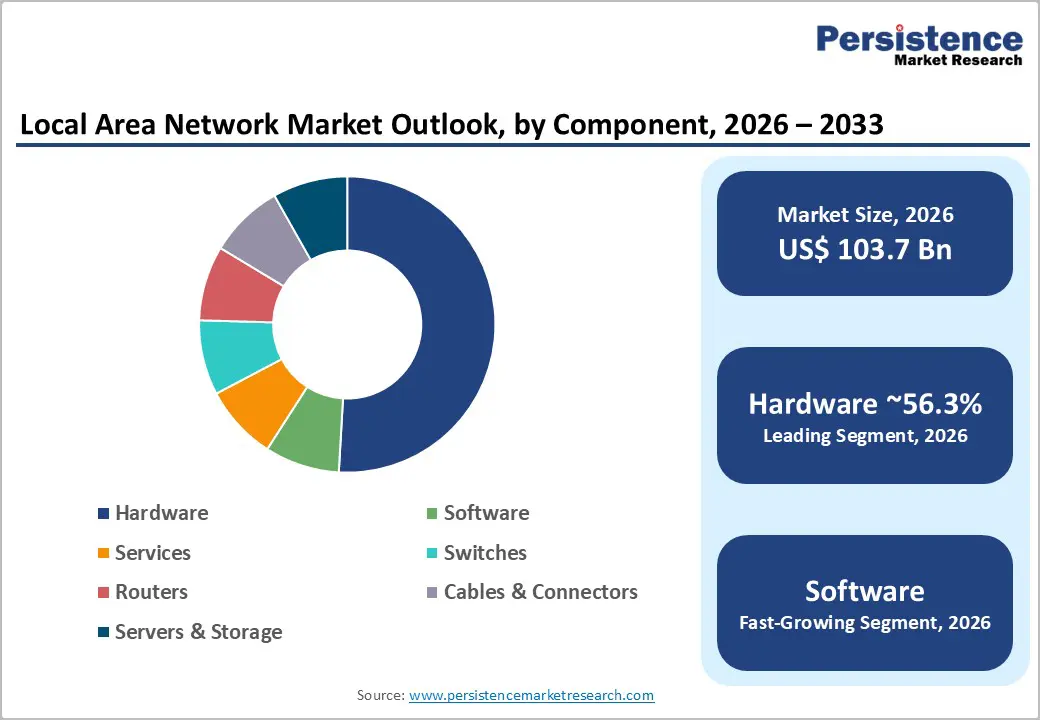
- Dominant Component: Hardware remains the dominant component, holding an anticipated 56.3% market share, driven by continued demand for switches, routers, and structured cabling as foundational network infrastructure.
- Leading Network Type: Wired LAN leads the network type segment with an anticipated 55.4% market share, driven by its reliability, security, and widespread deployment across enterprise campuses, data centers, and industrial environments.
| Key Insights | Details |
|---|---|
| Local Area Network Market Size (2026E) | US$103.7 Bn |
| Market Value Forecast (2033F) | US$143.0 Bn |
| Projected Growth (CAGR 2026 to 2033) | 4.7% |
| Historical Market Growth (CAGR 2020 to 2025) | 4.1% |
DRO Analysis
Driver Analysis - AI-Driven Network Modernization and Converged Security Demand
Enterprises are increasingly modernizing LAN infrastructure to support artificial intelligence workloads, hybrid work environments, and integrated cybersecurity frameworks. Networks are evolving into intelligent platforms capable of real-time monitoring, predictive analytics, and automated policy enforcement. This shift is driving demand for solutions that combine switching, wireless access, and security into unified architectures. Businesses are prioritizing investments that improve operational efficiency, reduce downtime, and enhance user experience. As a result, vendors are expanding software capabilities and integrating AI-driven tools, increasing the overall value of LAN deployments beyond traditional connectivity functions.
Wi-Fi 7 Adoption and Enterprise Refresh Cycles
The emergence of Wi-Fi 7 technology is accelerating LAN upgrade cycles across enterprises, campuses, and public infrastructure. Organizations are replacing legacy access points and switches to support higher bandwidth, lower latency, and improved device density. This transition is particularly important in environments with high data traffic, such as corporate offices, educational institutions, and healthcare facilities.
Wireless upgrades are also driving demand for complementary wired infrastructure, including high-performance switches and structured cabling systems. As enterprises aim to future-proof their networks, integrated solutions that offer scalability, centralized management, and enhanced performance are gaining significant traction.
Government Investments and Cybersecurity Regulations
Public sector initiatives and regulatory frameworks are playing a critical role in sustaining LAN market growth. Large-scale infrastructure programs aimed at expanding broadband access are indirectly driving demand for enterprise and institutional network upgrades. At the same time, stricter cybersecurity regulations are compelling organizations to adopt secure-by-design networking solutions. Compliance requirements are increasing the need for advanced network monitoring, encryption, and access control capabilities. Vendors that can deliver integrated security features within LAN infrastructure are well-positioned to benefit from this regulatory-driven demand.
Restraint Analysis - High Deployment Costs and Infrastructure Complexity
LAN deployment involves significant capital investment in hardware, cabling, installation, and ongoing maintenance. Advanced technologies such as fiber-optics and high-capacity switches require specialized equipment and skilled labor, thereby increasing overall project costs. For small and medium-sized enterprises, these upfront expenses can act as a barrier to adoption. In many cases, organizations opt for phased upgrades or managed services to reduce financial burden. The complexity of integrating new systems with existing infrastructure further extends deployment timelines and increases operational risk.
Operational Complexity and Fragmented Network Environments
Managing modern LAN environments has become increasingly complex due to the coexistence of wired, wireless, hybrid, and cloud-managed architectures. Organizations must ensure consistent performance, security, and compliance across multiple network layers. This fragmentation places additional pressure on IT teams, requiring advanced expertise and tools to manage networks effectively. Regulatory requirements related to data protection and cybersecurity further complicate operations. As a result, enterprises often face higher administrative overhead and longer implementation cycles.
Opportunity Analysis - Expansion of Cloud-Managed LAN Solutions
Cloud-managed networking is emerging as a major growth opportunity in the LAN market. Organizations are adopting cloud-based platforms to simplify network deployment, monitoring, and maintenance across distributed locations. These solutions provide centralized control, real-time analytics, and automated updates, reducing the need for on-site management. The shift toward subscription-based models also enables vendors to generate recurring revenue while offering cost-effective solutions to customers. As businesses continue to embrace digital transformation, demand for scalable and flexible cloud-managed LAN systems is expected to increase significantly.
Rising Demand from Industry Digitization and Smart Infrastructure
The rapid digitization of industries such as healthcare, education, manufacturing, and retail is expanding the scope of LAN applications. Connected devices, IoT systems, and smart building technologies require reliable and high-speed local connectivity. For example, healthcare facilities rely on LANs for telemedicine and real-time patient monitoring, while manufacturing plants use networked systems for automation and process control. This diversification of use cases is creating new opportunities for vendors to deliver customized solutions tailored to specific industry requirements.
Category-wise Analysis
Component Insights
Hardware is expected to be the leading segment, accounting for 56.3% of the market in 2026. This dominance is attributed to the essential role of switches, routers, cables, access points, and servers in establishing network infrastructure. Hardware investments are often the priority in enterprise network upgrades, particularly in large-scale deployments where performance, reliability, and scalability are critical. For example, enterprises upgrading to multi-gigabit Ethernet or deploying Power over Ethernet (PoE) switches for IoT devices must first strengthen their physical infrastructure. Switches and structured cabling systems form the backbone of LAN architecture, ensuring seamless data transmission and network stability across campuses, data centers, and branch offices.
Software is likely to be the fastest-growing segment, driven by the increasing need for network management, security, and automation. Organizations are adopting software-defined networking (SDN) and cloud-managed platforms that enable centralized monitoring, predictive analytics, and policy-based network control. For instance, enterprises operating multiple branch locations are increasingly using cloud dashboards to manage traffic, enforce security policies, and troubleshoot issues remotely. These tools help improve network performance, reduce downtime, and enhance security posture. Services also play a vital role, particularly in deployment, system integration, and lifecycle management, ensuring optimal performance in complex and large-scale network environments.
Network Type Insights
Wired LAN is expected to be the leading segment, with an anticipated 55.4% share of the market in 2026, driven by its superior reliability, security, and performance. Wired networks are widely used in enterprise campuses, data centers, and industrial environments where stable and high-speed connectivity is essential. For example, financial institutions and manufacturing facilities rely heavily on wired LANs to support latency-sensitive applications such as transaction processing and automated production systems. Structured cabling systems, including copper and fiber optics, remain critical components, supporting both wired endpoints and the backhaul for wireless access points.
Wireless LAN (WLAN) is likely to be the fastest-growing segment, driven by increasing demand for mobility, flexible work environments, and IoT connectivity. The adoption of advanced wireless standards such as Wi-Fi 7 is enabling higher data speeds, lower latency, and improved device density management. For instance, universities, hospitals, and smart office spaces are deploying high-capacity wireless networks to support thousands of connected devices simultaneously. Hybrid LAN solutions, which combine wired reliability with wireless flexibility, are also gaining popularity as organizations aim to optimize user experience while maintaining network performance and security.
Regional Insights
North America Local Area Network Market Trends - Cloud-Managed LAN Adoption and AI-Driven Network Modernization
North America leads the local area network market with a 35.9% share in 2026, driven primarily by strong demand in the U.S. The region benefits from advanced IT infrastructure, early adoption of emerging technologies, and the presence of major networking vendors, including Cisco Systems, Hewlett Packard Enterprise, and Juniper Networks. Enterprises are actively investing in network modernization to support AI workloads, cloud computing, and hybrid work environments. For instance, large-scale campus and enterprise deployments of Wi-Fi 7 solutions by Cisco and HPE Aruba are accelerating refresh cycles across corporate offices and educational institutions.
Government initiatives to expand broadband access and improve digital infrastructure are further supporting market growth. Programs such as large-scale federal broadband funding are enabling better connectivity across underserved regions, indirectly driving enterprise LAN upgrades. The regulatory environment emphasizes cybersecurity and data protection, encouraging organizations to adopt secure networking solutions integrated with zero-trust frameworks. Investment trends indicate a growing preference for cloud-managed LAN systems and integrated networking platforms, particularly among distributed enterprises. The region also serves as a hub for innovation, with continuous advancements in wireless technologies, AI-driven network automation, and software-defined networking shaping the competitive landscape.
Europe Local Area Network Market Trends - Cybersecurity Compliance and Industry 4.0 Network Integration
Europe’s LAN market is characterized by strong regulatory frameworks and ongoing digital transformation initiatives. Countries such as Germany, the U.K., France, and Spain are leading contributors to regional growth. Industrial automation and smart manufacturing initiatives in Germany, supported by Industry 4.0 programs, are driving demand for robust and secure LAN infrastructure in factories. At the same time, public sector digitization efforts in the U.K. and France are increasing the need for scalable and secure enterprise networks. Companies such as Nokia and Alcatel-Lucent Enterprise are actively expanding enterprise networking solutions tailored to these requirements.
Regulatory policies focused on cybersecurity and data protection are shaping market dynamics, requiring organizations to adopt secure and compliant networking solutions. Frameworks such as NIS2 and broader EU cybersecurity directives are pushing enterprises to invest in secure-by-design LAN architectures. While growth rates may be moderate compared to other regions, Europe offers significant opportunities for vendors specializing in secure, energy-efficient, and compliant networking technologies. Investments in smart cities and digital infrastructure projects, such as connected transportation systems and public Wi-Fi networks, are expected to support long-term market expansion and create demand for integrated wired and wireless LAN solutions.
Asia Pacific Local Area Network Market Trends - Rapid Digitalization and Hyperscale Infrastructure Expansion
Asia Pacific is expected to be the fastest-growing region in the LAN market, driven by rapid digitalization, expanding IT infrastructure, and increasing adoption of cloud and IoT technologies. Key markets include China, Japan, India, and Southeast Asia. The region is witnessing strong investments in hyperscale data centers and enterprise IT infrastructure, with companies such as Huawei Technologies playing a major role in deploying campus and enterprise networking solutions across China and other parts of Asia. Japan and South Korea are focusing on advanced connectivity, including high-speed wireless networks and smart infrastructure, which is accelerating LAN adoption in commercial and industrial sectors.
India is emerging as a major growth hub due to government initiatives promoting digital transformation, such as smart city development, digital governance, and nationwide connectivity programs. The expansion of enterprise IT parks, educational campuses, and healthcare infrastructure is creating sustained demand for LAN deployments. Meanwhile, Southeast Asian countries are investing in digital economies and cloud infrastructure, encouraging enterprises to adopt scalable and cloud-managed networking solutions. The region’s strong manufacturing base and large-scale infrastructure projects provide a favorable environment for LAN market growth. Increasing demand for high-speed connectivity, combined with rising cybersecurity awareness, is expected to drive sustained expansion and encourage adoption of advanced, secure LAN architectures.
Competitive Landscape
The global local area network market is moderately concentrated, with a mix of global leaders and regional players competing across different segments. Leading companies dominate the enterprise and high-performance networking space, while smaller vendors focus on niche markets and cost-effective solutions. Competition is primarily based on product innovation, performance, pricing, and service capabilities.
Key players are focusing on innovation, cloud integration, and security convergence to strengthen their market position. Strategies include expanding product portfolios, investing in AI-driven network management, and offering subscription-based services. Companies are also pursuing mergers and acquisitions to enhance technological capabilities and global reach.
Key Industry Developments:
- In July 2025, Hewlett Packard Enterprise announced the successful completion of its US$14 billion acquisition of Juniper Networks, aiming to build a comprehensive AI-driven, cloud-native networking portfolio and strengthen its position in enterprise LAN and WLAN markets.
- In November 2025, Cisco Systems introduced new Wi-Fi 7 enterprise networking solutions, including advanced wireless access points and secure routing features, aimed at enhancing performance, automation, and security across campus and branch networks.
Companies Covered in Local Area Network Market
- Cisco Systems
- Hewlett-Packard Enterprise
- Juniper Networks
- Huawei Technologies
- Arista Networks
- Extreme Networks
- Ubiquiti Inc.
- Fortinet
- CommScope
- NETGEAR
- D-Link Corporation
- Nokia
- Alcatel-Lucent Enterprise
- TP-Link Technologies
- Zyxel Communications
- Dell Technologies
Frequently Asked Questions
The local area network market is estimated to be valued at US$103.7 billion in 2026.
The local area network market is projected to reach US$143.0 billion by 2033.
Key trends include the adoption of Wi-Fi 7 technology, increasing demand for cloud-managed LAN solutions, integration of AI-driven network automation, and a growing focus on cybersecurity and zero-trust architectures.
The hardware segment leads the market with an anticipated 56.3% share, driven by strong demand for switches, routers, and structured cabling infrastructure.
The local area network market is expected to grow at a CAGR of 4.7% from 2026 to 2033.
Major players include Cisco Systems, Hewlett-Packard Enterprise, Huawei Technologies, Arista Networks, and Juniper Networks.


