




- Hardware & Software IT Services
- Containers As A Service Market
Containers As A Service Market Size, Share, and Growth Forecast 2026 - 2033
Containers As A Service Market by Service Type (Management and Orchestration, Security), Deployment (Public, Private Cloud), Enterprise Size (Small and Medium Enterprises, Large Enterprises), End-user, and Regional Analysis, 2026 - 2033

Containers As A Service Market Size and Trends Analysis
The global containers as a service market size is likely to be valued at US$7.4 billion in 2026 and is expected to reach US$36.4 billion by 2033, growing at a CAGR of 25.6% during the forecast period from 2026 to 2033, driven by the rapid shift toward microservices-based application architectures and the surging demand for swift software deployment cycles. Increasing adoption of Kubernetes-based orchestration platforms across enterprises is further supporting expandable and automated container management.
Key Industry Highlights:
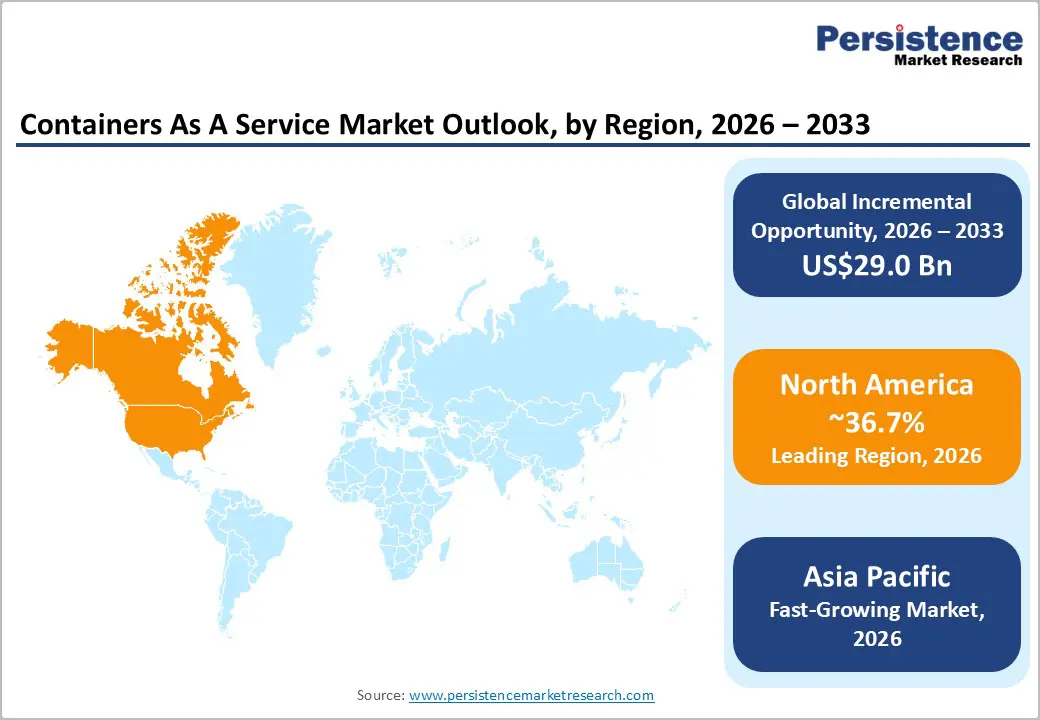
- Leading Region: North America, with about a 36.7% share in 2026, backed by the presence of renowned hyperscalers such as Amazon Web Services.
- Fast-growing Region: Asia Pacific, spurred by ongoing digital transformation supported by government cloud initiatives.
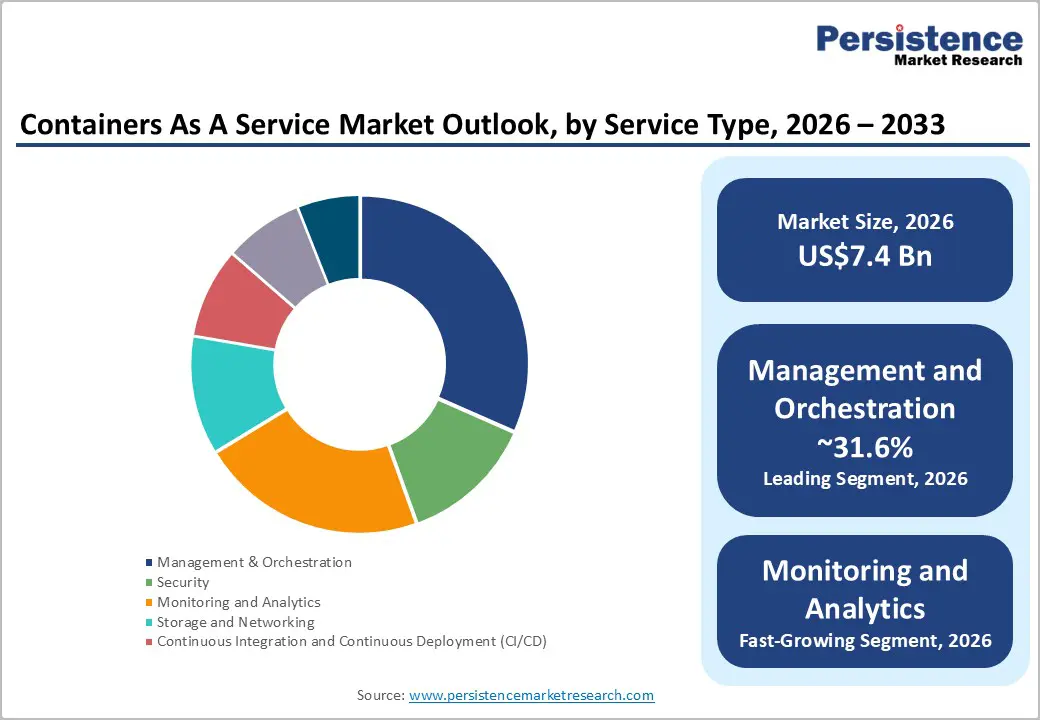
- Leading Service Type: Management and orchestration, approximately 31.6% share in 2026, as surging use of microservices requires centralized control systems to manage thousands of containers efficiently.
- Dominant End-user: The IT and telecommunication segment, with nearly 38.2% share in 2026, with high demand for low-latency infrastructure to support 5G networks and cloud services.
- Recent Collaboration: In September 2025, the Cloud Native Computing Foundation (CNCF) announced a new partnership with Docker to extend secure and extensible support for CNCF-hosted projects. Through this collaboration, all CNCF projects gained direct access to Docker's Sponsored Open Source (DSOS) program.
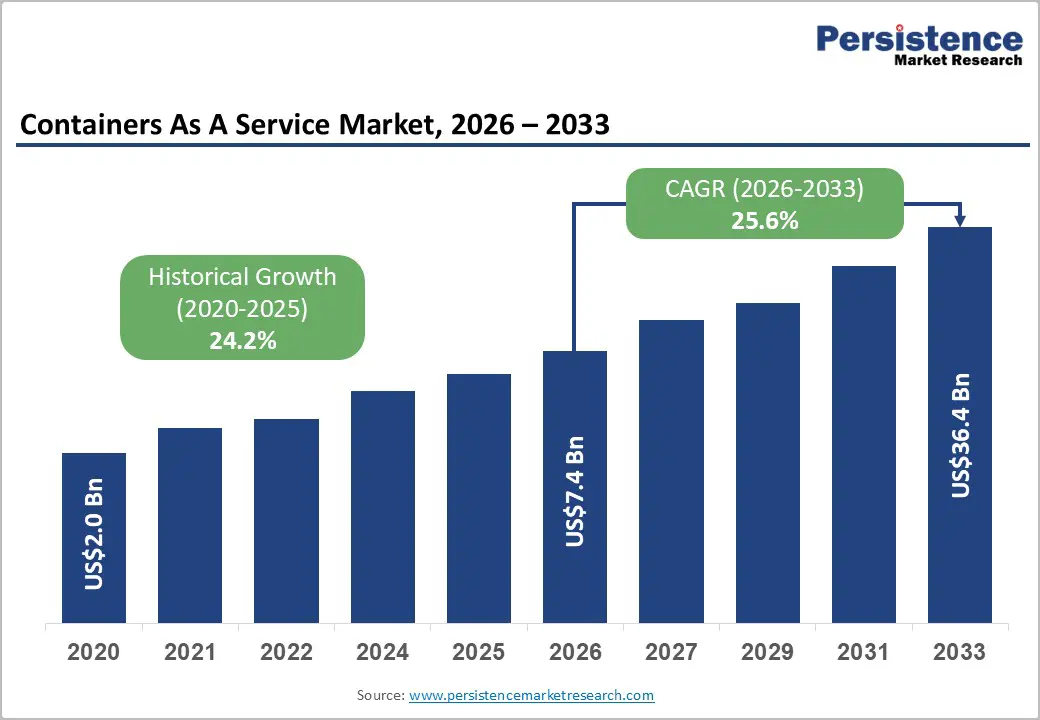
DRO Analysis
Driver - Consumption-Based Billing to Broaden SME Access
Managed Containers as a service (CaaS) now takes on security scanning and compliance tasks that Small and Medium-sized Enterprises (SMEs) once had to handle internally. SMEs have emerged as the fastest-growing customer group, attracted by pay-per-use billing and low entry costs. This model removes the requirement for upfront infrastructure investment.
Tools such as AWS Fargate and EKS cost-visibility features let SMEs run production clusters without requiring a dedicated DevOps team. Automated rightsizing and spot-instance usage align costs with fluctuating traffic. This is a meaningful shift as SMEs no longer need to over-provision to handle peak loads. They pay only for what they consume, which makes containerized deployment financially viable even for lean teams.
SBOM Compliance Requirements to Push Enterprises toward Managed CaaS
Government mandates around software supply chain security are quietly accelerating managed CaaS adoption. The Cybersecurity and Infrastructure Security Agency (CISA) released a draft update in August 2025 to its Software Bill of Materials (SBOM) Minimum Elements guidance, calling for machine-processable formats that support expandable implementation and integration into broad cybersecurity practices.
A 2022 Office of Management and Budget (OMB) directive already requires agencies to use SBOMs complied with CISA guidance. The 2025 update adds new required data elements such as Component Hash, License, and Tool Name, while emphasizing automation and interoperability. For enterprises selling to federal agencies, embedding SBOM generation into a managed CaaS pipeline is far simpler than building it in-house. An SBOM-powered software composition analysis tool can integrate into a DevSecOps pipeline to generate a real-time component inventory. This capability is being bundled by managed CaaS providers globally.
Restraint - A Thin Pipeline of Skilled Kubernetes Practitioners Slows Deployments
Despite rising adoption, the supply of skilled Kubernetes professionals is not keeping pace. The 2025 Cloud Native Computing Foundation (CNCF) Annual Cloud Native Survey confirmed that cultural challenges, skills gaps, and operational complexity continue to slow progress, even as Kubernetes reaches 82% production adoption across IT organizations. The problem runs deeper than headcount. Running Kubernetes well requires expertise across service mesh configuration, GitOps workflows, and edge cluster management, skills that take time to develop.
There is a global shortage of experienced Kubernetes operators, and achieving full end-to-end cloud-native delivery remains complex, requiring both technical expertise and strategic planning. Organizations in emerging markets face the additional burden of relying on expensive consultants, which stretches timelines and raises operating risk. CNCF does provide certification programs for Kubernetes application developers and administrators, but training pipelines have yet to match real-world demand.
Opportunity - Data Residency Laws to Make Room for Domestic CaaS Providers
Strict data sovereignty rules across key economies are compelling organizations to rethink where their containerized workloads run. In October 2025, the European Commission launched a €180 million (approximately US$195 million) tender under its Cloud III Dynamic Purchasing System. It allows EU institutions to procure sovereign cloud services over six years, thereby establishing a practical benchmark for how sovereignty requirements apply to cloud infrastructure. This creates high demand for locally operated CaaS.
AWS announced a €7.8 billion (nearly US$8.9 billion) investment in a European Sovereign Cloud set to launch in Germany, while Microsoft rolled out its Sovereign Private Cloud in June 2025, enabling air-gapped deployments in France and Germany. For domestic and regional CaaS providers, these regulatory conditions deliver a structural advantage over hyperscalers operating under foreign jurisdictions. The EU and member states such as Germany and France have introduced additional cloud requirements specifically for government use, opening procurement lanes that favor compliant and in-country providers.
5G Rollouts at the Network Edge to Create a Natural Fit for Lightweight CaaS
The buildout of 5G infrastructure is generating a new category of compute demand that traditional data centers are poorly positioned to serve. Micro data centers placed at tower bases now process local network functions and IoT traffic before sending optimized packets upstream, allowing teams to add capacity incrementally instead of building large facilities. Containers are the preferred workload format here because of their small footprint and fast start-up times.
Dish Wireless, for example, deployed distributed telco edge data centers to support its 5G rollout, hosting network functions in multiple form factors, including containers. Telcos are actively incorporating edge clouds to improve 5G deployments. The trend of distributed computing is propelling adoption of containerized architectures that can be deployed quickly in complex geographies. Managed CaaS sits at the center of this, providing orchestration, lifecycle management, and security for container fleets spread across dozens of edge nodes that no single ops team could manually maintain.
Category-wise Analysis
Service Type Insights
The management and orchestration segment is predicted to lead with a share of approximately 31.6% in 2026, as containers are now used at massive scale in distributed and microservices-based systems. Without orchestration, enterprises cannot manage thousands of containers running across multiple environments. Tools such as Kubernetes, widely used across AWS, Azure, and Google Cloud, handle scheduling, load balancing, expansion, and self-healing.
The monitoring and analytics segment is estimated to be the fastest-growing over the forecast period, as container environments are highly dynamic and short-lived. Containers can spin up and shut down in seconds, which makes traditional monitoring tools ineffective. This has increased demand for observability platforms that track logs, metrics, and traces in real time.
End-user Insights
The IT and telecommunication segment is anticipated to dominate with a share of nearly 38.2% in 2026, as these industries run extremely high-volume, low-latency workloads. Telecom operators are shifting toward cloud-native 5G core networks, which are heavily containerized. For example, Ericsson and Nokia have published whitepapers showing that 5G core network functions are now deployed on Kubernetes clusters to enable network slicing and quick service rollout. This allows telecom companies to launch new services without rebuilding infrastructure.
The retail segment is expected to remain in the second position in 2026, as it relies heavily on seasonal and customer-facing digital platforms. Retailers experience extreme traffic spikes during events such as Black Friday or festive sales, and containers help expand applications instantly. Retail also depends on microservices for personalized shopping experiences, recommendation engines, and inventory management systems.
Regional Insights
North America Containers As A Service Market Trends
North America is predicted to dominate in 2026 with a share of approximately 36.7%, as it combines early cloud adoption, strong hyperscaler presence, and deep enterprise digitization. Most global CaaS platforms are headquartered here, including Amazon Web Services, Microsoft Azure, and Google Cloud. These firms influence product standards and pricing. A key validation comes from CNCF, which shows that North America has the highest share of Kubernetes contributors and enterprise adopters.
U.S. Containers As A Service Market Trends
A share of nearly 78.3% is expected to be held by the U.S. in 2026, as enterprises are moving from basic container use to advanced platform engineering and serverless containers. Companies are no longer just deploying containers; they are building internal developer platforms on top of Kubernetes. Capital One has publicly shared its Kubernetes adoption to improve deployment speed and resilience. The U.S. National Institute of Standards and Technology (NIST) has also published cloud-native security guidance, encouraging container adoption in regulated industries.
Asia Pacific Containers As A Service Market Trends
Asia Pacific is anticipated to be the fastest-growing region in 2026 with a share of nearly 32.8%, as large-scale digital transformation and government-backed cloud programs. China, India, and Southeast Asian nations are shifting public services and enterprises to cloud-native models. For instance, Singapore’s Government on Commercial Cloud (GCC) program supports container-based deployments for public sector applications. Also, Japan’s Digital Agency promotes cloud-native adoption across ministries. These initiatives are pushing demand rather than experimental usage.
China Containers As A Service Market Trends
China will likely lead Asia Pacific in 2026 with a share of around 33.5%, due to its well-established domestic cloud network and policy-driven technology adoption. Companies such as Alibaba Cloud and Huawei Cloud provide fully localized CaaS platforms. Alibaba Cloud’s ACK (Alibaba Kubernetes Service) is widely used in e-commerce and fintech platforms. According to Alibaba’s official whitepapers, its container platform supports large-scale events, including Singles’ Day, where systems handle massive transaction volumes using container orchestration.
India Containers As A Service Market Trends
In 2026, India is projected to account for a share of approximately 21.7%, owing to start-up culture expansion and public digital infrastructure. Government platforms such as National Informatics Center support cloud-native deployments for e-governance projects. Initiatives, including Digital India and ONDC (Open Network for Digital Commerce) rely on scalable backend systems, where containers play a key role. On the enterprise side, IT firms, including Tata Consultancy Services and Infosys, use Kubernetes to manage global client workloads.
Europe Containers As A Service Market Trends
Europe will likely see decent growth in the forecast period with a share of nearly 15.6% in 2026, bolstered by regulation, data sovereignty, and hybrid cloud requirements rather than speedy experimentation. The European Union’s focus on General Data Protection Regulation (GDPR) compliance and data protection encourages companies to adopt controlled container environments instead of fully public cloud-native models. Projects under GAIA-X, a Europe-based cloud initiative, promote interoperable and sovereign cloud infrastructure, where containers are a key component.
Germany Containers As A Service Market Trends
Germany will likely register a substantial share of approximately 38.6% in 2026, spurred by its well-established industrial base and Industry 4.0 transformation. Manufacturing companies are adopting containers to modernize factories and connect IoT devices. For example, Siemens has developed industrial edge platforms that use containerized applications for real-time analytics, as highlighted in its official technical documentation. The government also supports digital transformation through initiatives such as Plattform Industrie 4.0, which encourages cloud-native technologies in manufacturing.
U.K. Containers As A Service Market Trends
A share of around 28.2% is predicted to be held by the U.K. in 2026, as the country is focusing on financial services, public sector modernization, and cloud governance. The U.K. Government Digital Service (GDS) promotes cloud-native adoption across departments, and several services are being rebuilt using container-based architectures. In the private sector, banks, including HSBC and Barclays, have adopted Kubernetes to improve application deployment and compliance, as noted in industry case studies and press releases. The U.K.’s growth is not as fast as Asia Pacific, but it is stable due to high demand from regulated industries that require secure container platforms.
Competitive Landscape
The global containers as a service market is oligopoly-led but operationally fragmented. A small set of hyperscale cloud vendors dominates infrastructure while a long tail of platform and niche Kubernetes tooling vendors compete on orchestration, hybrid control, and developer experience. The market is essentially controlled by three hyperscalers forming the core competitive axis, namely, AWS, Google Cloud, and Microsoft Azure. These companies together anchor most enterprise CaaS workloads through tightly integrated networks such as ECS/EKS/Fargate (AWS), GKE/Cloud Run (Google), and AKS (Azure).
Outside hyperscalers, the competitive layer is strongly ecosystem-driven rather than platform-driven. Vendors such as Red Hat (OpenShift), VMware (Tanzu), Rancher (SUSE), and IBM compete heavily in hybrid and on-prem/container portability use cases where enterprises do not want full public-cloud dependency. These players rarely win on raw infrastructure expansion but compete on policy control, governance, multi-cluster management, and regulated industry deployments.
Key Industry Developments
- In April 2026, Google announced GKE HyperCluster at Cloud Next '26, representing a prominent architectural shift in container orchestration. GKE HyperCluster is a control plane capable of managing up to one million accelerator chips from a single control plane across multiple regions.
- In April 2026, a consortium based in Europe, including DEEP by POST Luxembourg Group, OVHcloud, and Clever Cloud, was selected by the European Commission as part of a key tender to provide sovereign cloud services to the institutions, bodies, and agencies of the EU. Clever Cloud contributes an advanced orchestration layer to manage, automate, and unify complex environments spanning public and private clouds.
- In March 2026, NanoCo, creators of the open-source AI agent platform NanoClaw, and Docker announced an integration allowing NanoClaw to be deployed inside Docker's MicroVM-based sandbox infrastructure with a single command. Through the partnership, users can install NanoClaw into a Docker Sandbox.
Companies Covered in Containers As A Service Market
- Alibaba Cloud
- Canonical Ltd.
- Cisco Systems, Inc.
- CrowdStrike
- Docker Inc.
- Gcore
- Hewlett Packard Enterprise (HPE)
- IBM Corporation
- IT Outposts
- Microsoft Corporation
- SITA Airport IT GmbH
- Successive Technologies LLC
- Tencent Cloud
- VMware (Broadcom)
Frequently Asked Questions
The global containers as a service market is projected to be valued at US$7.4 billion in 2026.
The containers as a service market is expected to reach US$36.4 billion by 2033.
Key market trends include the rising shift toward Kubernetes-native platforms and serverless containers.
Management and orchestration are expected to be the leading service type with a share of nearly 31.6% in 2026, as enterprises rely on Kubernetes to automate expansion and deployment of complex containerized applications.
The containers as a service market is expected to grow at a CAGR of 25.6% from 2026 to 2033.
Alibaba Cloud, Canonical Ltd., Cisco Systems, Inc., and CrowdStrike are a few key market players.


