




- Hardware & Software IT Services
- Endpoint Detection and Response (EDR) Market
Endpoint Detection and Response (EDR) Market Size, Share, and Growth Forecast, 2026 – 2033
Endpoint Detection and Response (EDR) Market by Solution Type (Software, Services), Endpoint Device (Workstations & Laptops, Servers, Mobile Devices, POS & Kiosk Systems), Industry (BFSI, IT & Telecom, Healthcare, Others), and Regional Analysis for 2026 – 2033

Endpoint Detection and Response (EDR) Market Size and Trends Analysis
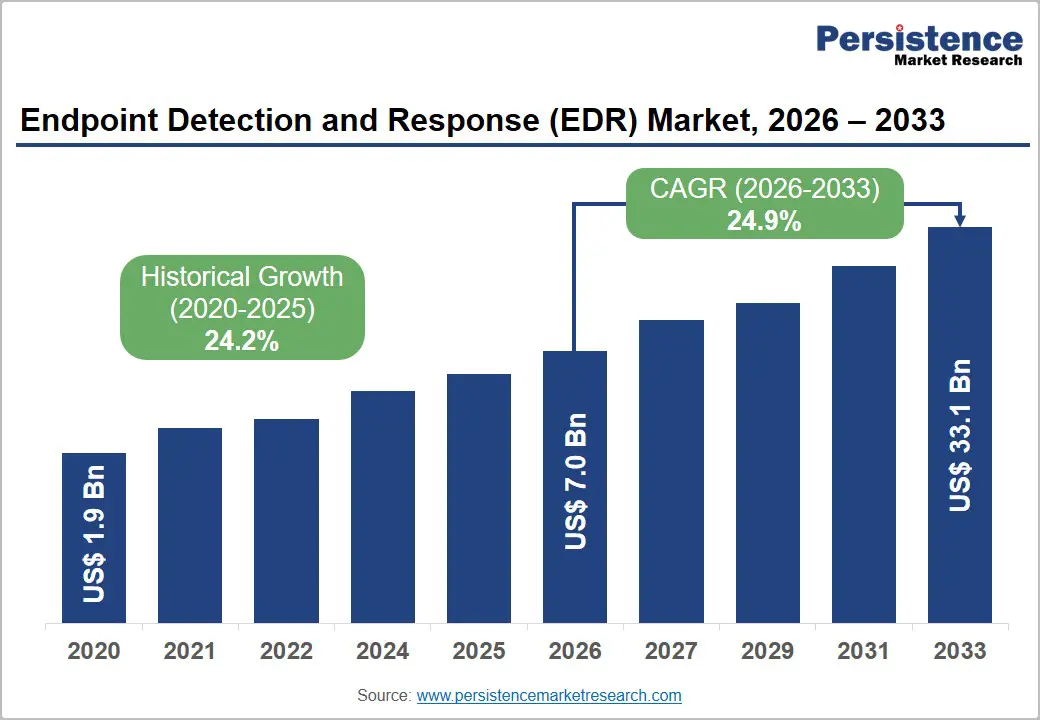
The global endpoint detection and response (EDR) market size is likely to be valued at US$7.0 billion in 2026 and is expected to reach US$33.1 billion by 2033, growing at a CAGR of 24.9% during the forecast period from 2026 to 2033, driven by strong growth amid the rising frequency and sophistication of cyberattacks targeting enterprise endpoints. According to Verizon’s 2025 Data Breach Investigations Report, ransomware was involved in 44% of global data breaches, while exploitation of vulnerabilities increased by 34% year-over-year, highlighting the need for continuous endpoint monitoring and rapid threat response capabilities. The report analyzed more than 22,000 security incidents and 12,195 confirmed breaches across 139 countries. CISA continued expanding its Known Exploited Vulnerabilities (KEV) Catalog throughout 2025 and 2026, reflecting the growing volume of actively exploited threats and reinforcing demand for advanced EDR solutions.
Key Industry Highlights:
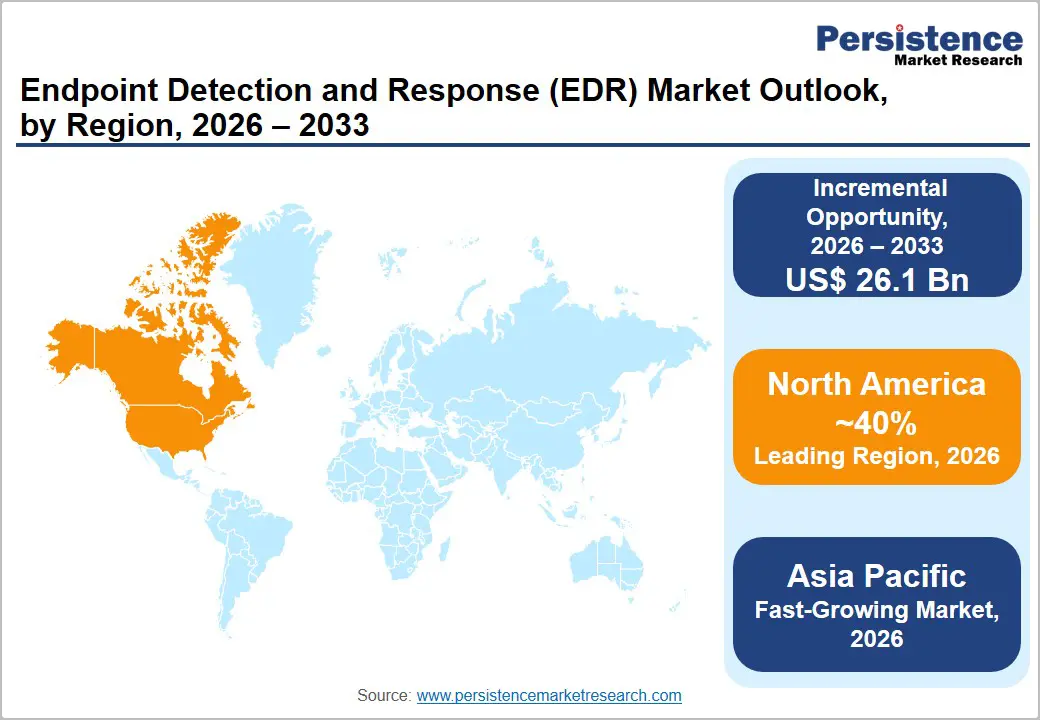
- Leading Region: North America is anticipated to be the leading region, accounting for a market share of 40% in 2026, driven by strong cybersecurity spending, advanced digital infrastructure, and early adoption of AI-powered security solutions.
- Fastest-growing Region: Asia Pacific is likely to be the fastest-growing region, supported by accelerating digitalization and cybersecurity investments.
- Leading Solution Type: The software segment is projected to represent the leading solution type in 2026, accounting for 64% of the revenue share, due to its critical role in real-time threat detection, endpoint monitoring, and automated incident response.
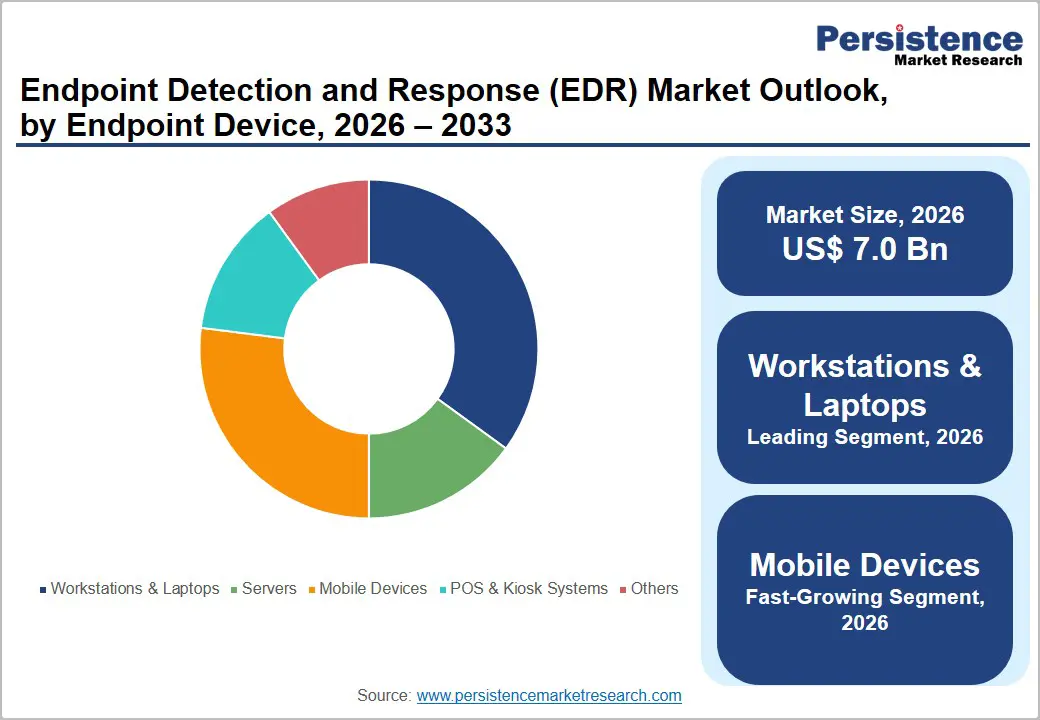
- Leading Endpoint Device: Workstations & laptops are anticipated to be the leading endpoint device, accounting for over 55% of the revenue share in 2026, supported by their widespread enterprise usage and increased exposure to cyber threats in remote and hybrid work environments.
- Key Opportunity: The growing convergence of AI-powered EDR, XDR, and managed security services across cloud, hybrid, and industry-specific environments presents a significant opportunity to deliver unified, automated, and proactive cyber threat protection worldwide.
DRO Analysis
Driver - Expansion of Remote/Hybrid Work and Endpoint Proliferation
Employees now access corporate resources through laptops, desktops, smartphones, tablets, and other connected devices from various locations, creating a larger attack surface for cybercriminals. Traditional perimeter-based security models are no longer sufficient to manage these distributed environments. As organizations continue adopting flexible work policies, they require continuous endpoint visibility, threat monitoring, and incident response capabilities.
This trend has accelerated investments in cloud-based EDR platforms that provide centralized security management. The proliferation of connected devices across enterprises strengthens demand for advanced endpoint security solutions. Businesses increasingly rely on Internet of Things (IoT) devices, operational technology systems, and remote collaboration tools that generate additional security risks.
Attackers frequently target endpoints through phishing, ransomware, credential theft, and zero-day exploits, making rapid detection and containment critical. EDR platforms help organizations identify suspicious behaviors, automate investigations, and reduce response times before threats spread across networks. Growing digital transformation initiatives, combined with increasing dependence on distributed workforces, continue to drive adoption of intelligent endpoint protection technologies.
Restraint - Integration Complexity and Skill Shortages
Many organizations operate diverse environments consisting of legacy systems, cloud platforms, third-party applications, and multiple security tools. Integrating EDR solutions with security information and event management systems, identity management platforms, and threat intelligence tools often requires significant planning and customization. Complex deployments can increase implementation timelines, operational costs, and resource requirements.
Another major restraint is the persistent shortage of skilled cybersecurity professionals capable of effectively managing and interpreting EDR alerts. Modern EDR platforms generate large volumes of security data that require continuous monitoring, threat hunting, and incident investigation. Many organizations lack trained personnel to analyze alerts accurately, resulting in alert fatigue and delayed response actions.
Opportunity - Sector-Specific Solutions for Healthcare and Critical Infrastructure
Healthcare organizations manage highly sensitive patient information and increasingly connected medical devices, making them attractive targets for ransomware and data theft attacks. Standard security tools often fail to address the unique operational requirements of hospitals, laboratories, and healthcare networks.
Vendors are developing specialized EDR solutions tailored to healthcare environments, offering enhanced visibility, compliance support, and protection for medical devices. These industry-focused capabilities create substantial growth opportunities for cybersecurity providers worldwide. Critical infrastructure sectors, including energy, utilities, transportation, and public services, also require specialized endpoint protection solutions designed for operational technology environments.
These sectors increasingly face sophisticated cyber threats that can disrupt essential services and national infrastructure operations. Traditional security approaches often lack the visibility needed to monitor industrial control systems and connected operational assets effectively. Sector-specific EDR platforms can deliver customized threat detection, asset monitoring, and incident response capabilities while minimizing operational disruptions.
Category-wise Analysis
Solution Type Insights
Software is expected to account for 64% of revenue in 2026. Organizations across industries rely on EDR software to continuously monitor endpoints, detect malicious activities, analyze behavioral anomalies, and automate threat response actions. For example, the widespread adoption of Microsoft Defender for Endpoint, which provides integrated threat detection, investigation, and response capabilities across enterprise environments.
Services are likely to represent the fastest-growing segment, supported by increasing demand for managed detection and response, consulting, implementation, and incident response support. Many organizations face cybersecurity talent shortages and lack the in-house expertise needed to manage complex EDR environments effectively. For instance, CrowdStrike Falcon Complete is a managed detection and response service that provides organizations with expert-led threat monitoring, investigation, and remediation capabilities.
Endpoint Device Insights
Workstations and laptops are projected to lead the market, capturing around 55% of the revenue share in 2026, supported by their extensive use across corporate, government, educational, and industrial environments. These devices serve as primary access points for employees to connect with enterprise applications, cloud platforms, and business networks, making them frequent targets for cyberattacks. A notable example includes SentinelOne Singularity Endpoint provides autonomous protection and real-time visibility across enterprise workstations and laptops.
Mobile devices are likely to be the fastest-growing endpoint device due to increasing enterprise mobility, remote work adoption, and widespread use of smartphones and tablets for business operations. Organizations increasingly allow employees to access corporate systems through mobile devices, creating new attack surfaces that require dedicated security monitoring and threat detection. For instance, Microsoft Defender for Endpoint Mobile delivers threat detection and protection capabilities for Android and iOS devices.
Industry Type Insights
The BFSI segment is expected to lead, accounting for 30% of revenue in 2026, due to the sector’s high exposure to cyber threats and strict regulatory requirements. Financial institutions manage vast amounts of sensitive customer data, transaction records, and digital assets, making them prime targets for ransomware attacks, credential theft, phishing campaigns, and financial fraud. For example, JPMorgan Chase employs advanced endpoint security technologies to safeguard enterprise systems and sensitive financial operations.
Healthcare is likely to represent the fastest-growing segment, supported by rising cybersecurity concerns surrounding patient data, connected medical devices, and healthcare information systems. Hospitals, clinics, research institutions, and healthcare networks are increasingly targeted by ransomware operators seeking to disrupt critical services and access sensitive medical records. A notable example includes the cybersecurity initiatives implemented by Mayo Clinic to strengthen endpoint protection across its digital healthcare infrastructure.
Regional Insights
North America Endpoint Detection and Response (EDR) Market Trends
North America is anticipated to be the leading region, accounting for a market share of 40% in 2026, supported by advanced cybersecurity infrastructure, high enterprise security spending, and widespread adoption of cloud technologies. Regulatory initiatives, cybersecurity mandates, and zero-trust adoption continue to accelerate market growth. For example, CrowdStrike which expanded its AI-powered Charlotte AI and autonomous security capabilities, strengthening automated threat detection and response across enterprise environments.
U.S. Endpoint Detection and Response (EDR) Market Trends
The U.S. is expected to dominate the regional market, accounting for approximately 85% of the market share in 2026, driven by rising ransomware attacks against enterprises and government agencies, which continue to drive cybersecurity investments. Federal cybersecurity initiatives encourage stronger endpoint protection across critical sectors. The adoption of zero-trust security architectures is increasing across public and private organizations.
Canada Endpoint Detection and Response (EDR) Market Trends
Canada is likely to be a significant market for endpoint detection and response (EDR), holding approximately 15% of the market share in 2026, supported by organizations increasing cybersecurity spending to address growing cyber risks. Cloud adoption among enterprises continues to expand rapidly. Critical infrastructure operators are investing in advanced threat detection technologies. Demand for managed detection and response services is increasing across mid-sized enterprises.
Europe Endpoint Detection and Response (EDR) Market Trends
Europe is likely to be a significant market due to increasing cybersecurity regulations, digital transformation initiatives, and heightened awareness of cyber threats. Organizations are focusing on strengthening endpoint security to protect sensitive business and customer data from ransomware and advanced persistent threats. A notable example includes Sophos, which continues to expand its managed detection and response capabilities across European enterprises.
U.K. Endpoint Detection and Response (EDR) Market Trends
The U.K. is likely to account for 20% of Europe market share in 2026, supported by financial services organizations continuing to invest heavily in endpoint protection solutions. The rapid adoption of hybrid work environments has increased endpoint security requirements. Cloud-based security architectures are becoming more prevalent across enterprises. Demand for managed security services continues to rise.
Germany Endpoint Detection and Response (EDR) Market Trends
Germany is anticipated to dominate the regional market, accounting for around 30% of the share in 2026, driven by increasing investments from manufacturing organizations in endpoint protection. Industry 4.0 initiatives are creating demand for advanced cybersecurity solutions. The integration of IT and operational technology systems is expanding the attack surface. German enterprises are strengthening cyber resilience strategies against ransomware attacks.
Asia Pacific Endpoint Detection and Response (EDR) Market Trends
The Asia Pacific region is likely to be the fastest-growing region, driven by rapid digitalization, expanding cloud adoption, and increasing cyber threats targeting enterprises and government institutions. The expansion of remote work, 5G infrastructure, and connected devices is creating new security challenges, encouraging broader EDR deployment. For example, Microsoft continues to expand Microsoft Defender for Endpoint deployments across Asia Pacific enterprises seeking AI-driven threat detection and response capabilities.
China Endpoint Detection and Response (EDR) Market Trends
China is projected to dominate the regional market, holding around 30% of the regional market share in 2026. Rapid digital transformation is increasing cybersecurity requirements across industries. The country continues to strengthen its focus on data security and cyber resilience. Large-scale cloud adoption is creating demand for advanced endpoint monitoring solutions. Manufacturing and industrial enterprises are investing in cybersecurity modernization.
India Endpoint Detection and Response (EDR) Market Trends
India is expected to emerge as a significant market, accounting for approximately a 22% share in 2026, due to accelerating digitalization initiatives. Increasing cyberattacks against enterprises are encouraging greater investment in endpoint security. Organizations are adopting cloud technologies at a significant pace. Expansion of remote and hybrid work models is increasing endpoint exposure. BFSI and IT sectors remain major adopters of advanced cybersecurity solutions.
Competitive Landscape
The global endpoint detection and response (EDR) market exhibits a moderately fragmented structure, driven by the increasing sophistication of cyber threats, growing enterprise demand for real-time endpoint visibility, and rapid adoption of AI-powered security technologies. The market is characterized by continuous innovation in behavioral analytics, threat hunting, automated remediation, and cloud-native security architectures.
With key leaders including CrowdStrike, Microsoft, Palo Alto Networks, SentinelOne, Cisco Systems, Sophos, Fortinet, and Bitdefender, the competitive environment remains highly dynamic. These players compete through artificial intelligence-driven threat detection, automated response capabilities, cloud-native platform development, strategic acquisitions, managed security services, and channel expansion.
Key Industry Developments:
- In June 2026, Vertosoft partnered with Huntress to expand access to advanced Endpoint Detection and Response (EDR) and managed cybersecurity solutions for public sector organizations, enabling government agencies, schools, and municipalities to strengthen protection against evolving cyber threats through Huntress’ AI-powered security platform and 24/7 security operations capabilities.
- In June 2026, Field Effect launched the industry's first AI-native Managed Detection and Response (MDR) service integrated with Endpoint Detection and Response (EDR), enabling organizations to accelerate threat detection, automate investigations, and strengthen protection against increasingly sophisticated cyberattacks.
Companies Covered in Endpoint Detection and Response (EDR) Market
- Bitdefender
- Broadcom, Inc.
- Cisco Systems
- CrowdStrike
- ESET
- FireEye
- Fortinet
- Kaspersky
- McAfee
- Microsoft Corporation
- Palo Alto Networks
- SentinelOne
- Sophos
Frequently Asked Questions
The global endpoint detection and response (EDR) market is projected to reach US$7 billion in 2026.
The endpoint detection and response (EDR) market is driven by rising cyberattacks, expanding remote and hybrid work environments, and increasing demand for AI-powered real-time threat detection and response solutions.
The endpoint detection and response (EDR) market is expected to grow at a CAGR of 24.9% from 2026 to 2033.
Key opportunities lie in AI-driven cloud-native EDR platforms, managed detection and response services, and sector-specific cybersecurity solutions for healthcare and critical infrastructure.
Bitdefender, Broadcom, Inc., Cisco Systems, CrowdStrike, and ESET are the leading players.


