Licorice Root Market Size, Share, Growth, and Regional Forecast, 2026 to 2033

Licorice Root Market is segmented by Form (Whole/Dried Root, Liquid Extract, Powder, Granule), by Nature (Organic, Conventional), by Grade (Pharmaceutical Grade, Food Grade, Feed Grade, Cosmetic Grade), and by Regional Analysis, 2026 - 2033

ID: PMRREP36351
Calendar

March 2026

193 Pages

Author : Amol Patil

Key Industry Highlights:

  • Leading Region: Asia Pacific, holding around 40% market share, supported by strong cultivation in China and Central Asia, extensive use in traditional medicine systems, and a well-established botanical extraction industry.
  • Fastest-Growing Nature Segment: Organic Licorice Root, fueled by increasing consumer demand for pesticide-free botanicals, sustainable sourcing practices, and premium herbal ingredients used in nutraceutical and cosmetic products.
  • Market Drivers: Rising demand for plant-based sweeteners and clean-label ingredients is accelerating the use of licorice root extracts as natural flavor enhancers and sugar alternatives in food and beverage products.
  • Opportunities: Expanding adoption of licorice extracts in the cosmetic and personal care industry, particularly for skin-brightening, anti-inflammatory, and anti-hyperpigmentation formulations in premium skincare products.
  • Key Developments: In February 2026, global confectionery manufacturers highlighted evolving flavor and texture trends ahead of ISM Cologne 2026, where Zhaoan Huazhijie Food Co., Ltd. prepared to showcase its liquorice candy portfolio. In December 2025, the Ministry of Commerce of the People's Republic of China announced the 2026 export quota allocation plan covering agricultural products including licorice and its derivatives.
Key Insights Details
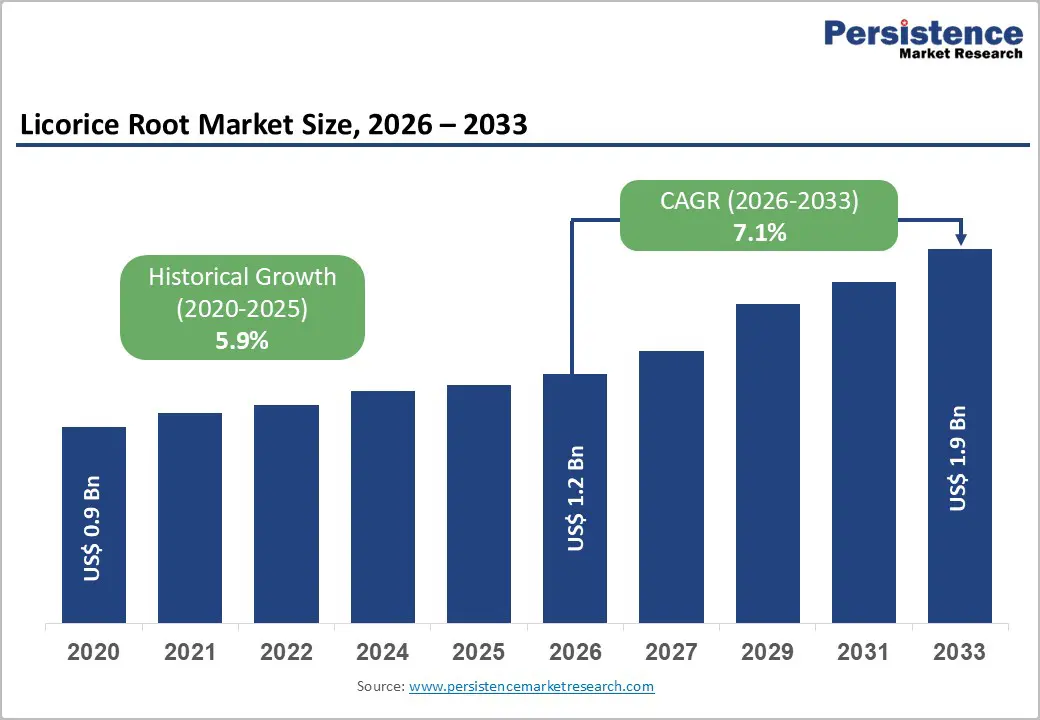
Global Licorice Root Market Size (2026E) US$ 1.2 Bn
Market Value Forecast (2033F) US$ 1.9 Bn
Projected Growth (CAGR 2026 to 2033) 7.1%
Historical Market Growth (CAGR 2020 to 2025) 5.9%

licorice-root-market-size-2026-2033

Market Dynamics

Driver - Rising Demand for Plant-Based Sweeteners and Clean-Label Ingredients

The global transition toward sugar reduction and the adoption of clean-label alternatives. According to the World Health Organization (WHO), the rise in lifestyle-related diseases has prompted strict regulatory mandates on sugar consumption, leading manufacturers to seek natural high-intensity sweeteners. Licorice root contains glycyrrhizin, a compound that is significantly sweeter than sucrose, making it an ideal candidate for low-calorie confectionery and beverages. Organizations like the International Food Information Council (IFIC) note that modern consumers increasingly scrutinize ingredient lists for recognizable plant-derived components. This shift has encouraged major brands such as Whole Earth Brands to expand their natural sweetener portfolios, driving significant volume growth in the Food Grade segment across North American and European markets.

Restraints - Stringent Regulatory Scrutiny and Safety Concerns Regarding Glycyrrhizin

A significant barrier to market expansion is the rigorous regulatory environment concerning the safe consumption levels of licorice derivatives. The Food and Drug Administration (FDA) and the European Food Safety Authority (EFSA) have established strict guidelines because excessive intake of glycyrrhizin can lead to adverse effects such as hypertension and potassium depletion. These safety concerns require manufacturers to provide precise labeling and often necessitate the production of Deglycyrrhizinated Licorice (DGL) for certain health applications. Such compliance burdens increase operational costs for producers like Ransom Naturals Ltd. and can limit the product’s use in mainstream food categories. This regulatory pressure acts as a bottleneck, particularly in developed regions where consumer safety oversight is highly intensive and transparent.

Opportunity - Surging Innovation in the Cosmetic and Personal Care Industry

There is a burgeoning opportunity for market participants to tap into the high-growth Cosmetic Grade segment. Licorice root extract, specifically the compound glabridin, is highly prized in the beauty industry for its skin-brightening and anti-hyperpigmentation properties. As the Personal Care Products Council (PCPC) highlights a significant shift toward green chemistry and botanical skincare, licorice is being formulated into premium anti-aging creams and sun-care products. Brands that focus on high-potency, standardized extracts can command premium pricing in the prestige beauty market. Companies like Shaanxi Fujie Pharmaceutical Co., Ltd. are increasingly targeting this sector by providing sustainable and ethically sourced extracts that align with the clean beauty movement favored by millennial and Gen Z demographics globally.

Category-wise Analysis

Form Insights

The liquid extract segment is the leading segment accounting for a dominant share in 2025. This leadership is justified by its high solubility and ease of integration into diverse applications such as syrups, beverages, and pharmaceutical tinctures. Manufacturers favor liquid formats for their standardized concentrations of glycyrrhizin, which ensure consistency in industrial-scale production. Meanwhile, Powder is identified as a significant contributor to the food processing and cosmetic industries due to its long shelf life and concentrated flavor. The Whole/dried root remains a staple in traditional herbal shops and for the production of stick licorice, catering to the artisanal and traditional medicine segments that prioritize minimal processing.

Nature Insights

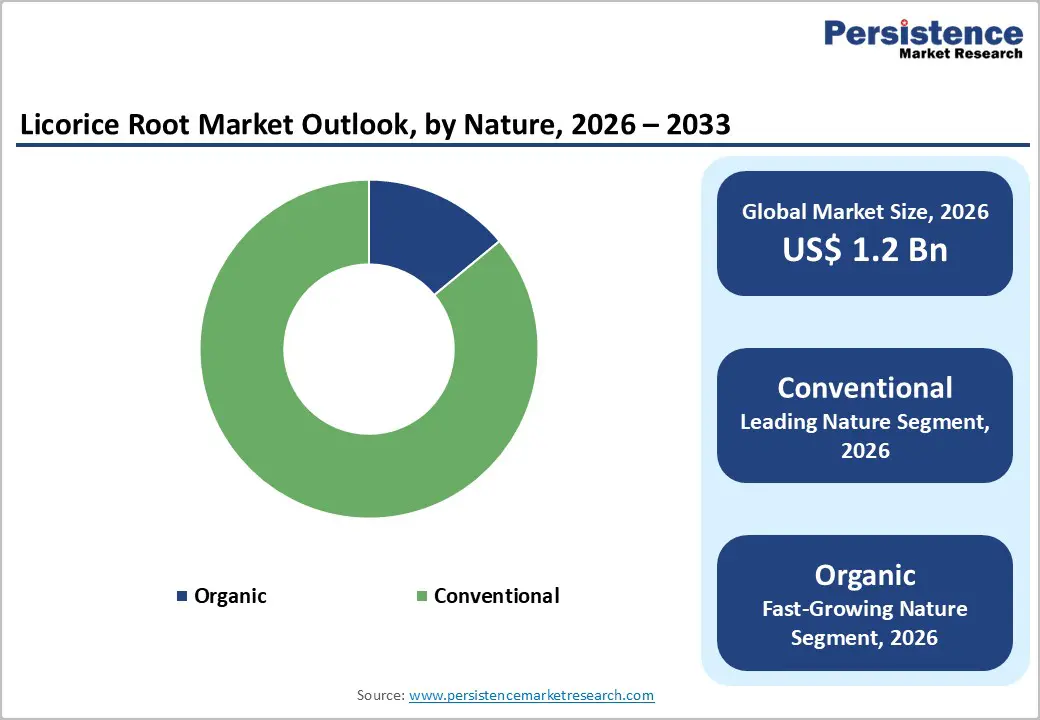
The conventional segment currently holds the leading position, accounting for an estimated 86% market share in 2025. This dominance is driven by its widespread availability and more competitive pricing, making it the primary choice for large-scale industrial applications in the tobacco and confectionery sectors. However, the organic segment is identified as the fastest growing segment through 2032. This rapid growth is fueled by the escalating consumer demand for pesticide-free and sustainably harvested botanicals. Authentic data from the Organic Trade Association (OTA) indicates that consumers are increasingly willing to pay a premium for certified organic licorice in the health supplement and premium skincare categories, encouraging producers like Arjuna Natural Ltd. to expand their organic-certified cultivation areas.
licorice-root-market-outlook-by-nature-2026-2033

Regional Insights

Asia Pacific Licorice Root Market Trends and Insights

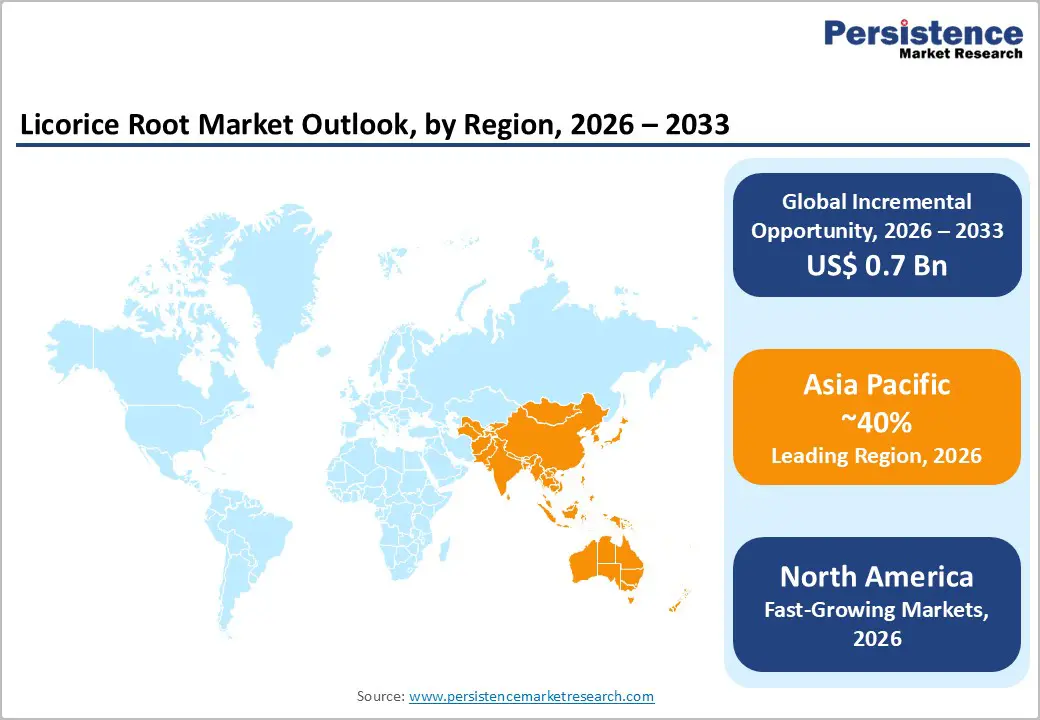
Asia Pacific currently holds the leading market share of 40% in 2025, deeply rooted in the long-standing tradition of licorice use in Traditional Chinese Medicine (TCM) and Ayurveda. China is the global hub for both production and consumption, with a vast infrastructure for the processing of licorice derivatives. The region benefits from extensive manufacturing advantages and a well-established supply chain that serves both domestic and international markets.

Innovation in this region is focused on the integration of licorice into functional beverages and dietary supplements. Countries like India and Japan are seeing a surge in demand for licorice-based wellness products, driven by an aging population and a cultural affinity for herbal remedies. Regulatory support for botanical medicine in these nations has fostered an innovation ecosystem where companies like Maruzen Pharmaceuticals Co., Ltd. thrive. Furthermore, the expansion of the e-commerce sector in Southeast Asia is making premium licorice products more accessible to urban consumers, ensuring that Asia Pacific remains the primary engine for global market value.

North America Licorice Root Market Trends and Insights

North America is identified as the fastest growing region for the licorice root market through 2032. The market leadership in the U.S. is driven by the explosive growth of the natural sweetener industry and the rising popularity of herbal dietary supplements. Organizations such as the American Botanical Council (ABC) have been instrumental in educating consumers about the clinical benefits of licorice root, particularly for adrenal support and digestive health.

The innovation ecosystem in North America is characterized by a high volume of new product launches in the functional food and clean beauty sectors. Major players like Whole Earth Brands are leveraging the demand for zero-sugar alternatives to expand their retail presence. Regulatory clarity from the FDA regarding the use of DGL and standardized extracts has fostered consumer trust. Additionally, the region's strong focus on R&D has led to the development of sophisticated licorice-based formulations in the pharmaceutical sector, making it a critical region for high-value segment growth.
licorice-root-market-outlook-by-region-2026-2033

Competitive Landscape

The licorice root market exhibits a moderately consolidated structure, where a group of established global ingredient suppliers and specialized regional processors hold significant influence. Key market leaders like Whole Earth Brands, Maruzen Pharmaceuticals, and Azelis Group NV dominate the industry through extensive distribution networks and advanced extraction capabilities. These companies employ strategies focused on vertical integration, long-term sourcing contracts, and strategic acquisitions to secure raw material supplies and expand their technological portfolios. Key differentiators include the ability to provide standardized active compounds and the attainment of prestigious certifications such as USDA Organic and ISO. Emerging business models are increasingly prioritizing traceability and direct-from-farm sourcing to satisfy the transparency demands of global pharmaceutical and cosmetic clients.

Key Developments:

  • In February 2026, the global confectionery industry highlighted evolving texture and flavor trends ahead of the ISM Cologne 2026, where Zhaoan Huazhijie Food Co., Ltd. prepared to showcase its liquorice candy portfolio and manufacturing capabilities.
  • In December 2025, the Ministry of Commerce of the People's Republic of China released the First Allocation Plan for Export Quotas of Certain Agricultural Products for 2026, which includes licorice and related products under the regulated export framework.

Companies Covered in Licorice Root Market

  • Whole Earth Brands
  • Maruzen Pharmaceuticals Co., Ltd.
  • Azelis Group NV
  • Arjuna Natural Ltd.
  • Norevo GmbH
  • Zagros Licorice Co.
  • Sepidan Osareh Jonoob Co.
  • Shaanxi Fujie Pharmaceutical Co., Ltd.
  • C.E. Roeper GmbH
  • Ransom Naturals Ltd.
  • F&C Licorice Ltd.
  • Others
Frequently Asked Questions

The global Licorice Root market is projected to be valued at US$ 1.2 Bn in 2026.

Rising Demand for Plant-Based Sweeteners and Clean-Label Ingredients is a major factor driving global Licorice Root market.

The Global Licorice Root market is poised to witness a CAGR of 7.1% between 2026 and 2033.

Surging Innovation in the Cosmetic and Personal Care Industry is a significant opportunity in the Licorice Root market.

Major players in the Global Licorice Root market include Whole Earth Brands, Maruzen Pharmaceuticals Co., Ltd., Azelis Group NV, Arjuna Natural Ltd., Norevo GmbH, and others.

Licorice Root Market Report Scope
Report Attribute Details
Historical Data/Actuals 2020 - 2025
Forecast Period 2026 - 2033
Market Analysis Value: US$ Bn
Geographical Coverage
  • North America
  • Europe
  • East Asia
  • South Asia and Oceania
  • Middle East and Africa
  • Latin America
Segmental Coverage
  • Form
  • Nature
  • Grade
  • Region
Competitive Analysis 
  • Whole Earth Brands
  • Maruzen Pharmaceuticals Co., Ltd.
  • Azelis Group NV
  • Arjuna Natural Ltd.
  • Norevo GmbH
  • Zagros Licorice Co.
  • Sepidan Osareh Jonoob Co.
  • Shaanxi Fujie Pharmaceutical Co., Ltd.
  • C.E. Roeper GmbH
  • Ransom Naturals Ltd.
  • F&C Licorice Ltd.
  • Others
Report Highlights
  • Market Forecast and Trends
  • Competitive Intelligence & Share Analysis
  • Growth Factors and Challenges
  • Strategic Growth Initiatives
  • Future Opportunities and Revenue Pockets
  • Market Analysis Tools
Market Segmentation

By Form

  • Whole/Dried Root
  • Liquid Extract
  • Powder
  • Granule

By Nature

  • Organic
  • Conventional

By End-user

  • Pharmaceutical Grade
  • Food Grade
  • Feed Grade
  • Cosmetic Grade

By Region

  • North America
  • Europe
  • East Asia
  • South Asia and Oceania
  • Latin America
  • Middle East and Africa

Related Reports

  1. Executive Summary
    1. Global Licorice Root Market Snapshot 2026 and 2033
    2. Market Opportunity Assessment, 2026-2033, US$ Bn
    3. Key Market Trends
    4. Industry Developments and Key Market Events
    5. Demand Side and Supply Side Analysis
    6. PMR Analysis and Recommendations
  2. Market Overview
    1. Market Scope and Definitions
    2. Market Dynamics
      1. Driver
      2. Restraint
      3. Opportunities
      4. Trends
    3. Macro-Economic Factors
    4. Forecast Factors - Relevance and Impact
    5. COVID-19 Impact Assessment
  3. Value Added Insights
    1. Value Chain analysis
    2. Key Market Players
    3. Key Promotional Strategies by key players
    4. PESTLE Analysis
    5. Porter's Five Forces Analysis
    6. Regulatory Landscape
  4. Price Trend Analysis, 2025
    1. Region-wise Price Analysis
    2. Price by Segments
    3. Price Impact Factors
  5. Global Licorice Root Market Outlook: Historical (2020 - 2025) and Forecast (2026 - 2033)
    1. Key Highlights
    2. Global Licorice Root Market Outlook: Form
      1. Introduction/Key Findings
      2. Historical Market Size (US$ Bn) Analysis by Form, 2020-2025
      3. Current Market Size (US$ Bn) Forecast, by Form, 2026-2033
        1. Whole/Dried Root
        2. Liquid Extract
        3. Powder
        4. Granule
      4. Market Attractiveness Analysis: Form
    3. Global Licorice Root Market Outlook: Nature
      1. Introduction/Key Findings
      2. Historical Market Size (US$ Bn) Analysis by Nature, 2020-2025
      3. Current Market Size (US$ Bn) Forecast, by Nature, 2026-2033
        1. Organic
        2. Conventional
      4. Market Attractiveness Analysis: Nature
    4. Global Licorice Root Market Outlook: Grade
      1. Introduction/Key Findings
      2. Historical Market Size (US$ Bn) Analysis by Grade, 2020-2025
      3. Current Market Size (US$ Bn) Forecast, by Grade, 2026-2033
        1. Pharmaceutical Grade
        2. Food Grade
        3. Feed Grade
        4. Cosmetic Grade
      4. Market Attractiveness Analysis: Grade
  6. Global Licorice Root Market Outlook: Region
    1. Key Highlights
    2. Historical Market Size (US$ Bn) Analysis by Region, 2020-2025
    3. Current Market Size (US$ Bn) Forecast, by Region, 2026-2033
      1. North America
      2. Europe
      3. East Asia
      4. South Asia & Oceania
      5. Latin America
      6. Middle East & Africa
    4. Market Attractiveness Analysis: Region
  7. North America Licorice Root Market Outlook: Historical (2020 - 2025) and Forecast (2026 - 2033)
    1. Key Highlights
    2. Pricing Analysis
    3. North America Market Size (US$ Bn) Forecast, by Country, 2026-2033
      1. U.S.
      2. Canada
    4. North America Market Size (US$ Bn) Forecast, by Form, 2026-2033
      1. Whole/Dried Root
      2. Liquid Extract
      3. Powder
      4. Granule
    5. North America Market Size (US$ Bn) Forecast, by Nature, 2026-2033
      1. Organic
      2. Conventional
    6. North America Market Size (US$ Bn) Forecast, by Grade, 2026-2033
      1. Pharmaceutical Grade
      2. Food Grade
      3. Feed Grade
      4. Cosmetic Grade
  8. Europe Licorice Root Market Outlook: Historical (2020 - 2025) and Forecast (2026 - 2033)
    1. Key Highlights
    2. Pricing Analysis
    3. Europe Market Size (US$ Bn) Forecast, by Country, 2026-2033
      1. Germany
      2. Italy
      3. France
      4. U.K.
      5. Spain
      6. Russia
      7. Rest of Europe
    4. Europe Market Size (US$ Bn) Forecast, by Form, 2026-2033
      1. Whole/Dried Root
      2. Liquid Extract
      3. Powder
      4. Granule
    5. Europe Market Size (US$ Bn) Forecast, by Nature, 2026-2033
      1. Organic
      2. Conventional
    6. Europe Market Size (US$ Bn) Forecast, by Grade, 2026-2033
      1. Pharmaceutical Grade
      2. Food Grade
      3. Feed Grade
      4. Cosmetic Grade
  9. East Asia Licorice Root Market Outlook: Historical (2020 - 2025) and Forecast (2026 - 2033)
    1. Key Highlights
    2. Pricing Analysis
    3. East Asia Market Size (US$ Bn) Forecast, by Country, 2026-2033
      1. China
      2. Japan
      3. South Korea
    4. East Asia Market Size (US$ Bn) Forecast, by Form, 2026-2033
      1. Whole/Dried Root
      2. Liquid Extract
      3. Powder
      4. Granule
    5. East Asia Market Size (US$ Bn) Forecast, by Nature, 2026-2033
      1. Organic
      2. Conventional
    6. East Asia Market Size (US$ Bn) Forecast, by Grade, 2026-2033
      1. Pharmaceutical Grade
      2. Food Grade
      3. Feed Grade
      4. Cosmetic Grade
  10. South Asia & Oceania Licorice Root Market Outlook: Historical (2020 - 2025) and Forecast (2026 - 2033)
    1. Key Highlights
    2. Pricing Analysis
    3. South Asia & Oceania Market Size (US$ Bn) Forecast, by Country, 2026-2033
      1. India
      2. Southeast Asia
      3. ANZ
      4. Rest of SAO
    4. South Asia & Oceania Market Size (US$ Bn) Forecast, by Form, 2026-2033
      1. Whole/Dried Root
      2. Liquid Extract
      3. Powder
      4. Granule
    5. South Asia & Oceania Market Size (US$ Bn) Forecast, by Nature, 2026-2033
      1. Organic
      2. Conventional
    6. South Asia & Oceania Market Size (US$ Bn) Forecast, by Grade, 2026-2033
      1. Pharmaceutical Grade
      2. Food Grade
      3. Feed Grade
      4. Cosmetic Grade
  11. Latin America Licorice Root Market Outlook: Historical (2020 - 2025) and Forecast (2026 - 2033)
    1. Key Highlights
    2. Pricing Analysis
    3. Latin America Market Size (US$ Bn) Forecast, by Country, 2026-2033
      1. Brazil
      2. Mexico
      3. Rest of LATAM
    4. Latin America Market Size (US$ Bn) Forecast, by Form, 2026-2033
      1. Whole/Dried Root
      2. Liquid Extract
      3. Powder
      4. Granule
    5. Latin America Market Size (US$ Bn) Forecast, by Nature, 2026-2033
      1. Organic
      2. Conventional
    6. Latin America Market Size (US$ Bn) Forecast, by Grade, 2026-2033
      1. Pharmaceutical Grade
      2. Food Grade
      3. Feed Grade
      4. Cosmetic Grade
  12. Middle East & Africa Licorice Root Market Outlook: Historical (2020 - 2025) and Forecast (2026 - 2033)
    1. Key Highlights
    2. Pricing Analysis
    3. Middle East & Africa Market Size (US$ Bn) Forecast, by Country, 2026-2033
      1. GCC Countries
      2. South Africa
      3. Northern Africa
      4. Rest of MEA
    4. Middle East & Africa Market Size (US$ Bn) Forecast, by Form, 2026-2033
      1. Whole/Dried Root
      2. Liquid Extract
      3. Powder
      4. Granule
    5. Middle East & Africa Market Size (US$ Bn) Forecast, by Nature, 2026-2033
      1. Organic
      2. Conventional
    6. Middle East & Africa Market Size (US$ Bn) Forecast, by Grade, 2026-2033
      1. Pharmaceutical Grade
      2. Food Grade
      3. Feed Grade
      4. Cosmetic Grade
  13. Competition Landscape
    1. Market Share Analysis, 2025
    2. Market Structure
      1. Competition Intensity Mapping
      2. Competition Dashboard
    3. Company Profiles
      1. Whole Earth Brands
        1. Company Overview
        2. Product Portfolio/Offerings
        3. Key Financials
        4. SWOT Analysis
        5. Company Strategy and Key Developments
      2. Maruzen Pharmaceuticals Co., Ltd.
      3. Azelis Group NV
      4. Arjuna Natural Ltd.
      5. Norevo GmbH
      6. Zagros Licorice Co.
      7. Sepidan Osareh Jonoob Co.
      8. Shaanxi Fujie Pharmaceutical Co., Ltd.
      9. C.E. Roeper GmbH
      10. Ransom Naturals Ltd.
      11. F&C Licorice Ltd.
      12. Others
  14. Appendix
    1. Research Methodology
    2. Research Assumptions
    3. Acronyms and Abbreviations

Research Methodology Framework for Market Research Excellence

At Persistence Market Research, we implement a comprehensive, validated, and multi-dimensional approachto market analysis that delivers actionable insights across complex market landscapes. Our methodology combines the analytical rigor of leading consulting firms with innovative research techniques, ensuring robust market assessments that guide strategic decision-making with confidence.

Core Research Philosophy

Our methodology is built on four foundational pillars:

Research Philosophy Image

At Persistence Market Research, our methodology is designed to transcend conventional market studies by combining analytical rigor, multi-source validation, and future-focused insights.

We integrate advanced research frameworks, robust data collection strategies, cutting-edge analytics, and innovative technologies to deliver a 360-degree view of complex markets.

We integrate advanced research frameworks, robust data collection strategies, cutting-edge analytics, and innovative technologies to deliver a 360-degree view of complex markets.

Each stage spanning from strategic scoping and hypothesis-building to competitive intelligence, quality validation, and actionable recommendations is engineered to provide clients with unmatched clarity, precision, and confidence in decision-making.

By embedding innovation and technology at the core, our approach ensures that insights are not only comprehensive but also predictive, empowering businesses to seize opportunities, mitigate risks, and achieve sustainable growth

Research Philosophy Image

Capturing Key Information and Events

During this phase, key research objectives focus on essential information and data points for assessing the market, including:

Research Philosophy Image

TAM-SAM-SOM Framework Implementation

We employ both top-down and bottom-up approaches to ensure accurate market sizing.

Top-Down Market SizingBottom-Up Market Sizing
Universe Definition: Total global/regional market identificationUnit Economics: Average transaction values, purchase frequencies, customer lifecycle
Segmentation Filters: Geographic, demographic, and behavioral constraintsCustomer Segmentation: Detailed buyer persona development and sizing
Market Share Analysis: Competitive landscape assessment and share allocationPenetration Analysis: Market penetration rates by segment and geography
Growth Rate Application: Historical trends and forward-looking growth assumptionsScaling Methodology: Extrapolation techniques with confidence intervals

Validation & Cross-Verification

  • Triangulation: Comparing top-down and bottom-up results for consistency
  • Sensitivity Analysis: Testing key assumptions and parameter variations
  • Peer Benchmarking: Comparison with analogous markets and industry benchmarks
  • Expert Review: External validation through industry specialist consultation

Research Philosophy Image

Forecasting & Projection Modeling

Our proprietary forecasting models incorporate multiple variables and scenarios.

Forecasting Components

  • Historical Trend Analysis: 10-year historical growth patterns and cyclical variations
  • Driver-Based Modeling: Economic indicators, demographic shifts, technology adoption
  • Scenario Planning: Base case, optimistic, and conservative projections
  • Monte Carlo Simulations: Probability-weighted outcomes and risk assessments

Model Validation

  • Back-Testing: Historical accuracy assessment over 3–5-year periods
  • Cross-Validation: Multiple modeling approaches for result comparison
  • External Benchmarking: Comparison with established market forecasts
  • Continuous Calibration: Quarterly model updates based on new data

Comprehensive Data Collection Strategy

Our secondary research phase establishes a robust knowledge base utilizing diverse, credible sources.

Secondary Data Sourcess

  • Industry Publications & Reports
  • Government & Regulatory Data
  • Financial Intelligence (filings & reports)
  • Academic Research & Digital Intelligence

Quality Assurance Protocol

  • Source credibility assessment and publication date validation
  • Data consistency checks across multiple sources
  • Bias identification and neutralization techniques
  • Information gap tracking for primary research prioritization

Research Philosophy Image

Primary Research Excellence

Our primary research methodology employs best-in-class techniques to capture unique market insights.

Quantitative Research Methods

  • Large-Scale Surveys: Statistically representative samples with 95% confidence intervals
  • Survey Methodology: Multi-channel deployment (online, telephone, in-person)
  • Question Architecture and Response Optimization

Qualitative Research Methods

  • Executive Interviews
  • Focus Groups
  • Expert Consultations

Quality Assurance & Validation Framework

Multi-Stage Validation Process

  • Source Verification and Consistency Testing
  • Outlier Detection and Bias Assessment
  • Peer Review Process and External Validation
  • Sensitivity Analysis and Confidence Intervals

Research Philosophy Image

Methodology Validation & Credibility

Our research methodology has been extensively validated through:

  • Academic Partnerships: Collaborations with top-tier business schools and research institutions
  • Client Success Stories: Documented case studies demonstrating research impact and ROI
  • Continuous Benchmarking: Performance comparison with leading global research firms

This comprehensive methodology framework positions Persistence Market Research at the forefront of market intelligence, combining the analytical sophistication of top-tier consulting firms with innovative research techniques. Our approach ensures that every market assessment delivers precise, actionable, and strategically valuable insights that drive business success in competitive market environments.

Ready to unlock your market potential? Contact our research experts to discuss how our validated methodology can transform your strategic decision-making with data-driven market intelligence.

Copyright © 2026 Persistence Market Research. All Rights Reserved

Connect With Us -
Licorice Root Market Size, Industry Share & Trends, 2033