




- Electrical Equipment & Services
- LAN Cable Market
LAN Cable Market Size, Share, and Growth Forecast 2026 - 2033
LAN Cable Market by Cable Type (Cat5e, Cat6, Cat6a, Cat7, Cat7a, Cat8, Others), Shielding Type (Unshielded Twisted Pair (UTP), Shielded Twisted Pair (STP)), Application (Residential, Commercial, Industrial, Data Centers, Telecom, Public Infrastructure, Others), and Regional Analysis, 2026 - 2033

LAN Cable Market Size and Trend Analysis
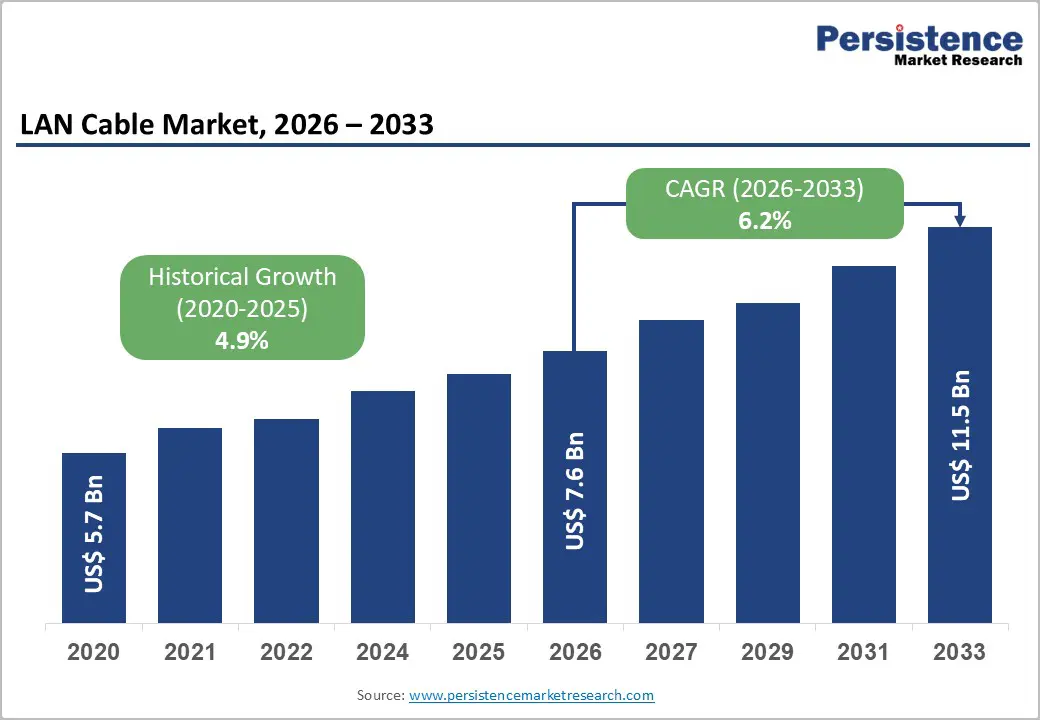
The global LAN cable market size is expected to be valued at US$ 7.6 billion in 2026 and projected to reach US$ 11.5 billion by 2033, growing at a CAGR of 6.2% between 2026 and 2033.
The market is witnessing sustained growth driven by the exponential rise in data traffic, the rapid deployment of hyperscale data centers, and the increasing demand for high-speed internet connectivity. As enterprises transition to cloud-based operations and IoT ecosystems expand globally, the need for reliable wired connectivity continues to grow. Advancements in structured cabling standards and government-backed digital infrastructure programs are further reinforcing market expansion.
Key Industry Highlights:
- Leading Cable Type: Cat6 dominates the market with around 27% share in 2026, valued at over US$ 2.1 Bn, driven by its cost efficiency, 10 Gbps capability, and widespread adoption in enterprise and smart building networks.
- Leading Shielding Type: Unshielded Twisted Pair (UTP) leads with over 65% market share in 2026, valued at more than US$ 4.9 Bn, due to its low cost, ease of installation, and strong suitability for residential and commercial applications.
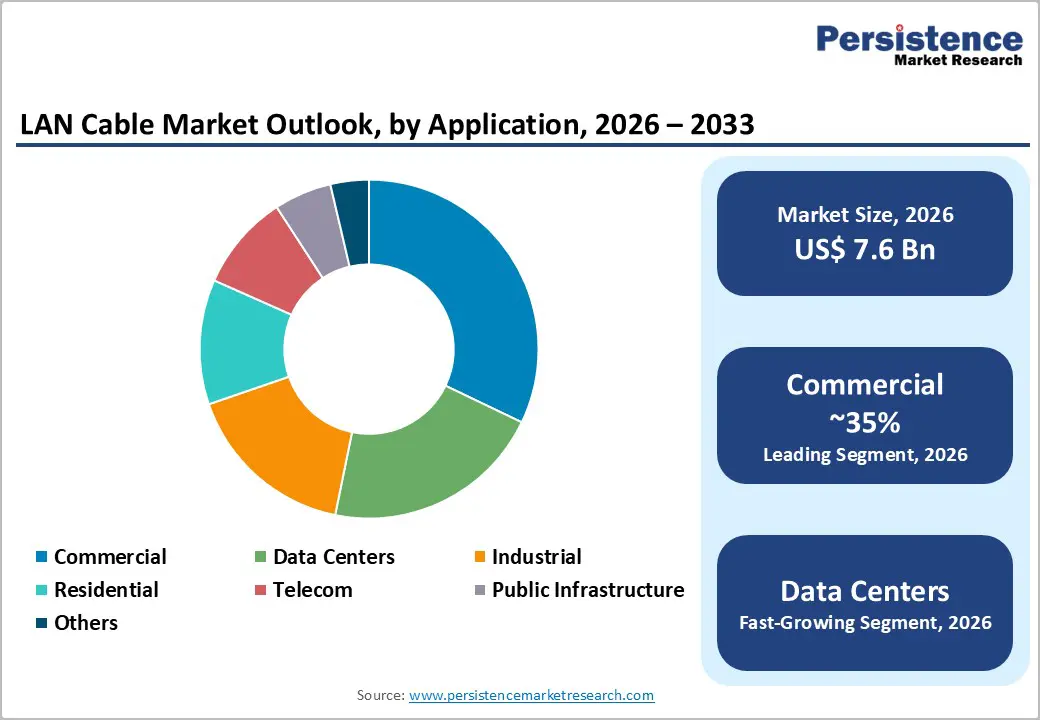
- Leading Application: Commercial segment dominates with approximately 35% share in 2026, valued at over US$ 2.7 Bn, driven by enterprise digitalization, hybrid work models, and continuous network upgrades.
- Fastest-Growing Application: Data Centers are the fastest-growing, expanding at a CAGR of 10.4%, fueled by cloud computing, AI workloads, and hyperscale infrastructure expansion.
- Leading Sales Channel: The Aftermarket channel is the fastest growing, expanding at a CAGR of 22.6%, driven by increasing demand for retrofit solutions, vehicle upgrades, and cost-effective access to advanced security features in existing vehicles.
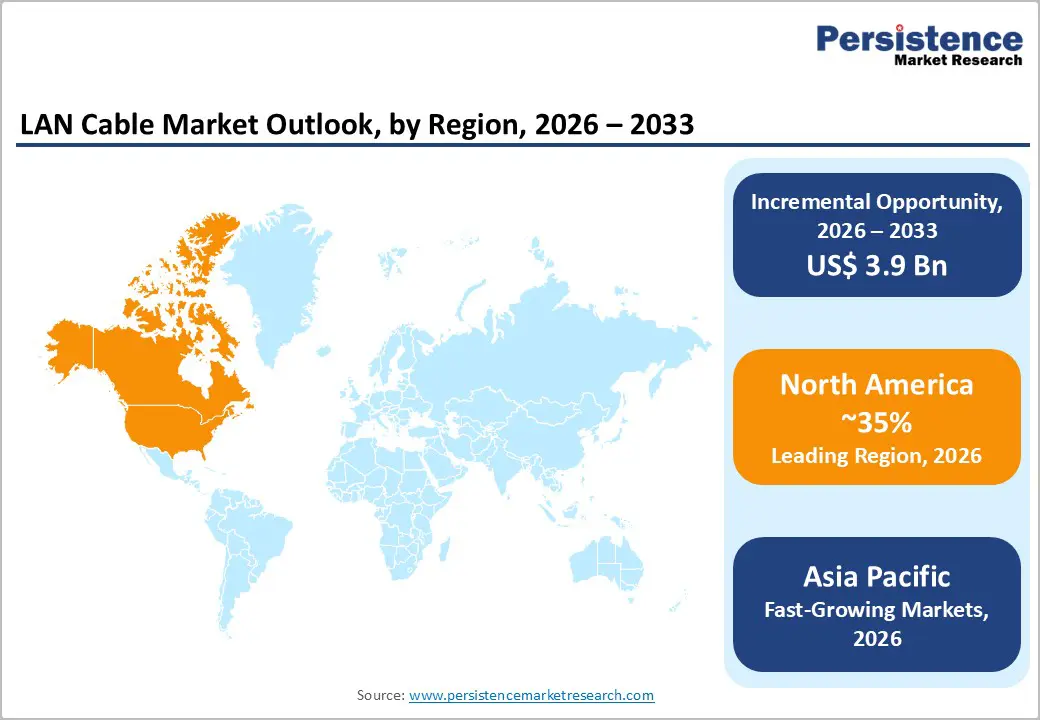
- Leading Region: North America leads the market with around 34% share in 2026, valued at more than US$ 2.6 Bn, supported by advanced digital infrastructure, a strong presence of hyperscale data centers, and strong enterprise IT spending.
- Fastest Growing Region: Asia Pacific is the fastest-growing region with a CAGR of 10.9%, driven by rapid 5G deployment, urbanization, and large-scale smart infrastructure investments.
Market Dynamics
Drivers - Growing Need for Low-Latency and High-Reliability Connectivity in Enterprise Networks
Modern enterprises increasingly require ultra-reliable and low-latency connectivity to support mission-critical applications such as real-time analytics, financial transactions, and enterprise resource planning systems. Unlike wireless networks, LAN cables provide stable and interference-free performance, making them indispensable in sectors such as BFSI and healthcare. Global telecom infrastructure data shows that over 99% of international data traffic is carried through cable-based backbone networks, emphasizing the reliance on high-performance wired connectivity. This rising need for uninterrupted connectivity ensures sustained demand for high-quality LAN cables, particularly in structured office environments where network downtime can result in significant operational losses.
Growing Need for Energy-Efficient and Sustainable Networking Solutions
Energy efficiency and sustainability have become critical considerations in network infrastructure planning. LAN cables consume significantly less energy compared to wireless networking systems, particularly in high-density environments such as data centers and commercial buildings. Organizations are aligning with sustainability goals and regulations promoted by bodies such as the International Energy Agency (IEA), driving demand for efficient wired solutions. Advancements in eco-friendly cable materials and manufacturing processes are further supporting adoption, as companies seek to reduce their carbon footprint while maintaining high-performance connectivity.
Restraints - Rising Competition from Wireless and Fiber-Optic Technologies
The growing maturity and decreasing cost of Wi-Fi 6 and Wi-Fi 6E wireless networking technologies pose an indirect competitive challenge to copper LAN cable adoption in residential and light commercial applications. Wi-Fi 6E devices now support a theoretical throughput of up to 9.6 Gbps, reducing the perceived need for wired installations in cost-sensitive environments. Within data centers, operators are increasingly replacing Cat6a with active optical cables and direct-attach copper assemblies rated for 400G and 800G, shrinking the addressable legacy copper LAN segment. This dual pressure from wireless above and fiber below constrains LAN cable market expansion in premium high-speed environments.
Raw Material Price Volatility and Supply Chain Disruptions
Copper remains the primary conductor material for LAN cables, and its price volatility directly impacts manufacturing costs and profit margins across the supply chain. Global copper prices experienced significant fluctuations, exceeding USD 14,500 per tonne (intraday) in January 2026, after only passing USD 12 000 per tonne for the first time in December 2025, compressing margins for cable manufacturers. Geopolitical tensions, trade tariffs, and logistics disruptions, as flagged, continue to impair supply chain predictability. Smaller manufacturers that lack vertical integration or strategic stockpiling capabilities are particularly vulnerable, potentially reducing market participation and limiting competitive product availability in emerging regional markets.
Opportunities - Power over Ethernet (PoE) Integration in Smart Buildings
Power over Ethernet (PoE) enables a single Cat6a or Cat8 cable to simultaneously deliver data and electrical power up to 90 watts, as defined by IEEE 802.3bt, powering LED lighting, IP cameras, VoIP phones, access control systems, and environmental sensors across commercial buildings. The global smart building market is anticipated to grow substantially through 2030, with intelligent building systems requiring upgraded cabling infrastructure to support PoE++ standards. As enterprises pursue energy efficiency certifications such as LEED and BREEAM, the integration of PoE-enabled LAN cabling into building management ecosystems is expected to create high value.
Integration of LAN Cabling in 5G Backhaul and Edge Computing Infrastructure
The rapid deployment of 5G networks is creating significant opportunities for LAN cable manufacturers, particularly in backhaul and edge computing environments. While 5G is wireless at the access level, it relies heavily on high-speed wired infrastructure for data transmission between base stations and core networks. According to estimates from the International Telecommunication Union (ITU), global 5G coverage is expanding at a double-digit rate annually, requiring robust internal cabling solutions. LAN cables, especially Cat6a and Cat8, are increasingly used in edge data centers to support ultra-low latency applications such as autonomous systems and real-time analytics.
Category-wise Analysis
Cable Type Insights
Cat6 dominates the Cable Type segment, accounting for approximately 27% of the market share with a value exceeding US$ 2.1 Bn in 2026 due to its balanced ability to meet current bandwidth and cost requirements. It supports speeds up to 10 Gbps over shorter distances, making it ideal for office networks, smart buildings, and small data centers. The growing need for stable video conferencing, cloud applications, and IoT connectivity further drives adoption. Ease of installation and widespread compatibility with existing hardware also strengthen its dominance.
Cat8 is emerging as the fastest-growing segment, driven by the increasing demand for ultra-high-speed data transmission in hyperscale data centers and high-performance computing environments. It supports speeds up to 25-40 Gbps with minimal latency, making it suitable for short-distance, high-density networking. The rise in AI workloads, edge computing, and real-time data processing is accelerating its demand. Its superior shielding and performance capabilities make it essential for next-generation networking needs.
Shielding Type Insights
Unshielded Twisted Pair (UTP) holds over 65% share in 2026, with a value of over US$ 4.9 Bn, due to its cost-effectiveness, flexibility, and ease of deployment. It is widely used in residential, commercial, and light industrial environments where electromagnetic interference is minimal. UTP cables are also easier to install and maintain, reducing overall infrastructure costs. Their compatibility with most networking equipment further reinforces their dominant position.
The Shielded Twisted Pair (STP) segment is experiencing the fastest growth, driven by the growing need for reliable data transmission in high-interference environments such as industrial facilities and data centers. STP cables provide enhanced protection against electromagnetic interference and crosstalk, ensuring consistent network performance. Increasing deployment of high-speed cables like Cat7 and Cat8, which often require shielding, also contributes to growth. As network reliability becomes critical, STP adoption is accelerating despite higher costs.
Application Insights
Commercial leads the application segment, accounting for approximately 35% of the market share in 2026, valued at US$ 2.7 Bn. Businesses increasingly rely on high-speed internet for cloud computing, communication tools, and digital operations. The shift toward hybrid work models and smart office environments further boosts demand for structured cabling. Continuous upgrades of legacy systems to support higher bandwidth also contribute to growth. Scalability requirements in commercial spaces drive consistent investments in LAN cables.
Data centers represent the fastest-growing end-use segment with a CAGR of 10.4%, fueled by the rapid expansion of cloud computing, hyperscale facilities, and digital services. Increasing data traffic from streaming, AI, IoT, and enterprise applications is driving the need for high-performance cabling solutions. Data centers require low-latency, high-speed connectivity, driving greater adoption of advanced cables. The need for efficient and reliable interconnectivity infrastructure is making LAN cables a critical component in modern data center ecosystems.
Regional Insights
North America LAN Cable Market Trends and Insights
North America holds a significant position in the LAN Cable market, with an estimated share of around 34% in 2026, exceeding US$ 2.6 Bn value, driven by the United States’ advanced digital infrastructure, high enterprise IT spending, and the presence of hyperscale operators such as Amazon Web Services, Microsoft Azure, and Google Cloud. Regulatory frameworks such as ANSI/TIA-568 structured cabling standards ensure uniform performance and installation quality.
Government initiatives, including broadband expansion programs and the CHIPS and Science Act, are further supporting infrastructure growth. Canada is emerging as a strategic secondary data center location, particularly in Toronto and Vancouver, thanks to its favorable climate and access to renewable energy.
Europe LAN Cable Market Trends and Insights
Europe holds a significant share of over 26% in 2026, supported by the European Union’s Digital Decade initiative, which targets universal Gigabit connectivity by 2030. Germany leads demand due to its strong industrial base and Industry 4.0 investments, while the United Kingdom benefits from financial sector digitization and data center expansion in London. Countries such as France and Spain are witnessing steady growth in broadband infrastructure and increasing structured cabling installations. Regulatory compliance frameworks like RoHS and ISO/IEC 11801 standards are driving the adoption of halogen-free and sustainable cables, with companies such as Nexans focusing on eco-friendly innovations.
Asia Pacific LAN Cable Market Trends and Insights
Asia Pacific is expected to grow at a CAGR of 10.9%, driven by rapid urbanization and the expansion of digital infrastructure. China dominates demand through large-scale telecom investments, smart city projects, and extensive 5G deployment led by China Mobile, China Telecom, and China Unicom. India is emerging as a high-growth market, supported by initiatives such as Digital India and BharatNet, driving double-digit growth in metropolitan Ethernet cable demand. Japan contributes high-value demand for advanced categories such as Cat7 and Cat7a, driven by automation and precision manufacturing.
The region is steadily transitioning toward higher-specification cables, alongside growing competition from fiber in backbone networks.
Competitive Landscape
The global LAN cable market is moderately fragmented, with the top players collectively holding over 35% of the market. Market leaders differentiate through ISO/IEC compliance laboratories, proprietary shielding technologies, sustainability credentials, and end-to-end structured cabling solutions.
Research and development investments are focused on eco-friendly cable compounds using halogen-free and recyclable materials, meeting increasingly stringent RoHS and REACH environmental regulations. Strategic partnerships between cabling manufacturers and connectivity solution providers are intensifying to capture hyperscale data center project pipelines.
Key Developments:
- In May 2025, Belden Inc. introduced a new TIA-compliant small-diameter Category 6A (Cat 6A) Ethernet cable designed to support high-performance network connectivity. The cable enables improved space efficiency and easier installation in high-density environments such as data centers and enterprise networks. This innovation enhances structured LAN cabling solutions while maintaining support for high-speed data transmission up to 10 Gbps.
- In January 2025, Prysmian Group showcased its advanced extended-distance Ethernet and structured cables, highlighting innovations in Category 5e, Category 6, and Category 6A copper LAN cables. The solutions are designed to support longer-reach Ethernet connectivity for enterprise networks, smart buildings, and data centers.
Companies Covered in LAN Cable Market
- CommScope Holding Company
- Corning Incorporated
- Nexans S.A.
- Prysmian Group
- Belden Inc.
- Legrand S.A.
- Panduit Corp.
- Siemon Company
- TE Connectivity
- Schneider Electric
- Furukawa Electric Co., Ltd.
- ABB Ltd.
- Leviton Manufacturing Co., Inc.
- Sumitomo Electric Industries
- Others
Frequently Asked Questions
US$ 7.6 Billion, driven by the rapid expansion of data centers, cloud computing infrastructure, 5G rollout, and growing enterprise network upgrades globally.
The need for high-speed, low-latency, and stable wired connectivity to support growing digital workloads and uninterrupted data transmission.
North America leads with 34% share (2026), driven by strong demand from hyperscale data centers, advanced enterprise networking infrastructure, and large-scale cloud deployments.
The rising adoption of IoT, edge computing, and smart buildings is increasing demand for reliable, high-bandwidth structured cabling.
Leading players include CommScope Holding Company, Corning Incorporated, Nexans S.A., Prysmian Group, Belden Inc., Legrand S.A.


