




- Electrical Equipment & Services
- Electric Vehicles Wiring Harness Market
Electric Vehicles Wiring Harness Market Size, Share, and Growth Forecast 2026 - 2033
Electric Vehicles Wiring Harness Market by Wiring Harness Type (Traction Wiring Harness, Body Wiring Harness, Chassis Wiring Harness, HVAC Wiring Harness, Battery Wiring Harness, Dashboard Wiring Harness, Door Wiring Harness, Others), Component (Connectors, Terminals, Locks, Wires/Cables, Outer Coverings, Others), Connector Type, by Material Type, by Power Type, by Regional Analysis, 2026 - 2033

Electric Vehicles Wiring Harness Market Size and Trend Analysis
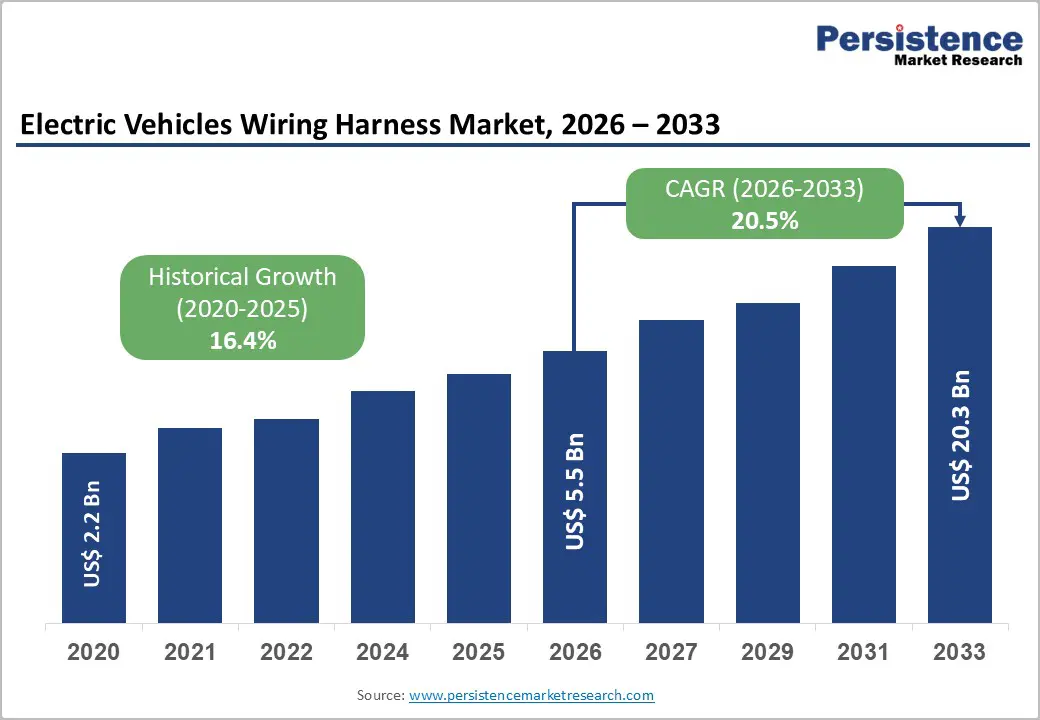
The global electric vehicles wiring harness market size is likely to be valued at US$ 5.5 Billion in 2026 and is expected to reach US$ 20.3 Billion by 2033, growing at a CAGR of 20.5% during the forecast period from 2026 and 2033. Explosive growth in electric vehicle (EV) adoption worldwide drives this surge, fueled by government incentives and battery technology advancements.
Key Industry Highlights:
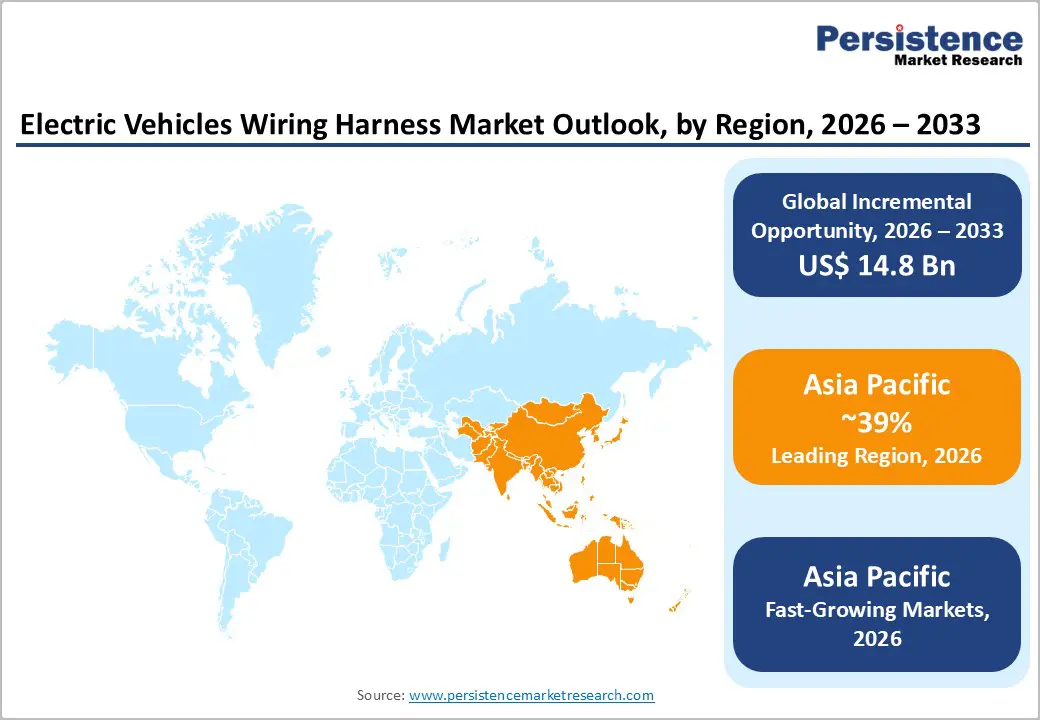
- Leading Region: Asia Pacific dominates the EV wiring harness market holding 39% share, led by China’s large-scale manufacturing ecosystem and strong government incentives, which accelerate EV production, strengthen supply chains, and support widespread adoption of advanced vehicle electrical systems.
- Fastest-Growing Region: Asia Pacific is the fastest-growing region with rising CAGR of 26.5%, driven by rising EV assembly in India and ASEAN countries, supported by favorable policies, increasing investments, and expanding local manufacturing capabilities for automotive components and wiring systems.
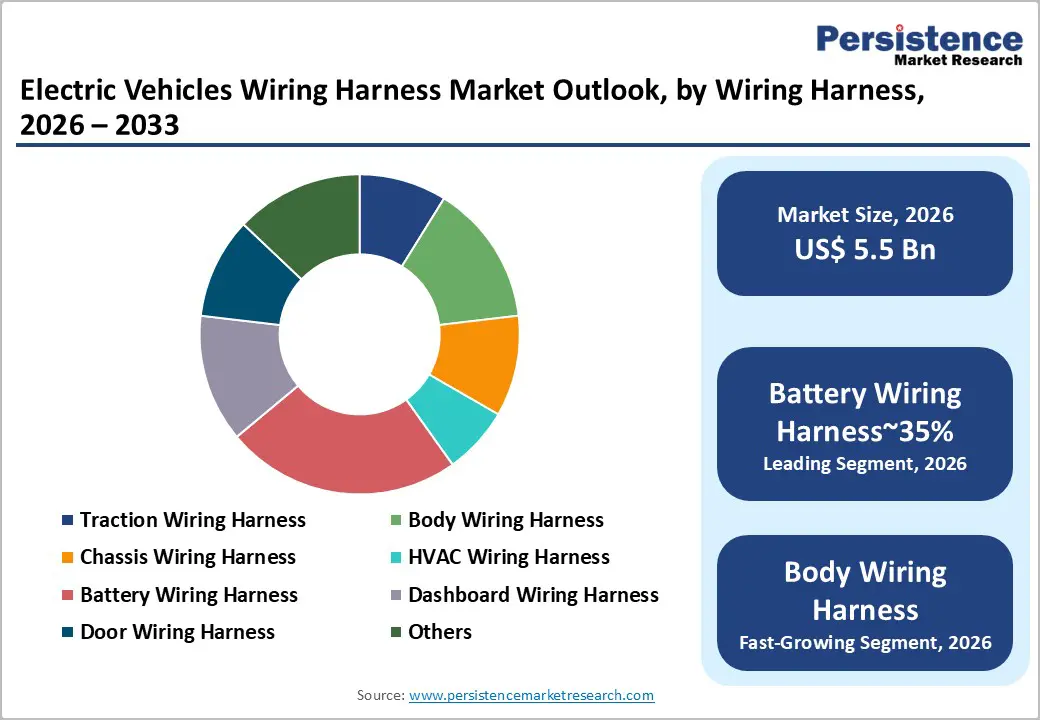
- Leading Segment: Battery wiring harness leads the market with 35% share, due to its critical role in managing high-voltage power distribution, ensuring safety, reliability, and efficiency in EV battery systems, particularly in lithium-ion-based electric vehicle architectures.
- Fastest-Growing Segment: Optical fiber wiring is rapidly gaining traction in autonomous vehicles, as it supports high-speed data transmission, reduces electromagnetic interference, and enables efficient communication for ADAS and software-defined vehicle technologies.
- Key Opportunity: Multi-motor EV platforms present strong growth opportunities, especially in commercial fleet electrification, as they require advanced wiring harness systems to manage complex power distribution, improving performance, efficiency, and operational reliability.
| Key Insights | Details |
|---|---|
| Electric Vehicles Wiring Harness Market Size (2026E) | US$ 5.5 Billion |
| Market Value Forecast (2033F) | US$ 20.3 Billion |
| Projected Growth CAGR(2026 - 2033) | 20.5% |
| Historical Market Growth (2020 - 2025) | 16.4% |
DRO Analysis
Drivers - Rapid EV Production Scale-Up and Electrification Mandates
Global electric vehicle (EV) production is expanding rapidly, driven by aggressive electrification targets set by governments worldwide, which is significantly increasing the demand for advanced wiring harness systems. According to the International Energy Agency (IEA), EV production in China is expected to reach approximately 10 million units in 2025, reflecting a strong 35% year-over-year growth.
This surge requires highly specialized wiring harnesses capable of supporting high-power battery and traction systems. Additionally, regulatory frameworks such as the European Union’s target of achieving 100% zero-emission vehicle sales by 2035 are compelling automakers to accelerate EV adoption. These mandates are pushing manufacturers to integrate more sophisticated wiring harness solutions that enhance vehicle efficiency, ensure operational safety, and support high-voltage architectures, ultimately making wiring harnesses a critical component in next-generation EV platforms.
Advancements in High-Voltage Systems and ADAS Integration
The evolution of EV architecture toward high-voltage systems and advanced driver assistance systems (ADAS) is significantly transforming wiring harness requirements. Modern EVs are increasingly adopting 800V platforms, which demand highly durable and efficient harness solutions capable of managing increased power loads and ensuring system reliability. At the same time, the integration of ADAS technologies is driving exponential growth in data transmission requirements.
According to SAE J1939 standards, EV wiring harnesses now handle up to 500% more data compared to traditional internal combustion engine vehicles. Leading manufacturers such as Tesla have reported a 40% increase in production output in 2025, further emphasizing the need for scalable and high-performance harness solutions. Additionally, the adoption of lightweight materials in harness design is helping reduce overall vehicle weight by nearly 10%, thereby improving driving range and supporting the transition toward Level 3 autonomous capabilities.
Restraints - Supply Chain Disruptions in Copper and Semiconductor Components
The EV wiring harness market continues to face notable challenges due to ongoing supply chain disruptions, particularly in the availability of critical raw materials such as copper and semiconductor components. Copper prices have surged by approximately 25% in 2025, as reported by the London Metal Exchange (LME), significantly increasing production costs for manufacturers. At the same time, semiconductor shortages have created bottlenecks in the availability of connectors and electronic components, further impacting production timelines.
Industry leaders such as Aptiv PLC have reported delays affecting nearly 20% of their order volumes, highlighting the severity of these disruptions. These supply constraints not only increase operational costs but also reduce production efficiency and limit the ability of manufacturers to meet growing demand. As a result, companies are increasingly focusing on supplier diversification and material optimization strategies to mitigate risks and maintain supply continuity.
Complex Design Challenges for Zonal Architectures
The shift toward zonal electrical architectures in EVs is introducing significant design and engineering complexities for wiring harness manufacturers. Unlike traditional centralized systems, zonal architectures require decentralized wiring layouts, which increase design intricacy and demand advanced engineering capabilities. According to SAE technical papers, transitioning to zonal architectures can increase engineering and development costs by approximately 15-20%.
Furthermore, legacy internal combustion engine (ICE) vehicle platforms are not easily adaptable to these new architectures, creating additional integration challenges for automakers. This limitation is particularly pronounced among mid-tier manufacturers that lack the resources to invest in complete platform redesigns. As a result, the adoption of zonal architectures is progressing at a slower pace in certain market segments. Despite their long-term benefits in reducing wiring complexity and improving efficiency, the initial cost burden and technical challenges remain key barriers to widespread implementation.
Opportunities - Rise of Multi-Motor and Heavy-Duty EV Platforms
The growing adoption of multi-motor configurations and heavy-duty electric vehicle platforms presents a significant opportunity for the wiring harness market. Vehicles equipped with dual or multiple motors require more complex and scalable harness systems to efficiently manage power distribution across different components. For instance, the Ford F-150 Lightning has recorded a 50% increase in sales in 2025, according to the U.S. Department of Energy, highlighting strong demand for high-performance EVs.
These vehicles rely heavily on advanced chassis and powertrain wiring harnesses to ensure optimal functionality. Additionally, the commercial EV segment is expected to grow at an annual rate of 25% through 2030, supported by favorable government incentives such as the Inflation Reduction Act. This growth is driving demand for durable and high-capacity wiring solutions, particularly in logistics and fleet applications, creating new revenue streams for manufacturers.
Optical Fiber Adoption for High-Speed Data Networks
The increasing demand for high-speed data transmission in EVs is driving the adoption of optical fiber wiring harnesses as an alternative to traditional copper-based systems. Optical fiber solutions offer significant advantages, including up to 70% weight reduction and the ability to support gigabit-speed data transmission, making them ideal for next-generation vehicle networks. In 2025, Broadcom reported successful testing of optical fiber systems that delivered up to 10 times faster response rates for ADAS applications, aligning with IEEE 802.3 standards.
Furthermore, stringent data security regulations such as Europe’s GDPR and China’s data protection laws are encouraging the use of secure and interference-resistant communication technologies. As vehicles become increasingly software-defined, the integration of optical fiber harnesses is expected to play a crucial role in enabling faster, more reliable, and secure in-vehicle data communication systems.
Category-wise Analysis
Wiring Harness Type Insights
Battery wiring harnesses hold the largest share of approximately 35% in the EV wiring harness market, primarily due to their critical role in ensuring safe and efficient high-voltage power transmission within electric vehicles. These harnesses are specifically designed to support lithium-ion battery systems, where reliability and safety are of utmost importance. According to SAE testing standards, battery wiring harnesses demonstrate an impressive reliability rate of 99.9% over 500,000 operational cycles, making them essential for long-term vehicle performance.
Leading EV manufacturers such as BYD have integrated battery wiring harnesses into nearly 80% of their vehicle models, reflecting their widespread adoption. As battery capacities continue to increase and EV performance expectations rise, the demand for high-quality battery harness solutions is expected to grow further. This segment will remain a key focus area for innovation, particularly in improving durability, thermal management, and system integration.
Component Insights
Connectors represent the largest component segment in the EV wiring harness market, accounting for approximately 40% of the total market share. These components play a vital role in enabling modular and flexible vehicle designs, allowing manufacturers to simplify assembly and maintenance processes. According to data from TE Connectivity, modern connectors are capable of handling voltage surges of up to 1,000V, making them suitable for high-voltage EV applications. However, connectors are also identified as one of the most failure-prone components, accounting for nearly 60% of potential issues, as per ISO 26262 standards.
This dual role highlights the importance of continuous innovation in connector design to enhance durability and reliability. As EV production scales up, the demand for high-performance connectors that support fast assembly, efficient power distribution, and easy serviceability is expected to increase significantly across global markets.
Connector Type Insights
Wire-to-wire connectors dominate the connector type segment, holding approximately 50% of the market share due to their flexibility and ease of integration in complex wiring systems. These connectors are widely used for routing electrical connections across various vehicle components, enabling efficient system design. According to Sumitomo Electric, the use of wire-to-wire connectors can reduce assembly time by up to two times, significantly improving manufacturing efficiency.
They are also extensively used in leading EV models, including those produced by Tesla, where they account for nearly 70% of harness configurations based on supply chain filings. Their ability to support modular architectures and simplify installation makes them highly preferred among manufacturers. As EV designs become more sophisticated, the demand for versatile and high-performance connector solutions is expected to grow, further strengthening the position of wire-to-wire connectors in the market.
Material Type Insights
Metal-based materials, particularly copper and its alloys, dominate the EV wiring harness market with an estimated share of 85%, owing to their superior electrical conductivity and reliability. Copper alloys are capable of achieving up to 98% conductivity efficiency at 800V, as per ASTM standards, making them the preferred choice for high-performance applications. However, rising copper costs and supply constraints are encouraging manufacturers to explore alternative materials such as aluminum, especially in cost-sensitive segments.
Aluminum offers a lightweight and cost-effective solution, although it has slightly lower conductivity compared to copper. Despite this, the ongoing focus on reducing vehicle weight and improving energy efficiency is supporting the gradual adoption of aluminum-based wiring solutions. Overall, while copper remains the dominant material, the market is witnessing a steady shift toward hybrid material strategies to balance performance, cost, and sustainability requirements.
Power Type Insighhts
Single-motor electric vehicles currently dominate the power type segment, accounting for approximately 60% of the market share, primarily due to their affordability and widespread adoption in entry-level EV models. These vehicles utilize simpler wiring harness systems, which help reduce manufacturing costs and improve overall efficiency. A notable example is the Nissan Leaf, which has achieved cumulative sales of over 1.5 million units, according to the Japan Automobile Manufacturers Association (JAMA).
The popularity of single-motor EVs is particularly strong in emerging markets, where cost sensitivity plays a significant role in purchasing decisions. However, as consumer preferences shift toward higher performance vehicles, the demand for multi-motor configurations is gradually increasing. Despite this trend, single-motor EVs are expected to maintain their dominance in the near term, supported by their cost advantages and suitability for urban mobility applications.
Regional Insights
North America Electric Vehicles Wiring Harness Market Trends
North America continues to play a leading role in the EV wiring harness market, driven by strong government support and increasing EV adoption rates. In the United States, policies such as the Inflation Reduction Act (IRA) have significantly boosted EV sales, resulting in approximately 2 million new EV registrations in 2025, according to the Environmental Protection Agency (EPA). This growth has encouraged major industry players to expand their manufacturing capabilities.
Aptiv has invested $1 billion in a new facility in Michigan to support key automakers such as General Motors and Ford. Additionally, innovation in wiring harness technology is gaining momentum, with organizations like SAE promoting advanced standards. Tesla’s adoption of 48V electrical architectures has reduced harness weight by nearly 30%, improving efficiency. These developments are positioning North America as a hub for technological advancement and large-scale EV production.
Europe Electric Vehicles Wiring Harness Market Trends
Europe remains a key market for EV wiring harnesses, with strong leadership from countries such as Germany, supported by substantial government investments and favorable regulatory frameworks. The Volkswagen Group alone produces nearly 1 million electric vehicles annually, benefiting from over €90 billion in subsidies and investments across the region. Standardization initiatives such as EN 50600 are helping harmonize safety and performance requirements across major markets, including France and the United Kingdom.
Additionally, technological innovation is gaining traction, with companies like SEAT in Spain integrating optical fiber solutions to enhance in-vehicle data transmission speeds by up to 25%, as reported by the European Commission. These advancements are supporting the development of next-generation EV architectures. Overall, Europe’s focus on sustainability, innovation, and regulatory alignment continues to drive growth in the EV wiring harness market.
Asia Pacific Electric Vehicles Wiring Harness Trends
Asia Pacific dominates the global EV wiring harness market, led by China, which produces approximately 12 million electric vehicles annually, according to the China Association of Automobile Manufacturers (CAAM). The region’s strong manufacturing ecosystem and government support have positioned it as a global leader in EV production. Companies such as CATL are driving demand for advanced battery systems, which in turn require high-performance wiring harness solutions.
In India, government initiatives like the FAME III scheme are accelerating EV adoption, with companies such as Tata Motors reporting a 40% increase in production. Additionally, global players like Furukawa Electric are expanding their local manufacturing presence to cater to growing demand. The combination of high production volumes, policy support, and technological advancements makes Asia Pacific a key growth engine for the EV wiring harness market.
Competitive Landscape
The EV wiring harness market is moderately consolidated, with leading players such as Aptiv, TE Connectivity, and Sumitomo Electric collectively accounting for nearly 50% of the global market share. These companies leverage strong vertical integration strategies to maintain a competitive edge and ensure supply chain efficiency. Continuous investment in research and development, particularly in 800V systems and zonal architectures, is enabling them to differentiate their offerings through innovation and proprietary technologies.
In addition, market leaders are expanding their global footprint by targeting emerging regions such as ASEAN through joint ventures with original equipment manufacturers (OEMs). Another emerging trend is the introduction of subscription-based models for software-updatable wiring systems, reflecting the shift toward software-defined vehicles. Overall, the competitive landscape is characterized by innovation, strategic partnerships, and a strong focus on scalability and future-ready solutions.
Key Developments:
- In February, 2025: Aptiv PLC introduced an advanced 800V high-voltage wiring harness system for the Lucid Air, achieving a 25% reduction in overall weight while improving energy efficiency, thermal performance, and power delivery, supporting next-generation EV architectures.
- In October, 2024: Sumitomo Electric announced a strategic partnership with BYD to scale mass production of battery wiring harnesses, focusing on high-voltage safety, manufacturing efficiency, and supply chain optimization to support the rapid expansion of electric vehicle production globally.
- In June, 2025: TE Connectivity launched next-generation optical connectors designed for automotive applications, fully compliant with IEEE standards, enabling high-speed data transmission, improved signal integrity, and lightweight solutions to support advanced driver assistance systems and software-defined vehicle architectures.
Companies Covered in Electric Vehicles Wiring Harness Market
- Aptiv PLC
- BizLink Holding Inc.
- Delphi Technologies
- Furukawa Electric Co., Ltd.
- Hitachi Automotive Systems, Ltd.
- Keboda Technology Co., Ltd.
- Lear Corporation
- Leoni AG
- Metra Electronics Corporation
- Motherson Sumi Systems Limited
- Nexans S.A.
- Samvardhana Motherson Group
- Sumitomo Electric Industries, Ltd.
- TE Connectivity Ltd.
- THB Group
- Yazaki Corporation
- Daimler Truck AG
Frequently Asked Questions
The electric vehicles wiring harness market is likely to be valued at US$ 5.5 Billion in 2026, reaching US$ 20.3 Billion by 2033 at 20.5% CAGR.
EV production surge and 800V systems, with 18 million global sales per IEA.
Battery Wiring Harness at 35% share for high-voltage reliability.
Asia Pacific powered by China's 12 million EV output.
Optical fiber for ADAS, reducing weight 70% per industry tests.
Aptiv, TE Connectivity, Sumitomo lead via high-voltage innovations.


