




- Construction & Engineering
- Mezzanine Floor Market
Mezzanine Floor Market Size, Share, and Growth Forecast 2026 - 2033
Mezzanine Floor Market by Product Type (Structural Steel, Rack-Supported, Shelf-Supported, Free-Standing), by Material (Steel, Aluminum, Concrete, Wood), by Load Capacity (Light Duty (Below 300 kg/m²), Medium Duty (300-1000 kg/m²), Heavy Duty (Above 1000 kg/m²)), Industry (Logistics & Warehousing, E-commerce, Automotive, Food & Beverage, Pharmaceuticals, Retail, Chemicals), and Regional Analysis, 2026 - 2033

Mezzanine Floor Market Size and Trend Analysis
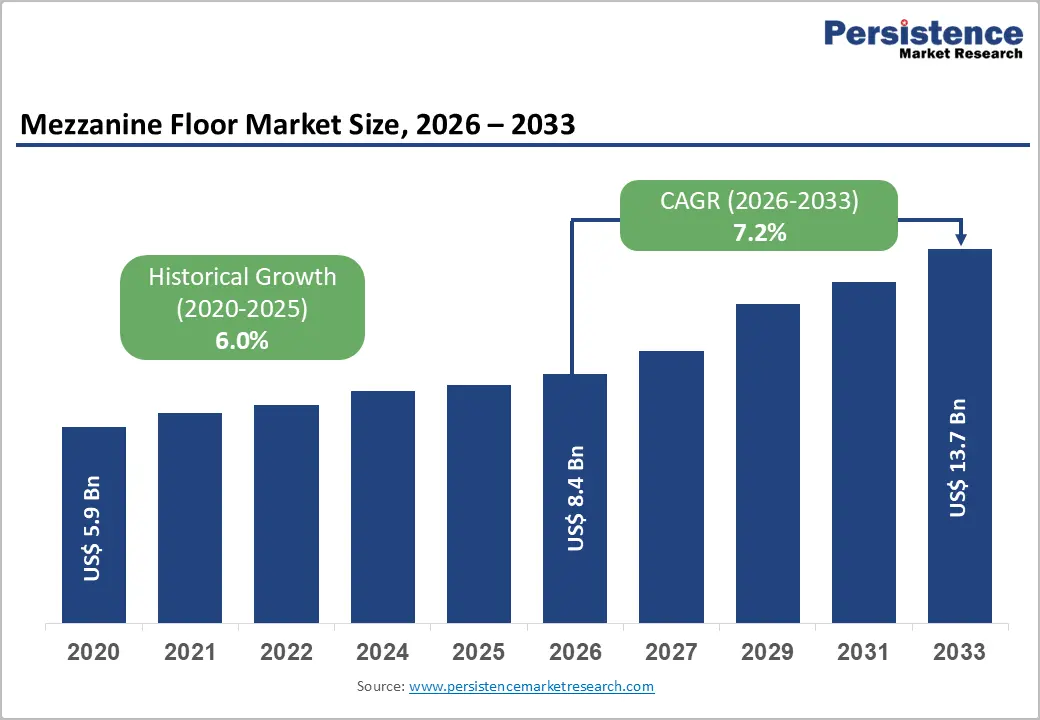
The global mezzanine floor market size is expected to be valued at US$ 8.4 billion in 2026 and projected to reach US$ 13.7 billion by 2033, growing at a CAGR of 7.2% between 2026 and 2033.
Rapid urbanization and the surge in e-commerce amplify this growth, as businesses seek efficient space optimization solutions. Rising air cargo volumes and expanding global trade are accelerating demand for warehouse infrastructure, while increased industrial and logistics activity further supports mezzanine adoption.
Rapid urban population growth and limited land availability are driving the adoption of multi-level storage systems, enabling businesses to maximize vertical space and enhance operational efficiency without incurring the high cost of new facility construction.
Key Industry Highlights:
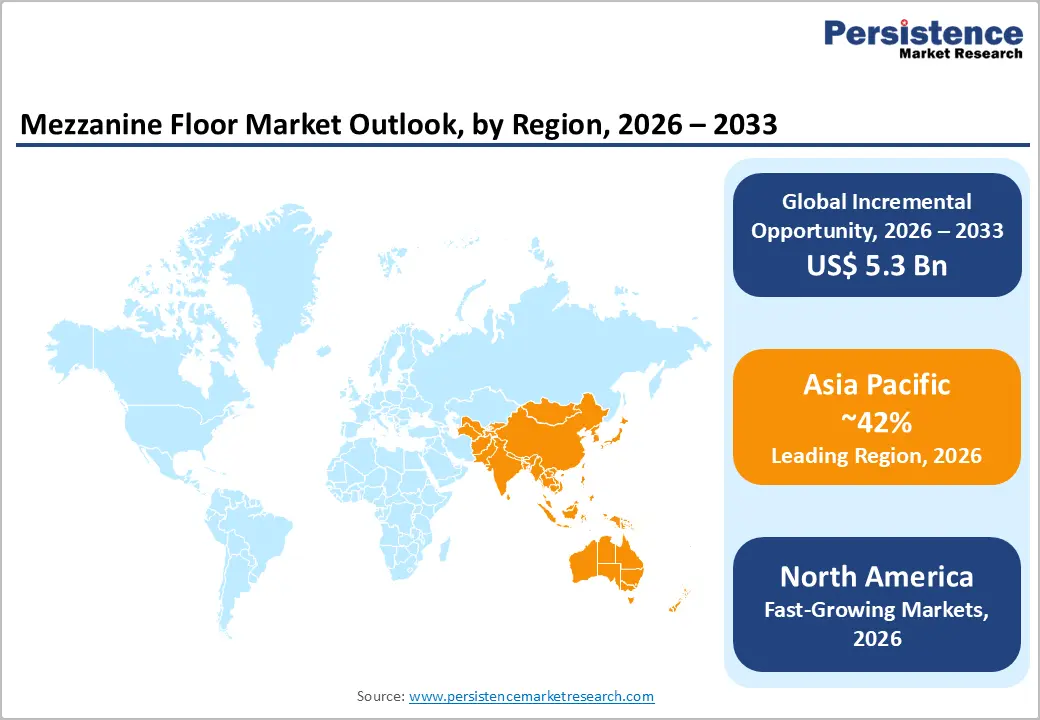
- Leading Region: Asia Pacific holds about 42% share in 2025, driven by rapid urbanization and logistics expansion across major economies.
- Fastest Growing Region: North America is the fastest growing region, supported by strong e-commerce growth and warehouse automation.
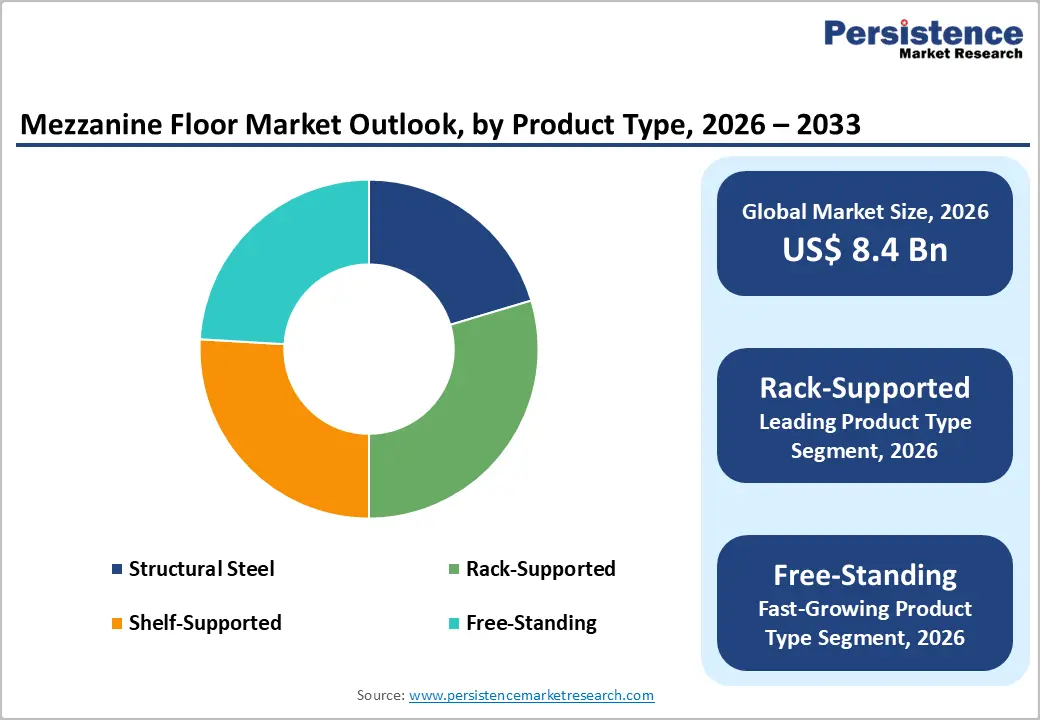
- Leading Product Type Category: Rack-supported mezzanines lead with around 35% share in 2025, due to efficient integration with pallet systems.
- Leading Material Category: Steel dominates with about 45% share in 2025, offering strength, durability, and cost efficiency.
- Key Opportunity: Sustainable retrofitting and energy-efficient upgrades enabled by mezzanine floors offer strong growth potential.
| Key Insights | Details |
|---|---|
| Mezzanine Floor Size (2026E) | US$ 8.4 billion |
| Market Value Forecast (2033F) | US$ 13.7 billion |
| Projected Growth CAGR (2026 - 2033) | 7.2% |
| Historical Market Growth (2020 - 2025) | 6.0% |
Market Dynamics
Drivers - Rising E-commerce Growth and Intensified Warehousing Operations Driving Demand
The rapid expansion of e-commerce and the increasing intensity of warehousing operations are key drivers of the mezzanine floor market. Online retail continues to grow rapidly, driving a surge in fulfillment centers, distribution hubs, and last-mile delivery infrastructure. Logistics operators and retailers are under pressure to optimize space utilization and improve order processing efficiency within existing facilities.
Mezzanine floors enable businesses to create additional operational space for picking, packing, sorting, and administrative functions without expanding their physical footprint. This allows companies to significantly enhance storage density and workflow efficiency while minimizing capital investment. As a result, industries such as logistics, retail, and manufacturing are increasingly adopting mezzanine solutions to support high-volume operations and meet growing consumer demand.
Urbanization and Land Constraints Driving Vertical Space Utilization Growth
Rapid urbanization and increasing land constraints in major economic regions are significantly driving demand for mezzanine floor solutions. Expanding urban populations and industrial activities have led to higher real estate costs and limited availability of large industrial plots. This has encouraged businesses to maximize the use of existing infrastructure rather than investing in new construction.
Mezzanine floors provide an efficient way to expand vertically within existing buildings, enabling additional storage, office, and operational areas. Supported by modern engineering standards, these structures ensure safety, load-bearing capacity, and regulatory compliance. This makes them particularly suitable for industries such as food and beverage, pharmaceuticals, and automotive, where organized and space-efficient layouts are essential for operational success.
Restraints - High Upfront Investment and Custom Engineering Costs Limiting Adoption
High upfront investment remains a key restraint in the Mezzanine Floor Market, as installation requires substantial spending on materials, design, and labor. Although mezzanine systems are more cost-effective than new construction, fluctuating steel prices and supply chain uncertainties often increase project costs, impacting overall budgets and planning.
In addition, each project requires customized engineering based on building structure, load requirements, and safety considerations. This involves structural analysis, certifications, and skilled installation, which further adds to expenses. For small and medium enterprises, such capital commitments can be challenging, making simpler storage alternatives more attractive and slowing adoption despite long-term efficiency benefits.
Regulatory and Safety Compliance Challenges Increasing Project Complexity
Complex and region-specific regulatory and safety compliance requirements act as another significant restraint in the mezzanine floor market. Authorities enforce strict standards related to load capacity, fire safety, access routes, handrails, and emergency exits to ensure worker safety and structural integrity. While essential, these regulations increase design complexity and project timelines.
In addition, compliance requirements can vary across regions, sometimes necessitating modifications to existing structures or materials, which further raises costs. In emerging markets, evolving regulations and inconsistent enforcement create uncertainty, prompting businesses to be cautious about investing. This regulatory burden can delay implementation and limit widespread adoption, especially among smaller enterprises with limited technical expertise.
Opportunities - Sustainable Retrofitting and Energy Efficient Facility Upgrades, Creating New Growth Avenues
A significant opportunity for the mezzanine floor Market lies in its application within sustainable retrofitting and energy-efficient facility upgrades. The growing global focus on reducing carbon emissions has encouraged industries to adopt space-optimization solutions that lower energy consumption and maximize the use of existing infrastructure. Mezzanine floors support this transition by enabling better space utilization without requiring new construction.
By integrating mezzanine structures into existing warehouses and industrial buildings, companies can consolidate operations and reduce overall energy usage per unit of output. This approach supports green building initiatives and certifications while improving operational efficiency. Industries such as food & beverage and pharmaceuticals benefit particularly, as mezzanine-enabled layouts help maintain controlled environments, reduce auxiliary space requirements, and align with sustainability regulations and corporate environmental goals.
Expansion of E-commerce and High Velocity Logistics Hubs Driving Demand
The rapid expansion of e-commerce and high-velocity logistics hubs presents a major growth opportunity for the Mezzanine Floor Market. The continuous rise in online shopping has led to the development of advanced fulfillment centers, distribution hubs, and last-mile delivery networks across major regions. These facilities require highly efficient space utilization to handle large order volumes and fast turnaround times.
Mezzanine floors are increasingly used to create additional space for sorting, picking, packing, and administrative operations within these logistics centers. Rack-supported and modular mezzanine systems are particularly favored due to their flexibility and compatibility with evolving warehouse layouts. As e-commerce companies continue to scale operations and invest in regional fulfillment infrastructure, the demand for adaptable, cost-effective, and space-efficient mezzanine solutions is expected to grow significantly.
Category-wise Analysis
Product Type Insights
Rack-supported mezzanine floors dominate the Product Type segment, accounting for approximately 35% of the global market share in 2025. Their leadership is driven by compatibility with pallet racking systems, reduced structural requirements, and strong adoption in high-density warehousing environments. These systems enable efficient use of vertical space while supporting integrated storage and operational workflows.
Free-standing mezzanine floors are emerging as the fastest-growing category, driven by their flexibility and adaptability across diverse applications. They can be installed independently of existing structures, making them suitable for offices, manufacturing units, and retail spaces. Increasing demand for modular and easily reconfigurable systems is accelerating their adoption in dynamic business environments.
Material Insights
Steel dominates the Material segment with an estimated 45% market share in 2025, owing to its superior strength, durability, and load-bearing capacity. It is widely used across industrial and commercial applications due to standardized manufacturing, regulatory compliance, and long lifecycle performance, making it the preferred choice for heavy and medium-duty mezzanine structures.
Aluminum is emerging as the fastest-growing material due to its lightweight nature, corrosion resistance, and ease of installation. It is increasingly preferred in applications requiring mobility, quick assembly, and lower structural load, particularly in food processing, pharmaceuticals, and light industrial environments. Its growing use supports flexible and cost-efficient mezzanine installations.
Load Capacity Insights
Medium-duty mezzanine floors, with load capacities ranging from 300 to 1000 kg/m², lead the segment with approximately 40% market share in 2025. This range offers an optimal balance of strength, versatility, and cost, making it suitable for warehousing, retail, and light manufacturing applications across various industries.
Heavy-duty mezzanine floors are the fastest-growing segment, driven by increasing demand from industries requiring high load-bearing capacity, such as automotive, chemicals, and heavy manufacturing. These systems support dense storage and heavy equipment, enabling businesses to maximize vertical space utilization in high-intensity operational environments.
Industry Insights
Logistics & warehousing dominate the End-Use Industry segment, accounting for approximately 38% of global demand in 2025. The sector relies heavily on mezzanine floors to enhance storage density, improve workflow efficiency, and support large-scale distribution operations, especially in fulfillment and sorting centers.
E-commerce is the fastest-growing industry, driven by rapid online retail expansion and increasing demand for efficient order fulfillment infrastructure. The need for faster delivery, high-density storage, and optimized picking operations is fueling the adoption of mezzanine systems in modern fulfillment centers and last-mile logistics hubs.
Regional Insights
North America Mezzanine Floor Market Trends and Insights
North America holds a significant share of the Mezzanine Floor Market, driven by a mature logistics and industrial ecosystem, with the United States as the largest contributor. The region benefits from high warehouse density, strong retail and e commerce infrastructure, and increasing demand for vertical space optimization in urban and high-cost areas. Advanced manufacturing and automation trends further support mezzanine adoption.
The region is expected to witness a steady growth supported by innovation in modular and bolt-together mezzanine systems and well-established regulatory frameworks. Strong engineering standards and compliance systems ensure safe and efficient installations, while rising investments in warehouse automation and retrofitting projects are accelerating adoption. The focus on efficiency and scalability positions North America as a key high-value market.
Europe Mezzanine Floor Market Trends and Insights
Europe accounts for a steady share of the mezzanine floor market, with strong demand across Germany, the United Kingdom, France, and Spain. The region is characterized by advanced industrial infrastructure, high logistics efficiency, and increasing use of multi-level warehouse designs. Demand is further supported by sectors such as automotive, pharmaceuticals, and high-tech manufacturing, which require organized and space-efficient layouts.
Europe is projected to grow at a CAGR of around 6.5% over the forecast period, driven by harmonized regulations and standardized construction practices. EU-wide directives and Eurocode standards simplify cross-border installations, reducing compliance complexity. Increasing focus on warehouse modernization, sustainability, and urban space constraints is further encouraging the adoption of mezzanine solutions across the region.
Asia Pacific Mezzanine Floor Market Trends and Insights
Asia Pacific leads the Mezzanine Floor Market with an estimated 42% share in 2025, making it the largest regional contributor globally. This dominance is driven by rapid industrialization, urbanization, and strong growth in logistics and manufacturing sectors across China, India, Japan, and ASEAN economies. Expanding e-commerce, rising warehouse construction, and increasing adoption of space-efficient infrastructure further reinforce market leadership in the region.
Asia Pacific is also the fastest-growing region, supported by large-scale industrial investments, government initiatives, and expanding trade networks. The rise of modern logistics parks, multi-level industrial facilities, and flexible storage systems is accelerating demand for mezzanine floors. Increasing foreign direct investment and the need for efficient land use are further boosting the adoption of modular and rack-supported mezzanine solutions across the region.
Competitive Landscape
The mezzanine floor market is moderately consolidated, with a mix of large system integrators and numerous regional and niche manufacturers. The project-specific nature of installations and reliance on local engineering expertise contribute to market fragmentation, encouraging collaboration between global players and local contractors to deliver customized, turnkey solutions.
Leading companies focus on expanding production capacity, geographic reach, and product innovation to meet growing demand. Differentiation is driven by design capabilities, customization, installation speed, and after-sales support. Increasing use of digital tools, modular designs, and sustainable materials further enhances competitiveness, along with evolving business models such as leasing and integrated automation solutions.
Key Developments:
- In December 2024, SSI Schaefer introduced a modular rack-supported mezzanine system tailored for high-throughput e-commerce fulfillment centers in Europe. The system integrates with existing pallet racks and allows quick reconfiguration, improving operational flexibility and enabling up to 25% higher throughput in pilot warehouse environments.
- In March 2024, Dexion Group expanded its U.S. production capacity by adding a dedicated line for sustainable steel mezzanine components. The facility emphasizes recycled steel usage and low-emission coatings, aligning with growing demand for eco-friendly warehouse infrastructure among major e-commerce and logistics operators.
- In November 2023, Jungheinrich launched a heavy-duty concrete-supported mezzanine solution compliant with updated seismic and fire safety standards in the Asia Pacific. Designed for pharmaceutical and manufacturing facilities, it offers enhanced load capacity, vibration resistance, and operational stability in high-performance and safety-critical environments.
Companies Covered in Mezzanine Floor Market
- Daifuku Co., Ltd.
- SSI Schaefer Group
- Mecalux S.A.
- Interlake Mecalux, Inc.
- Jungheinrich AG
- MiTek Mezzanine Systems, Inc.
- Stow International
- AR Racking
- Dematic
- Kardex Remstar
- Interroll Group
- Stanley Black & Decker, Inc.
- Gonvarri Material Handling
- Panel Built, Inc.
- Avanta UK
Frequently Asked Questions
The global Mezzanine Floor Market is projected to reach US$ 8.4 billion in 2026, driven by strong growth from logistics and e commerce sectors.
Key drivers include urbanization, rising land costs, and e commerce growth, with mezzanine systems improving storage density by 20-40%.
Asia Pacific leads with an estimated 42% share in 2025, supported by rapid industrialization and logistics infrastructure growth.
A key opportunity is sustainable retrofitting, where mezzanine floors enable energy-efficient, space-optimized facility upgrades.
The key market players include SSI Schaefer, Dexion Group, Jungheinrich, Mecalux, and Interlake Mecalux.


