




- Renewable Energy
- Hydrogen Compressor Market
Hydrogen Compressor Market Size, Share, and Growth Forecast 2026 - 2033
Hydrogen Compressor Market by Lubrication Type (Oil-based, Oil-free), End-user (Petrochemical and Chemicals, Oil and Gas), and Regional Analysis, 2026 - 2033

Hydrogen Compressor Market Size and Trends Analysis
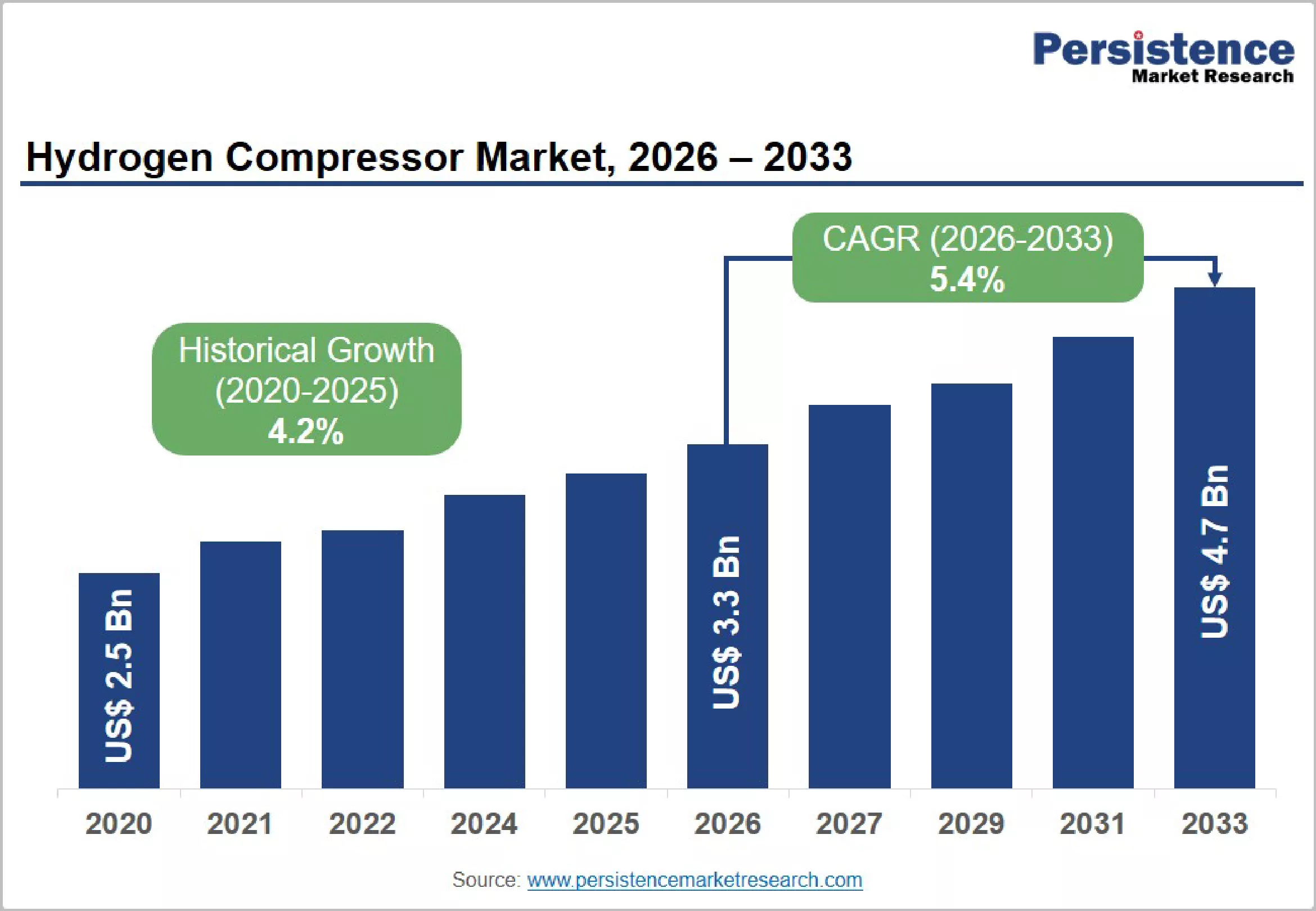
The global hydrogen compressor market size is likely to be valued at US$3.3 billion in 2026 and is estimated to reach US$4.7 billion by 2033, growing at a CAGR of 5.4% during the forecast period from 2026 to 2033, driven by increasing investments in green hydrogen production and expanding hydrogen refueling infrastructure. Growth of large-scale electrolyzer projects and hydrogen pipeline networks is also predicted to boost the market.
Key Industry Highlights:
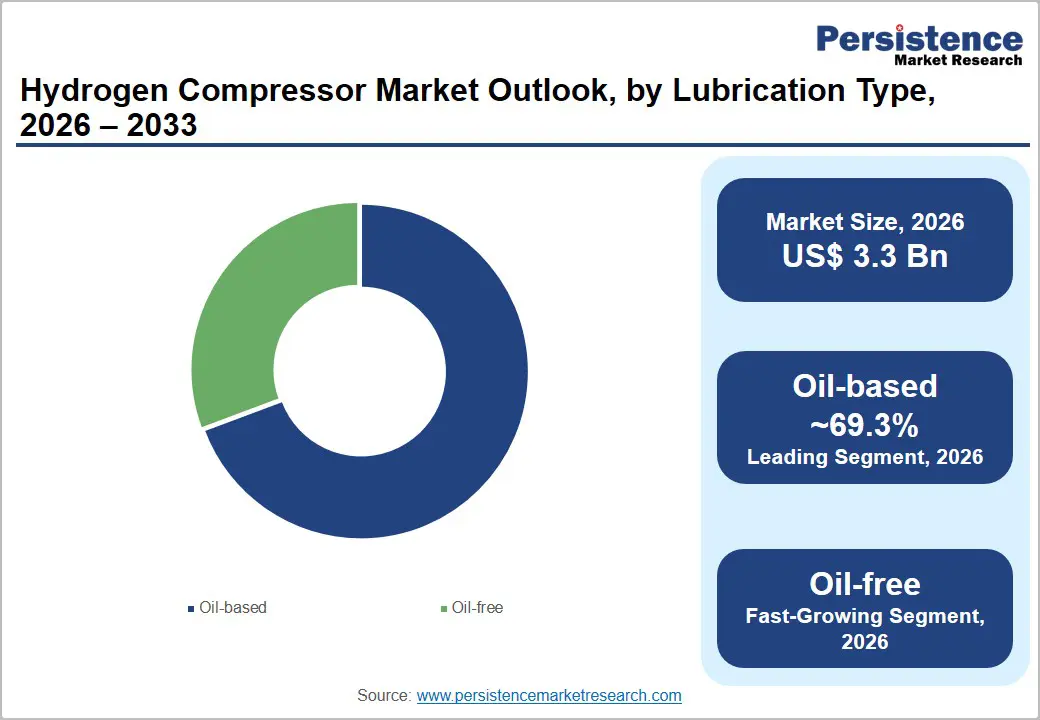
- Leading Lubrication Type: Oil-based compressors, approximately 69.3% share in 2026, as they provide superior lubrication and sealing.
- Dominant End-user: Petrochemical and chemical, with nearly 45.8% share in 2026, as hydrogen is an essential feedstock in ammonia, methanol, and hydrocracking.
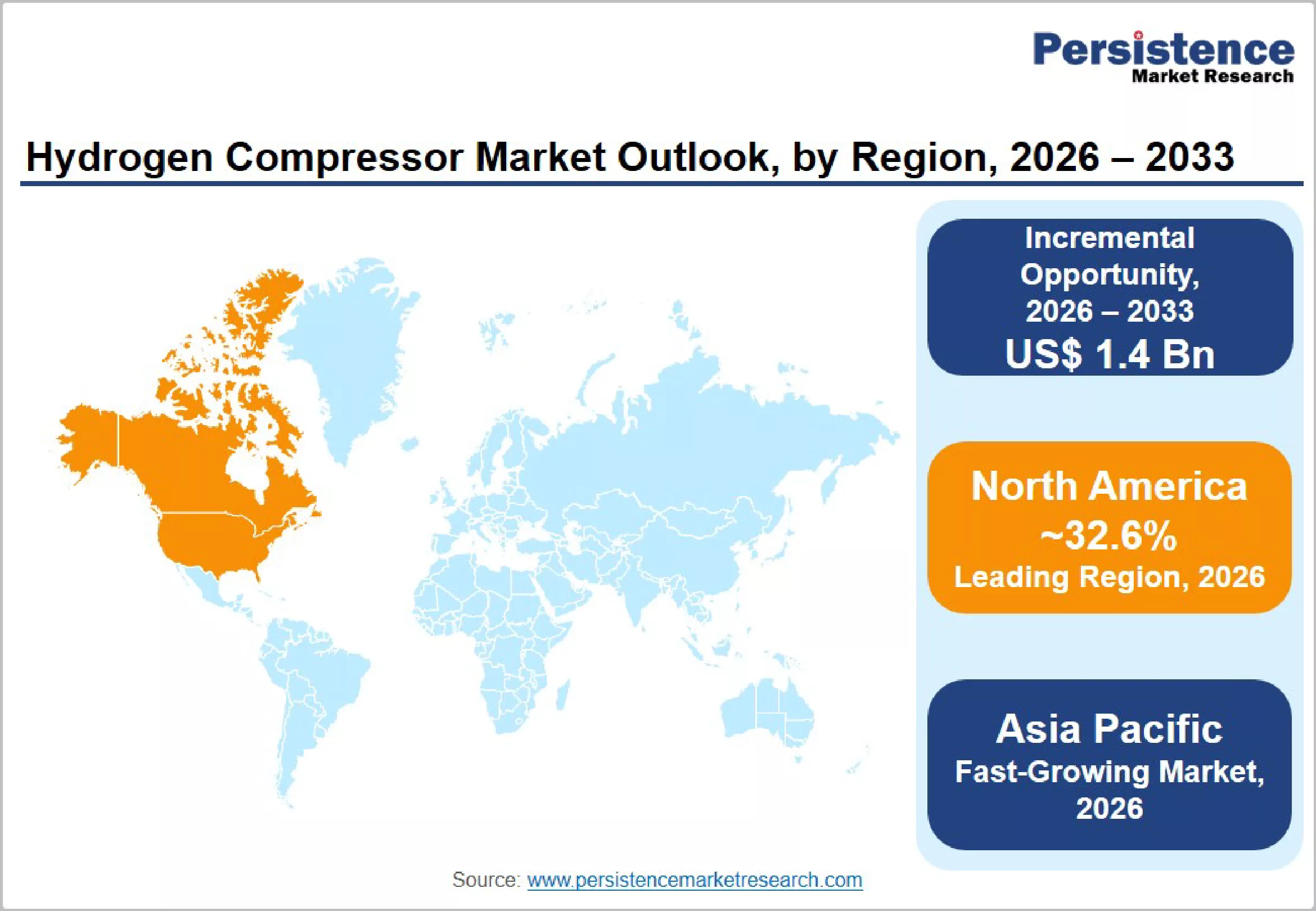
- Leading Region: North America, with about 32.6% share in 2026, owing to its established hydrogen infrastructure and large refining and chemical industries.
- Fast-growing Region: Asia Pacific, fueled by government support for hydrogen economies.
- Latest Product: In September 2025, CATAGEN introduced its ClimaHtech hydrogen compressor technology at Gastech 2025 in Milan. The company launched both stationary and mobile compressors utilizing a patented liquid-piston design that eliminates conventional mechanical pistons and diaphragms.
DRO Analysis
Driver - Sustained Industrial Demand to Keep Hydrogen Compression Indispensable
Hydrogen has been an industrial gas for decades. The two sectors consuming the most of it show no sign of reducing their dependence on it. According to the International Energy Agency's (IEA) Global Hydrogen Review 2025, global hydrogen demand reached almost 100 million tons (Mt) in 2024, a 2% increase from 2023, pushed by surging use in oil refining and industry, with demand from new applications accounting for less than 1% of the total.
The fertilizer sector is similarly entrenched. About 70% of ammonia is used for fertilizers, while the remainder is used for various industrial applications such as plastics, explosives, and synthetic fibers. Since ammonia synthesis via the Haber-Bosch process runs at pressures of 150 to 300 bar, high-capacity hydrogen compressors are a fixed and non-negotiable part of every fertilizer production facility. As fertilizer demand continues to rise with global food production requirements, so does the baseline need for hydrogen compression equipment.
Expanding Pipeline Networks to Make Compression a Physical Necessity
Pipelines are the most cost-effective method for transporting large volumes of hydrogen overland. However, they require compressor stations at regular intervals to maintain operating pressure. This creates an infrastructure-level demand for hydrogen compressors that expands with every kilometer of new pipeline built. According to the IEA's Global Hydrogen Review 2025, around 37,000 km of hydrogen pipelines have been announced to 2035, but less than 6% have reached Final Investment Decision (FID), with most projects concentrated in Europe and China.
Concrete construction is already underway. In Germany, work began in 2025 on repurposing a 400 km section of a natural gas pipeline, a world-first repurposing project of this intensity. China also started construction of the 737 km Zhangjiakou Kangbao-Caofeidian hydrogen pipeline, expected to be completed by mid-2027. Each of these pipelines will require compressor stations, making hydrogen compressor deployment a key function of infrastructure build-out.
Restraint - Metal Degradation under Hydrogen Exposure
Hydrogen Embrittlement (HE) is one of the most persistent engineering challenges in hydrogen compression. When hydrogen atoms diffuse into metallic components, including compressor casings, valves, pistons, and pipework, they weaken the metal's internal structure. These hence reduce fracture toughness and increase the risk of cracking under pressure cycling. A peer-reviewed study published in the Journal of Materials Science: Materials in Engineering (2025) confirmed that hydrogen embrittlement poses a significant challenge for pipeline materials operating under high-pressure hydrogen environments, significantly compromising fracture toughness when hydrogen enters the metal.
In hydrogen compressors specifically, the problem is worsened by pressure fluctuations. A PMC study on hydrogen-induced crack propagation in X80 steel noted that X80 steel, commonly used in gas pipeline systems, is highly susceptible to hydrogen embrittlement. Crack propagation is fueled by pressure cycling caused by compressor start-up and shutdown operations and volume adjustments boosted by demand changes. Designing compressor components from hydrogen-compatible alloys or applying protective coatings adds significant material cost and engineering complexity.
Opportunity - Development of Thermoplastic Composite Impellers
Hydrogen is an extremely light gas, which means centrifugal compressors must spin their impellers at very high speeds to generate meaningful pressure. Conventional metallic impellers hit a structural speed ceiling before they can achieve the compression ratios required for hydrogen pipeline applications. It compels operators to add multiple compressor stages, increasing system size, cost, and maintenance burden. Thermoplastic composite impellers solve this issue. In December 2025, Greene Tweed announced that its newly engineered composite closed impeller, manufactured using carbon fiber-reinforced Polyether Ether Ketone (PEEK), set a record-breaking tip speed of 688 m/s in testing.
It is nearly double that of traditional metallic impellers, which typically operate at speeds of up to 360 m/s for closed designs and 500 m/s for open designs before bursting. The lightweight composite design is up to five times lighter than metal impellers and delivers three times the strength-to-weight ratio. It enables high operational speeds and improved compression ratios for light gases such as hydrogen, thereby allowing operators to reduce compressor stages and cut system size, cost, and maintenance needs. Greene Tweed confirmed it is now working with centrifugal compressor Original Equipment Manufacturers (OEMs) to move the technology into real-world deployment.
Launch of Electrochemical Hydrogen Compressors
Electrochemical Hydrogen Compressors (EHCs) represent a fundamentally different approach to hydrogen compression. Instead of mechanical pistons or impellers, EHCs use an applied electrical voltage to drive hydrogen ions across a Proton Exchange Membrane (PEM). The hydrogen recombines as high-pressure gas on the other side, with no moving parts involved at any stage. A comprehensive review published in Materials for Renewable and Sustainable Energy (Springer, 2025), covering EHC advances from 2020 to 2025, confirmed that EHCs provide high energy efficiency, operation without movement of parts, and simultaneous purification capabilities. These help in producing high-purity hydrogen output without requiring separate purification stages.
On energy consumption, a 50 µm tubular PEM membrane EHC achieved an energy consumption of 3.1 kWh/kg H2 at 30°C, competitive with conventional mechanical compression. The U.S. Department of Energy (DOE) Hydrogen and Fuel Cell Technologies Office has identified EHCs as a priority compression technology, with current technical targets set at energy consumption below 3 kWh/kg at high compression ratios. This is a benchmark that recent laboratory systems are approaching. As green hydrogen production from electrolysis rises, the ability to compress and purify hydrogen in a low-maintenance electrochemical step makes EHCs a practical alternative to conventional compression.
Category-wise Analysis
Lubrication Type Insights
Oil-based compressors are predicted to lead with a share of approximately 69.3% in 2026, as they deliver better sealing, low wear, improved heat dissipation, and long operating life under demanding industrial conditions. Hydrogen molecules are extremely small and prone to leakage. Lubricating oil creates an additional sealing layer between moving components, helping maintain compression efficiency and reducing hydrogen losses. Oil lubrication also minimizes friction between pistons, cylinders, and bearings, which is important in continuous operations such as ammonia plants, refineries, and chemical facilities.
Oil-free compressors are estimated to be the fastest-growing segment over the forecast period, as hydrogen is increasingly being used in applications where gas purity is significant. Even tiny traces of oil contamination can damage fuel cells, poison catalysts, reduce process efficiency, and increase maintenance costs. This is particularly important in hydrogen refueling stations, semiconductor manufacturing, and green hydrogen production facilities. As governments and private companies broaden hydrogen mobility infrastructure, demand for oil-free compressors is rising steadily.
End-user Insights
The petrochemical and chemical sector is anticipated to dominate with a share of nearly 45.8% in 2026, as hydrogen is an essential feedstock in several large-scale industrial processes. Ammonia production, methanol manufacturing, hydrocracking, hydrotreating, and various specialty chemical processes require hydrogen at elevated pressures. Compressors are hence critical to maintaining continuous plant operations. The sector also consumes hydrogen around the clock, creating sustained demand for superior compression equipment.
The oil and gas segment is expected to remain in the second position in 2026, as energy companies are now incorporating hydrogen into decarbonization strategies. Hydrogen is already widely used in refining operations for desulfurization and hydroprocessing. Growth is being pushed by blue hydrogen projects, carbon capture initiatives, hydrogen blending in natural gas networks, and large-scale hydrogen transportation infrastructure. Governments are further supporting hydrogen blending projects to utilize existing natural gas infrastructure, which is augmenting growth.
Regional Insights
North America Hydrogen Compressor Market Trends
North America is predicted to dominate in 2026 with a share of approximately 32.6%, as it has one of the most well-established hydrogen ecosystems globally. The region already has extensive hydrogen consumption across refining, petrochemicals, ammonia production, and industrial gas applications. This creates consistent demand for hydrogen compression equipment. Another key advantage is increasing government support. The U.S. Department of Energy (DOE) launched the Regional Clean Hydrogen Hubs program to establish large hydrogen production and distribution networks across the country. These projects require compressors for production, storage, transportation, and refueling infrastructure.
U.S. Hydrogen Compressor Market Trends
A share of nearly 62.5% is expected to be held by the U.S. in 2026, owing to unprecedented investment in clean hydrogen production and infrastructure. The Inflation Reduction Act introduced the 45V Clean Hydrogen Production Tax Credit, making hydrogen projects more financially attractive. The DOE's hydrogen hub initiative is also fostering project development across multiple states. A notable example is the DOE's US$1.66 billion loan guarantee to Plug Power in January 2025 to support the construction of up to six hydrogen production facilities in the country. These projects are estimated to require substantial compressor installations for hydrogen handling and liquefaction.
Asia Pacific Hydrogen Compressor Market Trends
Asia Pacific is anticipated to be the fastest-growing region in 2026 with a share of nearly 25.8%, as governments across the region view hydrogen as a key solution for energy security and carbon reduction. Countries are investing heavily in hydrogen production, storage, transportation, and refueling infrastructure. The region is witnessing ongoing expansion of hydrogen mobility programs, green hydrogen projects, and hydrogen-based industrial decarbonization. According to industry assessments, China, Japan, and South Korea are constantly extending hydrogen refueling networks and large-scale hydrogen projects.
China Hydrogen Compressor Market Trends
China will likely lead in Asia Pacific in 2026 with a share of around 37.6%, backed by favorable government policies, expanding manufacturing capabilities, and large-scale industrial hydrogen demand. The country is investing heavily in green hydrogen production to decarbonize steel, chemicals, refining, and transportation sectors. China's National Development and Reform Commission has identified hydrogen as a strategic industry supporting the country's carbon neutrality goals. Also, the country has become a leading manufacturing hub for hydrogen equipment, including electrolyzers and related infrastructure.
South Korea Hydrogen Compressor Market Trends
In 2026, South Korea is projected to account for a share of approximately 29.3%, as it has one of the most structured hydrogen economy roadmaps in the world. The government views hydrogen as a strategic fuel for transportation, power generation, and industrial applications. South Korea continues to broaden hydrogen refueling infrastructure and hydrogen-powered mobility solutions. Industry reports indicate that the country plans significant expansion of hydrogen refueling stations by 2030, creating sustained demand for compressors used in hydrogen storage and dispensing systems.
Europe Hydrogen Compressor Market Trends
Europe will likely see decent growth over the forecast period with a share of nearly 14.3% in 2026, as hydrogen remains a central component of the region's decarbonization strategy. The European Union continues to support hydrogen production, industrial decarbonization, and renewable energy integration through various funding programs. Hydrogen is now being used in sectors that are difficult to electrify, including steel manufacturing, chemicals, heavy transport, and energy storage. Although project approvals can take longer due to regulatory requirements, Europe maintains a superior pipeline of hydrogen projects.
Germany Hydrogen Compressor Market Trends
Germany will likely register a substantial share of approximately 40.2% in 2026, as it is actively pursuing hydrogen to reduce emissions from its industrial sector, mainly steel, chemicals, and manufacturing. Local companies are investing in hydrogen import terminals, pipeline infrastructure, and electrolyzer deployment. Germany's National Hydrogen Strategy continues to support hydrogen adoption across industrial and energy sectors. As hydrogen production, storage, and transportation capacity expands, demand for advanced compression systems is increasing.
U.K. Hydrogen Compressor Market Trends
A share of around 28.4% is predicted to be held by the U.K. in 2026, as hydrogen becomes increasingly important in its energy transition plans. The government is promoting both green hydrogen and low-carbon hydrogen production to reduce emissions from industry, transportation, and power generation. Hydrogen is also being evaluated for blending into gas networks and supporting industrial decarbonization projects. The U.K.'s offshore wind capacity provides a strong foundation for future green hydrogen production. As new hydrogen production facilities, storage projects, and transportation networks are developed, the demand for hydrogen compression equipment is projected to increase steadily in the next ten years.
Competitive Landscape
The global hydrogen compressor market is moderately fragmented with the presence of established compressor manufacturers and specialized hydrogen technology providers competing across industrial hydrogen, refueling stations, and emerging green hydrogen projects. Key participants include Siemens Energy, Burckhardt Compression, Howden, Ariel Corporation, Sundyne, and NEUMAN & ESSER. They are constantly investing in oil-free and high-pressure compression technologies as hydrogen refueling stations and green hydrogen facilities require ultra-high purity hydrogen.
Strategic partnerships and project-based contracts are also influencing competition. Companies are increasingly working with electrolyzer manufacturers, hydrogen infrastructure developers, and energy companies to secure long-term projects. Another notable trend is the rising importance of hydrogen refueling infrastructure. As fuel-cell trucks, buses, and heavy-duty vehicles gain traction, compressor manufacturers are competing to become preferred suppliers for hydrogen refueling stations.
Key Industry Developments:
- In March 2026, Kawasaki Heavy Industries began demonstration testing of its KM Comp-H2 centrifugal hydrogen compressor using 100% pure hydrogen. The demonstration facility was established to evaluate performance, reliability, and long-term operation for hydrogen liquefaction plants, marking what the company described as a world-first trial for this application.
- In March 2026, Voestalpine expanded its H2Future green hydrogen pilot plant in Austria with the installation of two hydrogen compressor units supplied by Hiperbaric. The compressors are capable of compressing hydrogen to 500 bar and will support hydrogen storage and utilization in low-carbon steel production processes.
- In January 2026, CSIR-Central Institute of Mining and Fuel Research (CSIR-CIMFR) completed India's first safety assessment of a hydrogen compressor-dispenser system. The initiative established technical and safety benchmarks for hydrogen refueling infrastructure and supports the country's rising hydrogen economy efforts.
Companies Covered in Hydrogen Compressor Market
- Hitachi, Ltd.
- Burckhardt Compression Holding AG
- IDEX (Corken)
- HAUG Sauer Kompressoren AG
- Chart Industries (Howden Group)
- Fluitron
- Ariel Corporation
- ATLAS COPCO AB
- Nel
- Ingersoll Rand
- Others
Frequently Asked Questions
The global hydrogen compressor market is projected to be valued at US$3.3 billion in 2026.
The hydrogen compressor market is expected to reach US$4.7 billion by 2033.
Key market trends include rising adoption of oil-free compressors and increasing deployment of hydrogen refueling stations.
Oil-based compressors are expected to be the leading lubrication type with a share of nearly 69.3% in 2026, due to their ability to handle continuous industrial operations.
The hydrogen compressor market is expected to grow at a CAGR of 5.4% from 2026 to 2033.
Hitachi, Ltd., Burckhardt Compression Holding AG, and IDEX (Corken) are a few key market players.


