




- Industrial Machinery
- Horizontal Milling Machine Market
Horizontal Milling Machine Market Size, Share, and Growth Forecast 2026 - 2033
Horizontal Milling Machine Market by Product Type (Plain Horizontal Milling Machines, Universal Horizontal Milling Machines, CNC Horizontal Milling Machines, Bed-Type Horizontal Milling Machines, Horizontal Boring Mills, Milling Centers), by Technology (Conventional, CNC), by Application, End-user, and Regional Analysis, 2026 - 2033

Horizontal Milling Machine Market Size and Trend Analysis
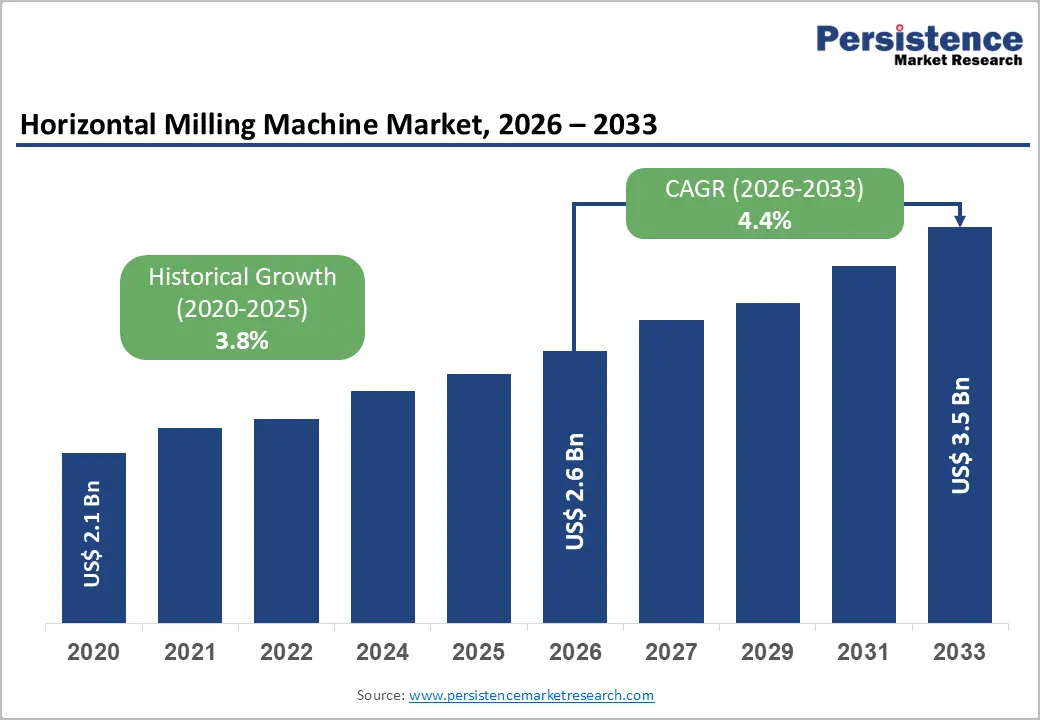
The global horizontal milling machine market size is likely to be valued at US$ 2.6 billion in 2026 and is expected to reach US$ 3.5 billion by 2033, growing at a CAGR of 4.4% during the forecast period from 2026 to 2033.
The horizontal milling machine market is on a sustained growth trajectory, propelled by expanding global manufacturing output, the accelerating transition toward CNC-enabled precision machining, and rising demand from high-complexity application sectors including aerospace and defense, automotive, and energy.
Key Industry Highlights:
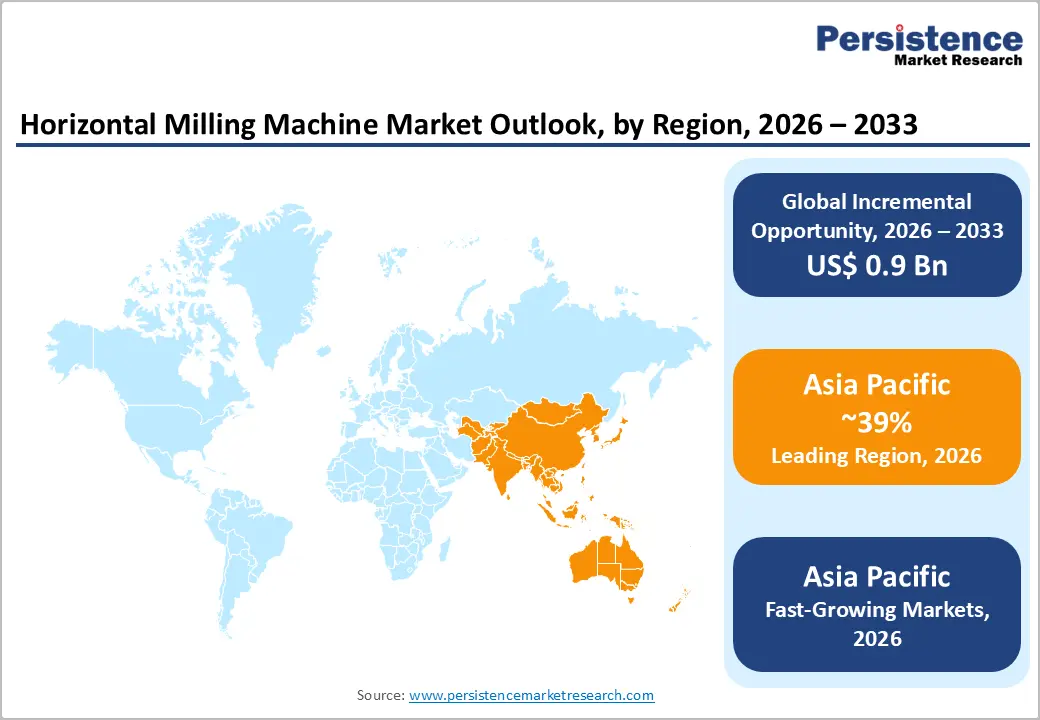
- Leading Region: Asia Pacific dominates the horizontal milling machine market, holding 39% share in 2025, led by China’s machine tool consumption exceeding US$ 20 billion annually, Japan’s globally acclaimed manufacturers, including Mazak and Makino, and India’s rapidly expanding automotive and defense machining sectors.
- Fastest Growing Region: North America is the fastest growing market with a positive CAGR driven by unprecedented reshoring investment under the CHIPS Act and IRA, mobilizing over US$ 600 billion in domestic manufacturing, directly generating sustained CNC horizontal milling machine procurement demand through 2033.
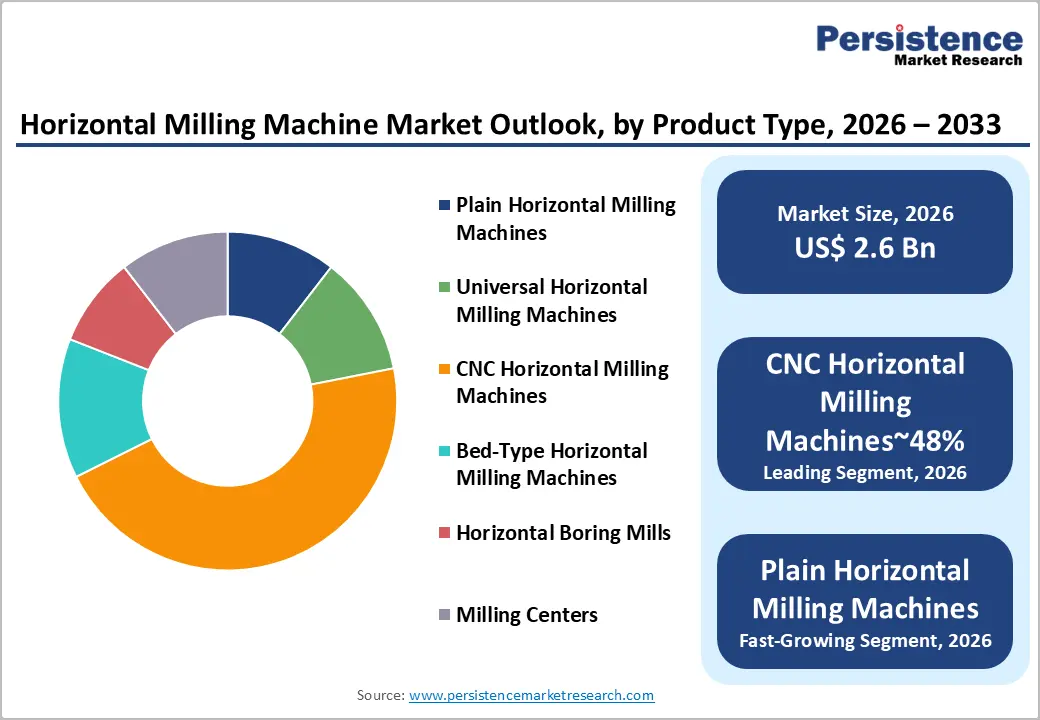
- Dominant Segment: CNC horizontal milling machines lead with approximately 48% market share, driven by their superior productivity, multi-pallet automation capability, and universal adoption in automotive, aerospace, and precision component manufacturing globally.
- Fastest Growing Segment: Aerospace & defense are fast-growing propelled by record global defense spending exceeding US$ 2.2 trillion, strong commercial aircraft order backlogs, and titanium/Inconel component demand for next-generation platforms.
- Key Opportunity: EV powertrain and structural component manufacturing represents the highest near-term growth opportunity, with IEA projecting 45 million annual EV sales by 2030, requiring dedicated high-speed aluminum-cutting CNC horizontal machining center installations at new OEM and supplier facilities globally.
| Key Insights | Details |
|---|---|
| Horizontal Milling Machine Market Size (2026E) | US$ 2.6 Billion |
| Market Value Forecast (2033F) | US$ 3.5 Billion |
| Projected Growth CAGR (2026 - 2033) | 4.4% |
| Historical Market Growth (2020 - 2025) | 3.8% |
Market Dynamics
Drivers - Aerospace & Defense Sector Expansion Driving Demand for High-Precision Horizontal Machining
The global aerospace and defense sector remains one of the most demanding end-users of horizontal milling machines, as it requires the production of large and complex structural components such as aircraft frames, engine casings, wing spars, and missile housings. These components are typically made from difficult-to-machine materials, including titanium alloys, Inconel, and high-strength aluminum.
According to industry data, aerospace and defense shipments in the United States exceeded US$ 950 billion in 2022, supported by strong order backlogs from major manufacturers, which continues to drive consistent machine tool demand. In addition, global defense spending surpassed US$ 2.2 trillion in 2023, leading to increased production of armored vehicles, naval systems, and munitions. These trends collectively generate sustained demand for high-performance CNC horizontal machining centers, particularly for precision-intensive and mission-critical manufacturing applications.
Industrial Reshoring and Smart Manufacturing Investment in Advanced Economies
The ongoing trend of reshoring manufacturing operations in developed regions such as the United States and Europe is significantly boosting investment in advanced production equipment, including horizontal milling machines. This shift is primarily driven by the need to strengthen supply chain resilience, reduce dependency on imports, and mitigate geopolitical risks.
Government initiatives and industrial policies are playing a key role in accelerating this transition, with large-scale funding programs supporting domestic manufacturing expansion. These investments are encouraging companies to upgrade their production capabilities with modern CNC horizontal machining centers. Additionally, the growing adoption of smart manufacturing practices and digital factory models is increasing demand for highly automated and connected machine tools. As industries move toward Industry 4.0 and Industry 5.0 frameworks, horizontal milling machines equipped with advanced automation, monitoring, and integration capabilities are becoming essential assets in modern manufacturing environments.
Restraints - High Capital Investment and Long Payback Periods
Advanced CNC horizontal milling machines, especially high-end horizontal machining centers, require substantial capital investment, making them a significant financial commitment for manufacturers. Prices can range from US$ 200,000 to over US$ 3 million depending on machine size, configuration, and performance capabilities. This high upfront cost often results in extended payback periods, typically between five to ten years, which can discourage investment, particularly among small and medium-sized enterprises.
In industries that experience demand fluctuations or economic uncertainty, companies tend to delay or reduce capital expenditure as part of risk management strategies. This behavior directly impacts the demand for new machine tools and creates volatility in the market. As a result, despite strong long-term growth potential, the high cost barrier and long return on investment cycle remain key challenges that limit faster adoption and consistent market expansion.
Skilled Operator Shortage for CNC Machine Operation and Programming
The efficient operation of modern CNC horizontal milling machines depends heavily on the availability of skilled operators and programmers who can manage complex machining processes and optimize multi-axis toolpaths. However, the manufacturing sector is currently facing a significant shortage of skilled labor, driven by factors such as workforce aging and insufficient training programs. Industry estimates indicate that millions of manufacturing jobs could remain unfilled in the coming years due to this skills gap.
This challenge is not limited to one region but is observed across major manufacturing economies globally. The lack of trained professionals reduces the ability of companies to fully utilize advanced machining equipment, leading to lower productivity and slower adoption of new technologies. Consequently, this talent shortage acts as a major restraint, limiting capacity expansion and delaying investment in high-end CNC horizontal machining solutions.
Opportunity - CNC Horizontal Machining Centers for Electric Vehicle Component Manufacturing
The rapid global transition toward electric vehicles is creating significant opportunities for horizontal machining centers, particularly in the production of EV-specific components. Key parts such as battery housings, electric motor casings, structural components, and high-voltage connectors require high-precision machining using lightweight materials like aluminum and magnesium alloys.
With global EV sales growing rapidly and expected to increase substantially in the coming years, automotive manufacturers are investing heavily in new production facilities and technologies. This shift is driving strong demand for advanced horizontal machining solutions that can support high-speed, high-volume production. Equipment manufacturers that focus on developing EV-optimized machining centers with features such as enhanced cutting performance, automation integration, and flexible pallet systems are likely to gain a competitive advantage. This segment represents a high-growth opportunity as the automotive industry continues to evolve toward electrification.
5-Axis CNC Horizontal Machining Centers for Medical and Precision Engineering
The growing demand for advanced medical devices and precision-engineered components is creating new opportunities for 5-axis CNC horizontal machining centers. These machines are essential for manufacturing complex and high-accuracy components such as orthopedic implants, surgical instruments, and diagnostic equipment, often made from materials like titanium, cobalt-chrome, and stainless steel. As the global medical device industry continues to expand, the need for reliable and precise manufacturing processes is increasing.
Strict regulatory standards require manufacturers to maintain high levels of accuracy, consistency, and traceability, making advanced CNC machining solutions highly valuable. Additionally, the rise of precision engineering applications across various industries is further supporting demand for multi-axis machining capabilities. Companies that invest in medical-grade, high-precision machining centers with integrated quality control and measurement systems can tap into a premium market segment with strong and consistent demand.
Category-wise Analysis
By Product Type Insights
CNC horizontal milling machines, including horizontal machining centers, represent the leading product type segment, accounting for a significant share of the overall market. These machines have become the preferred choice for high-volume and precision manufacturing across industries such as automotive, aerospace, and industrial equipment. Their ability to perform multiple operations in a single setup, combined with features like multi-pallet systems and automatic tool changers, significantly improves productivity and reduces downtime.
Modern horizontal machining centers are equipped with advanced capabilities, including large tool storage capacity and rotary tables that allow machining on multiple sides of a component without repositioning. This enhances efficiency and accuracy while minimizing human intervention. Continuous technological advancements by leading manufacturers are further improving machine performance, reliability, and automation capabilities. As a result, CNC horizontal machining centers are expected to maintain their dominant position in the market over the forecast period.
By Technology Insights
CNC technology dominates the horizontal milling machine market, representing the majority share due to its superior performance and advanced capabilities. The shift from conventional manual machines to CNC-controlled systems has transformed manufacturing processes by enabling high precision, repeatability, and the ability to produce complex geometries. CNC horizontal milling machines use standardized programming languages and advanced software, allowing operators to execute highly intricate machining operations with consistency.
Additionally, these machines are fully compatible with modern digital manufacturing systems, supporting real-time monitoring, predictive maintenance, and performance optimization. Features such as connectivity, automation integration, and data-driven decision-making further enhance their value in industrial applications. As industries increasingly adopt smart manufacturing and automation technologies, the demand for CNC-based solutions continues to rise. This strong technological advantage ensures that CNC machines remain the preferred choice across various manufacturing sectors worldwide.
By Application Insights
The automotive sector is the leading application segment in the horizontal milling machine market, driven by its large-scale production requirements and high demand for precision components. Key automotive parts such as engine blocks, transmission housings, cylinder heads, and differential components require extensive machining, making horizontal machining centers essential in production lines.
The global automotive industry produces millions of vehicles each year, with each vehicle consisting of numerous machined components, thereby generating consistent demand for machining solutions. Additionally, the transition toward electric vehicles is reshaping the application landscape by introducing new components such as battery enclosures and electric drive systems. While traditional engine-related machining may decline, the overall demand for precision machining remains strong due to the emergence of new EV components. This ongoing transformation ensures that the automotive sector continues to be a major contributor to market growth.
By End-user Insights
Industrial manufacturing is the largest end-use segment in the horizontal milling machine market, driven by its wide-ranging applications across multiple industries. This segment includes general machining, metal fabrication, equipment manufacturing, and contract machining services, all of which rely heavily on efficient and precise machining processes. The diversity of applications within industrial manufacturing ensures steady demand for horizontal milling machines across different scales of operation, from small workshops to large production facilities.
As global manufacturing activity continues to expand, the need for reliable and high-performance machining equipment also increases. Additionally, the adoption of automation and advanced manufacturing technologies is further boosting demand for modern CNC machines. The strong foundation of industrial production worldwide supports consistent equipment replacement and upgrades, making this segment a key driver of overall market demand.
Regional Insights
North America Horizontal Milling Machine Market Trends
North America represents a technologically advanced and mature market for horizontal milling machines, supported by a strong industrial base in the United States. The region’s manufacturing sector consistently invests in advanced machining solutions to maintain competitiveness and efficiency. Government initiatives aimed at strengthening domestic production capabilities are encouraging large-scale investments in manufacturing infrastructure, particularly in sectors such as semiconductors and electric vehicles.
These developments are creating sustained demand for horizontal machining centers. Additionally, industries such as aerospace, automotive, and defense continue to be major contributors to equipment demand. Canada also plays an important role, with its aerospace and energy sectors driving the need for high-precision machining. Strict regulatory requirements in defense manufacturing further increase demand for certified and high-quality machine tools. Overall, the region offers strong growth opportunities supported by continuous technological advancement and industrial investment.
Europe Horizontal Milling Machine Market Trends
Europe is one of the most advanced and established markets for horizontal milling machines, known for its strong engineering capabilities and manufacturing excellence. Countries such as Germany lead the region with a well-developed machine tool industry and a strong presence of globally recognized manufacturers. The region’s automotive and aerospace industries generate consistent demand for high-precision machining equipment, supporting both domestic consumption and export growth.
In addition, countries like Italy, the United Kingdom, and France contribute significantly to the market through specialized manufacturing activities. Europe’s focus on innovation, sustainability, and industrial modernization is driving investments in advanced manufacturing technologies. Regulatory standards and quality requirements also ensure the adoption of high-performance machining solutions. Furthermore, initiatives aimed at strengthening regional manufacturing capabilities are expected to boost demand for horizontal milling machines, making Europe a key market in the global landscape.
Asia Pacific Horizontal Milling Machine Market Trends
Asia Pacific is the largest and fastest-growing market for horizontal milling machines, driven by rapid industrialization and strong manufacturing expansion across key economies. China plays a dominant role as both a major producer and consumer of machine tools, supported by large-scale investments in automotive, aerospace, and industrial manufacturing. Government initiatives aimed at boosting domestic production capabilities are further strengthening market growth.
Japan is recognized as a global leader in machine tool innovation, known for producing high-quality and precision machining solutions. India is emerging as a promising market, supported by government initiatives promoting manufacturing and increasing investments in key industries. Additionally, Southeast Asian countries are attracting foreign investments due to their cost advantages and growing industrial base. This regional growth is creating significant demand for advanced machining equipment, positioning Asia Pacific as a critical hub for future market expansion.
Competitive Landscape
The global horizontal milling machine market is moderately consolidated, with a few leading companies holding strong positions due to their long-standing engineering expertise and continuous innovation. Well-established players such as DMG MORI, Yamazaki Mazak Corporation, Makino, and Haas Automation lead the CNC horizontal machining center segment. They maintain their leadership through broad product portfolios, advanced technologies, and strong global distribution and service networks.
These companies focus heavily on innovation, offering high-performance machines with improved precision and efficiency. Their strong dealer ecosystems also help them provide reliable after-sales support, which strengthens customer loyalty. In addition, continuous investment in research and development enables them to stay ahead of market demands and evolving manufacturing requirements, making them preferred partners for industries seeking high-quality and technologically advanced milling solutions.
Key Developments:
- January 2025: DMG MORI unveiled its NHX 10000 horizontal machining center at Intec 2025, featuring a new AI-assisted thermal compensation system and extended pallet pool automation capability targeting large-batch aerospace and automotive structural component production.
- September 2024: Yamazaki Mazak Corporation launched the HCN-6800 NEO horizontal machining center with enhanced multi-pallet automation compatibility and a redesigned spindle delivering 30% higher torque output for titanium and Inconel machining in aerospace applications.
- April 2024: Makino Milling Machine Co., Ltd. introduced its a61nx-5E 5-axis horizontal machining center optimized for EV battery housing and electric motor component machining, featuring a high-speed aluminum cutting spindle and integrated in-process gauging for automotive production lines.
Companies Covered in Horizontal Milling Machine Market
- DMG MORI
- Yamazaki Mazak Corporation
- Makino Milling Machine Co., Ltd.
- Haas Automation, Inc.
- DN Solutions
- Waldrich Coburg
- JTEKT Toyoda Americas Corporation
- FERMAT Machinery
- TECNICOLL SRL
- CHIN YUAN HSING Machine Industrial Co., Ltd.
- TAICNC
- HELLER Group
- Lazzati S.p.A.
- FPT Industrie
- ŠMT
- Doosan Machine Tools
- Kitamura Machinery Co., Ltd.
- Okuma Corporation
Frequently Asked Questions
The global Horizontal Milling Machine Market is projected to reach US$ 3.5 Billion by 2033, growing from US$ 2.6 Billion in 2026 at a CAGR of 4.4% during the 2026-2033 forecast period.
The primary growth drivers are the expanding aerospace and defense sector, with global defense spending exceeding US$ 2.2 trillion and strong commercial aircraft backlogs at Boeing and Airbus, and the strategic reshoring of manufacturing in North America and Europe under initiatives including the CHIPS and Science Act and IRA mobilizing over US$ 600 billion in domestic manufacturing investment.
CNC Horizontal Milling Machines hold the leading position in the By Product Type category, accounting for approximately 48% of total market share. Their dominance is built on superior throughput, multi-pallet automation capability, ISO G-code programmability, and Industry 4.0 connectivity features that make them the preferred platform for high-volume precision component manufacturing globally.
Asia Pacific is the dominant region, led by China’s machine tool consumption and production each exceeding US$ 20 billion annually, Japan’s world-class manufacturers including Mazak and Makino, and India’s rapidly growing automotive and defense machining sectors supported by the Production Linked Incentive scheme driving significant manufacturing capacity expansion.
The leading opportunities are EV powertrain and structural component manufacturing, with IEA projecting 45 million annual EV sales by 2030 requiring dedicated high-speed aluminum-cutting HMC installations, and the medical device sector approaching US$ 700 billion by 2030, demanding FDA and EU MDR-compliant 5-axis CNC horizontal machining for implants and surgical instruments.
The leading market participants include DMG MORI, Yamazaki Mazak Corporation, Makino Milling Machine Co., Ltd., Haas Automation Inc., DN Solutions, Waldrich Coburg, JTEKT Toyoda Americas Corporation, FERMAT Machinery, HELLER Group, Lazzati S.p.A., FPT Industrie, TECNICOLL SRL, TAICNC, CHIN YUAN HSING Machine Industrial Co., Ltd., and ŠMT.


