




- Industrial Machinery
- Hank Reeling Machine Market
Hank Reeling Machine Market Size, Share, and Growth Forecast, 2026 - 2033
Hank Reeling Machine Market by Automation Level (Automatic Hank Reeling Machines, Fully Automated/Smart Hank Reeling Machines, Others), Application (Cotton Yarn Production, Others), End-user, Enterprise Size, and Regional Analysis for 2026 - 2033

Hank Reeling Machine Market Size and Trends Analysis
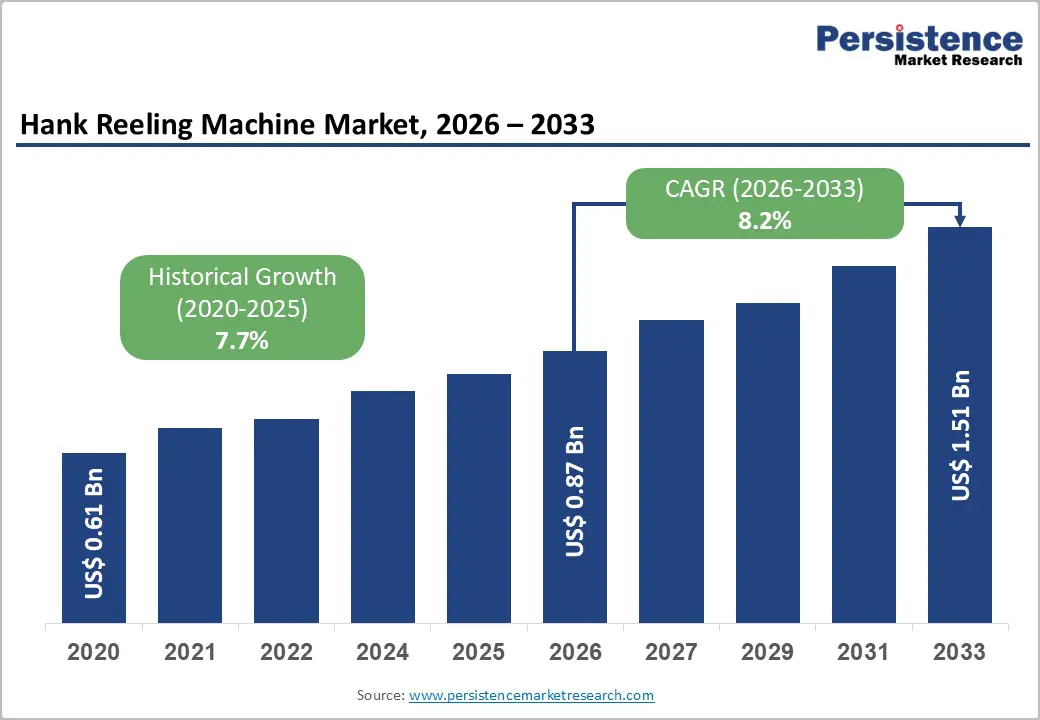
The global hank reeling machine market size is likely to be valued at US$ 0.87 billion in 2026 and is expected to reach US$ 1.51 billion by 2033, growing at a CAGR of 8.2% between 2026 and 2033, driven due to rising yarn-processing activities, increasing replacement of manual and semi-automatic equipment, and ongoing modernization initiatives across major textile-producing countries.
Growth is particularly evident in Asia Pacific, where textile manufacturing remains a strategic industrial sector. Investments in automation, quality enhancement, and labor efficiency are encouraging textile manufacturers to adopt advanced hank reeling technologies. Manufacturers offering automated systems, improved yarn quality control, and flexible retrofit solutions are expected to gain a competitive advantage as mills focus on operational efficiency and production consistency.
Key Industry Highlights:
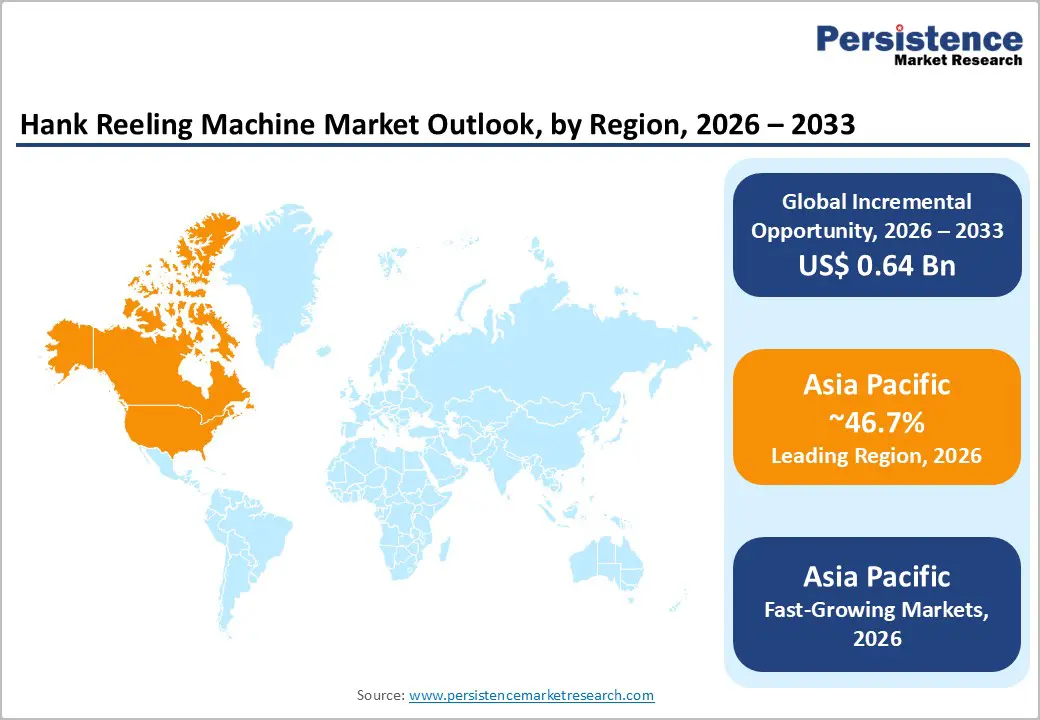
- Leading Region: Asia Pacific is projected to account for 46.7% of market share in 2026, supported by its dominant textile manufacturing base, strong export infrastructure, and large-scale yarn processing operations across China, India, and ASEAN countries.
- Fastest-growing Region: Asia Pacific is driven by ongoing textile industry modernization, automation investments, and expanding synthetic yarn production capacity.
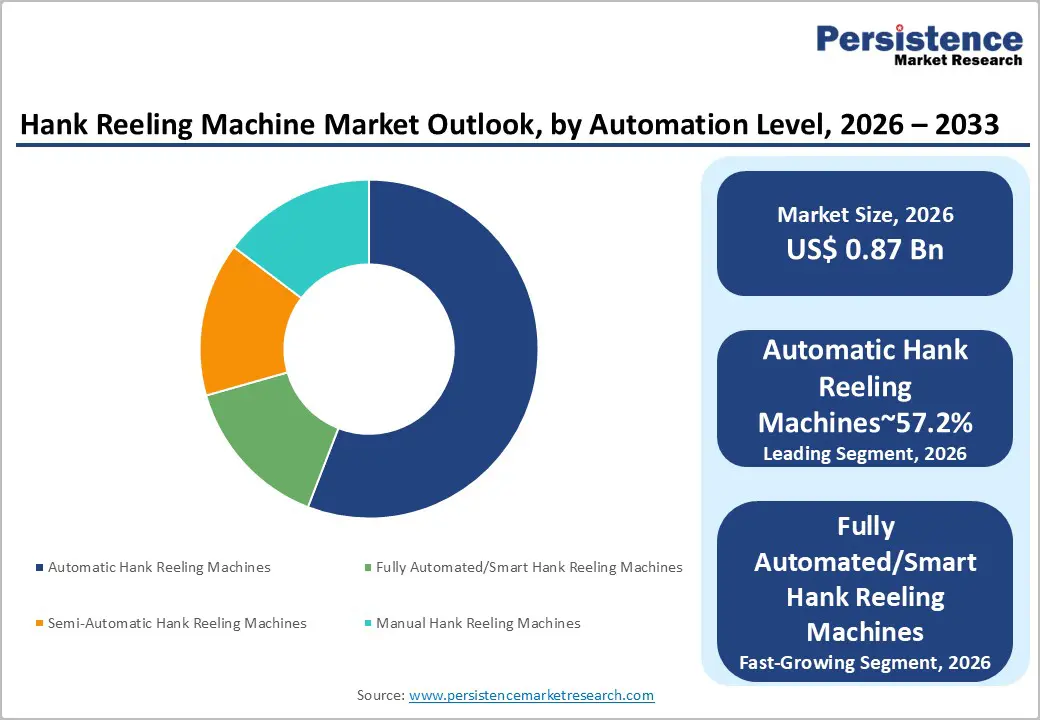
- Dominant Automation Level: Automatic hank reeling machines are anticipated to hold 57.2% of market share in 2026, driven by strong adoption among large textile manufacturers seeking higher throughput, operational efficiency, and reduced manual intervention.
- Leading Application: Cotton yarn production is anticipated to account for 61.4% of market share in 2026, supported by extensive cotton spinning activities in India, China, Pakistan, and Bangladesh, along with sustained demand from apparel and home textile manufacturers.
DRO Analysis
Driver - Growing Textile Production and Export Activities Supporting Machinery Demand
Demand for hank reeling machines is directly linked to yarn production, spinning activities, and textile manufacturing output. As textile-producing countries continue expanding exports and domestic production capacities, investments in yarn-processing equipment are increasing. India remains one of the world's largest textile manufacturing hubs, supported by extensive employment generation, export-oriented production, and government-backed support programs for cotton yarn processing. Similarly, China's textile industry continues to benefit from strong industrial output and stable capacity utilization rates, while the U.S. maintains a sizable textile manufacturing ecosystem focused on specialized and value-added products.
As textile mills expand operations and modernize production facilities, periodic replacement of aging machinery and installation of new yarn-processing lines continue to create sustained demand for hank reeling equipment. The trend is particularly visible in export-oriented textile clusters seeking higher productivity and quality consistency.
Automation and Quality Requirements Driving Technology Adoption
Increasing labor costs and rising quality expectations are accelerating the transition toward automated hank reeling systems. Textile manufacturers are prioritizing equipment capable of improving productivity, reducing manual intervention, minimizing yarn breakage, and maintaining consistent package quality.
Modern machine suppliers are incorporating features such as digital control systems, automatic tension adjustment, energy-efficient motors, programmable operating parameters, and remote monitoring capabilities. Automated solutions help manufacturers improve operational efficiency while reducing maintenance requirements and production downtime.
The growing emphasis on production optimization and quality assurance is encouraging mills to replace labor-intensive systems with advanced automated machinery capable of supporting large-scale commercial operations and premium yarn production.
Restraint - High Capital Investment Requirements Limit Adoption among Smaller Enterprises
Despite the operational benefits associated with automation, the relatively high upfront cost of advanced hank reeling machines remains a major challenge for small and medium-sized textile enterprises. Manual and semi-automatic systems continue to offer a lower-cost alternative, particularly for businesses operating with limited capital budgets.
Many textile manufacturers delay equipment modernization due to concerns regarding return on investment, financing availability, and uncertain market conditions. Regulatory compliance requirements, import dependence for advanced machinery, and fluctuations in textile demand can further influence purchasing decisions.
The cost differential between conventional and automated systems remains substantial in several developing markets, slowing adoption rates among smaller operators and contributing to longer replacement cycles across portions of the industry.
Opportunity - Expansion of Technical Textiles and Synthetic Yarn Processing
The increasing adoption of synthetic fibers and technical textiles presents a significant growth opportunity for the hank reeling machine market. Technical textile applications require higher levels of precision, process control, and yarn consistency compared with conventional textile products.
Manufacturers producing industrial textiles, protective fabrics, automotive textiles, filtration materials, and performance fabrics are investing in advanced yarn-processing technologies to meet stringent quality requirements. As production of specialty and synthetic yarns expands globally, demand for automated hank reeling equipment capable of handling diverse fiber types is expected to increase.
This trend creates opportunities for equipment manufacturers to develop premium systems offering enhanced flexibility, digital monitoring, and advanced process control capabilities.
Localization of Manufacturing and Regional Modernization Initiatives
Governments and industry stakeholders are increasingly encouraging domestic manufacturing of textile machinery to reduce import dependence and strengthen industrial competitiveness. Investments in indigenous equipment development, coupled with modernization programs across textile-producing regions, are creating favorable conditions for local machine suppliers.
The emergence of locally developed automated reeling technologies demonstrates growing technical capabilities within developing economies. As textile manufacturers seek cost-effective modernization solutions supported by regional service networks, domestic equipment providers are expected to gain market share.
These developments create opportunities for manufacturers capable of delivering reliable, competitively priced systems while maintaining international performance standards.
Category-wise Analysis
Automation Level Insights
Automatic hank reeling machines are anticipated to account for approximately 57.2% of the market share in 2026. Their dominance is driven by increasing demand for higher productivity, consistent yarn quality, and reduced labor dependency across commercial spinning mills. Large textile manufacturers in India, China, and Bangladesh increasingly prefer automatic systems to improve throughput and minimize operational errors. These machines are widely used in cotton spinning clusters such as Coimbatore and Gujarat, where continuous production and quality consistency are critical for export-oriented operations.
Fully automated and smart hank reeling machines are projected to be the fastest-growing segment. Growth is supported by the adoption of Industry 4.0 technologies and increasing investment in intelligent textile manufacturing. Features such as predictive maintenance, real-time production monitoring, and remote diagnostics help mills reduce downtime and optimize efficiency. Textile producers in China, Japan, and South Korea are increasingly deploying smart machinery as part of broader factory automation initiatives aimed at improving operational performance and product quality.
Application Insights
Cotton yarn production is anticipated to hold approximately 61.4% of the market share in 2026. Cotton remains the most extensively processed natural fiber, particularly in major textile-producing countries such as India, China, Pakistan, and Bangladesh. Strong demand from apparel, home textiles, and export-oriented yarn manufacturing continues to support investment in cotton-processing equipment. India's extensive cotton-spinning industry and government support programs for cotton yarn production further reinforce the segment's leading position.
Synthetic yarn production is expected to be the fastest-growing application segment. Rising demand for polyester, nylon, acrylic, and blended fibers is accelerating investments in advanced yarn-processing technologies. Synthetic yarns are increasingly used in sportswear, automotive textiles, industrial fabrics, and technical textile applications. For example, growing production of performance apparel and automotive interior textiles in China and Southeast Asia is driving demand for high-precision hank reeling systems capable of handling specialty and engineered yarns.
Regional Insights
North America Hank Reeling Machine Market Trends
North America represents a mature but technologically advanced market for hank reeling machines, with demand primarily driven by modernization projects, productivity enhancement initiatives, and replacement of aging equipment. Textile manufacturers across the region are increasingly investing in automation technologies to address labor shortages, improve operational efficiency, and maintain product quality standards. The region is characterized by strong adoption of advanced manufacturing technologies and a growing emphasis on supply-chain resilience.
U.S. Hank Reeling Machine Market Trends
The U.S. is anticipated to dominate the North America market due to its established textile manufacturing sector and strong focus on industrial automation. Textile producers are increasingly adopting automated yarn-processing equipment to reduce downtime, improve productivity, and meet stringent quality requirements. Investments in advanced manufacturing facilities and digital production technologies continue to support demand for modern hank reeling systems. The country's emphasis on reshoring manufacturing activities and strengthening domestic textile production further supports machinery upgrades.
Canada Hank Reeling Machine Market Trends
Canada represents a smaller but stable market, supported by technical textile manufacturing, industrial fabric production, and modernization initiatives within the textile sector. Canadian manufacturers increasingly focus on operational efficiency and sustainable production practices, creating opportunities for advanced and energy-efficient hank reeling equipment.
Latin America Hank Reeling Machine Market Trends
Latin America remains an emerging growth market, supported by expanding textile production, industrial modernization programs, and increasing demand for productivity-enhancing machinery. Growing competition from international textile suppliers is encouraging regional manufacturers to upgrade processing capabilities and improve operational efficiency.
Brazil Hank Reeling Machine Market Trends
Brazil is the largest market in Latin America due to its extensive textile manufacturing base and strong domestic consumption. The country hosts a well-developed apparel, home textile, and yarn production industry, creating consistent demand for textile processing equipment. Investments in production modernization and efficiency improvement projects continue to drive machinery adoption across major textile clusters.
Colombia Hank Reeling Machine Market Trends
Colombia is emerging as an important textile manufacturing center within the region. Investments in industrial modernization, workforce development, and export-oriented textile production are creating opportunities for advanced machinery suppliers. Local manufacturers are increasingly focusing on productivity improvements and value-added textile production, supporting demand for automated reeling equipment.
Asia Pacific Hank Reeling Machine Market Trends
Asia Pacific is expected to be the largest regional market, accounting for approximately 46.7% of global market revenue in 2026. The region benefits from its dominant position in global textile manufacturing, extensive export infrastructure, abundant labor availability, and strong government support for industrial development. Rapid modernization of spinning mills and increasing adoption of automated textile machinery continue to drive market growth across the region.
China Hank Reeling Machine Market Trends
China is estimated to account for approximately 37% of the Asia Pacific market share in 2026, making it the largest country-level market in Asia Pacific. The country's extensive textile manufacturing capacity, integrated supply chain, and large-scale export activities support continuous investment in yarn-processing equipment. Chinese textile manufacturers are increasingly adopting smart manufacturing technologies and automated machinery to improve efficiency, reduce labor dependency, and maintain global competitiveness.
India Hank Reeling Machine Market Trends
India is expected to represent approximately 26% of the Asia Pacific market share in 2026 and is one of the fastest-growing countries for hank reeling machine adoption. The country's large spinning industry, strong cotton production base, and government-supported textile modernization programs continue to stimulate demand. Increasing exports of yarn, fabrics, and apparel, combined with growing automation adoption among textile mills, are expected to support sustained market growth throughout the forecast period.
Japan Hank Reeling Machine Market Trends
Japan's market is characterized by advanced manufacturing capabilities and a strong focus on high-quality textile production. Demand is primarily driven by technological upgrades, precision manufacturing requirements, and investments in smart textile production systems. Japanese manufacturers continue to prioritize automation, energy efficiency, and operational excellence.
Competitive Landscape
The global hank reeling machine market exhibits a moderately fragmented structure. A small group of established international suppliers competes in the premium automation segment, while numerous regional manufacturers serve price-sensitive markets with customized and cost-effective solutions.
Leading companies are focusing on automation, digital transformation, retrofit solutions, and geographic expansion. Key competitive differentiators include energy efficiency, productivity enhancement, intelligent machine control, comprehensive service support, and customized solutions for specific textile applications. The industry is increasingly moving toward integrated service-based business models that combine equipment sales with maintenance, upgrades, and digital support solutions.
Key Industry Developments:
- In June 2025, Rieter Holding AG introduced enhanced upgrade and retrofit solutions for its Autoconer X6 winding platform, enabling improvements in machine efficiency, energy savings, and package quality.
- In September 2025, Saurer Group unveiled a series of new automation and digitalization solutions at ITMA Asia + CITME 2025, including the Autocard SC8, Autocoil 3 with PDS Pre-Draft System, Hunter S1 AGV, and the Autocoro 11 rotor spinning platform.
Companies Covered in Hank Reeling Machine Market
- Rieter Holding AG
- Saurer Group
- Savio Macchine Tessili S.p.A.
- Hangzhou Textile Machinery Group Co., Ltd.
- Qingdao Leafs Machinery Co., Ltd.
- Nantong East Textile Machinery Co., Ltd.
- Xinghua Tangshi Textile Machinery Co., Ltd.
- Jiangsu Yingyou Textile Machinery Co., Ltd.
- Wuxi Hongyuan Electromechanical Technology Co., Ltd.
- Zhejiang Taitan Co., Ltd.
- Murata Machinery, Ltd. (Muratec)
- Toyota Industries Corporation (Textile Machinery Division)
- Lakshmi Machine Works Limited (LMW)
- Texcoms Worldwide
- Aryan Engineering
- Shree Ramkrishna Engineering Works Ltd.
Frequently Asked Questions
The global hank reeling machine market is estimated to be valued at US$0.87 billion in 2026.
The hank reeling machine market is expected to reach US$1.51 billion by 2033.
Key trends include the increasing adoption of fully automated and smart reeling machines, integration of digital monitoring and predictive maintenance technologies, growing demand for synthetic and technical yarn processing, and modernization initiatives across textile manufacturing hubs in Asia Pacific.
Automatic hank reeling machines lead the market, accounting for approximately 57.2% of market share, owing to their ability to improve productivity, yarn quality consistency, and operational efficiency.
The hank reeling machine market is projected to grow at a CAGR of 8.2% between 2026 and 2033.
Some of the major companies include Rieter Holding AG, Saurer Group, Savio Macchine Tessili S.p.A., Hangzhou Textile Machinery Co., Ltd., and Qingdao Leafs Machinery Co., Ltd.


