




- Industrial Machinery
- Zero Turn Mowers Market
Zero Turn Mowers Market Size, Share, and Growth Forecast, 2026 - 2033
Zero Turn Mowers Market by Cutting Width (50-60 inches, More than 60 inches, Others), Application (Commercial, Residential, Others), Power Source, and Regional Analysis for 2026 - 2033

Zero Turn Mowers Market Size and Trends Analysis
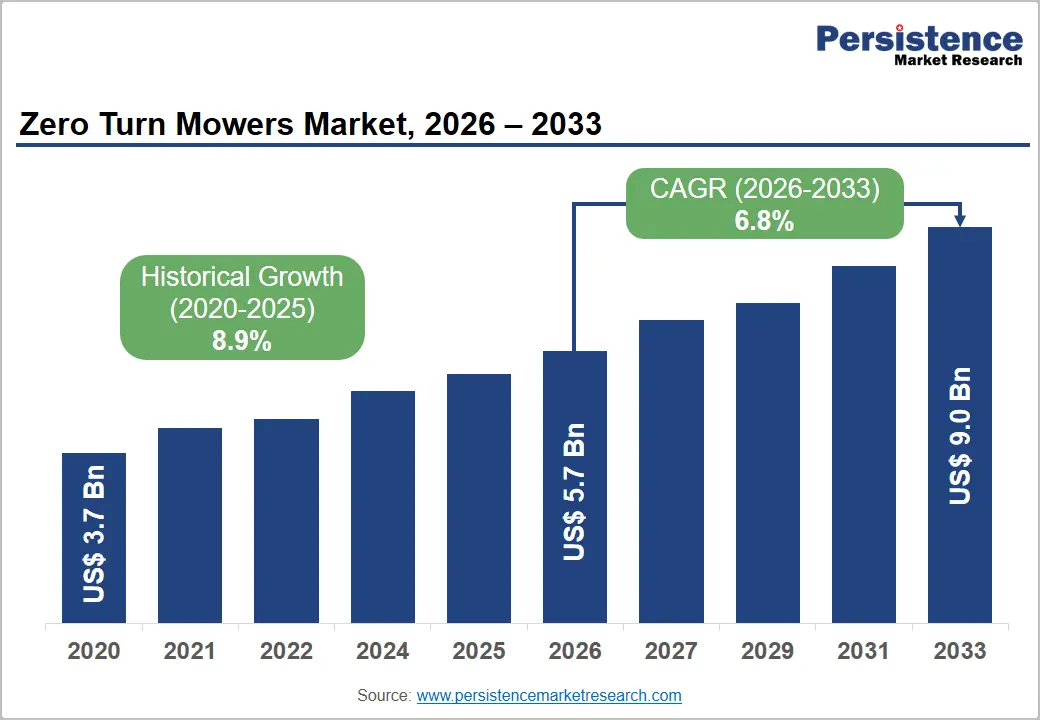
The global zero turn mowers market size is likely to be valued at US$5.7 billion in 2026 and is expected to reach US$9.0 billion by 2033, growing at a CAGR of 6.8% between 2026 and 2033, driven by increasing demand for professional landscaping services, rising adoption of battery-powered outdoor equipment, and ongoing technological advancements in commercial turf management. Zero-turn mowers continue to gain preference among commercial operators and residential consumers due to their superior maneuverability, reduced mowing time, and operational efficiency.
Key Industry Highlights:
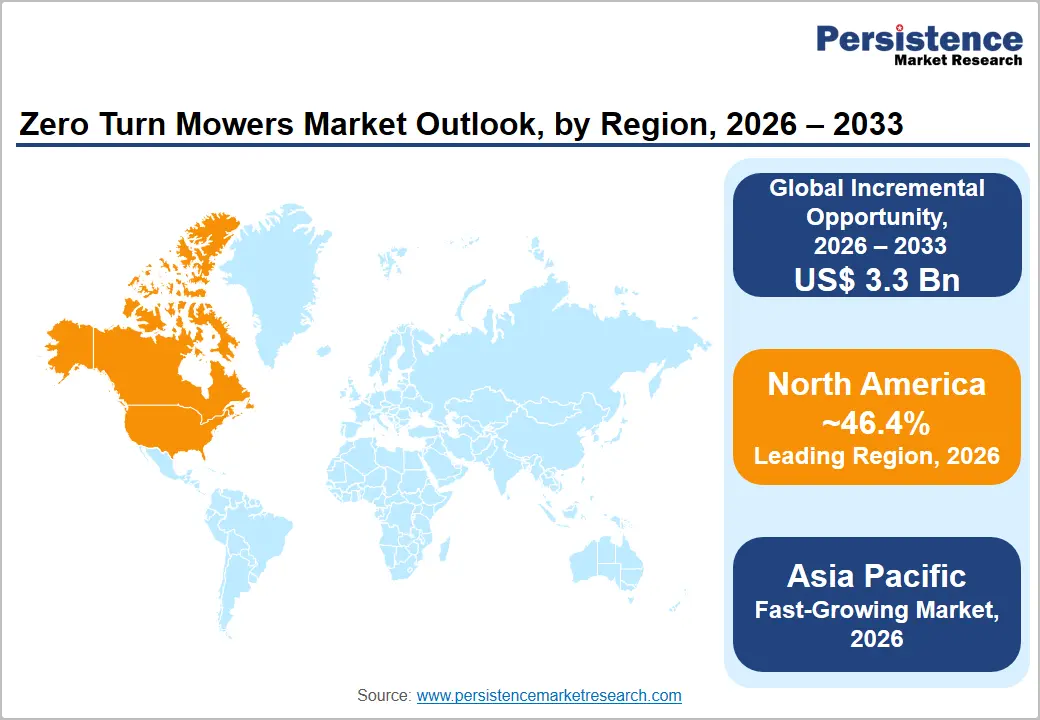
- Leading Region: North America is anticipated to account for approximately 46.4% of the market share, driven by strong commercial landscaping activity, extensive residential lawn ownership, and rapid adoption of advanced mowing technologies.
- Fastest-growing Region: Asia Pacific is projected to register the highest growth rate through 2033, supported by urbanization, expanding commercial infrastructure, increasing green space development, and rising adoption of mechanized landscaping equipment across China, India, Japan, and ASEAN countries.
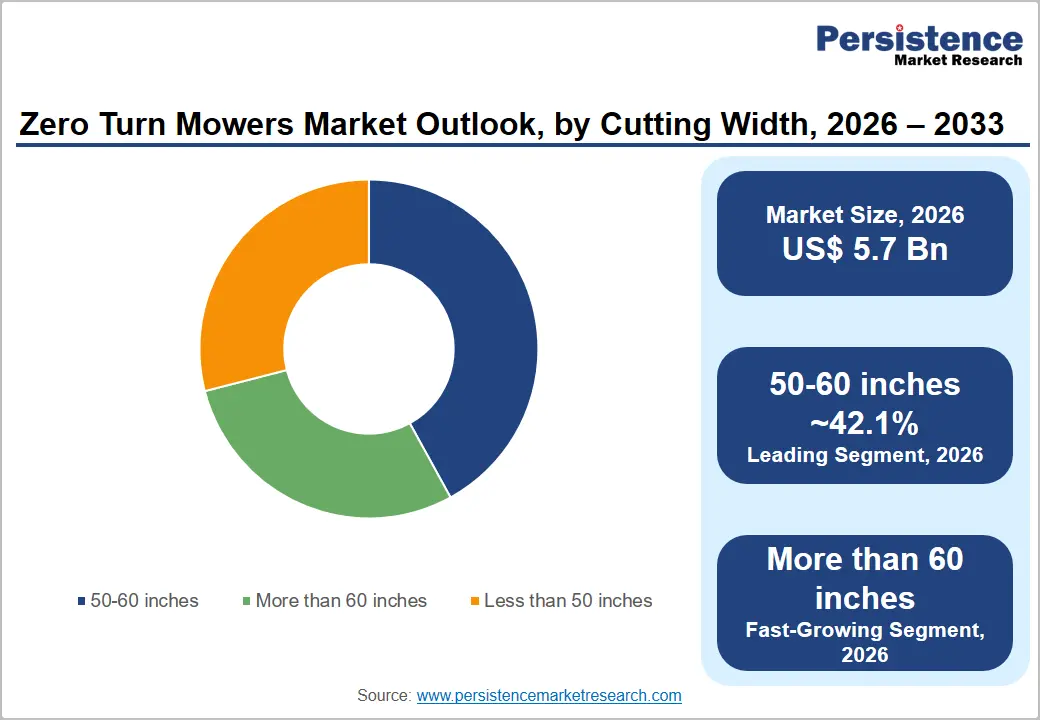
- Dominant Cutting Width: 50-60 inches is anticipated to account for approximately 42.1% of market share, owing to its optimal balance of productivity, maneuverability, and suitability for both residential and commercial applications.
- Leading Application: The commercial segment is anticipated to hold approximately 53.7% of the market share in 2026, driven by strong demand from landscaping contractors, municipalities, golf courses, sports facilities, educational campuses, and corporate properties.
DRO Analysis
Driver - Increasing Demand for Commercial Landscaping and Grounds Maintenance Services
Commercial landscaping remains the primary demand driver for zero-turn mowers worldwide. Professional landscaping contractors, municipalities, educational institutions, golf courses, and corporate campuses increasingly require high-productivity mowing equipment capable of maintaining large turf areas efficiently. Zero-turn mowers can significantly reduce mowing time compared to conventional riding mowers due to their exceptional maneuverability and higher operating speeds.
The expansion of residential communities, recreational facilities, sports complexes, and public parks continues to increase the total area requiring professional turf maintenance. Labor shortages across landscaping industries have further accelerated demand for equipment that improves worker productivity and reduces operating costs. Commercial operators are increasingly investing in larger deck sizes, advanced hydrostatic transmissions, and fleet management capabilities to maximize operational efficiency. These trends are expected to sustain strong demand for premium zero-turn mower platforms throughout the forecast period.
Electrification and Environmental Compliance Driving Equipment Modernization
The growing focus on emissions reduction and environmental sustainability is accelerating adoption of battery-powered zero-turn mowers. Improvements in lithium-ion battery technology have enhanced runtime, charging efficiency, and equipment reliability, making electric solutions increasingly viable for residential and commercial applications.
Municipal authorities, educational campuses, and commercial property managers are prioritizing low-noise and low-emission equipment to comply with evolving environmental requirements. Electric zero-turn mowers offer reduced maintenance requirements, lower operating costs, and improved user comfort compared to conventional gasoline-powered alternatives. Manufacturers are responding through expanded electrical product portfolios, advanced battery systems, and integrated charging solutions. As battery technology continues to improve, electrification is expected to become one of the most influential growth drivers shaping future market development.
Restraint - High Initial Acquisition Costs and Infrastructure Requirements
Despite strong growth prospects, the market continues to face challenges associated with high equipment acquisition costs. Commercial-grade zero-turn mowers require substantial upfront investment, particularly for larger deck sizes and battery-powered models. Many small landscaping companies and residential users remain sensitive to purchase prices, limiting adoption rates in certain markets.
Battery-powered models introduce additional considerations, including charging infrastructure, battery replacement planning, and fleet integration requirements. While electric platforms can provide lower long-term operating costs, many buyers continue to prioritize lower initial expenditures when making purchasing decisions. These factors create a barrier to rapid technology adoption and may slow equipment replacement cycles, particularly among budget-conscious customers and smaller commercial operators.
Opportunity - Expansion of Battery-Powered Residential and Professional Equipment
Battery-powered zero-turn mowers represent one of the most attractive growth opportunities in the market. Residential consumers are increasingly seeking quieter, cleaner, and lower-maintenance lawn care solutions. Improvements in battery performance and charging technology have made electric models more practical for larger residential properties and light-commercial applications.
Manufacturers are investing heavily in battery innovation, expanding product portfolios that combine professional-grade performance with simplified ownership. As battery-powered equipment becomes more affordable and capable, adoption is expected to accelerate among homeowners, municipalities, and commercial landscaping operators seeking sustainable alternatives to traditional gasoline-powered equipment.
Autonomous and Connected Turf Management Solutions
Automation is emerging as a transformative opportunity within the zero-turn mower industry. Manufacturers are increasingly integrating autonomous navigation systems, GPS guidance, fleet management software, remote diagnostics, and predictive maintenance capabilities into equipment platforms.
Commercial landscaping businesses face ongoing labor shortages and rising operating costs, creating strong demand for productivity-enhancing technologies. Autonomous mowing systems can improve route efficiency, reduce labor dependency, and deliver more consistent turf maintenance outcomes. Connected equipment platforms also enable fleet managers to monitor performance, optimize utilization, and reduce maintenance downtime. These capabilities are expected to create significant value for commercial customers while generating new recurring revenue opportunities for manufacturers.
Category-wise Analysis
Cutting Width Insights
The 50-60-inch segment is anticipated to account for approximately 42.1% of market share in 2026. This deck size offers an effective balance between productivity and maneuverability, making it suitable for commercial landscapers as well as large residential properties. Popular models such as the Toro TimeCutter 60-inch, John Deere ZTrak Z500 Series, and Kubota Z400 Series have strengthened demand in this segment by offering professional-grade performance across diverse mowing environments.
The more than 60-inch segment is projected to be the fastest-growing category. Demand is increasing among golf courses, sports complexes, municipalities, and large commercial properties where maximizing acreage coverage is a priority. Equipment such as the Scag Turf Tiger II 72-inch and Hustler Super Z HyperDrive demonstrates the growing preference for larger decks that reduce mowing time and labor costs.
Application Insights
The commercial segment is anticipated to account for approximately 53.7% of the market share in 2026, remaining the dominant application category. Landscaping contractors, municipalities, golf courses, educational campuses, and corporate facilities continue to invest in zero-turn mowers due to their high productivity and operational efficiency. Commercial fleets commonly utilize equipment from brands such as Exmark, Scag, Toro, and Ferris to manage extensive turf areas while minimizing labor requirements.
The residential segment is expected to record the fastest growth through 2033. Rising homeowner spending on lawn maintenance and increasing adoption of battery-powered models are supporting expansion. Products such as the Toro TimeCutter eMR4275, Ryobi 80V Electric Zero Turn, and EGO Power+ Z6 are making zero-turn technology more accessible to residential users by offering quieter operation, lower maintenance requirements, and improved ease of use.
Regional Insights
North America Zero Turn Mowers Market Trends
North America is anticipated to account for approximately 46.4% of the market share in 2026, maintaining its position as the leading regional market. Strong demand from commercial landscaping contractors, municipalities, golf courses, sports facilities, and residential property owners continues to support market growth. The region benefits from high mechanization levels, extensive lawn areas, strong consumer purchasing power, and a well-established dealer network. Growing investments in battery-powered equipment, autonomous mowing technologies, and connected fleet management solutions are expected to further strengthen market expansion throughout the forecast period.
U.S. Zero Turn Mowers Market Trends
The U.S. is anticipated to account for approximately 84% of the North America market in 2026, making it the primary revenue contributor. Large suburban housing developments, widespread lawn ownership, and a mature landscaping services industry drive consistent demand for zero-turn mowers. Commercial landscaping companies are increasingly modernizing fleets with larger deck configurations and advanced productivity-enhancing features. The growing adoption of battery-powered and autonomous mowing equipment, coupled with increasing environmental awareness, is creating new opportunities for manufacturers operating in the U.S. market.
Canada Zero Turn Mowers Market Trends
Canada is anticipated to represent approximately 11% of the regional market in 2026 and continues to benefit from increasing investments in municipal landscaping, recreational facilities, and residential property maintenance. Demand is particularly strong in urban and suburban regions where professional lawn care services are expanding. The adoption of electric outdoor power equipment is gaining momentum as municipalities seek to reduce emissions and noise levels in public spaces.
Europe Zero Turn Mowers Market Trends
Europe represents a mature but steadily evolving market characterized by stringent environmental regulations, growing sustainability initiatives, and increasing adoption of electric outdoor power equipment. Demand is supported by municipal landscaping projects, commercial property maintenance, sports facilities, and public green space development. Manufacturers are focusing on battery technology, autonomous operation, and sustainable product design to align with regional environmental objectives.
Germany Zero Turn Mowers Market Trends
Germany remains the largest market in Europe due to its advanced manufacturing base, strong landscaping industry, and emphasis on environmental sustainability. Demand for battery-powered zero-turn mowers is increasing as commercial operators and municipalities seek low-emission alternatives. The country's focus on green infrastructure development continues to support equipment modernization.
U.K. Zero Turn Mowers Market Trends
The U.K. is a key market driven by investments in public parks, sports facilities, golf courses, and urban landscaping projects. Commercial landscaping companies increasingly favor high-efficiency mowing equipment to manage labor costs and improve productivity. Battery-powered solutions are gaining popularity due to stricter environmental and noise-control requirements.
France Zero Turn Mowers Market Trends
France benefits from strong demand across municipal landscaping, tourism infrastructure, hospitality properties, and recreational facilities. Local authorities are increasingly investing in sustainable grounds maintenance practices, creating opportunities for electric and low-noise mowing equipment. Growth is further supported by expanding commercial property developments.
Spain Zero Turn Mowers Market Trends
Spain's market is driven by landscaping requirements across hotels, resorts, golf courses, and public recreational areas. Tourism-related infrastructure continues to generate demand for professional turf maintenance equipment. Increasing investments in urban beautification and public green spaces are expected to support long-term market growth.
Asia Pacific Zero Turn Mowers Market Trends
Asia Pacific is anticipated to be the fastest-growing regional market during the forecast period. Rapid urbanization, expanding commercial infrastructure, increasing investments in public green spaces, and rising awareness of professional landscaping practices are driving market expansion. The region also benefits from strong manufacturing capabilities, cost-efficient production, and growing adoption of advanced outdoor power equipment technologies.
China Zero Turn Mowers Market Trends
China serves as both a major manufacturing hub and a rapidly growing consumer market for outdoor power equipment. Increasing urban development, public infrastructure projects, and smart city initiatives are supporting demand for commercial landscaping equipment. The country's strong battery manufacturing ecosystem also supports the development of electric zero-turn mower platforms.
Japan Zero Turn Mowers Market Trends
Japan remains a significant market due to its advanced engineering capabilities and focus on equipment innovation. Demand is driven by golf courses, sports facilities, municipal landscaping, and commercial property maintenance. Manufacturers continue to invest in battery-powered and autonomous mowing technologies to address labor shortages and improve operational efficiency.
India Zero Turn Mowers Market Trends
India is emerging as a high-growth market supported by expanding urban infrastructure, residential township development, educational campuses, hospitality projects, and corporate parks. Growing awareness of mechanized landscaping solutions is encouraging adoption among commercial landscaping contractors and facility management companies.
Competitive Landscape
The global zero turn mowers market is moderately fragmented, with competition driven by product innovation, dealer network strength, pricing strategies, and technological differentiation. Leading manufacturers maintain strong market positions through extensive product portfolios, established brand recognition, and broad distribution capabilities.
Leading market participants are focusing on product innovation, electrification, automation, and geographic expansion. Investment priorities include battery-powered equipment, autonomous mowing technologies, connected fleet management systems, and dealer network enhancement. Companies are also emphasizing customer support services and recurring revenue opportunities through digital ecosystem development.
Key Industry Developments:
- In October 2025, The Toro Company introduced the PROLINE® AMI autonomous mower and expanded its contractor-focused equipment portfolio at Equip Expo 2025.
- In July 2025, Deere & Company launched Operations Center™ PRO Service, a new digital support platform for turf, agriculture, forestry, and construction equipment.
Companies Covered in Zero Turn Mowers Market
- The Toro Company
- Deere & Company (John Deere)
- Husqvarna AB
- Kubota Corporation
- AriensCo (Gravely)
- Scag Power Equipment
- Exmark Manufacturing Company
- Bad Boy Mowers
- Ferris Industries
- Wright Manufacturing, Inc.
- The Grasshopper Company
- Bobcat Company
- Mean Green Products
- Spartan Mowers
- Hustler Turf Equipment
- Jacobsen (Textron Specialized Vehicles)
Frequently Asked Questions
The global zero turn mowers market is anticipated to be valued at US$5.7 billion in 2026.
The global zero turn mowers market is projected to reach US$9.0 billion by 2033.
The zero turn mowers market is expected to grow at a CAGR of 6.8% between 2026 and 2033.
Key trends include the growing adoption of battery-powered zero-turn mowers, increasing deployment of autonomous and connected mowing technologies, expansion of commercial landscaping services, and rising investments in low-emission outdoor power equipment.
The 50-60-inch cutting width segment leads the market and is anticipated to account for approximately 42.1% of the market share, owing to its balance of productivity and maneuverability.
Major companies include The Toro Company, Deere & Company (John Deere), Husqvarna AB, Kubota Corporation, and Scag Power Equipment.


