




- Industrial Machinery
- Horizontal Belt Filters Market
Horizontal Belt Filters Market Size, Share, and Growth Forecast, 2026 - 2033
Horizontal Belt Filters Market by Product Type (50-100 sqm Belt Size, Above 100 sqm Belt Size, Others), Application (Mineral Processing, Chemical Processing, Others), End-use Industry, and Regional Analysis for 2026 - 2033

Horizontal Belt Filters Market Size and Trends Analysis
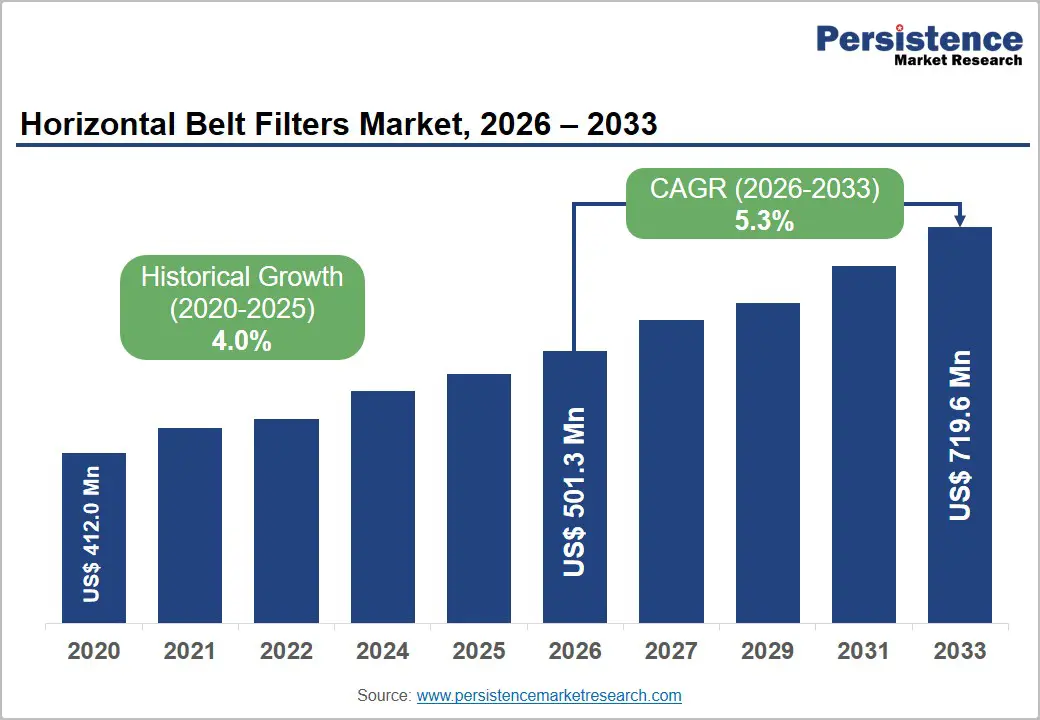
The global horizontal belt filters market size is likely to be valued at US$501.3 million in 2026 and is expected to reach US$719.6 million by 2033, growing at a CAGR of 5.3% between 2026 and 2033, driven by expanding mineral extraction activities, stricter industrial wastewater treatment requirements, and increasing emphasis on water recovery within resource-intensive operations.
Horizontal belt filters have become an important technology for continuous solid-liquid separation, enabling higher operational efficiency across mining, chemical processing, metallurgy, and industrial waste management applications. As industries focus on sustainability, water conservation, and productivity improvements, demand for advanced filtration solutions continues to strengthen.
Key Industry Highlights:
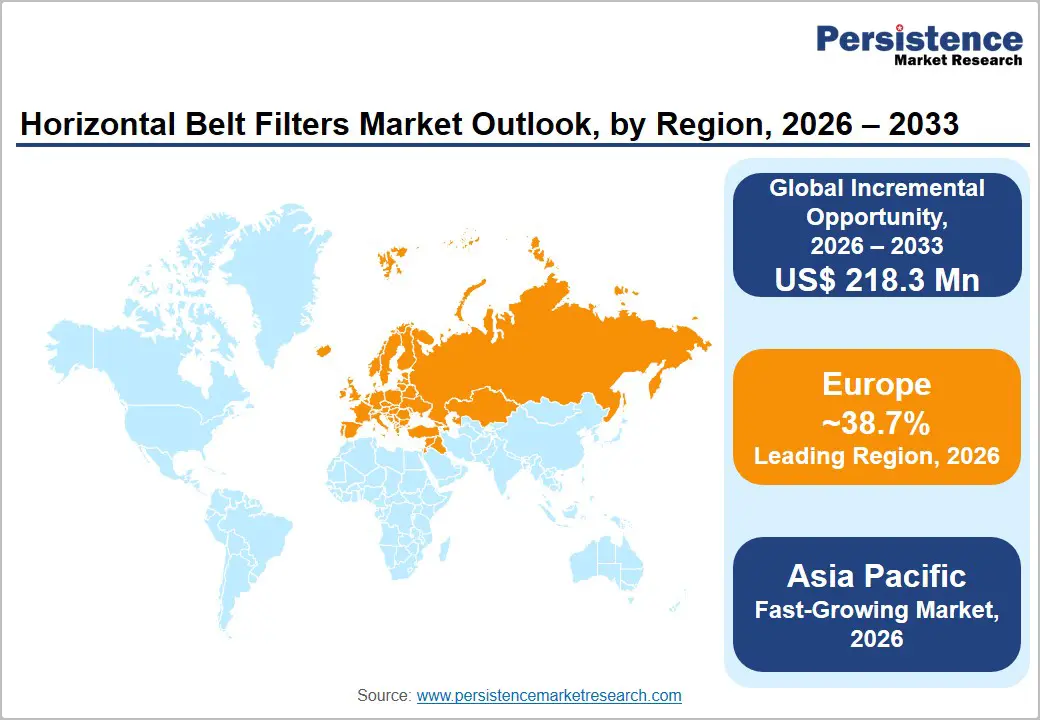
- Leading Region: Europe is anticipated to account for 38.7% of the market share in 2026, supported by stringent environmental regulations, mature industrial infrastructure, and strong adoption of advanced filtration technologies.
- Fastest-growing Region: Asia Pacific is projected to register the highest growth rate through 2033, driven by rapid industrialization, expanding mining activities, increasing wastewater treatment investments, and stricter environmental compliance requirements across China, India, and Southeast Asia.
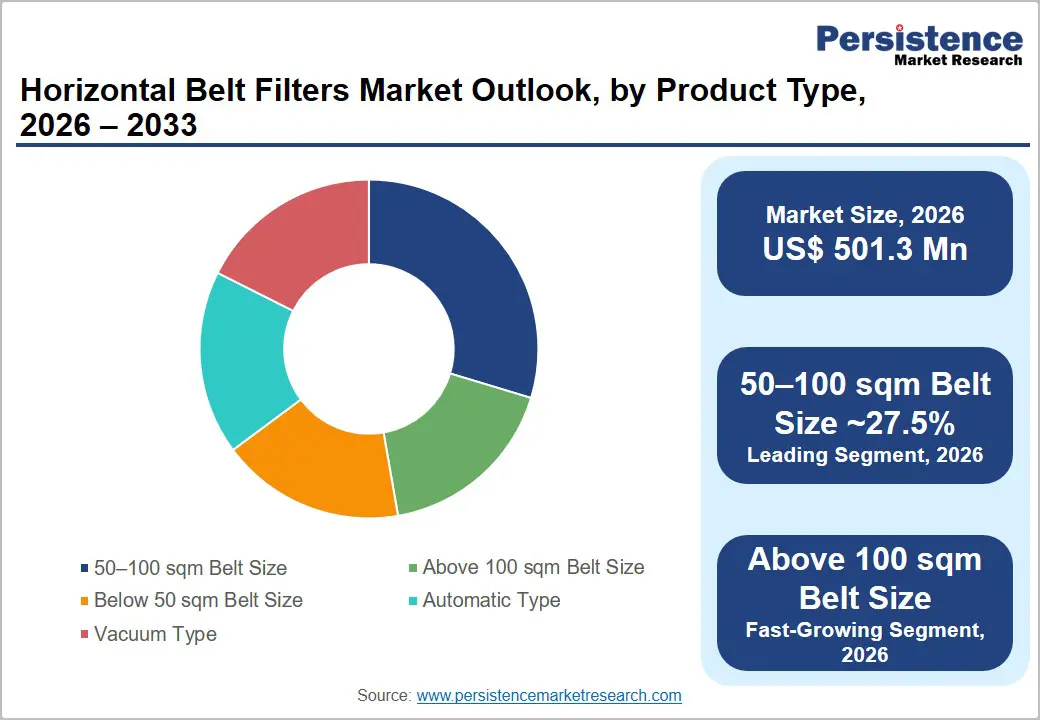
- Dominant Product Type: 50-100 sqm Belt Size is anticipated to hold 27.5% of the market share in 2026, owing to its optimal balance of throughput capacity, operational efficiency, installation flexibility, and cost-effectiveness across mining, metallurgy, and chemical processing applications.
- Leading Application: Mineral processing is anticipated to account for 36.1% of the market share in 2026, supported by sustained demand from copper, iron ore, lithium, nickel, and other critical mineral processing operations requiring efficient dewatering and water recovery solutions.
DRO Analysis
Driver - Expansion of Mining and Critical Minerals Production
The accelerating development of critical mineral supply chains is creating significant demand for high-capacity dewatering and filtration equipment. Rising production volumes of lithium, nickel, cobalt, graphite, copper, and rare earth minerals have resulted in increased investment in mining, beneficiation, and refining facilities worldwide. These operations require efficient solid-liquid separation technologies to improve material recovery rates and manage large slurry volumes.
Horizontal belt filters are particularly suited to these environments because they support continuous operation, high-throughput processing, and effective cake washing capabilities. Large-scale mining projects increasingly require filtration systems capable of handling substantial production volumes while minimizing water consumption. The growing adoption of filtered tailings management and water recovery initiatives further reinforces demand. As mining companies prioritize operational efficiency and environmental performance, horizontal belt filters are becoming an essential component of modern mineral processing infrastructure.
Increasing Environmental Regulations and Water Management Requirements
Industrial facilities face growing pressure to improve wastewater treatment performance and reduce environmental impact. Governments and regulatory agencies continue to strengthen discharge standards, water reuse requirements, and tailings management regulations across mining, chemical processing, metallurgy, and industrial manufacturing sectors.
Horizontal belt filters help facilities comply with these requirements by reducing moisture content in processed materials, recovering process water, and improving waste management efficiency. The technology supports cleaner production practices by minimizing water consumption and reducing disposal volumes. Industrial operators are also recognizing the economic benefits associated with improved water recovery and lower waste-handling costs. As environmental compliance becomes increasingly important, investments in advanced filtration technologies are expected to rise across multiple end-use industries.
Restraint - High Capital Investment and Application Complexity
Despite their operational advantages, horizontal belt filters involve substantial capital expenditures and engineering requirements. Most systems are custom-designed to accommodate specific slurry characteristics, throughput requirements, and process conditions. This customization increases project complexity and extends procurement and commissioning timelines.
The need for pilot testing, laboratory evaluation, and process optimization before installation often adds to project costs. Buyers must also consider long-term maintenance requirements, replacement components, and technical support capabilities. In mining and chemical processing applications, variations in feed material characteristics can further complicate equipment selection and system design. Consequently, some operators postpone upgrades or replacement projects due to investment risk and lengthy implementation schedules.
Opportunities - Growth of Water Reuse and Circular Processing Initiatives
Industrial water conservation is emerging as a major investment priority worldwide. Companies are increasingly adopting circular economy principles that emphasize resource recovery, wastewater recycling, and reduced environmental impact. Horizontal belt filters support these objectives by maximizing water recovery during dewatering operations and improving downstream process efficiency.
Higher water recovery rates can reduce freshwater consumption, lower wastewater treatment costs, and improve overall plant sustainability. Industries operating in water-stressed regions are particularly focused on technologies that enable closed-loop water management systems. Suppliers that combine filtration equipment with monitoring solutions, process optimization services, and lifecycle support are well positioned to capture additional value as customers pursue broader sustainability goals.
Industrial Expansion across Asia Pacific
Rapid industrialization throughout Asia Pacific continues to create substantial opportunities for filtration equipment suppliers. Investments in mining, chemicals, industrial wastewater treatment, food processing, and manufacturing facilities are increasing demand for advanced solid-liquid separation technologies.
Many countries across the region are implementing stricter environmental regulations while simultaneously expanding industrial capacity. This combination of regulatory compliance requirements and production growth is generating strong demand for both new installations and retrofit projects. Industrial operators increasingly seek filtration systems capable of improving productivity, reducing water consumption, and supporting sustainable manufacturing practices. These trends position Asia Pacific as one of the most attractive growth markets for horizontal belt filter suppliers over the forecast period.
Category-wise Analysis
Product Type Insights
The 50-100 sqm belt size segment is anticipated to account for 27.5% of the market share in 2026, making it the leading product category. Its dominance stems from its ability to balance throughput capacity, operational efficiency, installation flexibility, and capital costs across industries such as mining, metallurgy, chemical processing, and wastewater treatment. These systems are widely deployed in copper concentrators, iron ore beneficiation plants, and industrial sludge dewatering facilities where continuous filtration performance is essential.
The above 100 sqm belt size segment is projected to be the fastest-growing category during the forecast period. Rising investments in large-scale mining projects, filtered tailings facilities, and industrial water recovery systems are driving demand for higher-capacity filtration equipment. For example, several new iron ore and copper processing projects have adopted belt filters exceeding 145 sqm to support higher throughput requirements and improved water recovery rates.
Application Insights
The mineral processing segment is anticipated to hold 36.1% of the market share in 2026. Mining operations rely on horizontal belt filters for concentrate dewatering, tailings management, and process water recovery. The segment continues to benefit from investments in copper, iron ore, lithium, and nickel projects, where efficient solid-liquid separation is critical to operational performance and sustainability objectives. Metallurgical ore processing and power waste treatment also contribute significantly to market demand, while food processing applications are gradually expanding in specialized filtration environments.
The chemical processing segment is expected to be the fastest-growing application during the forecast period. Chemical manufacturers are increasingly upgrading filtration infrastructure to improve wastewater treatment, product recovery, and regulatory compliance. Examples include filtration systems used in fertilizer production, inorganic chemical processing, and specialty chemical manufacturing, where efficient slurry handling and water reuse have become key operational priorities. Growing sustainability initiatives and stricter discharge standards continue to accelerate adoption across the sector.
Regional Insights
North America Horizontal Belt Filters Market Trends
North America represents a significant market for horizontal belt filters, supported by a large industrial base, advanced mining operations, and stringent environmental regulations. Demand is primarily driven by investments in mineral processing, industrial wastewater treatment, and critical mineral supply chains. Growing emphasis on water recovery, filtered tailings management, and process optimization continues to support market expansion across the region.
U.S. Horizontal Belt Filters Market Trends
The U.S. is the largest market in North America, benefiting from extensive mining activities, industrial wastewater treatment upgrades, and increasing investments in critical minerals such as lithium, copper, and rare earth elements. Mining companies are modernizing beneficiation facilities to improve water recovery and reduce environmental impact, while chemical manufacturers are adopting advanced filtration technologies to comply with evolving discharge standards. Strong engineering capabilities and established service networks further strengthen market demand.
Canada Horizontal Belt Filters Market Trends
Canada represents an important growth market due to its large mining sector and expanding critical minerals industry. Investments in copper, nickel, potash, and lithium projects are creating demand for high-capacity filtration systems. The country's focus on sustainable mining practices and tailings management is encouraging the adoption of advanced dewatering technologies, including horizontal belt filters.
Europe Horizontal Belt Filters Market Trends
Europe is anticipated to account for approximately 38.7% of the global horizontal belt filters market in 2026, making it the leading regional market. The region benefits from mature industrial infrastructure, stringent environmental regulations, and widespread adoption of advanced filtration technologies. Market growth is increasingly supported by modernization projects, sustainability initiatives, and investments in resource recovery systems.
Germany Horizontal Belt Filters Market Trends
Germany serves as the largest market in Europe due to its strong manufacturing base and advanced process engineering expertise. The country's chemical, metallurgy, and industrial processing sectors continue to invest in high-performance filtration systems to improve operational efficiency, water reuse, and regulatory compliance.
U.K. Horizontal Belt Filters Market Trends
The U.K. is witnessing increasing adoption of industrial filtration technologies across wastewater treatment, chemicals, and resource recovery applications. Growing emphasis on industrial sustainability and environmental performance is encouraging facilities to upgrade aging filtration infrastructure.
France Horizontal Belt Filters Market Trends
France remains a key market due to ongoing investments in industrial water treatment, chemical manufacturing, and circular economy initiatives. Companies are increasingly deploying advanced filtration systems to reduce waste generation, improve water recovery rates, and support sustainability objectives.
Asia Pacific Horizontal Belt Filters Market Trends
Asia Pacific is projected to be the fastest-growing regional market throughout the forecast period. Rapid industrialization, expanding mining activities, growing chemical production, and increasing environmental awareness are driving strong demand for horizontal belt filters across multiple industries. Investments in wastewater treatment infrastructure and sustainable manufacturing practices further support market growth.
China Horizontal Belt Filters Market Trends
China represents the largest market in Asia Pacific due to its extensive mining, chemical processing, metallurgy, and manufacturing sectors. Large-scale investments in mineral processing facilities and industrial wastewater treatment projects continue to generate substantial demand for filtration equipment. Increasing environmental regulations are further accelerating the adoption of advanced dewatering technologies.
India Horizontal Belt Filters Market Trends
India is emerging as one of the fastest-growing markets in the region. Expanding mining operations, rising investments in industrial infrastructure, and stricter environmental regulations are driving demand for horizontal belt filters. Growth in iron ore beneficiation, mineral processing, and chemical manufacturing projects is creating significant opportunities for equipment suppliers.
Japan Horizontal Belt Filters Market Trends
Japan maintains steady demand through investments in advanced manufacturing, wastewater treatment, and resource efficiency initiatives. Industrial operators are increasingly adopting high-performance filtration technologies to improve operational sustainability and process reliability.
Competitive Landscape
The global horizontal belt filters market exhibits a moderately consolidated structure at the global level, with several multinational equipment manufacturers maintaining strong positions in mining and industrial filtration applications. These leading companies compete through technological innovation, extensive installed bases, engineering expertise, and global service networks.
Leading market participants are focusing on high-capacity system innovation, digital monitoring technologies, lifecycle service agreements, and geographic expansion within mining-intensive regions. Competitive differentiation increasingly depends on engineering expertise, process optimization support, automation capabilities, and long-term customer relationships rather than equipment supply alone.
Key Industry Developments:
- In February 2026, DELKOR India completed the revamp of Tata Steel's 145 m² Horizontal Belt Filter at the West Bokaro coal operation.
- In September 2025, FLSmidth expanded its filtration portfolio through the deployment of high-capacity Horizontal Belt Filters as part of a next-generation iron ore beneficiation facility.
Companies Covered in Horizontal Belt Filters Market
- FLSmidth
- Metso
- ANDRITZ Separation
- TAKRAF Group (DELKOR)
- Roxia
- BHS-Sonthofen
- Komline-Sanderson
- WesTech Engineering
- Micronics Engineered Filtration Group
- Peterson Filters Corporation
- Compositech Products Manufacturing (CPM)
- Tsukishima Kikai Co., Ltd. (TSK)
- HASLER Group
- Veolia Water Technologies
- Clear Edge Filtration
- Menardi Filter Elements LLC
Frequently Asked Questions
The global horizontal belt filters market is anticipated to be valued at US$501.3 million in 2026.
The horizontal belt filters market is expected to reach US$719.6 million by 2033.
Key trends include the growing adoption of filtered tailings management systems, increasing focus on process water recovery and reuse, rising investments in critical mineral mining projects, and the integration of automation and digital monitoring technologies into filtration systems.
The 50-100 sqm belt size segment is the leading product type, anticipated to account for 27.5% of the market share, owing to its balance of throughput capacity, operational efficiency, and installation flexibility.
The horizontal belt filters market is projected to grow at a CAGR of 5.3% between 2026 and 2033.
Major companies include FLSmidth, Metso, ANDRITZ, TAKRAF (DELKOR), and BHS-Sonthofen.


