




- IT and Telecommunication
- Graph Database Market
Graph Database Market Size, Share, and Growth Forecast, 2026 - 2033
Graph Database Market by Data Model (Property Graph, RDF (Resource Description Framework), Others), Component (Solution/Software, Services, Others), Application, Industry, and Regional Analysis for 2026 - 2033

Graph Database Market Size and Trends Analysis
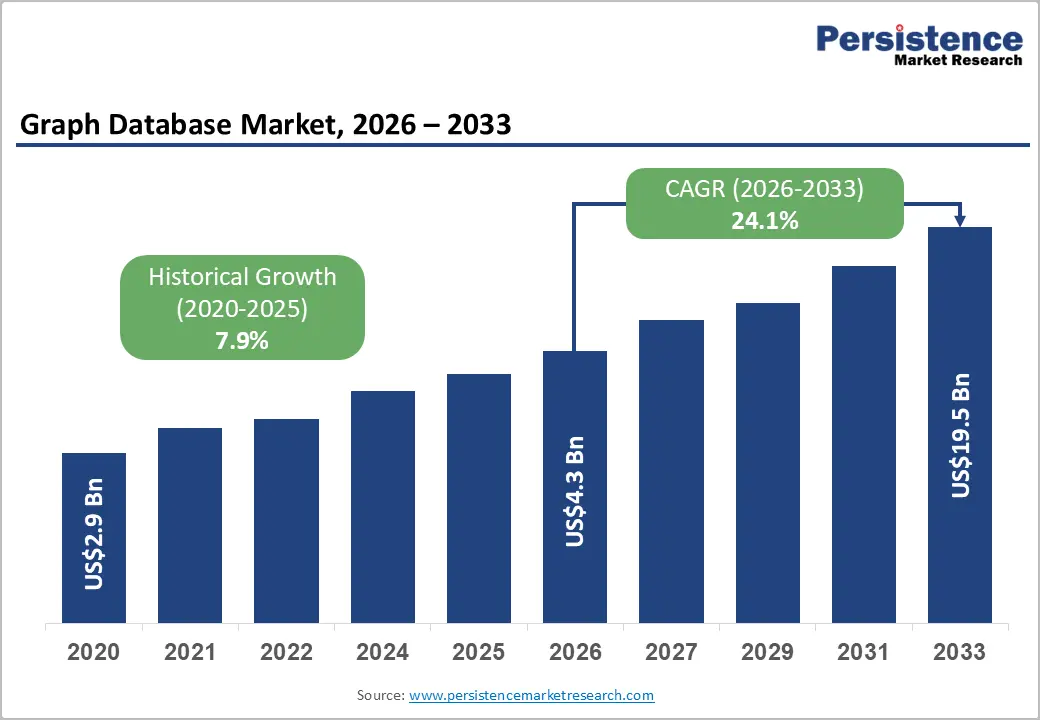
The global graph database market size is likely to be valued at US$4.3 billion in 2026 and is expected to reach US$19.5 billion by 2033, growing at a CAGR of 24.1% during the forecast period from 2026 to 2033, driven by the increasing adoption of artificial intelligence (AI), cloud-native data platforms, and advanced analytics technologies, all of which require efficient handling of highly interconnected data. Graph databases enable organizations to model and analyze complex relationships between entities, helping uncover valuable insights from large and dynamic datasets. Growing applications in fraud detection, customer analytics, recommendation systems, and knowledge graph development are further driving demand. As businesses increasingly focus on real-time intelligence and AI-powered decision-making, graph databases are emerging as a foundational element of next-generation enterprise data infrastructures.
Key Industry Highlights:
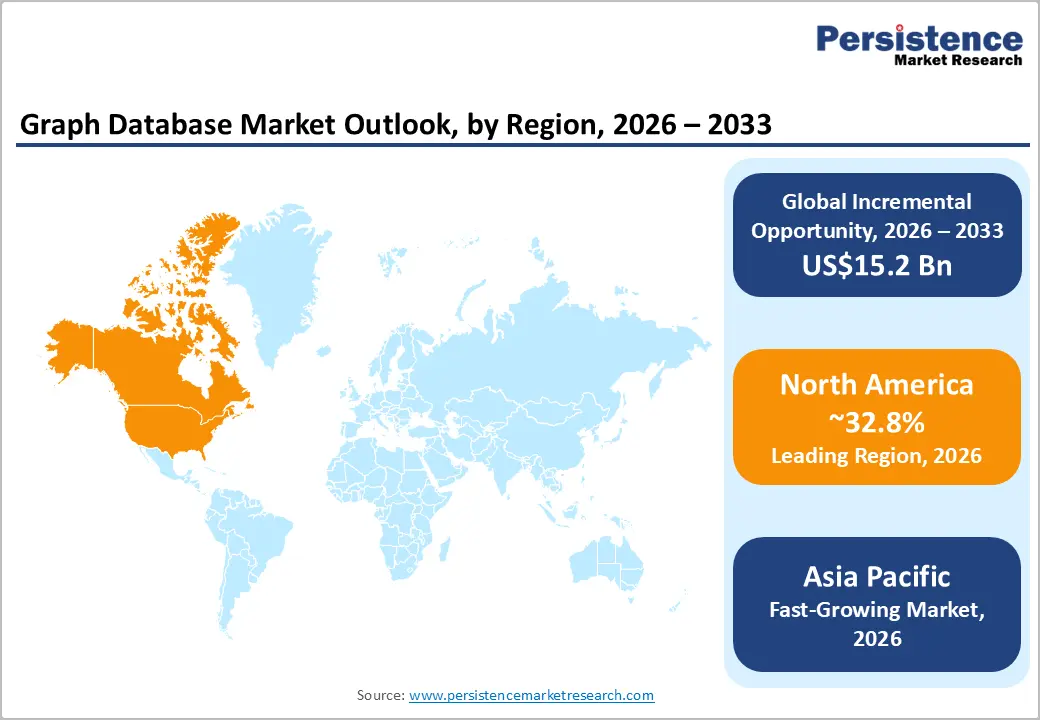
- Leading Region: North America is projected to account for 32.8% market share in 2026, driven by strong enterprise AI adoption, advanced cloud infrastructure, and extensive deployment of graph databases across the BFSI, healthcare, retail, and technology sectors.
- Fastest-growing Region: Asia Pacific, projected to register the highest growth rate through 2033, supported by rapid digital transformation, increasing cloud investments, expanding AI adoption, and strong demand from China, India, Japan, and Southeast Asian economies.
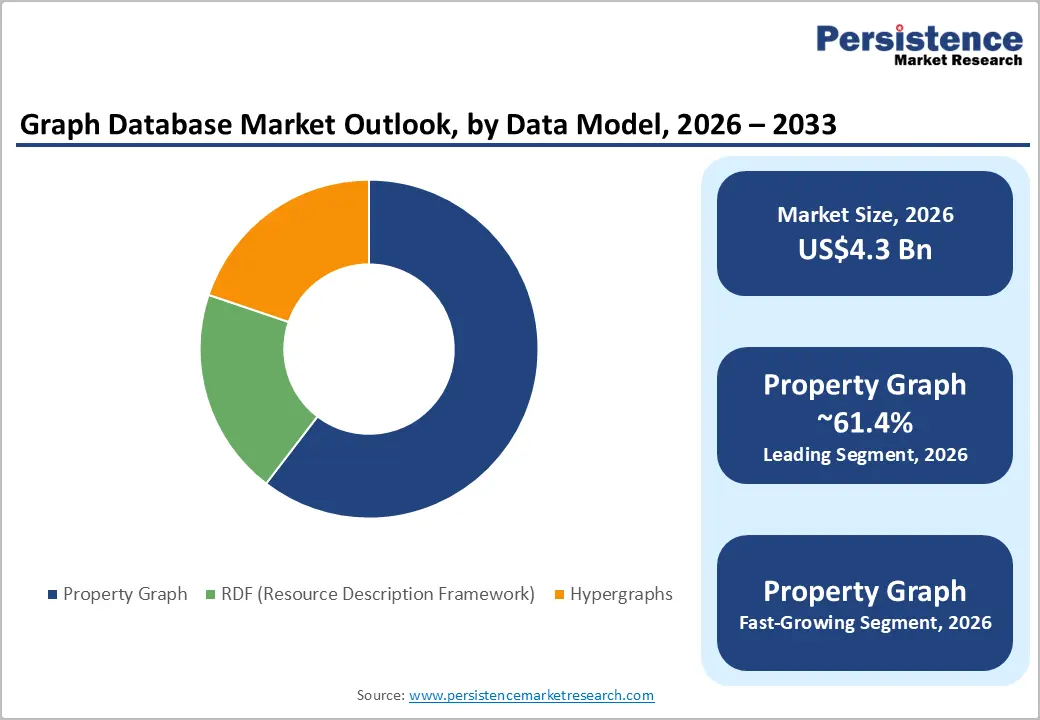
- Dominant Data Model: Property graph is anticipated to account for 61.4% of market share in 2026, owing to its flexibility, scalability, and widespread use in fraud detection, customer analytics, recommendation systems, and knowledge graph applications.
- Leading Component: Solution/Software is estimated to hold 67.1% of market share in 2026, supported by growing adoption of graph database platforms, analytics engines, visualization tools, and cloud-native graph services across enterprise environments.
DRO Analysis
Driver - Growing Adoption of AI, GraphRAG, and Connected Data Architectures
The rapid expansion of artificial intelligence applications is creating significant demand for graph database technologies. Organizations increasingly require data infrastructures capable of managing relationships between entities, concepts, and events to support advanced AI models and retrieval-augmented generation (RAG) frameworks. Unlike traditional databases, graph databases preserve contextual relationships, allowing AI systems to deliver more accurate, explainable, and context-aware results.
The emergence of GraphRAG architectures, knowledge graphs, and agentic AI systems has further strengthened demand for graph-based data platforms. Enterprises across financial services, healthcare, retail, and technology sectors are investing in graph databases to improve data retrieval, recommendation accuracy, customer intelligence, and decision support systems. As AI adoption continues to accelerate globally, graph databases are expected to become a foundational layer within enterprise AI ecosystems.
Increasing Demand for Fraud Detection, Risk Management, and Compliance Analytics
Financial institutions and other highly regulated industries are increasingly leveraging graph databases to combat fraud and strengthen risk management capabilities. Traditional relational databases often struggle to identify complex relationships among transactions, users, devices, and networks, whereas graph databases excel at uncovering hidden connections and suspicious behavioral patterns.
The continued growth of digital banking, online payments, and real-time transaction processing has significantly increased the volume and complexity of financial data. Organizations are utilizing graph technologies to improve fraud detection accuracy, reduce false positives, and enhance compliance monitoring. As regulatory requirements become more stringent and financial crime grows more sophisticated, graph databases are becoming an essential tool for safeguarding enterprise operations and protecting customer assets.
Restraint - Integration Complexity and Limited Availability of Specialized Skills
Despite their advantages, graph databases face adoption challenges related to implementation complexity and workforce expertise. Many organizations operate extensive legacy infrastructures built on relational, document, or data warehouse technologies, making migration to graph-based architectures a resource-intensive process.
Successful deployment often requires specialized knowledge in graph modeling, graph query languages, and data integration methodologies. Organizations may also face additional costs associated with employee training, consulting services, and infrastructure modernization. These challenges are particularly significant for small and medium-sized enterprises with limited technical resources and budget constraints. Consequently, many businesses continue to adopt graph capabilities incrementally rather than pursuing large-scale migrations, which may slow overall market penetration.
Opportunity - Expanding Adoption of Recommendation Engines and Personalization Platforms
The growing importance of personalized digital experiences presents a significant opportunity for graph database vendors. Retailers, streaming platforms, financial institutions, and online marketplaces increasingly rely on recommendation engines to improve customer engagement, conversion rates, and retention.
Graph databases enable organizations to analyze relationships among customers, products, content, and behavioral patterns in real time. This capability supports highly accurate recommendation systems that deliver relevant content and product suggestions. As enterprises continue investing in customer experience optimization, graph-based recommendation engines are expected to emerge as one of the fastest-growing application areas within the market.
Rising Demand for Managed Cloud Graph Database Services
The continued expansion of cloud computing creates substantial opportunities for managed graph database solutions. Organizations are increasingly seeking scalable, cloud-native platforms that reduce infrastructure management requirements while accelerating deployment timelines.
Managed graph services offer simplified implementation, automated maintenance, flexible pricing models, and seamless integration with AI and analytics platforms. These advantages are particularly attractive in rapidly digitizing economies where businesses seek advanced data capabilities without significant upfront investments. Vendors offering cloud-based graph database services combined with compliance, security, and industry-specific capabilities are well positioned to capture emerging growth opportunities across global markets.
Category-wise Analysis
Data Model Insights
Property graph is anticipated to hold 61.4% market share in 2026, due to its flexibility, ease of implementation, and ability to represent complex relationships using attribute-rich nodes and edges. It is widely adopted for fraud detection, customer analytics, recommendation engines, and knowledge graph applications. For example, financial institutions use property graph databases to uncover hidden fraud networks, while e-commerce platforms leverage them to power personalized product recommendations. Its scalability and developer-friendly architecture continue to drive widespread enterprise adoption.
Property graph is also anticipated to record the highest growth rate during the forecast period, supported by increasing deployment of AI-driven applications, GraphRAG frameworks, and enterprise knowledge graphs. Major platforms such as Neo4j, Amazon Neptune, and TigerGraph are expanding graph capabilities to support advanced analytics and generative AI workloads. Although RDF remains important for semantic web applications and hypergraphs serve specialized use cases, Property Graph continues to gain momentum due to its versatility and broad commercial applicability.
Component Insights
Solution/Software is anticipated to hold 67.1% market share in 2026, driven by strong demand for graph database platforms, analytics engines, visualization tools, and cloud-native graph services. Organizations across banking, retail, and telecommunications sectors are investing in graph software to support fraud detection, network analysis, and customer intelligence initiatives. Subscription-based licensing and cloud deployment models further contribute to the segment’s revenue leadership.
Services are projected to be the fastest-growing component segment as organizations increasingly seek support for graph database implementation, migration, integration, and ongoing management. For example, enterprises adopting graph-powered AI and knowledge graph solutions often rely on consulting and managed service providers to accelerate deployment and optimize performance. Growing complexity in enterprise data environments and rising demand for cloud-managed graph solutions are expected to sustain strong growth in this segment.
Regional Insights
North America Graph Database Market Trends
North America is anticipated to remain the largest regional market for graph databases, accounting for approximately 32.8% of market revenue in 2026. Growth is driven by advanced cloud infrastructure, strong AI adoption, and significant investments in data modernization initiatives. Enterprises across financial services, healthcare, retail, and technology sectors are increasingly deploying graph databases to support fraud detection, customer intelligence, knowledge graphs, and real-time analytics applications.
U.S. Graph Database Market Trends
The U.S. is expected to dominate the North America market due to its mature technology ecosystem and early adoption of AI-driven data platforms. Leading cloud providers, database vendors, and AI developers continue to invest heavily in graph technologies to enhance enterprise analytics, cybersecurity, and generative AI capabilities. Growing demand for GraphRAG architectures and knowledge graph solutions further supports market expansion.
Canada Graph Database Market Trends
Canada is experiencing steady growth, supported by increasing investments in AI research, cloud computing infrastructure, and digital transformation initiatives. Financial institutions, healthcare organizations, and public sector agencies are adopting graph databases to improve data connectivity, risk management, and customer analytics.
Europe Graph Database Market Trends
Europe remains a key market for graph database adoption, supported by digital transformation programs, increasing cloud utilization, and stringent data governance requirements. Organizations are leveraging graph databases to improve regulatory compliance, supply chain visibility, customer intelligence, and enterprise knowledge management.
Germany Graph Database Market Trends
Germany represents the largest market in Europe, driven by its strong industrial manufacturing, automotive, and enterprise software sectors. Organizations are deploying graph databases to optimize supply chains, improve predictive maintenance, and support Industry 4.0 initiatives.
U.K. Graph Database Market Trends
The U.K. is a major adopter of graph database technologies, particularly within banking, insurance, and fintech sectors. The growing need for fraud detection, anti-money laundering systems, and customer relationship analytics continues to accelerate market demand.
France Graph Database Market Trends
France is witnessing increased adoption of graph databases across government, financial services, and healthcare sectors. Organizations are investing in connected data architectures to improve operational efficiency, data governance, and AI-driven decision-making.
Spain Graph Database Market Trends
Spain is emerging as a growing market due to rising cloud adoption and digitalization initiatives. Enterprises are utilizing graph technologies to enhance customer experience, optimize logistics operations, and strengthen business intelligence capabilities.
Asia Pacific Graph Database Market Trends
Asia Pacific is projected to be the fastest-growing regional market throughout the forecast period, supported by rapid digital transformation, expanding cloud infrastructure, and increasing enterprise AI adoption. The region is benefiting from growing investments in financial technology, e-commerce, telecommunications, and smart manufacturing.
China Graph Database Market Trends
China holds the largest share within the Asia Pacific market and is expected to remain the region's dominant country throughout the forecast period. Strong investments in AI, cloud computing, smart manufacturing, and digital infrastructure continue to drive graph database adoption. Large-scale deployment of recommendation engines, knowledge graphs, and financial risk management platforms is further supporting market growth.
Japan Graph Database Market Trends
Japan is a significant contributor to regional demand, driven by enterprise digitalization, advanced manufacturing technologies, and growing adoption of AI-powered analytics. Organizations are increasingly implementing graph databases to improve supply chain visibility, network management, and operational intelligence.
India Graph Database Market Trends
India is emerging as one of the fastest-growing country markets due to rapid cloud adoption, expanding fintech ecosystems, and government-led digital transformation initiatives. Banks, e-commerce companies, and telecommunications providers are increasingly utilizing graph databases for fraud detection, customer analytics, and recommendation systems.
South Korea Graph Database Market Trends
South Korea continues to invest heavily in AI, telecommunications, and advanced digital infrastructure. Enterprises are leveraging graph databases to support real-time analytics, cybersecurity applications, and intelligent network management.
Competitive Landscape
The global graph database market exhibits a moderately consolidated structure, with a small group of leading vendors controlling a significant share of global revenue. However, the broader competitive landscape remains fragmented, with numerous specialized providers competing across niche applications, industry-specific solutions, and emerging AI-driven use cases.
Leading vendors are prioritizing AI-driven innovation, cloud-native deployment models, strategic partnerships, and industry-specific solutions. Organizations are increasingly differentiating themselves through GraphRAG capabilities, knowledge graph integration, managed services offerings, and scalable cloud architectures. Subscription-based revenue models, ecosystem expansion, and enterprise AI enablement remain central to long-term competitive strategies.
Key Industry Developments:
- In February 2025, IBM announced its acquisition of DataStax, a provider of AI and data solutions, to strengthen its watsonx AI portfolio and expand enterprise capabilities in knowledge graphs, vector search, and generative AI data management.
- In May 2025, Neo4j launched Aura Graph Analytics, a serverless graph analytics platform that enables organizations to analyze connected data directly from databases, data warehouses, and lakehouses without requiring data movement.
Companies Covered in Graph Database Market
- Neo4j
- Amazon Web Services (AWS)
- Oracle Corporation
- IBM Corporation
- Microsoft Corporation
- TigerGraph
- DataStax
- Stardog
- ArangoDB
- Memgraph
- Graphwise
- RelationalAI
- Bitnine Global
- Ontotext
- Cambridge Semantics
- Oxford Semantic Technologies
Frequently Asked Questions
The global graph database market is estimated to be valued at US$4.3 billion in 2026.
The graph database market is projected to reach US$19.5 billion by 2033.
Key trends include the growing adoption of AI and GraphRAG architectures, increasing deployment of knowledge graphs, expansion of managed cloud graph database services, rising use of fraud detection and risk analytics, and growing demand for personalized recommendation engines.
Property graph is the leading segment, accounting for approximately 61.4% of the global market share, driven by its flexibility, scalability, and suitability for enterprise AI, fraud detection, and recommendation applications.
The graph database market is expected to grow at a CAGR of 24.1% from 2026 to 2033.
Some of the major companies include Neo4j, Amazon Web Services (AWS), IBM Corporation, Oracle Corporation, Microsoft Corporation, TigerGraph, and DataStax.


