




- IT and Telecommunication
- Ambient Computing Market
Ambient Computing Market Size, Share, and Growth Forecast, 2026 - 2033
Ambient Computing Market by Component (Hardware, Software, Others), Technology (Voice Assistants & NLP, Edge Computing, Others), Application, and Regional Analysis for 2026 - 2033

Ambient Computing Market Size and Trends Analysis
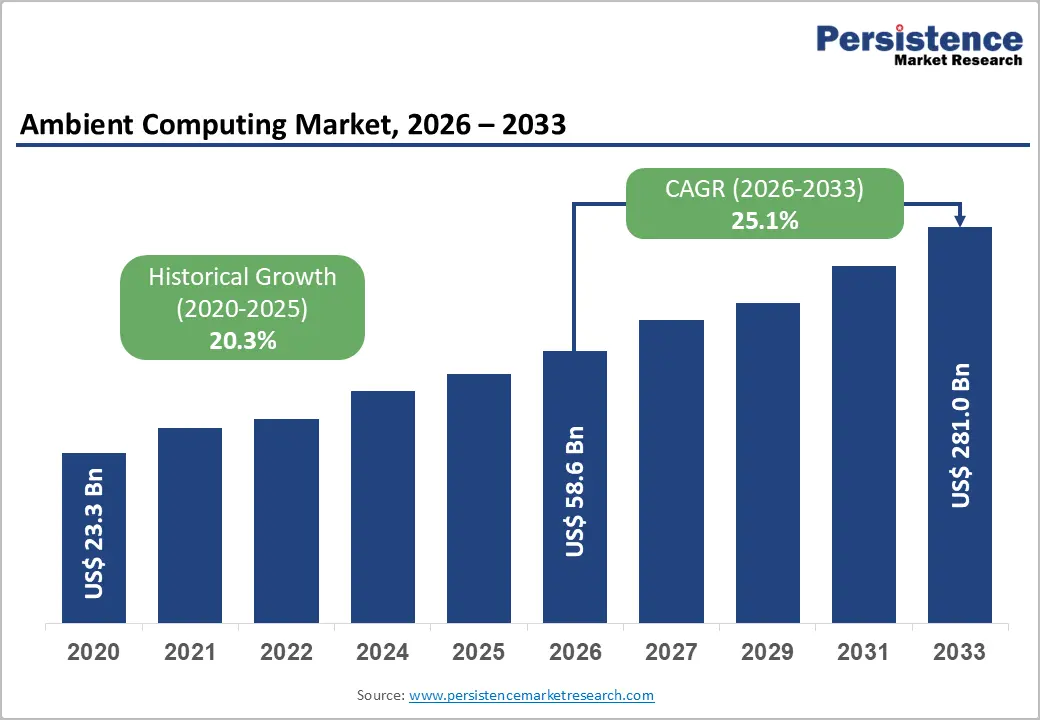
The global ambient computing market size is likely to be valued at US$ 58.6 billion in 2026 and is expected to reach US$281.0 billion by 2033, growing at a CAGR of 25.1% between 2026 and 2033, driven by the convergence of artificial intelligence (AI), Internet of Things (IoT), edge computing, and natural-language interfaces into persistent, context-aware environments.
Enterprises and consumers are adopting ambient systems as they reduce friction in digital interactions and enable predictive, automated decision-making. The market is transitioning from device-centric ecosystems to experience-centric platforms, where intelligence is embedded seamlessly into everyday environments.
Key Industry Highlights:
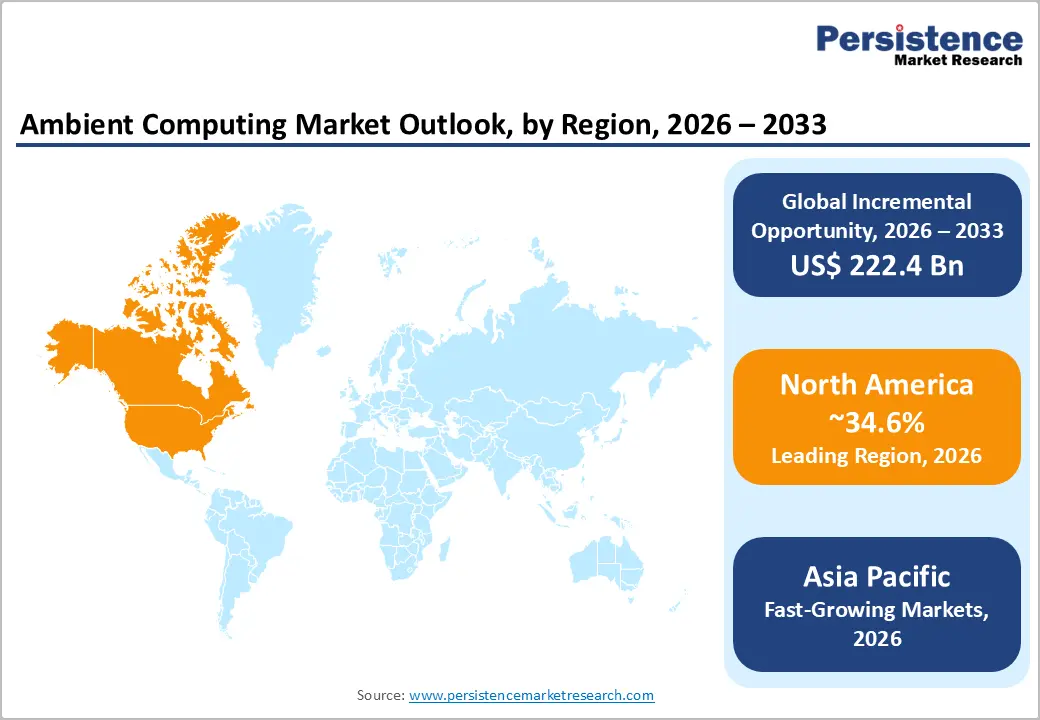
- Leading Region: North America is projected to account for approximately 34.6% of market share in 2026, supported by advanced digital infrastructure, strong AI adoption, and the presence of major technology companies.
- Fastest-growing Region: Asia Pacific is likely to be the fastest-growing region, driven by rapid urbanization, large-scale smart city investments, and increasing deployment of IoT and 5G infrastructure.
- Investment Plans: Global investments are heavily focused on AI integration, edge computing infrastructure, and smart ecosystem development, with significant capital flowing into smart homes, healthcare automation, and connected urban infrastructure to enable scalable ambient environments.
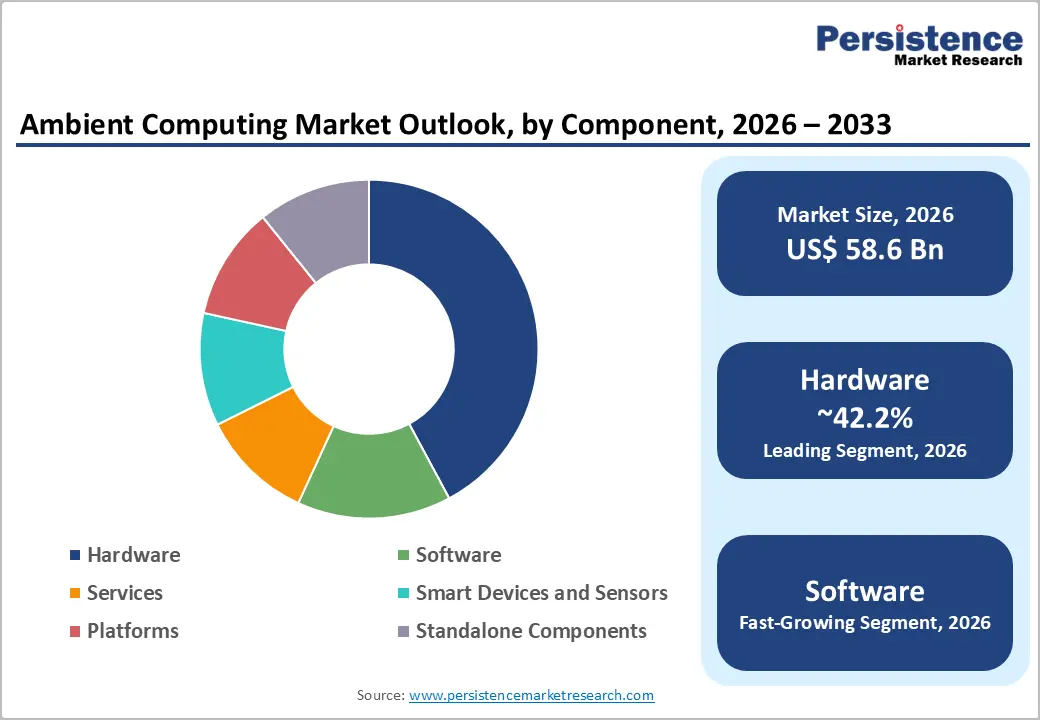
- Dominant Component: Hardware is anticipated to dominate, holding approximately 42.2% market share, due to its foundational role in enabling sensing, connectivity, and real-time interaction within ambient computing ecosystems.
- Leading Technology: Voice Assistants & Natural Language Processing (NLP) are estimated to lead with around 38.2% share, as they provide the primary interface for seamless, intuitive human-machine interaction in ambient environments.
DRO Analysis
Driver - AI-Enabled Device Ecosystems are becoming the Default Interaction Layer
Ambient computing is evolving from isolated voice assistants into multimodal, context-aware ecosystems that integrate speech recognition, computer vision, sensor data, and automation. Enterprise AI adoption has increased significantly in recent years, reflecting growing readiness to embed intelligence into workflows, customer engagement, and operational systems. At the same time, the rapid expansion of IoT connectivity, including large-scale deployment of low-power wide-area networks (LPWAN), is strengthening the infrastructure backbone required for ambient environments.
This convergence enables continuous data capture and real-time decision-making, expanding the addressable market beyond consumer applications into enterprise automation, industrial operations, and platform-based services. Businesses are leveraging ambient computing to optimize workflows, reduce manual intervention, and improve operational efficiency. The shift toward integrated ecosystems also increases vendor lock-in and recurring revenue opportunities through subscriptions and managed services.
Smart-Home, Smart-Building, and Smart-Health Use Cases are Commercializing Ambient Intelligence
The commercialization of ambient computing is accelerating as major technology providers integrate advanced AI capabilities into consumer and enterprise ecosystems. Smart homes now incorporate voice-enabled assistants, connected appliances, intelligent climate control, and security systems that operate with minimal user input. In commercial buildings, ambient systems are improving energy efficiency, occupancy management, and predictive maintenance.
Healthcare is emerging as a critical adoption area, where ambient computing supports clinical documentation, patient monitoring, and workflow automation. These use cases demonstrate clear productivity gains and cost efficiencies, making adoption more economically viable. The transition from experimental deployments to production-grade systems indicates that ambient computing is becoming a practical upgrade path for existing digital infrastructure, rather than requiring entirely new systems.
Restraint- Privacy, Security, and Regulatory Compliance Increase Deployment Complexity
Ambient computing systems rely on continuous data collection, contextual analysis, and personalization, raising significant concerns about data privacy, cybersecurity, and regulatory compliance. Organizations must implement robust governance frameworks to manage sensitive data, ensure transparency, and maintain user trust. Regulatory environments, particularly in developed markets, are becoming more stringent, requiring compliance with data protection laws, AI governance standards, and risk management frameworks. These requirements increase implementation costs, extend deployment timelines, and create barriers for smaller vendors. In sectors such as healthcare and public infrastructure, compliance obligations can significantly slow adoption due to the need for certification, validation, and auditability.
Opportunity - Healthcare and Assisted Living Present High-Value Growth Potential
The growing global aging population is creating strong demand for ambient-assisted living and remote healthcare solutions. Ambient computing enables passive monitoring, real-time alerts, and personalized care without requiring active user engagement. Applications include fall detection, medication adherence, voice-enabled assistance, and automated clinical documentation.
Healthcare providers are increasingly adopting ambient systems to reduce administrative burden, improve patient outcomes, and optimize resource allocation. The integration of AI into clinical workflows enhances decision-making and reduces operational inefficiencies. This segment represents a high-value opportunity because it combines long-term demographic demand with measurable economic benefits, making it attractive for both technology vendors and healthcare institutions.
Asia Pacific’s Smart Infrastructure Expansion Supports Rapid Scaling
Asia Pacific is witnessing significant investment in smart cities, digital infrastructure, and next-generation connectivity, laying a strong foundation for the adoption of ambient computing. Governments and private enterprises are deploying connected systems across transportation, energy management, public safety, and urban planning.
The region benefits from large-scale manufacturing capabilities, high consumer adoption of connected devices, and rapid urbanization. These factors reduce production costs and accelerate commercialization. The expansion of 5G networks and edge computing infrastructure further enhances the feasibility of real-time ambient applications. As a result, the Asia Pacific offers substantial opportunities for vendors to deploy scalable, localized solutions tailored to diverse market needs.
Category-wise Analysis
Component Insights
The hardware segment is anticipated to dominate the market, accounting for approximately 42.2% of market share in 2026. Hardware forms the foundation of ambient computing ecosystems, including sensors, microphones, cameras, smart displays, edge devices, and connectivity modules. These components enable continuous data collection and real-time interaction between users and their environments.
The widespread adoption of smart speakers, wearables, and connected appliances highlights the importance of hardware as the initial entry point for ambient experiences. The demand for advanced hardware is increasing as devices become more capable of on-device processing, contextual awareness, and low-latency response. Manufacturers are integrating AI capabilities directly into hardware components, enabling more efficient and secure operations. This reinforces hardware’s role as the primary revenue driver in the current market landscape.
The software segment is expected to be the fastest-growing segment, due to its role in orchestration and intelligence. Software platforms enable data processing, automation, personalization, and system integration, making them central to ambient computing functionality. The rise of generative AI and machine learning is enhancing the ability of systems to interpret complex user inputs and deliver context-aware responses.
Organizations are increasingly adopting software-driven solutions to enable predictive analytics, workflow automation, and cross-device integration. Subscription-based models and cloud-based platforms are also driving recurring revenue growth. As ambient computing evolves, software will play a critical role in differentiating vendor offerings and enabling scalable, flexible deployments.
Technology Insights
Voice Assistants & Natural Language Processing (NLP) is estimated to lead with approximately 38.2% market share in 2026. Voice interaction remains the most intuitive interface for ambient computing, allowing users to interact with systems without physical input. Advances in NLP have improved the accuracy and contextual understanding of voice commands, enabling more natural and conversational interactions.
Voice assistants are widely used in smart homes, vehicles, and healthcare environments, where hands-free operation is essential. Their ability to simplify user interaction and reduce learning curves makes them a key driver of adoption across diverse user groups.
Edge Computing is likely to be the fastest-growing technology segment. Edge computing enables data processing closer to the source, reducing latency and improving system responsiveness. This is critical for applications that require real-time decision-making, such as industrial automation, healthcare monitoring, and autonomous systems.
The shift toward edge architectures also addresses privacy concerns by minimizing the need to transmit sensitive data to centralized cloud systems. As ambient computing applications become more complex, edge computing will play a vital role in ensuring scalability, reliability, and security.
Regional Insights
North America Ambient Computing Market Trends
North America is expected to hold the largest share of the ambient computing market, accounting for approximately 34.6% of global revenue in 2026, with the U.S. acting as the primary growth engine. The region benefits from advanced digital infrastructure and strong leadership from companies such as Amazon.com Inc., Microsoft Corporation, Alphabet Inc., and Apple Inc., all of which are actively embedding ambient intelligence into their ecosystems.
U.S. Ambient Computing Market Trends
The U.S. is expected to lead regional adoption, due to its mature AI, cloud, and IoT ecosystem. Developments such as Amazon’s rollout of Alexa+ integrated with next-generation Echo devices (2025) and Google’s expansion of Gemini-powered home automation highlight the shift toward fully ambient, context-aware environments.
Microsoft is also advancing ambient computing in enterprise settings through AI copilots integrated into workplace tools and healthcare workflows. These innovations are accelerating adoption across smart homes, enterprise automation, and healthcare, reinforcing the U.S. as the global innovation hub.
Canada Ambient Computing Market Trends
Canada is strengthening its position through investments in AI research and smart infrastructure. Government-backed AI initiatives and collaborations with companies such as NVIDIA Corporation are advancing edge AI and real-time analytics. Smart-city projects in Toronto and Vancouver are integrating IoT-enabled infrastructure for traffic management and energy optimization, contributing to the adoption of ambient systems in urban environments.
Regulatory frameworks across North America emphasize data security, privacy, and interoperability, encouraging companies to adopt secure-by-design architectures. Continuous investment in R&D and ecosystem partnerships is sustaining the region’s leadership in ambient computing innovation.
Europe Ambient Computing Market Trends
Europe represents a significant market driven by regulatory harmonization, sustainability initiatives, and smart-city development. The region’s emphasis on ethical AI and data protection is shaping how ambient computing systems are designed and deployed.
Germany Ambient Computing Market Trends
Germany leads in industrial applications of ambient computing, supported by companies such as Siemens AG and Robert Bosch GmbH. Developments in Industry 4.0 and smart factories are integrating ambient intelligence into manufacturing processes, enabling predictive maintenance, real-time monitoring, and autonomous decision-making. These advancements are strengthening Germany’s role as a leader in industrial ambient computing.
U.K. Ambient Computing Market Trends
The U.K. is focusing on smart cities and digital transformation. Initiatives such as London’s smart infrastructure programs and increased adoption of AI-driven public services are driving demand for ambient systems. Collaboration between government agencies and technology providers is accelerating deployment in transportation, healthcare, and urban management, improving efficiency and service delivery.
Spain Ambient Computing Market Trends
Spain is expanding its smart-city initiatives, particularly in cities such as Barcelona, which has implemented IoT-enabled systems for waste management, traffic control, and public safety. These projects demonstrate how ambient computing can enhance urban efficiency and improve quality of life, creating a strong foundation for future growth.
The European regulatory environment prioritizes data protection, transparency, and ethical AI deployment, thereby increasing compliance requirements while enhancing user trust and system reliability. Investments in digital twins, energy-efficient infrastructure, and urban automation continue to drive market expansion.
Asia Pacific Ambient Computing Market Trends
Asia Pacific is likely to be the fastest-growing region, with a projected CAGR of 27.18%, driven by rapid urbanization, expanding digital infrastructure, and large-scale deployment of connected technologies.
China Ambient Computing Market Trends
China is leading regional growth through extensive smart-city programs and large-scale IoT deployment. Technology companies such as Huawei Technologies are developing integrated ecosystems that combine connectivity, cloud, and AI. The country’s numerous smart-city pilot projects are implementing ambient systems for traffic management, surveillance, and energy optimization, accelerating adoption at scale.
Japan Ambient Computing Market Trends
Japan is focusing on ambient computing in healthcare and smart infrastructure. The country’s aging population is driving demand for assisted living technologies, including remote monitoring and AI-driven care systems. Japanese firms are integrating ambient intelligence into robotics and smart-home solutions, enhancing both healthcare delivery and everyday convenience.
The region’s strong manufacturing capabilities, combined with increasing consumer demand and government support, are accelerating adoption across smart homes, healthcare, industrial automation, and retail. Asia Pacific’s diverse ecosystem positions it as a key driver of future market growth.
Competitive Landscape
The ambient computing market exhibits a semi-consolidated structure, with a few dominant players controlling platform ecosystems while numerous smaller companies compete in specialized segments. Leading firms leverage their expertise in AI, cloud computing, and hardware integration to establish strong market positions. Competition is driven by innovation, ecosystem expansion, and strategic partnerships. Companies are focusing on developing integrated solutions that combine hardware, software, and services to deliver seamless user experiences.
Market leaders are focusing on ecosystem integration, edge AI deployment, and vertical-specific solutions. Key strategies include expanding device portfolios, enhancing AI capabilities, and adopting subscription-based business models. Companies are also prioritizing partnerships to strengthen interoperability and accelerate innovation across the value chain.
Companies Covered in Ambient Computing Market
- Amazon.com Inc.
- Microsoft Corporation
- Alphabet Inc.
- Apple Inc.
- Samsung Electronics
- NVIDIA Corporation
- Qualcomm Incorporated
- Intel Corporation
- Cisco Systems Inc.
- Huawei Technologies
- Arm Limited
- Siemens AG
- Schneider Electric
- Robert Bosch GmbH
- ABB Ltd.
- Johnson Controls International plc
Frequently Asked Questions
The global ambient computing market is valued at US$58.6 billion in 2026.
The ambient computing market is projected to reach US$281.0 billion by 2033.
Key trends include the convergence of AI, IoT, and edge computing, the rise of context-aware and voice-enabled interfaces, increasing adoption in smart homes and healthcare, and the shift toward device ecosystems that enable seamless, automated user experiences.
The hardware segment leads the market with approximately 42.2% share, as it forms the backbone of ambient systems through sensors, connected devices, and edge-enabled infrastructure.
The ambient computing market is expected to grow at a CAGR of 25.1% between 2026 and 2033.
Some of the major players include Amazon.com Inc., Microsoft Corporation, Alphabet Inc., Apple Inc., and Samsung Electronics.


