




- Industrial Machinery
- Firewood Processing Machine Market
Firewood Processing Machine Market Size, Share, and Growth Forecast, 2026 - 2033
Firewood Processing Machine Market by Product Type (Portable Firewood Processors, Stationary Firewood Processors, Others), Power Source (Gasoline-Powered, Electric-Powered, Others), Application, Deployment, and Regional Analysis for 2026 - 2033

Firewood Processing Machine Market Size and Trends Analysis
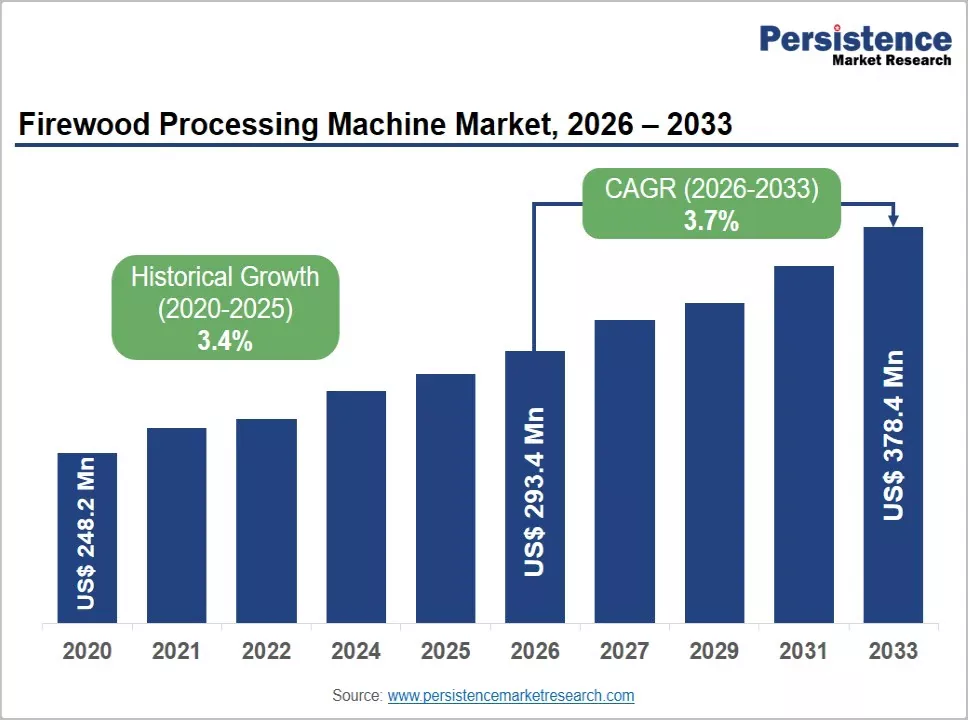
The global firewood processing machine market size is likely to be valued at US$293.4 million in 2026 and is expected to reach US$378.4 million by 2033, growing at a CAGR of 3.7% between 2026 and 2033, driven by continued residential use of firewood, expansion of commercial firewood supply businesses, and increasing mechanization across forestry and sawmill operations.
Product development is shifting toward higher throughput, automated splitting, improved operator ergonomics, and flexible power systems. Electrification is also gaining relevance as manufacturers introduce electric and hybrid processors for fixed-site and commercial applications.
Key Industry Highlights
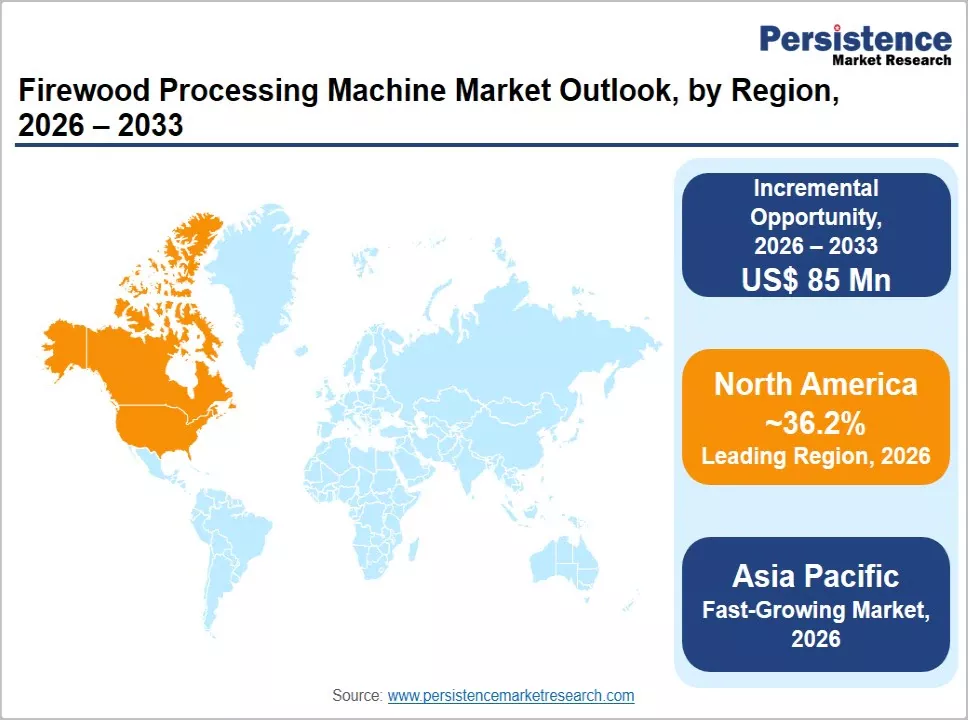
- Leading Region: North America is anticipated to account for 36.2% of market revenue, supported by established residential wood heating, commercial firewood suppliers, and a strong equipment manufacturing base.
- Fastest-growing Region: Asia Pacific is anticipated to register the fastest regional growth, driven by expanding timber production, biomass utilization, forestry mechanization, and increasing adoption of commercial wood-processing equipment.
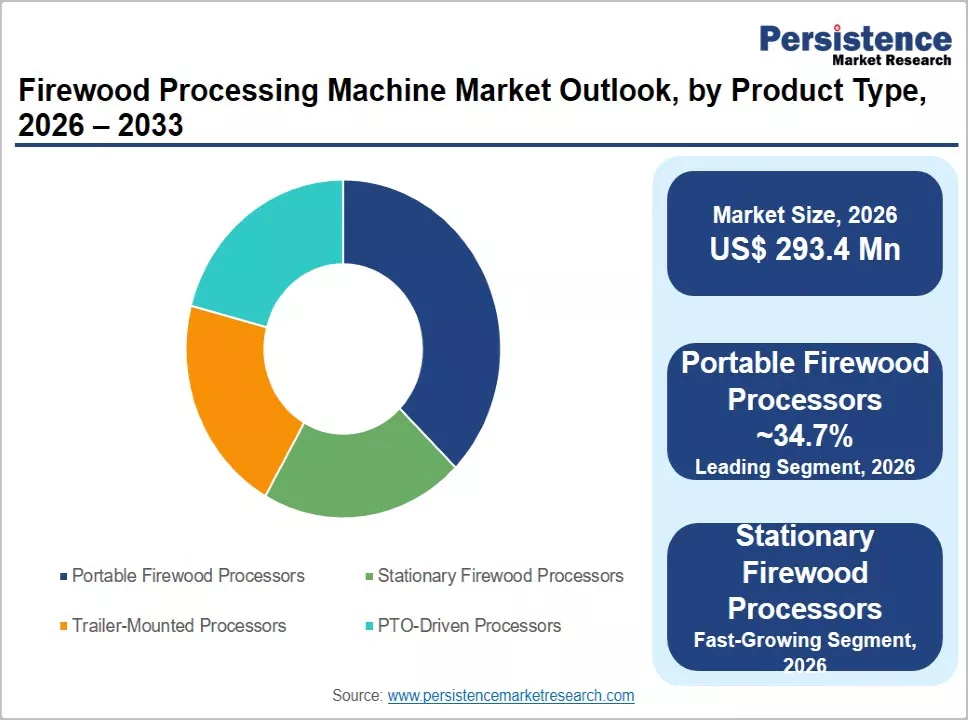
- Dominant Product Type: Portable firewood processors are anticipated to account for 34.7% of the market share, supported by demand from residential users, small commercial firewood suppliers, forestry contractors, and operators requiring mobile equipment.
- Leading Power Source: Gasoline-powered processors are anticipated to hold 46.4% of market share, reflecting their suitability for mobile and decentralized operations where portability, independent operation, and high processing capacity are important.
DRO Analysis
Drivers - Expansion of Residential and Small-Commercial Wood Heating Applications
Residential wood use provides a broad demand base for firewood processing equipment, particularly in colder regions where households supplement conventional heating with wood. The U.S. Energy Information Administration's 2020 Residential Energy Consumption Survey identified 11.1 million U.S. homes using wood for heating or other residential purposes, including approximately 8.8 million homes using wood as a secondary heating source and 2.3 million using it as a primary heating source.
This installed user base supports demand for portable, PTO-driven, trailer-mounted, and compact processors that can operate on farms, private woodland properties, and small commercial sites. Commercial firewood suppliers also benefit from integrated equipment that combines sawing, splitting, and conveying in one production cycle. As labor-intensive processing becomes less attractive, equipment capable of improving output per operator gains relevance. The residential application segment, accounting for approximately 45% of the market, therefore provides a broad equipment base, while commercial suppliers represent an important source of higher-capacity replacement and expansion demand.
Mechanization, Automation, and Productivity Improvements
Firewood processing is increasingly shifting from manual cutting and splitting toward integrated hydraulic and electronically controlled systems. Modern commercial processors can combine log feeding, cutting, splitting, conveying, cleaning, and packaging reducing the number of separate processing stages required. POSCH, for example, offers integrated firewood systems capable of processing substantial volumes while incorporating automated handling and splitting functions.
Manufacturers are also introducing intelligent controls to reduce operator intervention and improve production consistency. Palax's C751 incorporates logic control, automatic feed assistance, sensor-based wedge positioning, and productivity monitoring, while its D460 uses PowerSpeed technology to adjust splitting force and speed according to operating conditions. These developments improve machine utilization and reduce repetitive manual adjustments. For commercial suppliers, forestry contractors, and high-volume users, the resulting productivity gains can increase throughput without requiring proportional increases in labor, supporting continued investment in automated processors.
Restraint - High Equipment Costs, Operating Economics, and Combustion-Related Regulation
Firewood processors require significantly greater upfront investment than conventional axes, manual splitters, or basic saw-and-split equipment. Commercial machines can range from tens of thousands of dollars to more than US$200,000 for high-capacity configurations, depending on processing capacity, automation, power source, conveyors, and auxiliary systems. This capital requirement can limit adoption among small residential users and seasonal operators.
Downstream combustion regulations can also affect the economics of commercial firewood production. In England, wood sold for domestic use in volumes below 2 cubic meters must meet certification requirements related to moisture content, while smoke-control areas restrict the use of unauthorized fuels. The U.K. government reported that domestic combustion accounted for 20% of national PM2.5 emissions in 2024, with indoor wood burning contributing 12%. These regulations increase the importance of producing dry, consistently sized firewood and can increase investment requirements for drying, storage, quality control, and integrated processing systems.
Opportunities - Electrification and Hybrid Drive Systems
Electric and hybrid processors are creating opportunities to diversify the market beyond gasoline- and PTO-dependent machinery. Japa offers processor configurations incorporating electric motors, tractor PTOs, and combined power arrangements. Its Japa 505, for example, can be configured with a 15-kW electric motor, tractor PTO, or combined drive, allowing users to adapt the equipment to site-specific power availability.
Tajfun's RCA PRO 500 Hy, introduced in 2025, further illustrates this technology transition. The machine uses an independent hydraulic drive and can operate using either a gasoline power unit or an electric motor. Tajfun states that the machine can process logs up to 50 cm in diameter and achieve output of up to 14 cubic meters per hour. The electric-powered segment is projected to grow at approximately 5.8-9.2% CAGR, creating opportunities for manufacturers targeting fixed commercial facilities, lower local emissions, reduced fuel dependence, and integration with automated material-handling systems.
Commercialization of Fragmented Firewood Supply Markets in Asia Pacific
Asia Pacific presents an expanding opportunity as timber production, biomass utilization, forestry mechanization, and regional equipment manufacturing develop simultaneously. China's National Bureau of Statistics reported 137.4 million cubic meters of timber production in 2024, representing an 8.2% increase from the previous year. The scale of China's forestry sector provides a substantial potential customer base for processing equipment.
Japan also recorded strong growth in fuelwood utilization. Its Forestry Agency reported that total fuelwood consumption, including wood chips, pellets, firewood, and charcoal, reached 20.47 million cubic meters in 2023, an increase of 17.9%.
The increase was associated primarily with woody biomass power generation and greater utilization of lower-quality wood resources. India, meanwhile, reported approximately 6.43 billion cubic meters of growing stock across forests and trees outside forests and estimated annual potential timber production from trees outside forests at 91.51 million cubic meters. These conditions create opportunities for processors designed around mixed log dimensions, PTO compatibility, compact footprints, and cost-efficient operation.
Category-wise Analysis
Product Type Insights
The portable firewood processors segment is anticipated to account for 34.7% market share in 2026, supported by decentralized firewood production across farms, woodland properties, roadside sites, and small commercial yards. Their mobility reduces dependence on permanent processing infrastructure and allows operators to position equipment closer to available timber.
Trailer compatibility, PTO operation, and independent engine options further expand deployment flexibility. POSCH's SpaltFix S-376 mobil, which processes logs from 7 to 36 cm in diameter, and mobile configurations from Palax and Japa illustrate the segment's emphasis on transportability and flexible operation. Cord King's mobile commercial processors similarly target professional firewood producers requiring equipment that can be deployed across different locations. These characteristics support continued demand from residential users, agricultural operators, and small commercial suppliers.
The stationary firewood processors segment is anticipated to grow, driven by centralized commercial production and increasing investment in integrated processing facilities. These machines become more economical when operators process large volumes at a fixed location and can connect feeding, conveying, drying, screening, and packaging systems. Palax's X Firewood Factory combines heavy-duty log feeding, sawing, splitting, and conveying and can process logs up to 90 cm in diameter.
POSCH's larger SpaltFix systems similarly integrate multiple processing stages for high-volume production. By reducing intermediate handling and allowing fewer operators to supervise multiple functions, stationary processors support commercial suppliers seeking higher annual output and greater labor productivity.
Power Source Insights
The gasoline-powered processors segment is anticipated to account for approximately 46.4% share in 2026. Gasoline-powered machines can operate without grid electricity or direct tractor connection, making them suitable for remote woodlots, farms, and temporary processing locations.
Examples include Japa's 365+, which is available in gasoline, electric, and PTO configurations, Eastonmade's gasoline-powered commercial processors, and Multitek's Wood Beaver range. Their operating flexibility and established servicing infrastructure continue to support gasoline demand. However, electric, diesel, and hybrid systems are expanding the available power options, particularly for commercial operators with specific throughput or emissions requirements.
The electric-powered processors segment is anticipated to grow, supported by fixed-site commercial production, lower local emissions, and increasing automation. Electric drives are particularly suited to facilities with reliable electrical infrastructure and existing electrically powered conveyors, drying, or packaging equipment.
Japa's 505 and 435 offer electric configurations alongside PTO and combined-drive options, while Tajfun's RCA PRO 500 Hy provides electric operation alongside gasoline power. These systems demonstrate the industry's shift toward flexible power architectures. For commercial facilities, electric processors can also simplify integration with automated production lines and reduce dependence on individual internal-combustion engines.
Regional Insights
North America Firewood Processing Machine Market Trends
North America is the leading regional market, accounting for 36.2% of market share in 2026. The U.S. is the principal demand center, supported by residential wood heating, commercial firewood suppliers, forestry activity, and an established equipment manufacturing base.
U.S. Firewood Processing Machine Market Trends
The U.S. Energy Information Administration reported that 11.1 million households used wood for energy in 2020, including 2.3 million using wood as their main space-heating source. This established residential base supports continued demand for portable and mobile processors. Manufacturers are also raising productivity for commercial users. Multitek offers processors ranging from the Lil Beaver at approximately one cord per hour to Pro Series machines producing 4-7 cords per hour, illustrating the market's shift toward higher-throughput commercial equipment.
Canada Firewood Processing Machine Market Trends
Canada has a strong specialist manufacturing base serving professional firewood suppliers and forestry contractors. Companies such as Eastonmade and Cord King supply commercial processing equipment designed for mobile and higher-volume operations. This supports replacement demand as operators move from standalone chainsaws and splitters toward integrated cutting, splitting, and conveying systems. The North American market is therefore increasingly shaped by labor productivity, throughput, mobility, and equipment versatility, rather than residential demand alone.
Europe Firewood Processing Machine Market Trends
Europe represents a mature market supported by biomass heating, forestry resources, commercial firewood production, and renewable-energy policies. The European Union obtained 26.7% of heating and cooling energy from renewable sources in 2024, up from 26.2% in 2023, with biomass remaining an important contributor.
Germany Firewood Processing Machine Market Trends
Germany provides a substantial forestry and biomass base. The country harvested 61.2 million cubic meters of timber in 2024, while energywood exceeded industrial wood for the first time since the statistical series began in 2006. This shift increases the relevance of machinery capable of converting lower-grade timber into standardized fuel. Austrian manufacturer POSCH serves this professional market with automated SpaltFix systems that combine sawing, splitting, conveying, cleaning, and packaging, reinforcing the European movement toward integrated production lines.
U.K. Firewood Processing Machine Market Trends
The U.K. presents a more regulation-driven market. Domestic combustion accounted for approximately 20% of PM2.5 emissions in 2024, while indoor wood burning contributed 12%, increasing attention to fuel quality and emissions. Palax's C751, designed for professional use, incorporates automated feeding, sensor-based X-Aim splitting adjustment, productivity monitoring, and fault diagnostics. The company specifically identifies Central Europe and the U.K. as important professional-use markets, demonstrating how equipment development is responding to productivity and operational requirements.
Asia Pacific Firewood Processing Machine Market Trends
Asia Pacific is the fastest-growing regional market, supported by timber production, biomass utilization, forestry mechanization, and expanding manufacturing capabilities.
China Firewood Processing Machine Market Trends
China recorded 137.4 million cubic meters of timber production in 2024, an 8.2% year-on-year increase. The expanding wood-processing base creates opportunities for domestic machinery manufacturers and international suppliers across cutting, splitting, conveying, and biomass applications. Growth is therefore increasingly connected to commercial and industrial wood utilization rather than residential heating alone.
India Firewood Processing Machine Market Trends
India has a substantial resource base, with 8.27 lakh square kilometers of forest and tree cover, equal to 25.17% of geographical area, according to the Forest Survey of India. The Ministry of New and Renewable Energy has also supported biomass briquette and pellet manufacturing and biomass-based cogeneration, creating an additional equipment demand channel. These developments broaden the regional opportunity toward biomass processing, agricultural residues, forestry operations, and decentralized fuel production, supporting demand for adaptable and cost-efficient processing equipment.
Competitive Landscape
The global firewood processing machine market is fragmented, with competition distributed across specialist firewood equipment manufacturers, forestry-equipment companies, agricultural machinery suppliers, and regional engineering businesses. Companies compete through machine throughput, portability, splitting force, automation, power-source flexibility, equipment durability, dealer networks, and after-sales service.
Manufacturers are emphasizing automation, flexible power systems, throughput optimization, product durability, and geographic expansion. Differentiation increasingly depends on hydraulic performance, automatic wedge adjustment, sensor-based controls, ergonomic operation, dealer support, and equipment customization. Integrated conveyors, cleaning, screening, and packaging systems are also becoming important as commercial customers seek complete production workflows rather than individual processing machines.
Key Industry Developments
- In April 2026, TP Silva announced the donation of a Japa 365+ firewood processor to Kremenets Forestry Professional College in Ukraine, supporting more efficient firewood production while providing hands-on training in modern processing technology.
- In September 2025, TP Silva expanded Japa's Canadian distribution network by welcoming Swift Fox Industries as a new importer, with the Canadian company receiving factory training and product familiarization in Finland.
Companies Covered in Firewood Processing Machine Market
- POSCH Gesellschaft m.b.H.
- Tajfun Planina d.o.o.
- Hakki Pilke
- Palax
- Japa
- Multitek Inc.
- Cord King
- Eastonmade Wood Splitters
- Rabaud
- Uniforest d.o.o.
- Binderberger Maschinenbau GmbH
- DYNA Products
- Hud-Son Forest Equipment
- Fuelwood Warwick Ltd.
- Blockbuster Inc.
- Wood-Mizer LLC
Frequently Asked Questions
The global firewood processing machine market is valued at approximately US$293.4 million in 2026.
The firewood processing machine market is expected to reach approximately US$378.4 million by 2033.
Key trends include increasing automation, integrated cutting and splitting systems, higher-throughput commercial processors, electric and hybrid power systems, automated feeding, sensor-based controls, and greater adoption of mobile processing equipment.
Portable firewood processors are the leading product type, anticipated to account for approximately 34.7% of the global market in 2026.
The firewood processing machine market is projected to grow at a 3.7% CAGR from 2026 to 2033.
Major players include TP Silva Oy, POSCH Gesellschaft m.b.H., Multitek Inc., Cord King, and Eastonmade Wood Splitters.


