




- Industrial Machinery
- Industrial Shock Absorber Market
Industrial Shock Absorber Market Size, Share, and Growth Forecast, 2026 - 2033
Industrial Shock Absorber Market by Product Type (Hydraulic Shock Absorbers, Pneumatic Shock Absorbers, Others), Application (Automotive, Aerospace, Industrial Machinery, Robotics, Packaging), and Regional Analysis for 2026 - 2033

Industrial Shock Absorber Market Size and Trends Analysis
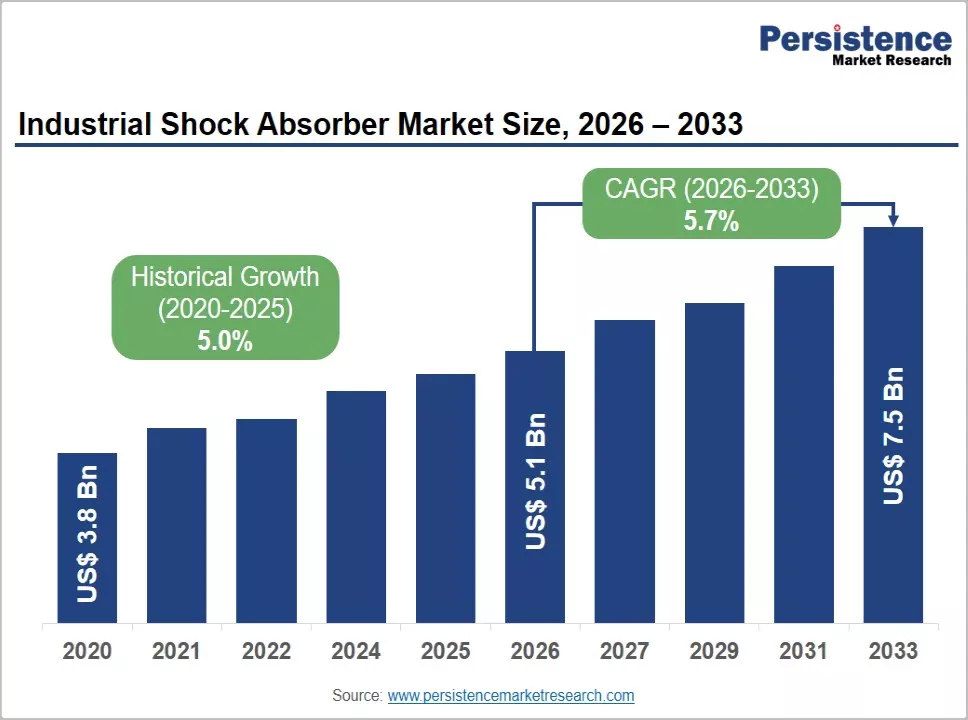
The global industrial shock absorber market size is likely to be valued at US$ 5.1 billion in 2026 and is expected to reach US$ 7.5 billion by 2033, growing at a CAGR of 5.7% during the forecast period from 2026 to 2033, driven by expanding factory automation, increasing robotics deployment, and rising requirements for controlled deceleration in manufacturing equipment.
Hydraulic and pneumatic shock absorbers help reduce impact forces, vibration, and mechanical wear across automotive production, packaging systems, aerospace equipment, and industrial machinery.
Key Industry Highlights:
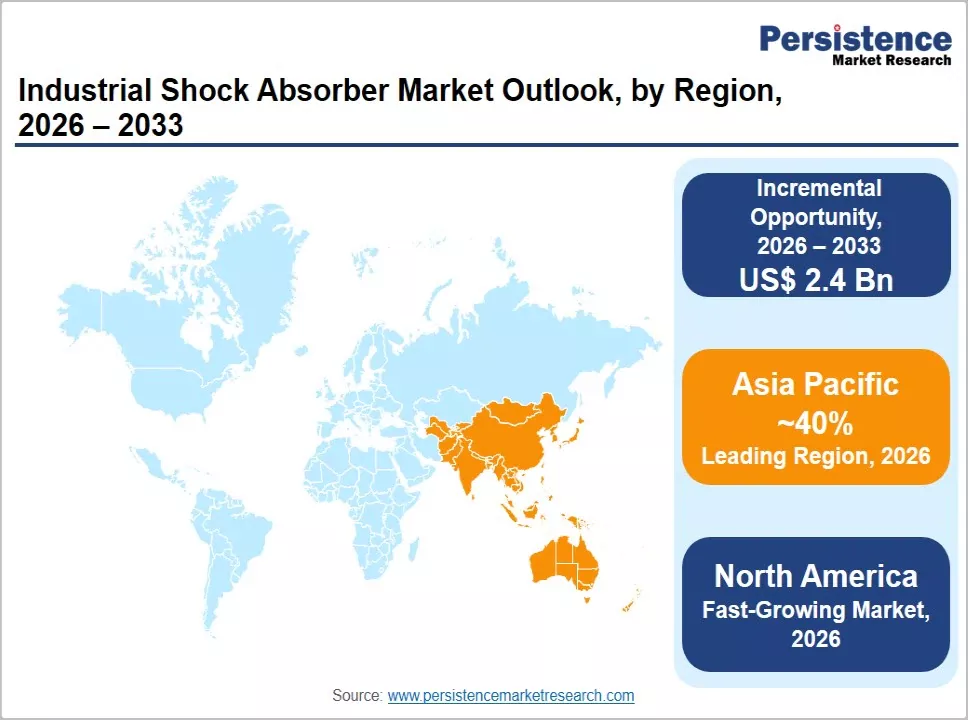
- Leading Region: Asia Pacific is anticipated to be the leading region, accounting for a market share of 40% in 2026, driven by large-scale manufacturing, expanding industrial automation, and rising robotics adoption.
- Fastest-growing Region: North America is likely to be the fastest-growing region in the market, supported by established aerospace and automotive manufacturing and industrial automation.
- Leading Product Type: Hydraulic shock absorbers are projected to represent the leading product type in 2026, accounting for 38% of the revenue share, owing to their proven reliable energy absorption and performance under heavy industrial loads.
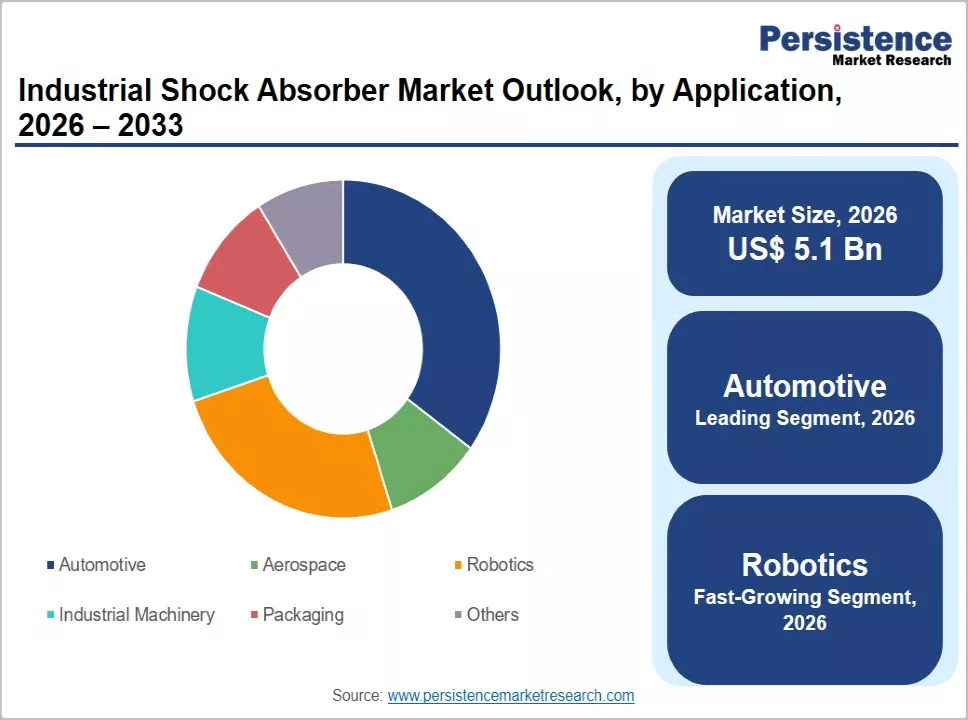
- Leading Application: Automotive is anticipated to be the leading application, accounting for about 32% of the market share in 2026, supported by assembly-line automation and vehicle manufacturing.
- Key Opportunity: The key market opportunity lies in developing adjustable, compact, and sensor-enabled industrial shock absorbers that improve automation precision, reduce equipment downtime, and support predictive maintenance across automotive, robotics, packaging, and industrial machinery applications.
DRO Analysis
Driver - Expansion of Robotics and Collaborative Robot Deployments
Automated production lines rely on controlled deceleration to prevent excessive impact when robotic arms, grippers, transfer systems, and positioning equipment reach their stopping points. Shock absorbers help minimize vibration, protect mechanical assemblies, and maintain repeatable motion during high-frequency operations.
As manufacturers introduce automation to improve productivity, reduce manual intervention, and increase production consistency, the number of motion-control applications requiring effective impact management continues to expand across automotive plants, electronics factories, packaging facilities, and general industrial machinery manufacturing operations worldwide.
The expansion of collaborative robots is also broadening the addressable market because these systems operate alongside workers and perform repeated pick-and-place, assembly, inspection, and material-handling tasks. Such applications require compact components that absorb end-stop energy while fitting within space-constrained equipment designs. Industrial shock absorbers support smoother movement, reduce stress on robot joints and fixtures, and help limit unplanned maintenance.
Restraint - Technological Substitution Risk in Light-Duty Applications
Technological substitution poses a restraint for industrial shock absorbers in light-duty applications where equipment operates at lower speeds, handles smaller loads, or requires only modest impact control. Designers may choose elastomer bumpers, springs, friction-based stops, pneumatic cushioning, or servo-controlled motion profiles when these alternatives meet performance requirements at lower system cost. In compact automation equipment, integrating controls and software can reduce the need for separate mechanical damping components.
The risk of substitution can intensify as machine builders redesign equipment around integrated drives, sensors, and programmable motion control. By slowing a mechanism before it reaches its endpoint, software-based control may reduce impact energy and lower reliance on standalone damping in selected applications. Low-cost alternatives can also appeal to small manufacturers that face tight capital budgets and have limited maintenance requirements.
Opportunity - Smart and Sensor-Enabled Shock Absorbers for Predictive Maintenance
Smart and sensor-enabled industrial shock absorbers create an opportunity to improve condition monitoring and predictive maintenance across automated facilities. By capturing indicators such as impact frequency, temperature, pressure, or changes in damping performance, connected systems can help maintenance teams identify abnormal operating conditions before they cause equipment damage or production interruptions.
When this information is integrated with industrial control platforms, manufacturers can plan service around actual component condition instead of relying solely on fixed maintenance intervals. These capabilities are especially relevant to robotic cells, packaging lines, and high-throughput machinery, where unexpected downtime can disrupt connected processes and increase operating costs. Adoption will depend on practical integration, sensor durability, data quality, and the ability to translate measurements into useful maintenance alerts.
Suppliers can strengthen their position by offering retrofit-ready monitoring modules, simple connectivity with factory systems, and clear guidance for interpreting performance trends. Smart designs may also help equipment builders document operating conditions, optimize replacement schedules, and reduce unnecessary component changes. Although added electronics and connectivity can increase upfront cost, measurable gains in uptime and maintenance planning can support the business case for connected damping solutions.
Category-wise Analysis
Product Type Insights
Hydraulic shock absorbers are the leading product type, accounting for 38% of the market share in 2026, due to their reliable energy dissipation, consistent damping performance, and suitability for demanding industrial operations. These components control moving loads, reduce impact forces, and protect machinery from excessive mechanical stress. Their applications span automotive manufacturing, aerospace equipment, material handling, and industrial automation systems. For example, ITT Enidine Inc. supplies industrial hydraulic shock absorbers for machinery and automation applications.
Adjustable shock absorbers represent the fastest-growing product type segment, supported by manufacturers as they increasingly require flexible damping performance across changing industrial operating conditions. Their adjustable characteristics allow users to accommodate different loads, speeds, and energy requirements without replacing the entire component. This flexibility benefits robotic workstations, automated assembly lines, packaging equipment, and material-handling systems. For instance, ACE Controls Inc. offers adjustable industrial shock absorbers for automation and machinery applications.
Application Insights
Automotive is projected to lead the application category, capturing around 32% of the market share in 2026, supported by extensive use of automated production equipment across vehicle manufacturing facilities. Assembly lines, robotic welding stations, material-handling systems, and component positioning equipment require controlled deceleration to prevent damaging impacts. Industrial shock absorbers help protect machinery, improve movement consistency, and reduce mechanical wear during repetitive manufacturing operations.
Robotics represent the fastest-growing application as manufacturers deploy automated systems to improve productivity, precision, and operational consistency. Robotic arms, pick-and-place systems, automated guided equipment, and material-handling robots may require shock absorbers to manage end-of-travel impacts and protect mechanical assemblies. These components help reduce vibration, limit structural stress, and support reliable repetitive movements in demanding production environments.
Regional Insights
North America Industrial Shock Absorber Market Trends
North America is likely to be the fastest-growing region, supported by advanced automotive manufacturing, aerospace production, industrial machinery modernization, and increasing automation across factories. These industries require dependable shock absorption to control equipment movement, reduce mechanical wear, and maintain operational reliability.
U.S. Industrial Shock Absorber Market Trends
The U.S. is expected to dominate the regional market, accounting for around 80% of the revenue share in 2026, due to its extensive automotive, aerospace, packaging, and machinery industries. Factory modernization encourages manufacturers to install automated equipment requiring controlled deceleration and reliable end-stop performance. Automotive manufacturing remains an important source of automation demand.
Canada Industrial Shock Absorber Market Trends
Canada is likely to be a significant market for industrial shock absorbers, supported by automotive production, aerospace manufacturing, food processing, and industrial machinery applications. Manufacturers use shock absorbers to reduce impact forces and protect automated equipment from premature wear. The automotive sector remains relevant to factory automation investment. Modernization of production facilities creates opportunities for replacement components and improved damping performance.
Europe Industrial Shock Absorber Market Trends
Europe is projected to hold a significant share of the industrial shock absorber market in 2026, due to established automotive manufacturing, precision engineering, aerospace production, and investments in automated industrial equipment. Demand centers on reliable damping components that protect machinery, support repeatable movement, and reduce maintenance requirements. Equipment upgrades and specialized machinery remain relevant opportunities for suppliers.
U.K. Industrial Shock Absorber Market Trends
The U.K. is likely to be a significant market for industrial shock absorbers within Europe, supported by aerospace engineering, automotive production, packaging machinery, and wider factory automation. Manufacturers require components that control movement, absorb impact energy, and protect precision equipment during repetitive operations. Modernization of production facilities can encourage replacement of older damping systems with more efficient designs.
Germany Industrial Shock Absorber Market Trends
Germany is anticipated to hold around 37% share of the European market in 2026, due to its automotive, machinery, metalworking, and factory automation industries. Manufacturers use damping components to protect equipment operating under repetitive loads and high-cycle conditions. Although installations declined from the previous year, the country's established automation infrastructure supports ongoing component demand.
Asia Pacific Industrial Shock Absorber Market Trends
Asia Pacific is anticipated to lead the global market by capturing around 40% share in 2026. This is driven by its extensive manufacturing capacity, expanding robotics adoption, and investments in automated production lines. Automotive, electronics, packaging, and industrial machinery manufacturers use shock absorbers to manage impact forces and protect equipment.
China Industrial Shock Absorber Market Trends
China is projected to dominate the regional market, holding around 30% share of the market in 2026, due to its extensive automotive, electronics, machinery, and industrial automation sectors. Manufacturers increasingly integrate robotics into production processes, creating demand for components that provide reliable deceleration and protect mechanical assemblies. Its large manufacturing base supports demand for damping components in automated assembly and material-handling systems.
India Industrial Shock Absorber Market Trends
India is expected to emerge as a significant market, owing to expanding automotive manufacturing, machinery production, packaging operations, and factory automation. Manufacturers are increasingly adopting robotic systems to improve productivity, consistency, and operational efficiency. Automotive production remains a key driver of this adoption. Industrial expansion creates demand for shock absorbers used in assembly equipment, automated handling systems, and packaging machinery.
Competitive Landscape
The global industrial shock absorber market exhibits a moderately fragmented structure, driven by demand for reliable motion control, automated manufacturing, equipment protection, and precision damping solutions. Competition includes established international manufacturers and specialized regional suppliers serving automotive, aerospace, robotics, packaging, and industrial machinery applications.
With key leaders including Parker Hannifin Corporation, ITT Enidine Inc., ACE Controls Inc., and Zimmer Group, the market benefits from extensive product portfolios, engineering expertise, and established distribution networks. These players compete through product innovation, application-specific engineering, product durability, customization, and technical support.
Key Industry Developments:
- In October 2025, Hutchinson launched its Spring & Viscous Damper Shock & Vibration Absorber at China International Industry Fair 2025, expanding its industrial damping portfolio with a solution designed to improve vibration isolation, production stability, and equipment lifespan in precision machinery applications.
Companies Covered in Industrial Shock Absorber Market
- Parker Hannifin Corporation
- ITT Enidine Inc.
- ACE Controls Inc.
- Zimmer Group
- Weforma Dämpfungstechnik GmbH
- SUSPA GmbH
- Taylor Devices Inc.
- Koba Co. Ltd.
- Aventics (Emerson Electric Co.)
- Hänchen GmbH
- Wuxi Bosheng Hydraulic Pneumatic Equipment Co. Ltd
Frequently Asked Questions
The industrial shock absorber market is projected to reach US$ 5.1 billion in 2026.
Rising industrial automation, robotics deployment, and demand for reliable equipment protection drive market growth.
The industrial shock absorber market is expected to grow at a CAGR of 5.7% from 2026 to 2033.
Smart sensor-enabled shock absorbers, predictive maintenance solutions, and adjustable damping systems offer key growth opportunities.
Parker Hannifin Corporation, ITT Enidine Inc., ACE Controls Inc., and Zimmer Group are the leading players.


