




- Power Generation, Transmission, & Distribution
- Electronic Load Market
Electronic Load Market Size, Share, and Growth Forecast, 2026 - 2033
Electronic Load Market by Current Type (DC Electronic Load, AC Electronic Load, Others), Voltage (Below 600V, Above 600V, Others), Form Factor, End-user, and Regional Analysis for 2026 - 2033

Electronic Load Market Size and Trends Analysis
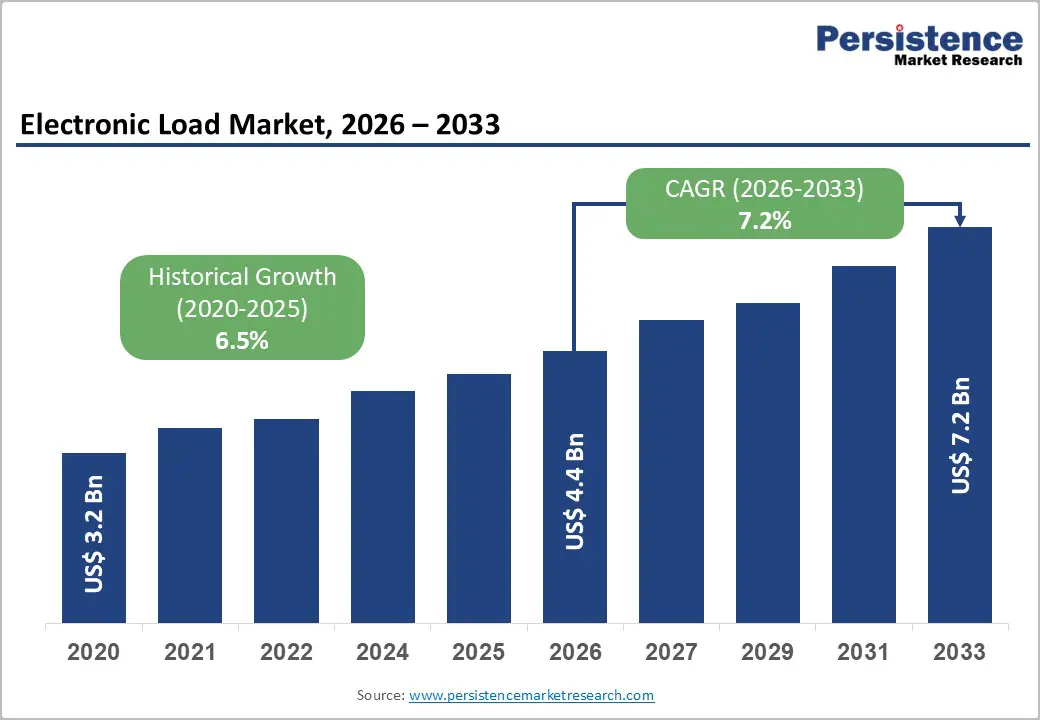
The global electronic load market size is likely to be valued at US$4.4 billion in 2026 and is expected to reach US$7.2 billion by 2033, growing at a CAGR of 7.2% between 2026 and 2033, driven by expanding EV battery and charger testing requirements, increasing renewable energy and energy storage deployments, and the rising complexity of high-density power electronics across telecom, industrial automation, and data center environments. The market’s evolution reflects a structural shift toward higher power density, modular architectures, and advanced validation capabilities, positioning electronic loads as essential infrastructure within modern electrical testing ecosystems.
Key Industry Highlights:
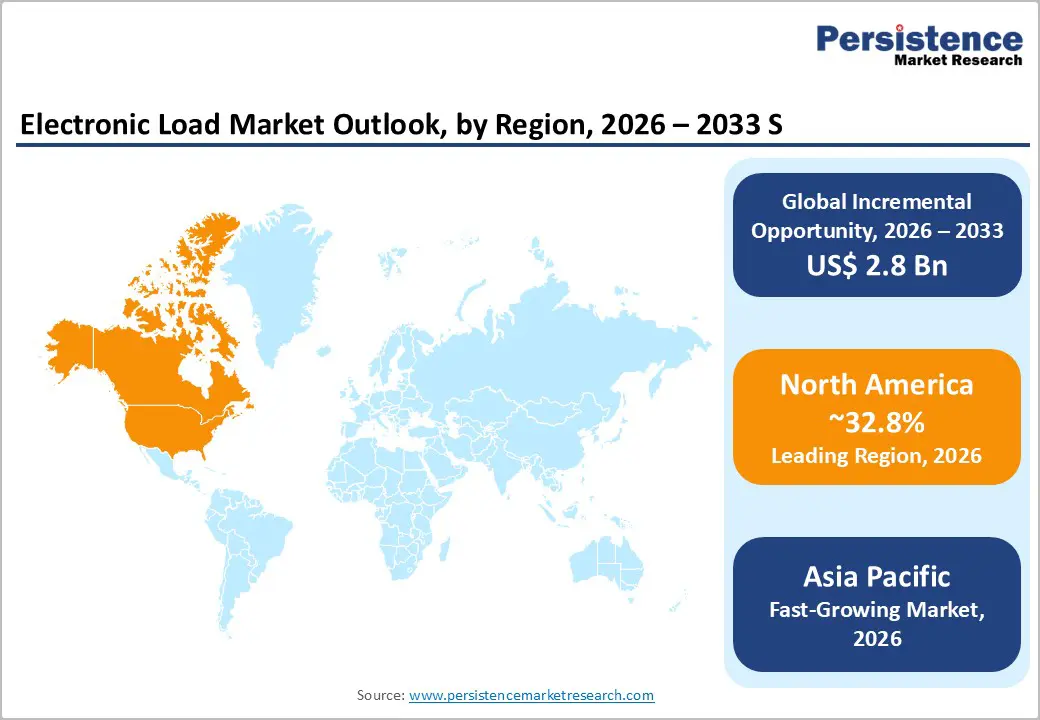
- Leading Region: North America is projected to hold 32.8% of the market share, supported by the strong presence of advanced test equipment manufacturers and high adoption of EV, semiconductor, and energy storage testing solutions.
- Fastest-growing Region: Asia Pacific is projected to be the fastest-growing region, driven by rapid EV production, expanding electronics manufacturing, and increasing investments in renewable energy infrastructure across China, Japan, India, and Southeast Asia.
- Investment Plans: Significant investments are being directed toward EV battery testing, fast-charging infrastructure, and grid-scale energy storage systems, with a growing focus on high-voltage (>600V) and regenerative electronic load technologies to support next-generation power validation requirements.
- Dominant Current Type: DC electronic loads are anticipated to lead the market with approximately 44.2% share, driven by their extensive use in battery testing, EV chargers, telecom power systems, and renewable energy applications.
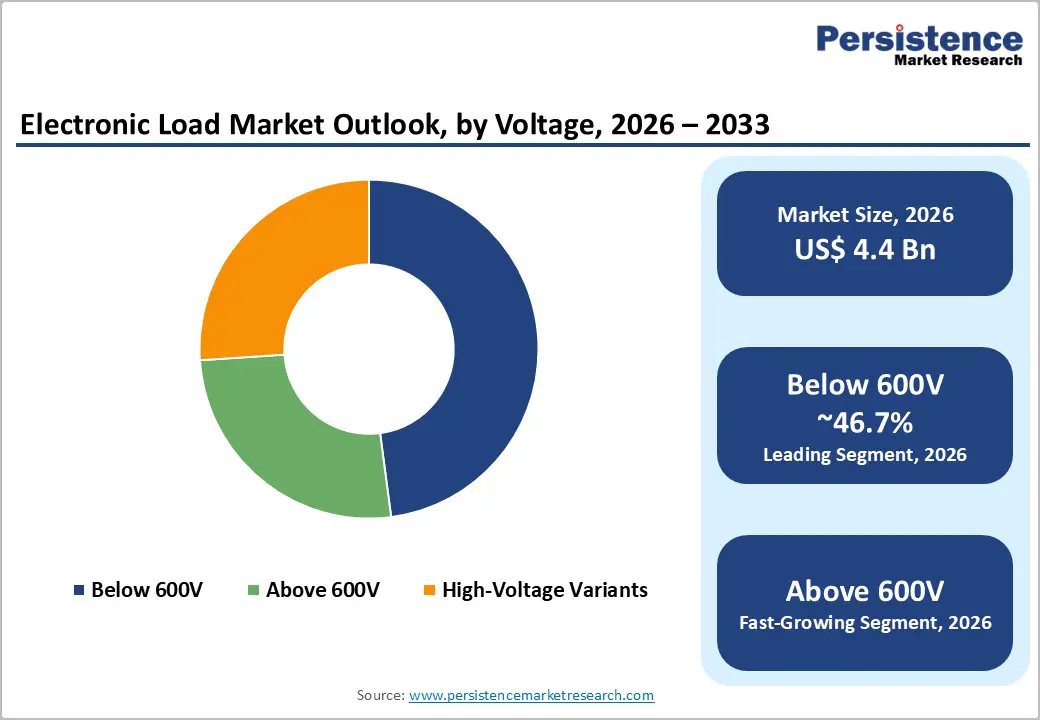
- Leading Voltage: The below-600V segment is estimated to dominate with 46.7% market share, supported by widespread use in consumer electronics, telecom infrastructure, and industrial testing environments.
| Key Insights | Details |
|---|---|
| Electronic Load Market Size (2026E) | US$4.4 Bn |
| Market Value Forecast (2033F) | US$7.2 Bn |
| Projected Growth (CAGR 2026 to 2033) | 7.2% |
| Historical Market Growth (CAGR 2020 to 2025) | 6.5% |
DRO Analysis
Driver Analysis - Rising EV Adoption and Battery Testing Demand
The rapid expansion of the electric vehicle market is a primary driver of electronic load demand. As EV production increases, so does the need for battery validation, charger testing, and battery management system (BMS) verification. These processes require precise simulation of real-world electrical conditions, including high-voltage discharge and dynamic load profiles. Electronic loads play a critical role in validating battery performance, lifecycle durability, and charging efficiency. The transition toward fast-charging infrastructure and higher voltage platforms further intensifies the need for advanced testing equipment. This trend is pushing manufacturers to develop regenerative and bidirectional load systems, which improve energy efficiency during testing and reduce operational costs.
Expansion of Renewable Energy and Energy Storage Systems
The increasing deployment of renewable energy systems, particularly solar and wind, is driving demand for electronic loads used in inverter testing, energy storage validation, and grid-interactive systems. As power grids integrate more intermittent energy sources, testing requirements become more complex. Electronic loads are essential for simulating real-world operating conditions, including variable load scenarios and transient responses. The growth of battery energy storage systems (BESS) further strengthens this demand, as these systems require extensive testing for performance, safety, and reliability. This trend is accelerating the adoption of high-power, programmable electronic loads, particularly in utility-scale and industrial applications, where system validation is critical before deployment.
Growth of Telecom Infrastructure and High-Density Electronics
The expansion of 5G networks and the increase in data center capacity are driving demand for electronic loads in telecom power systems, rectifiers, and backup energy solutions. Modern communication infrastructure relies on highly efficient and reliable power systems, all of which require rigorous validation. At the same time, the rise of high-density electronics in industrial automation and semiconductor manufacturing is increasing the need for precise load simulation and power testing. Electronic loads enable engineers to validate performance under varying electrical conditions, ensuring product reliability and compliance with industry standards.
Restraint Analysis - High Capital Investment and Operational Costs
Electronic loads, particularly high-power and regenerative systems, require significant upfront investment. Advanced systems designed for EV, renewable energy, and industrial applications often involve modular architectures, high-voltage capabilities, and integrated software, which increase overall costs. For small and mid-sized laboratories, the need to invest in scalable systems rather than single-function devices can delay procurement decisions. Maintenance, calibration, and system integration costs further contribute to the total cost of ownership, limiting adoption in cost-sensitive segments.
Regulatory Complexity and Compliance Requirements
The market is also constrained by complex and evolving regulatory frameworks, especially in regions with strict energy and transportation policies. Compliance requirements for EV charging infrastructure, grid-connected systems, and safety standards vary across regions, increasing manufacturers' burden. Testing equipment must meet multiple standards, which often leads to longer validation cycles and increased engineering effort. This complexity is particularly challenging for high-voltage and cross-border applications, where interoperability and certification requirements can slow down product development and deployment.
Opportunity Analysis - High-Voltage Testing For EV Fast Charging and Bidirectional Systems
The shift toward high-voltage EV platforms and fast-charging infrastructure presents a significant growth opportunity. As automakers adopt 800V architectures and develop bidirectional charging capabilities such as vehicle-to-grid (V2G) and vehicle-to-load (V2L), testing requirements become more sophisticated. Electronic loads capable of handling high voltage and power levels are essential for simulating real-world charging scenarios and validating system performance. This trend is expected to drive demand for advanced regenerative and programmable load systems, particularly in automotive and infrastructure applications.
Growth in Energy Storage and Grid-Edge Applications
The increasing deployment of energy storage systems and microgrids is creating new opportunities for electronic load manufacturers. These systems require extensive testing to ensure efficiency, reliability, and integration with existing power infrastructure. Electronic loads are used in battery cycling, inverter validation, and grid simulation, making them critical tools in the development and deployment of modern energy systems. The shift toward decentralized energy generation further expands the market, particularly in regions investing in grid modernization.
Asia Pacific Manufacturing Expansion and Localization
Asia Pacific represents a major opportunity due to its strong manufacturing base and growing demand for electronic testing solutions. The region benefits from high production volumes, shorter product development cycles, and increasing investments in EVs and electronics manufacturing. Local availability of test equipment, combined with faster service and support, is becoming a key purchasing factor. This trend is encouraging global and regional players to expand their presence, strengthening supply chains and improving customer responsiveness.
Category-wise Analysis
Current Type Insights
DC electronic loads are expected to dominate the market, accounting for approximately 44.2% market share in 2026, and are anticipated to maintain their leadership position through the forecast period, while also emerging as the fastest-growing segment with a CAGR of around 8.4%. Their dominance is primarily driven by the increasing prevalence of DC-based systems across industries, including lithium-ion batteries, EV chargers, telecom rectifiers, and solar energy storage systems. As electrification trends accelerate, particularly in automotive and renewable sectors, DC loads are becoming indispensable for validating performance under real-world operating conditions.
DC loads are particularly well-suited for battery cycling, EV powertrain validation, and energy storage system testing, where precise current control, fast transient response, and efficiency are critical. For example, EV manufacturers rely on DC electronic loads to simulate battery discharge cycles and validate fast-charging systems, while renewable energy companies use them for testing solar inverters and battery storage units. Their compatibility with regenerative testing systems further enhances their value proposition by feeding energy back into the grid, thereby significantly reducing operational costs during high-power testing.
Voltage Insights
The segment below 600V is expected to lead the market with a 46.7% share in 2026 and is anticipated to remain the dominant voltage category over the forecast period, supported by widespread use in consumer electronics, telecom power systems, and industrial control applications. These systems are extensively used in laboratory environments, product validation testing, and quality assurance processes where moderate voltage levels are sufficient. The segment benefits from lower acquisition costs, ease of integration, and broad application scope, making it the preferred choice for standard testing requirements. For example, electronics manufacturers use sub-600V loads to test power supplies, adapters, and embedded systems, while telecom companies use them to validate rectifiers and backup power modules in network infrastructure.
The above 600V segment is anticipated to be the fastest-growing category, driven by rising demand for high-voltage testing in EV batteries, fast-charging infrastructure, renewable energy systems, and grid-scale applications. The transition toward 800V EV architectures and increasing deployment of utility-scale energy storage systems are key factors accelerating growth in this segment. High-voltage electronic loads are critical for validating EV battery packs, DC fast chargers, solar inverters, and grid-connected converters, where power levels are significantly higher.
For instance, automotive OEMs and battery manufacturers use >600V loads to simulate real-world driving and charging conditions, while renewable energy developers rely on them to test large-scale inverter systems and grid integration performance. In response, manufacturers are expanding their portfolios with high-power, high-voltage electronic loads featuring advanced safety, precision control, and regenerative capabilities, enabling efficient and reliable testing in demanding industrial and utility-scale environments.
Regional Insights
North America Electronic Load Market Trends - Innovation-Led Growth in EV, Semiconductor, and Energy Storage Testing
North America is expected to lead, accounting for approximately 32.8% of the market share in 2026, and is anticipated to maintain its dominance over the forecast period due to its strong innovation ecosystem and early adoption of advanced testing technologies. The region benefits from a well-established base of test and measurement companies such as Keysight Technologies, AMETEK, and Magna-Power Electronics, which continuously invest in high-performance and regenerative electronic load solutions.
The U.S. remains the primary contributor, supported by the rapid deployment of battery energy storage systems and continued innovation in EV powertrains and semiconductor technologies. For instance, Keysight Technologies introduced next-generation high-power automated test equipment solutions in 2025, including regenerative electronic loads designed for EV and energy storage validation. This type of innovation strengthens the region’s leadership in high-voltage and high-density power testing applications.
The region also benefits from rising investments in data centers and semiconductor manufacturing, driven by companies such as Intel and NVIDIA, which require advanced power validation systems. At the same time, the expansion of EV infrastructure by companies such as Tesla increases the need for charger and battery testing solutions. These developments collectively reinforce North America’s position as a mature and innovation-driven market for electronic loads.
Europe Electronic Load Market Trends - Policy-Driven Demand for EV and Grid-Integrated Power Testing Solutions
Europe’s electronic load market is strongly influenced by regulatory harmonization and sustainability-driven policies, particularly in the automotive and energy sectors. Government initiatives promoting EV adoption, charging infrastructure, and renewable energy integration are creating sustained demand for advanced testing solutions. The region’s regulatory environment encourages manufacturers to adopt high-efficiency, compliant, and grid-compatible testing systems, which directly support the growth of electronic loads.
Countries, including Germany, the U.K., France, and Spain, play critical roles in shaping the regional landscape. Germany leads in industrial electronics and EV manufacturing, supported by companies like Volkswagen AG and BMW Group, both of which are investing heavily in EV platforms and battery technologies. These developments require extensive testing of battery packs, onboard chargers, and power electronics, thereby increasing demand for high-voltage electronic loads.
The U.K. serves as a key hub for testing and certification, while France and Spain are accelerating the deployment of EV charging infrastructure. European-based test equipment specialists such as EA Elektro-Automatik continue to expand their high-power programmable load portfolios, particularly for EV and renewable energy applications. The region’s focus on energy efficiency, emissions reduction, and grid stability is driving adoption of regenerative and high-power testing systems, especially in grid-connected and industrial applications.
Asia Pacific Electronic Load Market Trends - Rapid Expansion Fueled by EV Manufacturing and Electronics Production Scale
Asia Pacific is likely to be the fastest-growing region and is anticipated to post the highest CAGR during the forecast period, driven by rapid industrialization, strong manufacturing capabilities, and the increasing adoption of EVs and renewable energy systems. Countries such as China, Japan, India, and key Southeast Asian economies are central to this growth trajectory.
China leads the region in EV production and battery manufacturing, with companies like BYD Company and CATL expanding large-scale production capacities. These developments significantly increase the demand for high-voltage electronic loads used in battery testing, fast-charging validation, and energy storage system development. In Japan, established players such as Kikusui Electronics and Matsusada Precision are advancing high-precision and high-voltage load technologies, supporting both domestic and global markets.
Taiwan also plays a critical role, with companies like Chroma ATE Inc. and GW Instek expanding their global footprint and introducing modular and high-power testing solutions. In India, government initiatives promoting EV adoption and domestic electronics manufacturing are driving demand for testing infrastructure, particularly in the automotive and power electronics sectors. The region’s well-established electronics manufacturing ecosystem enables shorter product development cycles and cost-efficient production, while local service capabilities improve responsiveness and reduce downtime. These advantages, combined with strong policy support for electrification and infrastructure development, position Asia Pacific as the primary growth engine for the electronic load market.
Competitive Landscape
The global electronic load market is fragmented with strong regional competition. Multiple players offer differentiated products tailored to specific applications, rather than competing on identical offerings.
The premium segment, particularly high-voltage and regenerative systems, shows moderate concentration, while the broader market remains competitive. Companies differentiate themselves through technology innovation, product performance, and service capabilities. Leading players are focusing on innovation, modular product design, and global expansion. Differentiation is achieved through advanced features such as regenerative capabilities, high-voltage performance, and integrated software platforms. Companies are also emphasizing customer support and lifecycle services to build long-term relationships and strengthen market position.
Key Industry Developments:
- In May 2025, EA Elektro-Automatik announced a strategic partnership with Keysight Technologies to integrate programmable DC power supplies with modular test platforms, enhancing automated power electronics testing and improving data-driven validation workflows.
- In October 2025, Keysight Technologies completed the acquisition of Spirent Communications plc, strengthening its capabilities in network testing and expanding its presence across advanced validation ecosystems, including power and electronic test solutions.
Companies Covered in Electronic Load Market
- Keysight Technologies
- AMETEK
- Chroma ATE Inc.
- EA Elektro-Automatik
- Kikusui Electronics
- ITECH Electronics
- GW Instek
- B&K Precision
- NH Research
- Magna-Power Electronics
- Matsusada Precision
- NF Corporation
- Rigol Technologies
- Rohde & Schwarz
- Tektronix
- Kepco Inc.
Frequently Asked Questions
The electronic load market is estimated to be valued at US$4.4 billion in 2026.
The electronic load market is projected to reach US$7.2 billion by 2033.
Key trends include the shift toward high-voltage (>600V) testing systems, increasing adoption of regenerative electronic loads, growing demand from EV battery and fast-charging validation, and the rise of modular and automated testing platforms.
DC electronic loads are the leading segment, accounting for approximately 44.2% market share, driven by widespread use in battery testing, EV systems, and renewable energy applications.
The electronic load market is expected to grow at a CAGR of 7.2% from 2026 to 2033.
Major players include Keysight Technologies, AMETEK, Chroma ATE Inc., EA Elektro-Automatik, and Kikusui Electronics.


