




- Hardware & Software IT Services
- Cyber Deception Market
Cyber Deception Market Size, Share, and Growth Forecast, 2026 – 2033
Cyber Deception Market by Deception Stack (Endpoint Deception, Network Deception, Others), Deployment Mode (On-Premises, Cloud-Based), End-user (Banking, Financial Services, and Insurance (BFSI), Others), and Regional Analysis for 2026 - 2033

Cyber Deception Market Size and Trends Analysis
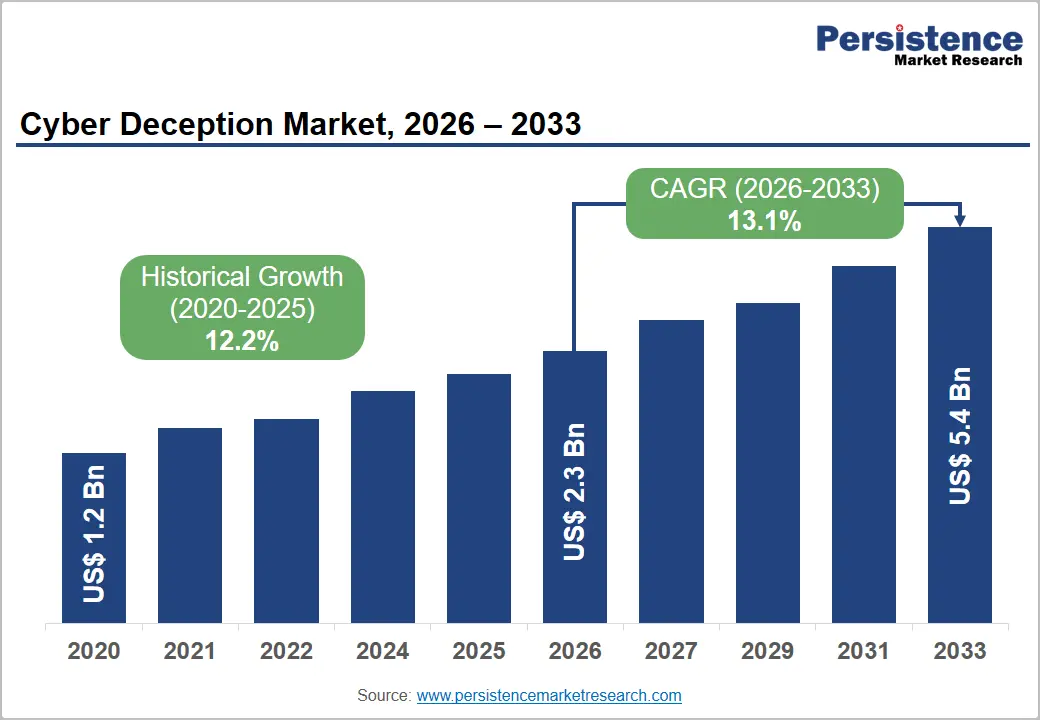
The global cyber deception market size is likely to be valued at US$2.3 billion in 2026 and is estimated to reach US$5.4 billion by 2033, growing at a CAGR of 13.1% during the forecast period from 2026 to 2033, driven by accelerated digital transformation across enterprises and public infrastructure systems.
Rising cyberattack complexity across banking, healthcare, and government environments increases the adoption of deception technologies for early intrusion detection. Regulatory tightening on data protection accelerates the deployment of advanced threat intelligence systems. Cloud migration and distributed network architectures increase attack surfaces, reinforcing demand for adaptive deception layers.
Key Industry Highlights:
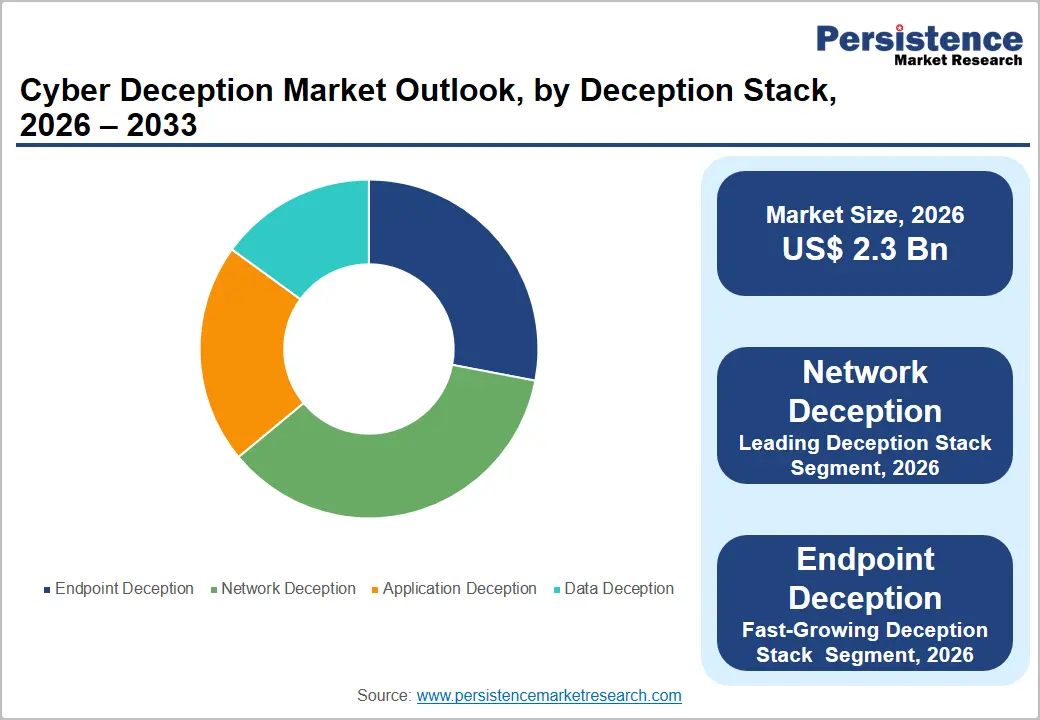
- Leading Deception Stack: Network deception is expected to hold around 36% revenue share in 2026, driven by enterprise demand for network-wide threat visibility.
- Fastest-growing Deception Stack: Endpoint deception is projected to record the fastest growth, driven by the expansion of remote work environments.
- Leading End-user: Banking, Financial Services, and Insurance (BFSI) is estimated to account for approximately 31% revenue share in 2026, driven by increasing digital transaction security requirements.
- Fastest-Growing End-user: Government and defense are forecast to record the fastest growth, driven by national cybersecurity modernization initiatives.
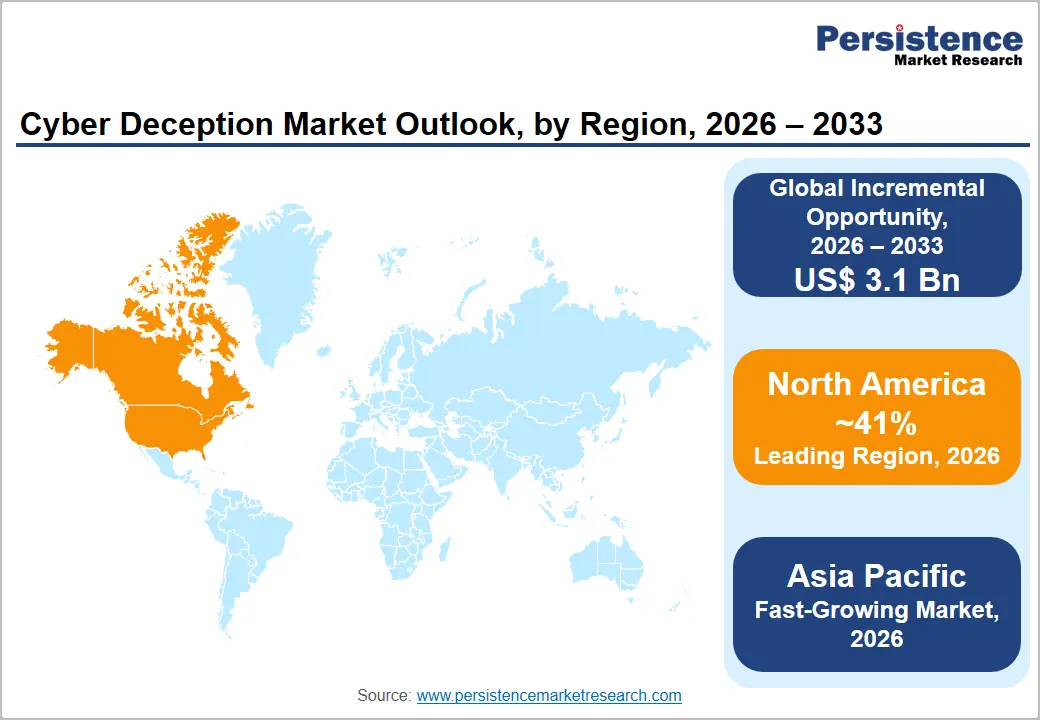
- Regional Leadership: North America is projected to capture around 41% market share in 2026, while Asia Pacific is forecast to record the fastest growth, driven by rapid digital infrastructure expansion.
- Competitive Environment: Moderately fragmented market supported by continuous innovation, strategic partnerships, and integrated cybersecurity platforms.
- Innovation Trends: Artificial intelligence-driven deception, cloud-native security platforms, and automated threat intelligence continue shaping technology development.
DRO Analysis
Driver - Growing Adoption of Zero-Trust Security Architecture
Organizations continue to strengthen cybersecurity strategies through zero-trust architecture, where every user, device, and application requires continuous verification before access is granted. Cyber deception complements this framework by deploying decoy assets that expose malicious activity before attackers reach critical systems. This proactive approach enables security teams to identify unauthorized movement at an early stage while reducing operational disruption.
Cybersecurity agencies, including the National Institute of Standards and Technology (NIST) and the Cybersecurity and Infrastructure Security Agency (CISA), continue to promote modern security architectures that emphasize continuous monitoring and threat detection. These initiatives encourage enterprises to integrate deception technologies into existing security ecosystems, improving threat visibility while supporting regulatory compliance and cyber resilience.
Restraint - Complex Integration with Existing Security Infrastructure
Many organizations operate diverse cybersecurity environments that include legacy infrastructure, multiple security platforms, and customized monitoring tools. Integrating deception technology into these environments often requires careful planning, interoperability testing, and continuous configuration management to maintain operational consistency.
Integration challenges increase deployment complexity and extend implementation timelines, creating higher operational costs for enterprises with large and geographically distributed IT infrastructure. These factors may delay technology adoption, particularly among organizations with limited cybersecurity resources.
Opportunity - Integration of Artificial Intelligence into Deception Platforms
Artificial intelligence is creating new opportunities for cyber deception platforms by enabling the dynamic creation of decoy assets, automated behavioral analysis, and adaptive threat response. Intelligent deception environments continuously adjust to attacker behavior, improving detection accuracy while reducing manual security administration across complex enterprise networks.
Technology companies continue to enhance cybersecurity platforms through artificial intelligence integration, while regulatory organizations publish guidance supporting the responsible deployment of AI within security operations. Continuous innovation is expected to accelerate enterprise adoption of intelligent deception solutions across cloud and hybrid environments.
Category-wise Analysis
Deception Stack Insights
Network deception is expected to lead the cyber deception market, accounting for approximately 36% of revenue in 2026. The segment maintains leadership due to broad deployment across enterprise networks for detecting lateral movement and unauthorized access. In 2026, Fortinet expanded integrated deception capabilities within enterprise security platforms, demonstrating increasing commercial adoption. Growing hybrid network complexity and continuous monitoring requirements strengthen demand across large organizations.
Endpoint deception is likely to represent the fastest-growing segment, propelled by expanding remote workforce security and endpoint attack prevention. In 2025, Microsoft enhanced endpoint security capabilities through AI-driven threat detection within Microsoft Defender, supporting proactive defense strategies. Rising endpoint diversity, work-from-anywhere models, and zero-trust implementation continue to accelerate deployment across enterprise environments.
Deployment Mode Insights
The on-premises segment is projected to lead the market, capturing around 57% of the revenue share in 2026. The segment remains dominant as government agencies, defense organizations, and highly regulated industries prioritize complete control over sensitive cybersecurity infrastructure. Acalvio Technologies continued strengthening enterprise on-premises deployments through expanded deception platform capabilities during 2025. Regulatory compliance requirements and internal data governance support sustained adoption.
Cloud-based is likely to be the fastest-growing segment, fueled by enterprise cloud transformation and scalable cybersecurity deployment. In 2026, Palo Alto Networks expanded cloud-native security services supporting deception-enabled threat detection across distributed workloads. Increasing adoption of Software-as-a-Service (SaaS), hybrid cloud infrastructure, and centralized security management continues to drive rapid deployment across organizations.
End-user Insights
Banking, Financial Services, and Insurance (BFSI) is likely to be the leading segment with a projected 31% of the cyber deception market share in 2026, due to the increasing protection requirements for financial transactions and sensitive customer information. IBM continued expanding financial cybersecurity services during 2026 to strengthen fraud detection capabilities. Digital banking expansion and regulatory compliance requirements sustain enterprise investment.
Government and defense are anticipated to be the fastest-growing segment, fueled by expanding national cybersecurity programs and critical infrastructure protection initiatives. In 2025, Cisco Systems strengthened cyber defense capabilities supporting government security operations through advanced threat intelligence integration. Increasing cyber warfare preparedness and modernization of defense infrastructure continue to accelerate the adoption of deception technologies.
Regional Insights
North America Cyber Deception Market Trends
North America is anticipated to be the leading region, accounting for a market share of 41% in 2026, driven by mature cybersecurity infrastructure, strong enterprise technology investment, and widespread implementation of zero-trust security strategies. Federal cybersecurity initiatives, AI-enabled security operations, and large-scale cloud adoption continue to strengthen the demand for deception technologies.
U.S. Cyber Deception Market Insights
The U.S. is expected to account for approximately 83% of the cyber deception market in 2026. Federal cybersecurity modernization initiatives, expanding cloud infrastructure, and increasing adoption of AI-powered security platforms continue to accelerate enterprise deployment. Strong participation from Microsoft, Palo Alto Networks, Cisco Systems, and CrowdStrike supports continuous innovation and commercialization of deception technologies.
Canada Cyber Deception Market Insights
Canada is projected to hold nearly 17% of the regional market share in 2026. National cybersecurity programs, increasing investments in digital government services, and modernization of financial sector security infrastructure continue to support market expansion. Growing enterprise cloud adoption encourages the implementation of proactive cyber defense solutions across public and private organizations.
Europe Cyber Deception Market Trends
Europe is projected to account for approximately 29% of the global market share in 2026. Regional market expansion is supported by implementation of the NIS2 Directive, increasing cybersecurity compliance requirements, and investment in digital resilience programs. Organizations continue integrating deception technologies to improve threat detection across critical infrastructure and regulated industries.
Germany Cyber Deception Market Insights
Germany is forecast to contribute around 33% of the Europe cyber deception market in 2026. Manufacturing digitalization, Industry 4.0 deployment, and industrial cybersecurity modernization continue to increase the demand for advanced threat detection technologies. Enterprise investments in operational technology security strengthen the adoption across the manufacturing and automotive industries.
U.K. Cyber Deception Market Insights
The U.K. is likely to represent approximately 9% of the European market in 2026. Financial institutions, healthcare organizations, and government agencies continue investing in proactive cybersecurity infrastructure. National cyber resilience initiatives and expanding cloud security programs encourage broader deployment of deception platforms.
Asia Pacific Cyber Deception Market Trends
Asia Pacific is forecast to be the fastest-growing market for cyber deception, stimulated by rapid digital transformation, expanding cloud infrastructure, and increasing cybersecurity investment across enterprises. Cisco Systems, Fortinet, Trend Micro, and Microsoft continue expanding regional cybersecurity operations.
China Cyber Deception Market Insights
China is expected to account for approximately 31% of the regional cyber deception market share in 2026. Continuous expansion of digital infrastructure, enterprise cybersecurity investment, and implementation of national cybersecurity regulations strengthen demand for deception technologies. Growth in industrial digitalization further supports long-term deployment opportunities.
India Cyber Deception Market Insights
India is projected to hold nearly 17% of the regional market share in 2026. Expansion of digital banking, cloud computing, information technology services, and government digital initiatives continues to drive cybersecurity investment. Increasing enterprise awareness of proactive threat detection supports wider adoption of deception platforms across multiple industries.
Competitive Landscape
The global cyber deception market is moderately fragmented, with competition driven by specialized cybersecurity providers and diversified technology companies expanding advanced threat detection capabilities. Continuous innovation in deception technology, artificial intelligence integration, and cloud-native security platforms is strengthening competitive differentiation across enterprise and government applications.
Key participants include Acalvio Technologies, Fortinet, Microsoft Corporation, Cisco Systems, and Rapid7, Inc. Strategic competition is centered on platform integration, automated threat intelligence, scalable deployment models, and partnerships that enhance cybersecurity ecosystems while improving detection efficiency across complex digital environments.
Key Industry Developments:
- In June 2026, Microsoft introduced an AI-driven cybercrime disruption strategy targeting the cyberattack supply chain, reinforcing proactive threat detection and coordinated action against malware infrastructure.
- In March 2026, Acalvio Technologies launched 360 Deception, a next-generation cyber deception platform designed to disrupt AI-driven attack automation and strengthen proactive threat detection across enterprise environments.
Companies Covered in Cyber Deception Market
- Acalvio Technologies
- Fortinet
- Microsoft Corporation
- Cisco Systems, Inc.
- Rapid7, Inc.
- Check Point Software Technologies Ltd.
- CrowdStrike Holdings, Inc.
- SentinelOne, Inc.
- Zscaler, Inc.
- Proofpoint, Inc.
- Fidelis Cybersecurity
- TrapX Security
- Thinkst Canary
- Smokescreen Technologies
- Cymmetria
Frequently Asked Questions
The global cyber deception market is projected to reach US$2.3 billion in 2026.
Growing adoption of zero-trust security frameworks and rising sophistication of cyber threats drive the cyber deception market.
The cyber deception market is poised to witness a CAGR of 13.1% from 2026 to 2033.
Expanding adoption of AI-powered deception platforms and increasing investment in critical infrastructure cybersecurity create significant opportunities for the cyber deception market.
Some of the key market players include Acalvio Technologies, Fortinet, Microsoft Corporation, Cisco Systems, and Rapid7, Inc.


