




- Animal Feed & Additives
- Corn Gluten Feed Market
Corn Gluten Feed Market Size, Share, and Growth Forecast 2026 - 2033
Corn Gluten Feed Market by Product Type (Dry Corn Gluten Feed, Wet Corn Gluten Feed, Pellets, Others), Production Process (Wet Milling, Dry Milling), Animal Type (Ruminants, Poultry, Swine, Aquaculture, Others), and Regional Analysis, 2026 - 2033

Corn Gluten Feed Market Share and Trends Analysis
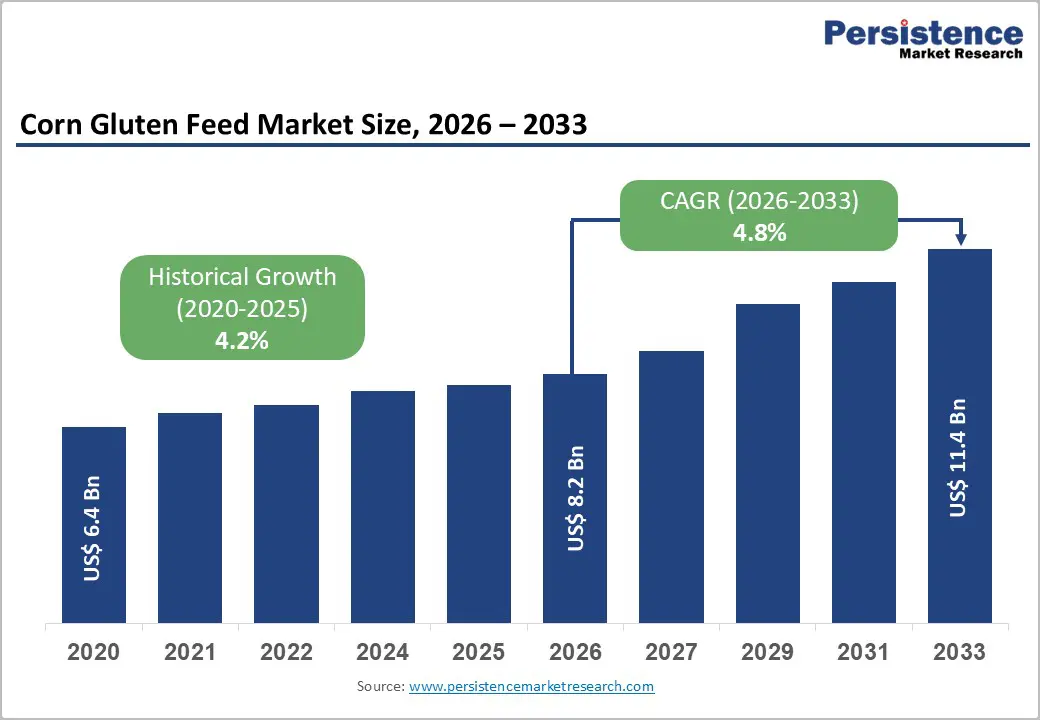
The global corn gluten feed market size is expected to be valued at US$ 8.2 billion in 2026 and projected to reach US$ 11.4 billion by 2033, growing at a CAGR of 4.8% between 2026 and 2033. This steady expansion is primarily driven by rising global demand for cost-effective, protein-rich animal feed amid increasing livestock production and meat consumption. Supporting this, the historical period from 2020 to 2025 saw the market grow from US$ 6.4 billion at a CAGR of 4.2%, fueled by advancements in corn processing and sustainable feed alternatives. Key factors include growing awareness of nutritional benefits such as high fiber content and digestibility, alongside regulatory pushes for efficient feed sourcing in major livestock regions.
Key Industry Highlights:
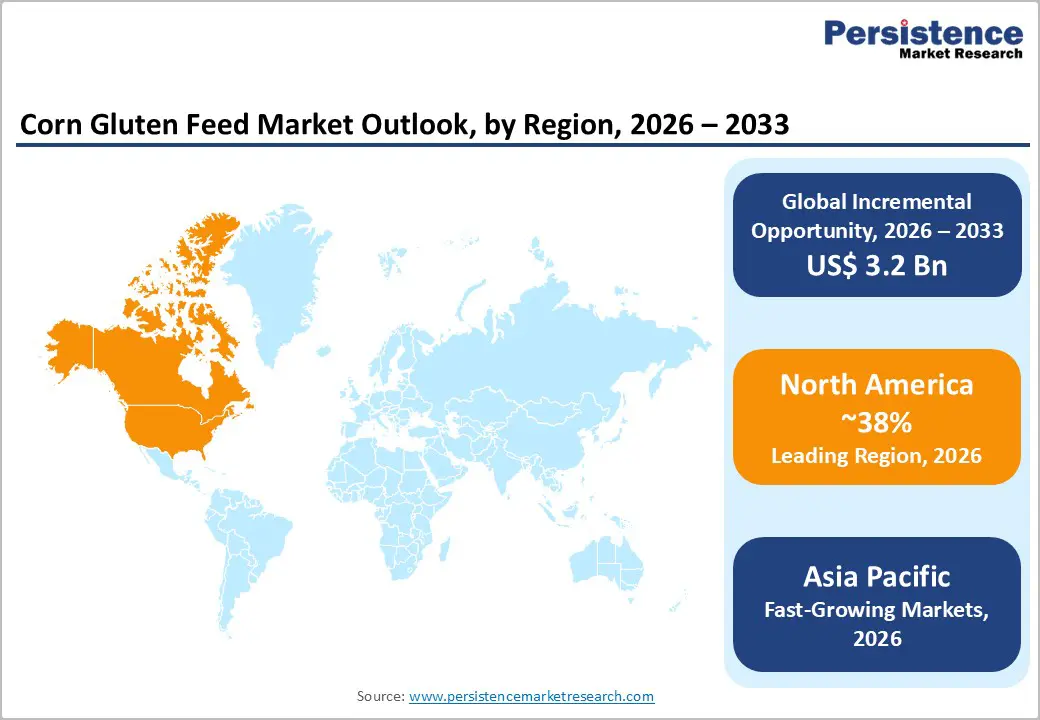
- North America dominates the Corn Gluten Feed Market - North America holds the largest share at 38% in 2025, primarily due to the abundance of corn in the U.S. and well-developed wet milling infrastructure. Advanced processing technologies, strong logistics networks, and established export channels help maintain a consistent supply and high-quality feed, supporting the region’s dominance in both domestic consumption and global exports.
- Asia Pacific emerges as the fastest-growing region - The Asia Pacific market is witnessing rapid growth, driven by expanding aquaculture and swine sectors in countries such as China and India. Increasing demand for affordable, high-energy feed ingredients and growing meat consumption are pushing feed manufacturers to adopt corn gluten feed, positioning the region as a key emerging market.
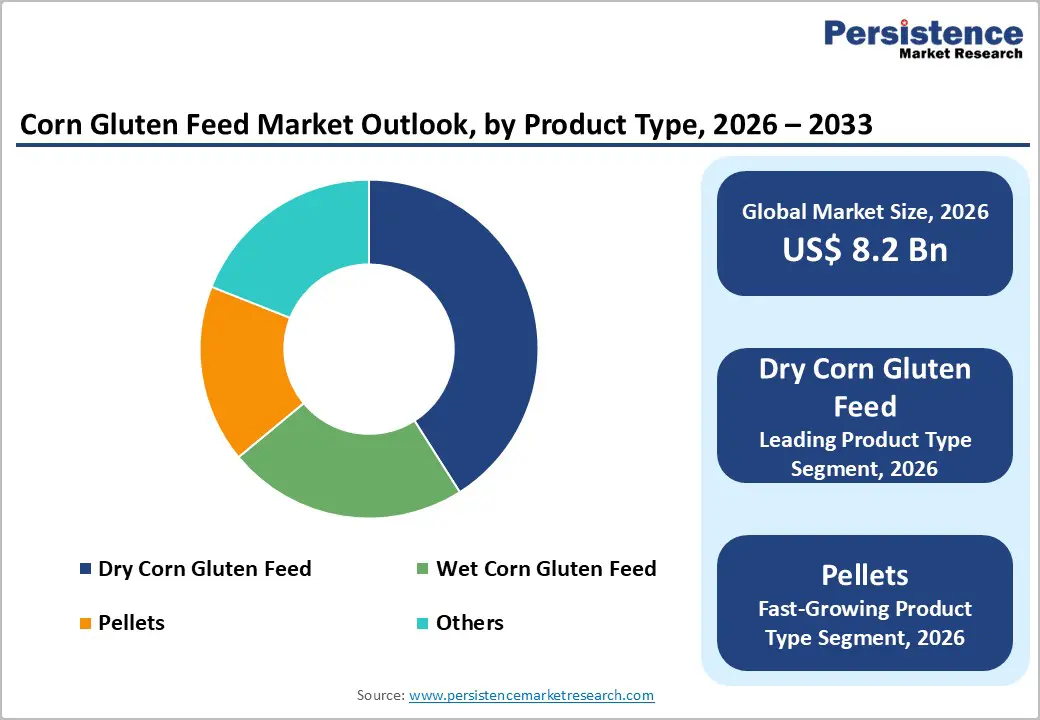
- Dry Corn Gluten Feed leads product type - Dry corn gluten feed accounts for 41% of the market, favored for its long shelf life, ease of storage, and transportability. Its high digestible energy and fiber content make it ideal for ruminant nutrition, particularly in dairy and beef cattle diets.
| Key Insights | Details |
|---|---|
| Corn Gluten Feed Size (2026E) | US$ 8.2 billion |
| Market Value Forecast (2033F) | US$ 11.4 billion |
| Projected Growth CAGR (2026 - 2033) | 4.8% |
| Historical Market Growth (2020 - 2025) | 4.2% |
Market Dynamics
Rising Livestock Demand Drives Growth
The surging global demand for animal protein is a primary growth driver for the corn gluten feed market. With worldwide meat consumption projected to rise by 14% by 2030 according to FAO estimates, livestock sectors require affordable, high-fiber feeds like corn gluten to optimize rations. Corn gluten feed, a byproduct of corn wet milling, provides 18-22% protein and excellent digestibility, reducing reliance on expensive soybean meal. This shift supports efficient animal nutrition, particularly in ruminants, where it enhances rumen health and milk yield in dairy operations, evidenced by USDA data showing U.S. dairy herds incorporating upto 20% corn gluten in diets for improved productivity.
Sustainable Byproduct Utilization Boosts Adoption
Utilization of corn gluten feed as a sustainable byproduct from corn processing industries propels market growth. Major corn producers like the U.S. generate millions of tons annually through wet milling for sweeteners and ethanol, diverting gluten feed to animal nutrition and minimizing waste. EPA reports highlight that this practice cuts feed production emissions by 30% compared to primary crops, aligning with global sustainability goals. Producers benefit from cost savings, often 20-30% cheaper than alternatives, while meeting regulatory standards for eco-friendly farming, as seen in EU bioeconomy initiatives promoting circular feed chains.
Restrains - Fluctuating Corn Prices Pose Major Market Restraint
Volatile corn prices significantly restrain the corn gluten feed market, as the product is a direct co-product of corn wet milling and ethanol production. Any disruption in corn supply caused by droughts, erratic weather patterns, export restrictions, biofuel policy shifts, or geopolitical trade tensions directly increases raw material costs. For example, price fluctuations observed in major producing countries such as the United States and Brazil have historically tightened margins for feed manufacturers. Since corn gluten feed is typically used as a cost-effective energy and fiber source, rising corn prices reduce its affordability advantage over alternative feed ingredients. Feed blenders and livestock producers often avoid long-term procurement contracts during high volatility periods, leading to unstable demand patterns. Additionally, smaller feed mills in price-sensitive regions struggle to absorb input cost shocks, which limits consistent offtake. This price unpredictability ultimately impacts production planning, profit margins, and supply chain stability across the global corn gluten feed market.
Competition from Soybean Meal Limits Market Expansion
Strong competition from soybean meal acts as another structural restraint for the corn gluten feed market. Soybean meal is widely preferred due to its higher protein content (typically 44-48%), superior amino acid profile, and established global trade network. Major soybean-producing countries such as Brazil, the United States, and Argentina dominate international exports, ensuring a stable supply and competitive pricing. Livestock producers, particularly in poultry and swine segments, often prioritize protein-dense ingredients to maximize feed conversion efficiency, placing soybean meal at an advantage. In ruminant nutrition, while corn gluten feed offers digestible fiber benefits, it cannot fully replace soybean meal without careful ration balancing. Blending requirements increase formulation complexity and operational costs for feed manufacturers. Furthermore, well-established global trading systems and price benchmarking mechanisms make soybean meal a more standardized commodity, limiting the expansion potential of corn gluten feed in protein-focused livestock markets.
Opportunity - Pellets Segment Offers Processing Innovation Opportunity
The pellets segment of the corn gluten feed market presents a significant opportunity for innovation and value addition. Pelletized feed improves handling, storage, and transport efficiency compared with traditional dry or wet forms, reducing losses due to dust, spoilage, or segregation during transit. Moreover, pelleting allows precise nutrient fortification, enabling feed manufacturers to enhance protein, fiber, or mineral content to meet specific livestock requirements. This segment also supports advanced processing techniques such as extrusion, steam conditioning, and coating with enzymes or probiotics, creating higher-value functional feeds that can command premium pricing. With the rising demand for intensive livestock farming, particularly in regions like Asia Pacific and Latin America, pelletized feed aligns with the need for uniform, high-quality feed that improves feed conversion ratios and animal growth performance. Additionally, pellet innovation opens doors for sustainability initiatives, such as incorporating co-products, reducing waste, and minimizing energy consumption during manufacturing, further strengthening the market’s growth potential while addressing environmental concerns.
Category-wise Analysis
Product Type Insights
Dry Corn Gluten Feed remains the leading product type, capturing 41% of the global market in 2025. Its popularity stems from a combination of long shelf life, easy storage, and transport efficiency, making it ideal for both domestic use and export markets. Produced through dehydration after wet milling, it retains about 20% protein and high energy content, making it particularly suitable for ruminants such as dairy and beef cattle. Compared with wet forms, dry corn gluten feed avoids spoilage and microbial growth, which ensures more consistent nutrition. In the U.S., dry forms account for approximately 70% of exports, supported by large-scale infrastructure in facilities operated by major players like Cargill and ADM, ensuring a stable supply even during periods when wet variants face seasonal or regional availability constraints.
Production Process Insights
The wet milling process dominates the corn gluten feed market, holding a 65% share in 2025. This process is preferred because it efficiently separates corn starch, producing high-quality co-products including corn gluten feed with optimal protein and energy profiles. Wet milling ensures precise nutrient retention, making it ideal for formulating consistent livestock feed. The International Starch Association reports that wet milling accounts for roughly 30% of U.S. corn processing volume, demonstrating its efficiency and scalability. Large-scale wet milling facilities, such as those operated by ADM and Cargill, can produce thousands of tons daily, ensuring consistent quality for feed manufacturers. Its adaptability allows the integration of co-product recovery systems, improving sustainability while meeting rising demand from intensive livestock production and global export requirements.
Regional Insights
North America Corn Gluten Feed Market Trends and Insights
North America remains the leading region in the global corn gluten feed market, driven by well-established corn production, processing infrastructure, and high livestock density. The United States dominates, accounting for the majority of production and exports, supported by large-scale wet milling facilities operated by companies such as ADM and Cargill, which ensure a consistent supply of high-quality dry and pelletized corn gluten feed. Rising demand from the dairy and beef sectors sustains steady consumption, with corn gluten feed valued for its digestible fiber, energy content, and cost-effectiveness compared with soybean meal. Technological advancements, such as pelleting, enzyme fortification, and precision feed formulation, are increasingly adopted to improve feed efficiency and animal performance. Market growth is also influenced by government support for sustainable livestock production, trade incentives, and well-developed supply chains that facilitate export to Latin America and Asia. Seasonal corn price fluctuations remain a challenge but are mitigated by robust logistics and storage infrastructure, keeping North America at the forefront of the corn gluten feed market.
Asia Pacific Corn Gluten Feed Market Trends and Insights
The Asia Pacific region is emerging as a fast-growing market for corn gluten feed, driven by the rapid expansion of poultry, swine, and dairy industries in countries like China, India, and Vietnam. Rising demand for affordable, high-energy feed ingredients is boosting the adoption of corn gluten feed, particularly in cost-sensitive livestock operations. Unlike mature markets in North America, many APAC producers rely on imports of dry and pelletized corn gluten feed due to limited local wet milling infrastructure. Innovation in feed processing, such as pelleting, enzyme fortification, and co-product blending, is gaining traction to improve feed conversion efficiency and nutritional value. Urbanization, increasing meat consumption, and government initiatives supporting modern livestock farming further propel market growth. However, fluctuating corn prices and competition from soybean meal pose challenges. Despite these constraints, the combination of growing livestock populations, rising protein demand, and technological adoption positions Asia Pacific as a key emerging region for corn gluten feed in the coming years.
Competitive Landscape
The corn gluten feed market is moderately consolidated, with competition driven by production capacity, product quality, and distribution reach. Key players focus on expanding wet milling operations, enhancing pellet and dry feed offerings, and ensuring consistent nutrient profiles to meet livestock demand. Innovation in feed processing, including enzyme fortification and co-product utilization, provides differentiation opportunities. Price competitiveness is critical, as fluctuations in corn and protein markets affect margins. Regional supply chain efficiency, export capabilities, and strategic partnerships with feed manufacturers further shape market positioning.
Key Developments:
- In July 2025, Zego created a new venture called CIVC (Collaborative Integrated Value Chain) LLC, which acquired key assets of Montana Gluten Free Processors LLC, including facilities, land, and equipment located in Belgrade.
Companies Covered in Corn Gluten Feed Market
- Archer Daniels Midland Company (ADM),
- Cargill Incorporated,
- Ingredion Incorporated,
- Tate & Lyle PLC
- Roquette Frères S.A.
- Bunge Limited
- Grain Processing Corporation
- Tereos Group
- AGRANA Beteiligungs-AG
- COFCO Corporation
- CHS Inc., Gulshan Polyols Ltd
- Commodity Specialists Company
- Aemetis Inc.
Frequently Asked Questions
The global Corn Gluten Feed Market is expected to reach US$ 8.2 billion in 2026.
Rising livestock production and meat consumption drive demand, with FAO forecasting 14% protein rise by 2030.
North America leads with a 38% share in 2025, powered by the U.S. corn milling dominance.
Asia Pacific aquaculture growth offers expansion, with fish feed demand surging via cost-effective pellets.
Leading firms include ADM, Cargill, Ingredion, and Tereos, focusing on milling expansions.


