




- Automotive
- Connected Vehicle Technology Market
Connected Vehicle Technology Market Size, Share, and Growth Forecast 2026–2033
Connected Vehicle Technology Market by Technology Type (5G / C-V2X, 4G / LTE), Vehicle Connectivity (Vehicle-to-Vehicle, Vehicle-to-Infrastructure), Application (Driver Assistance, Safety and Security, Telematics & Diagnostics), and Regional Analysis, 2026–2033

Connected Vehicle Technology Market Size and Trend Analysis
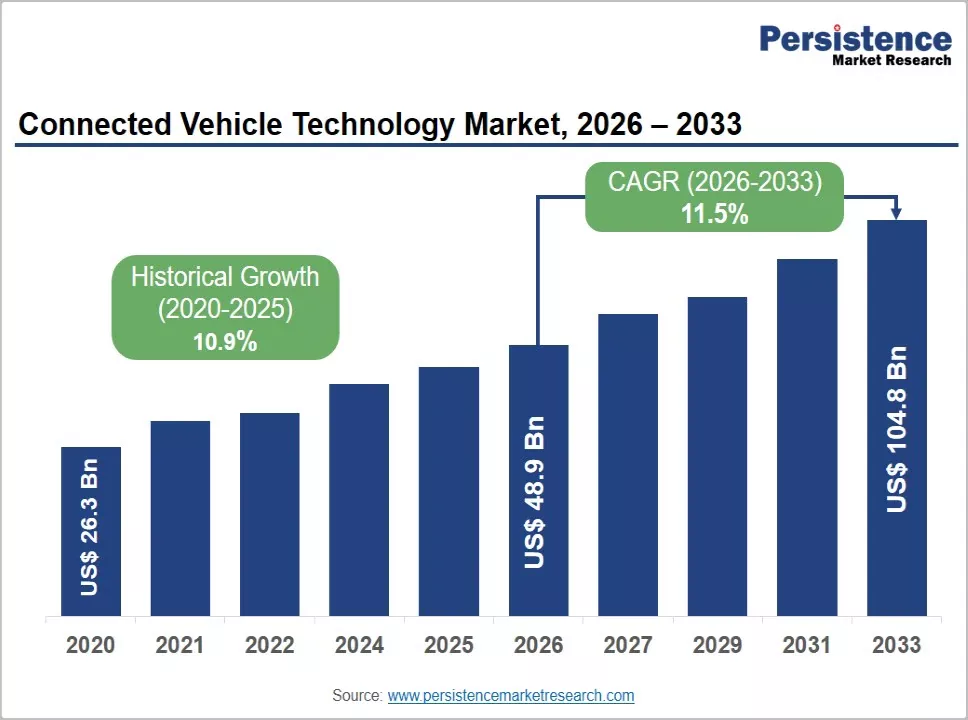
The global connected vehicle technology market size is likely to be valued at US$ 48.9 billion in 2026 and is projected to reach US$ 104.8 billion by 2033, growing at a CAGR of 11.5% during the forecast period between 2026 and 2033. Connected vehicle technology is no longer only an emergency call and navigation add-on. It is the data backbone of the software-defined vehicle, linking cars to other vehicles, roadside units, pedestrians, the cloud, and the power grid.
The forecast period is defined by the move from 4G to 5G and cellular vehicle-to-everything (C-V2X) links, over-the-air updates that turn vehicles into upgradeable products, and growing use of vehicle data in insurance, fleet management, and smart-city projects. Automakers, chip and module suppliers, mobile operators, and infrastructure owners should read this as a platform-led category in which latency, security, and software capability determine competitive position.
Key Industry Highlights
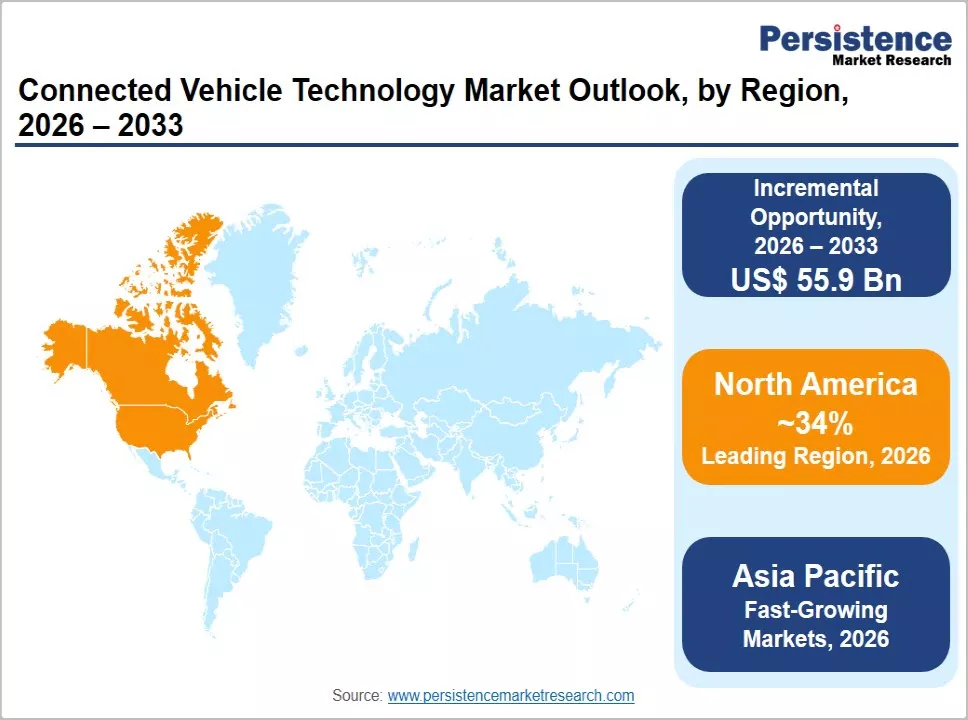
- Dominant and Fastest-growing Region: North America holds 34% of the market revenue in 2026, supported by high connected-car penetration, large mobile operators, and C-V2X spectrum rules, while Asia Pacific is projected to be the fastest-growing region at an estimated 13.4% CAGR through 2033, driven by China, Japan, South Korea, and India.
- Leading Technology Type: 4G / LTE commands about 52% of 2026 revenue, as most connected vehicles on the road still use LTE telematics control units and as networks are widely available. 5G and C-V2X are growing fastest, helped by lower-cost reduced capability modems such as the Qualcomm A10 introduced at CES 2026.
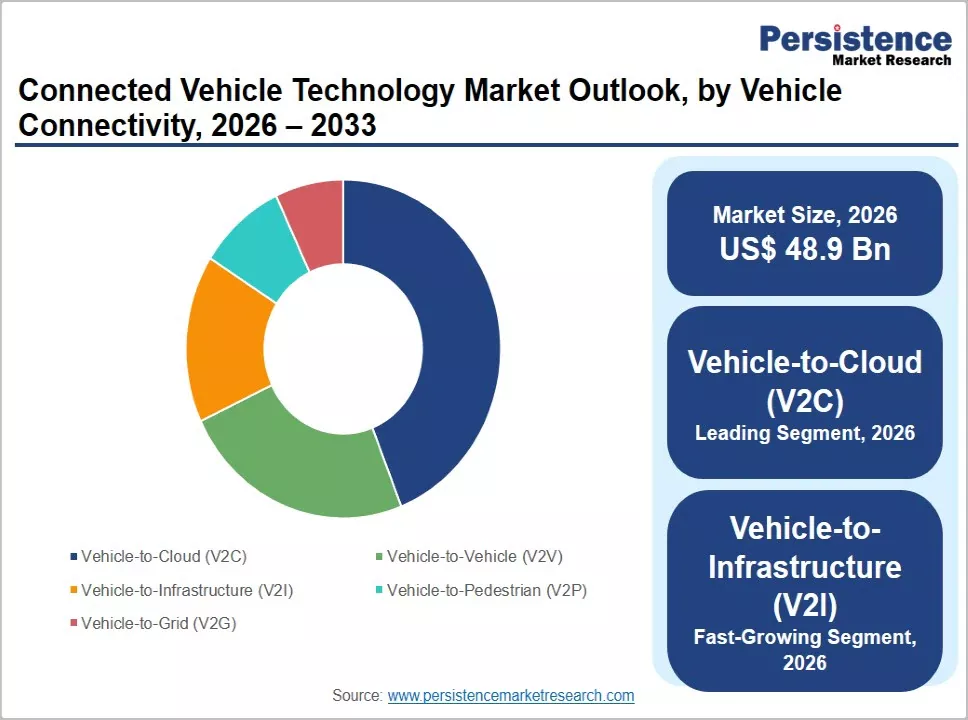
- Leading Vehicle Connectivity and Application: Vehicle-to-Cloud accounts for around 44% of revenue, reflecting the scale of cloud-linked telematics, diagnostics, and fleet services, and telematics and diagnostics is the largest application at about 29%. Vehicle-to-Infrastructure and over-the-air updates are the fastest-growing connectivity type and application.
- Fastest-growing Segments and Emerging Opportunity: Road-safety and tolling services built on C-V2X are an emerging opportunity. The 5G Automotive Association demonstrated real-time hazard alerts, signal information, and automated tolling in Sacramento in February 2026, with Verizon, HARMAN, and Qualcomm among the participants.
DRO Analysis
Driver- Safety Regulation, 5G and C-V2X Rollout, and Software-Defined Vehicles
Safety rules and consumer demand for driver assistance are pushing connectivity into more vehicles, and automakers are using connectivity to deliver software features after sale. Qualcomm introduced its A10 5G Modem-RF in January 2026, its first 5G reduced capability modem for automotive, to help automakers scale 5G across more models at lower cost. Aptiv's LINC platform is working with Verizon on C-V2X combined with 5G and edge computing for low-latency road safety. Over-the-air updates, subscription features, and usage-based insurance add recurring revenue, which makes connectivity a profit line rather than a cost for carmakers.
Restraint- Cybersecurity and Privacy Risks, Fragmented Standards, and Network Sunsets
Every connected vehicle is a potential target for cyberattacks, and rules on data ownership and consent differ across regions, which adds compliance cost and slows data-sharing models. Standards and spectrum rules are still fragmented between C-V2X, older short-range systems, and regional variants, which delays interoperable roadside deployments. Operators are also switching off 2G and 3G networks, forcing retrofits or software replacements for older connected vehicles, and the cost of roadside infrastructure limits vehicle-to-infrastructure rollouts in many cities.
Opportunity- C-V2X Safety Services, Vehicle-to-Grid, and Connected Data Monetisation
C-V2X road safety, electronic tolling, satellite-linked connectivity, and vehicle-to-grid charging represent the largest white space. The 5G Automotive Association's demonstrations in Sacramento in February 2026 showed Verizon's edge-based network C-V2X solution alongside direct 5.9 GHz tolling using equipment from Audi, Indra, Cohda Wireless, and Microsec. Renault and EyeNet have also tested C-V2X collision prevention, while fleet, insurance, and smart-city customers are willing to pay for vehicle data that improves safety and traffic flow.
Category-wise Analysis
Why Does 4G / LTE Command a Majority of the Global Connected Vehicle Technology Market?
4G / LTE is projected to lead the segment, holding nearly 52% of market share in 2026. LTE telematics units offer wide network coverage, low module cost, and enough bandwidth for navigation, diagnostics, and over-the-air updates, which makes them the standard choice for most vehicle programmes. Qualcomm, NXP, Infineon, and module suppliers provide mature chipsets, and mobile operators including AT&T and Verizon support large connected-car subscriptions. Many carmakers bundle several years of connectivity with new vehicles, which creates a base for paid upgrades once the trial period ends.
5G and C-V2X are likely to be the fastest-growing technology, driven by low-latency safety services and rising bandwidth needs for in-vehicle entertainment and software updates. The Qualcomm A10 reduced capability modem is designed to bring 5G to mainstream cars. 3G and 2G are declining as networks are switched off, although they still serve older vehicles and low-cost fleet devices in some emerging markets. Suppliers are responding with modules that fall back to LTE, so that vehicles built today stay connected as networks change.
Vehicle Connectivity Insights
What Is Driving Vehicle-to-Cloud Dominance Across the Connected Vehicle Technology Industry?
Vehicle-to-Cloud is expected to lead the segment, holding about 44% of market share in 2026. Cloud links carry telematics, diagnostics, navigation data, remote services, and over-the-air updates, and they are the foundation for usage-based insurance and fleet platforms. Tesla, Toyota, and other automakers run their own cloud platforms, while TomTom provides live traffic and map data.
Vehicle-to-Infrastructure is likely to be the fastest-growing connectivity type, supported by smart-road projects, signal-phase information, and tolling pilots. Vehicle-to-Vehicle and Vehicle-to-Pedestrian links add collision warnings, and Vehicle-to-Grid is emerging as electric vehicles are used as flexible power storage that can support the grid during peak demand. Large-scale adoption depends on bidirectional chargers, utility tariffs, and battery warranty terms.
Application Insights
Why Do Telematics and Diagnostics Lead Global Connected Vehicle Technology Demand?
Telematics and diagnostics is projected to lead the application segment, accounting for around 29% of market share in 2026. Remote diagnostics reduce service visits and warranty cost, and fleet and insurance customers use vehicle data to manage uptime, fuel use, and driver safety. Aptiv, ZF, and Magna supply connected hardware and software across these use cases, and Toyota and Tesla use fleet data to improve vehicle design and service planning.
Over-the-air updates are likely to be the fastest-growing application, as automakers move to software-defined architectures that allow new features, security patches, and recalls to be handled remotely. Driver assistance, safety and security, infotainment, and mobility and fleet management together make up the rest of demand, with ADAS gaining importance as cooperative sensing becomes possible. In cooperative sensing, roadside cameras and nearby vehicles share information about hidden hazards, extending what onboard sensors can detect. Infotainment and human-machine interfaces are also being upgraded with AI assistants that rely on constant connectivity.
Regional Insights
North America Connected Vehicle Technology Market Trends and Insights
North America is forecast to dominate the regional market, account for around 34% of the connected vehicle technology market in 2026. The region has high connected-car penetration, strong mobile operators such as AT&T and Verizon, and automakers such as Tesla that rely heavily on over-the-air software. C-V2X spectrum rules and state-level smart-road projects support infrastructure deployments, while higher vehicle prices and consumer concern about data use are the main brakes on faster adoption.
U.S. Connected Vehicle Technology Market Size
The U.S. is estimated to hold around 88% of the North America regional market in 2026. Mobile operators, automakers, and chip suppliers drive adoption, and the 5G Automotive Association's demonstrations with federal and state transport agencies, including a deployment district in Atlanta, show how C-V2X is moving from pilots to commercial rollout.
Canada Connected Vehicle Technology Market Size
Canada is expected to account for around 12% of the North America regional market in 2026. Connected fleets, insurance telematics, and cross-border logistics support demand, and mobile operators continue to extend 5G coverage.
Europe Connected Vehicle Technology Market Trends and Insights
Europe is anticipated to command around 18% of market share in 2026. The region has strict safety and data rules, strong premium carmakers, and active C-V2X and cooperative driving trials involving Renault and others. NXP, Infineon, Aptiv, ZF, and Magna supply chips, modules, and systems, while data privacy and cybersecurity rules shape product design.
Germany Connected Vehicle Technology Market Size
Germany is projected to account for around 28% of the Europe regional market in 2026. Premium automakers and suppliers such as ZF and Infineon are based here, and the focus on software-defined vehicles, over-the-air updates, and cooperative driving supports high-value connected systems.
U.K. Connected Vehicle Technology Market Size
The U.K. is estimated to account for nearly 14% of the Europe regional market in 2026. A strong telematics and insurance sector, smart-motorway and connected corridor trials, and a large fleet base support demand for vehicle connectivity services.
Which Region Will Drive the Fastest Connected Vehicle Technology Growth Through 2033?
Asia Pacific is forecast to be the fastest-growing region, capturing around 29% of market share in 2026 and expanding at an estimated 13.4% CAGR through 2033. China's large-scale C-V2X deployments, strong 5G networks, and fast-growing electric vehicle makers, together with Japan and South Korea's focus on cooperative driving, are driving growth.
China Connected Vehicle Technology Market Size
China is projected to hold 44% of the Asia Pacific regional market in 2026. Vehicle-road-cloud integration and 5G-Advanced C-V2X deployments have been showcased in Shanghai, and domestic automakers add 5G modules and over-the-air updates as standard features.
India Connected Vehicle Technology Market Size
India is expected to account for around 12% of the Asia Pacific regional market in 2026. Connected features are spreading from premium to mass-market cars, fleets are adopting telematics, and 4G networks remain the main platform while 5G coverage grows.
Competitive Landscape
The global connected vehicle technology market is moderately fragmented, with chip and module suppliers, automotive system makers, mobile operators, and automakers all competing for value. Qualcomm, NXP, Aptiv, ZF, and Magna lead on chipsets, modules, and integrated systems, while Infineon, TomTom, AT&T, Verizon, Tesla, and Toyota compete through semiconductors, maps and data, network services, and in-house software platforms.
Competitive intensity is rising as automakers build their own software stacks, mobile operators move into edge computing for vehicles, and chip makers offer complete platforms. Winning requires low-latency and secure connectivity, scalable cloud and update platforms, strong partnerships with carmakers and operators, and compliance with regional data and safety rules.
Key Industry Developments
- In January 2026, Qualcomm Technologies introduced the Qualcomm A10 5G Modem-RF at CES 2026, its first 5G reduced capability (RedCap) modem for the automotive industry. The modem is designed to offer low-power, low-cost, global LTE and 5G support for mission-critical services, helping automakers move more vehicles from LTE to 5G.
- In February 2026, The 5G Automotive Association hosted live C-V2X demonstrations in Sacramento, California, covering real-time road hazard alerts, traffic signal information, satellite-enabled voice calls, and automated connected vehicle tolling. Participants included Verizon, whose Edge Transportation Exchange combines multi-access edge computing with 5G, as well as HARMAN, Qualcomm, and Miovision.
Companies Covered in Connected Vehicle Technology Market
- Aptiv PLC
- AT&T Inc.
- Infineon Technologies AG
- Magna International
- NXP Semiconductors
- Qualcomm Technologies Inc.
- Tesla Inc.
- TomTom N.V.
- Toyota Motor Corporation
- Verizon Communications Inc.
- ZF Friedrichshafen AG
Frequently Asked Questions
The global connected vehicle technology market is valued at US$ 48.9 billion in 2026.
Safety regulation, 5G and C-V2X rollout, software-defined vehicles, over-the-air updates, and recurring data and subscription revenue, partly offset by cybersecurity and privacy risks, fragmented standards, and network sunsets.
4G / LTE holds around 52% of the market. LTE telematics units offer wide network coverage, low module cost, and enough bandwidth for navigation, diagnostics, and software updates.
North America leads with a 34% share in 2026, driven by high connected-car penetration, strong mobile operators, and early C-V2X and software-defined vehicle adoption, while Asia Pacific is the fastest-growing region.
The largest opportunities are C-V2X road safety and tolling services, vehicle-to-grid charging, satellite-linked connectivity, and the monetisation of vehicle data.
Leading companies include Qualcomm, NXP, Aptiv, ZF Friedrichshafen, and Magna International. The market is moderately fragmented, with chip makers, system suppliers, mobile operators, and automakers competing on latency, security, and software capability.


