




- Automotive
- Connected Car Device Market
Connected Car Device Market Size, Share, and Growth Forecast 2026 - 2033
Connected Car Device Market by Communication Type (V2V, V2I, V2P, V2N, V2G), Product Type (Driver Assistance System, Telematics, In-Car Infotainment, Cyber-security Hardware), Connectivity Technology (Embedded, Integrated, Tethered, DSRC, C-V2X (4G/5G)), and Regional Analysis, 2026 - 2033

Connected Car Device Market Size and Trend Analysis
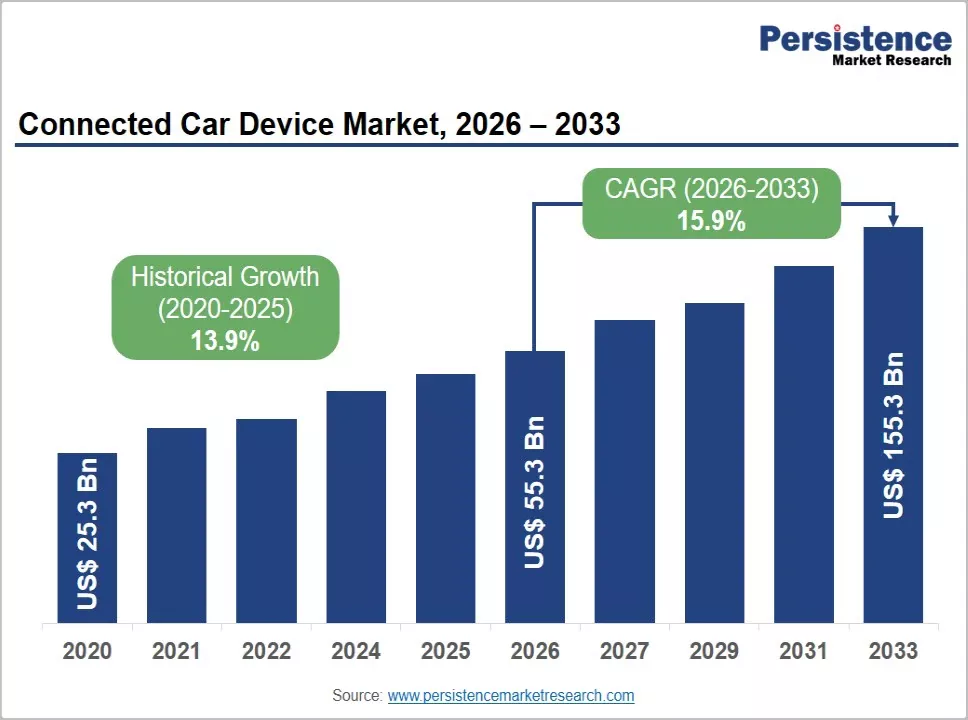
The global connected car device market size is likely to be valued at US$ 55.3 billion in 2026, and is estimated to reach US$ 155.3 billion by 2033, growing at a CAGR of 15.9% during the forecast period 2026 - 2033.
Growth is underpinned by tightening vehicle safety and cybersecurity regulations, the rapid shift toward software-defined vehicles, and expanding 5G and cellular vehicle-to-everything (C-V2X) infrastructure across developed and emerging economies.
The market registered a historical CAGR of 13.9% during 2020 - 2025, reflecting semiconductor supply disruptions, fragmented connectivity standards, and uneven infrastructure readiness. However, the forecast period anticipates robust acceleration as automakers embed connectivity as standard equipment, regulators mandate advanced driver assistance and over-the-air update capabilities, and consumers expect real-time navigation, safety alerts, and personalized in-vehicle services.
Key Industry Highlights
- Dominant Communication Type: Vehicle-to-network (V2N) is set to command around 41% of the revenue share in 2026, while vehicle-to-grid (V2G) is likely to grow the fastest at about 21.3% CAGR through 2033, as electric vehicle adoption and bidirectional charging programs expand.
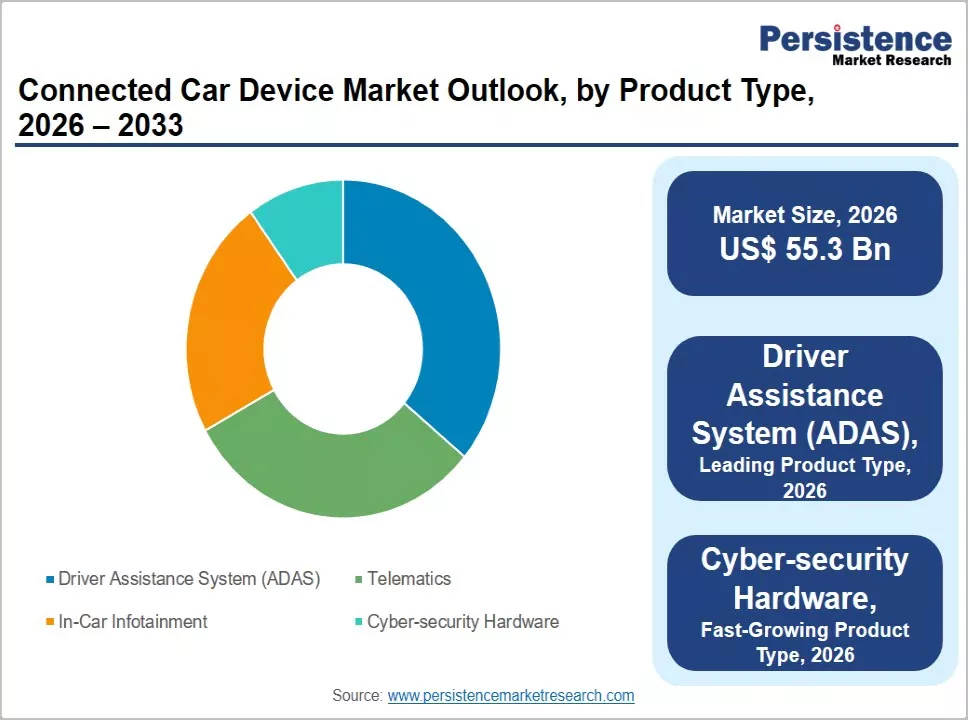
- Leading Product Type: Driver assistance systems (ADAS) are expected to lead with 34% in 2026, while cyber-security hardware is likely to be the fastest-growing at about 19.8% CAGR during 2026 - 2033, reflecting mandatory cybersecurity management requirements for connected vehicles.
- Dominant Connectivity Technology: Embedded connectivity is anticipated to lead with an estimated 46% share in 2026, while C-V2X (4G/5G) is slated to represent the fastest-growing technology at 21.5% CAGR from 2026 to 2033.
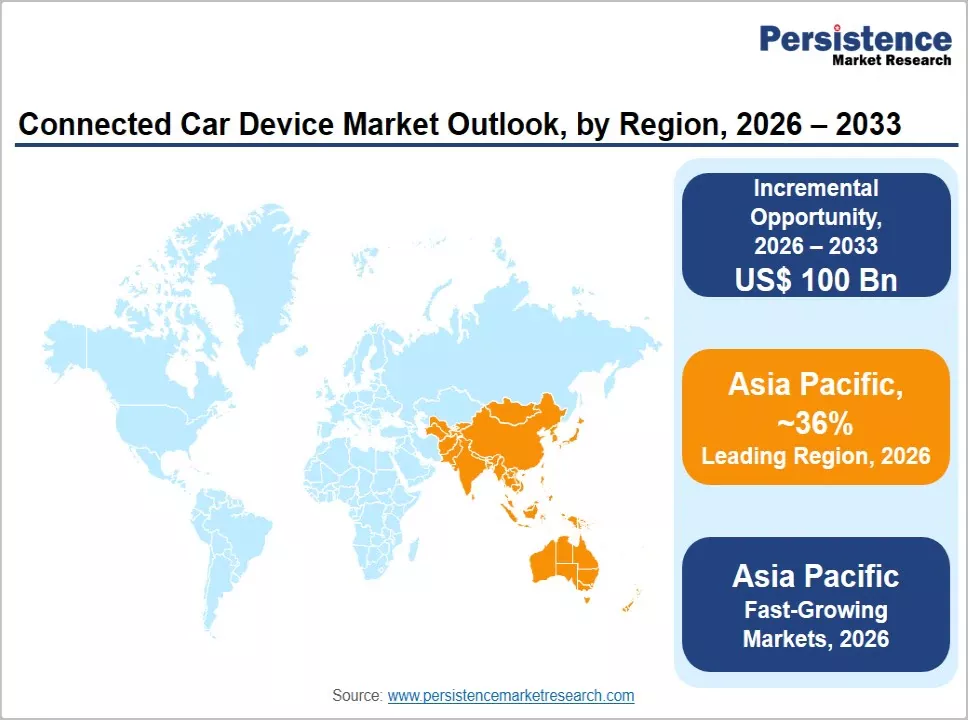
- Regional Leadership: Asia Pacific is poised to dominate with an estimated 36% share in 2026 and register a 17.4% CAGR through 2033, led by vehicle-road-cloud integration in China and strong automotive electronics output in Japan and South Korea.
- Competitive Environment: Competitive dynamics include semiconductor and software partnerships, expanded roadside C-V2X pilots, and a growing focus on vehicle cybersecurity and over-the-air update platforms.
DRO Analysis
Drivers: Safety Regulations, ADAS Adoption, and Software-Defined Vehicles as Primary Growth Catalyst
Regulatory requirements and the shift toward software-defined vehicles are the leading forces driving the connected car device market growth, as automakers integrate sensors, communication modules, and central computing platforms to meet safety and consumer expectations. In Europe, the General Safety Regulation now requires a growing list of driver assistance functions on all new vehicles, while the U.S. has finalized a rule that will require automatic emergency braking on light vehicles by 2029.
These mandates increase the content of connected and sensor-based devices per vehicle. At the same time, software-defined architectures enable manufacturers to deliver over-the-air updates, subscription features, and data-driven services, creating recurring revenue streams that justify higher investment in telematics control units, domain controllers, and secure gateways. Rising consumer willingness to pay for connected safety and convenience features is also encouraging automakers to scale these systems across vehicle segments.
C-V2X Deployment and 5G Integration
Roadside and cloud infrastructure for vehicle-to-everything communication is moving from pilots to early deployment. Atlanta became the first U.S. "Day One Deployment District" for C-V2X in September 2025, and roadside units are now being integrated with tolling and traffic management systems. Industry roadmaps also anticipate satellite connectivity in vehicles from around 2027, complementing terrestrial 4G and 5G networks. This convergence of regulation, infrastructure, and technology maturity ensures sustained growth in the connected car device market in the coming years.
Restraints: Cybersecurity Risk, Data Privacy Concerns, and Regulatory Fragmentation
Cybersecurity and data privacy have become major challenges for the connected car device market. Every additional connection, including cellular modems, Bluetooth, Wi-Fi, and charging interfaces, increases the attack surface, and a successful intrusion could compromise vehicle safety, customer data, or entire fleets. Regulations such as UN Regulation No. 155 require manufacturers to operate certified cybersecurity management systems, which raises development and compliance costs. Privacy rules governing the collection and sharing of vehicle data also limit how quickly connected services can be monetized.
Rising Costs and Standards Fragmentation
Semiconductor shortages, complex electronic architectures, and the cost of integrating multiple radios and sensors inflate bill-of-materials costs, especially for entry-level vehicles. Differences in spectrum allocation and technology choices between regions, including the shift from dedicated short-range communication (DSRC) to C-V2X in the U.S., require manufacturers to adapt designs for each market. Restrictions on connected vehicle hardware and software linked to certain foreign suppliers add further complexity to global sourcing. Long vehicle lifecycles also slow the replacement of legacy fleets, delaying the benefits of cooperative safety systems.
Opportunities: Vehicle-to-Grid Services, Satellite Connectivity, and Data-Driven Mobility Services
The rapid expansion of electric vehicles is creating opportunities for connected devices that enable bidirectional charging, smart energy management, and grid support. Utilities and automakers are testing vehicle-to-grid programs that allow vehicles to supply power during peak demand, which requires secure communication between the vehicle, charger, and grid operator. Satellite-enabled emergency messaging and voice calling are also emerging as value-added features, extending coverage to areas with weak terrestrial networks and supporting new service offerings.
Usage-Based Services and Aftermarket Expansion
Insurance telematics, fleet management, predictive maintenance, and in-car commerce are expected to generate new revenue pools for device manufacturers, software providers, and mobile operators. Aftermarket connectivity devices, including plug-in telematics dongles and retrofit safety modules, offer a pathway to connect the large installed base of older vehicles. Emerging economies in Asia, Latin America, and the Middle East are also expected to see growing demand for affordable connected devices as smartphone penetration and cellular coverage improve.
Category-wise Insights
Communication Type Analysis
Why Does Vehicle-to-Network (V2N) Lead the Connected Car Device Market?
Vehicle-to-network communication is the leading communication type segment, expected to hold about 41% of the connected car device market revenue share in 2026. V2N relies on existing cellular infrastructure to deliver navigation updates, live traffic, remote diagnostics, emergency calling, and cloud-based services, which makes it the most widely commercialized form of connectivity. Automakers favor V2N because it does not depend on dedicated roadside equipment and supports a continuous stream of data for analytics and over-the-air updates.
Demonstrations of V2N-based hazard alerts and road-work warnings are also strengthening confidence in network-based safety applications. Rising use of edge computing and low-latency 5G slices is also expected to improve the responsiveness of network-based safety alerts.
Vehicle-to-grid communication is likely to grow the fastest through 2033. V2G systems allow electric vehicles to charge, store, and return power to the grid based on real-time price and demand signals. This requires secure communication protocols, smart chargers, and vehicle control units that manage battery health while enabling grid participation. Pilot programs by utilities and automakers, combined with growing EV fleets, are accelerating adoption. Vehicle-to-vehicle, vehicle-to-infrastructure, and vehicle-to-pedestrian communication remain important safety technologies, with deployment gradually expanding as roadside infrastructure and device penetration increase.
Product Type Analysis
Why Do Driver Assistance Systems Dominate Connected Car Devices?
Driver assistance systems are the leading product type segment, projected to capture about 34% of the revenue share in 2026. These systems combine radar, cameras, ultrasonic sensors, and increasingly connected map and cloud data to support emergency braking, lane keeping, adaptive cruise control, and blind-spot detection. Mandatory safety regulations in Europe, the U.S., China, and other major markets are pushing automakers to fit ADAS as standard equipment rather than as an optional upgrade.
High content per vehicle and steady replacement and upgrade cycles make ADAS the most valuable product category. Continuous improvements in sensor fusion and artificial intelligence processing are further enhancing detection accuracy and reducing false alerts.
Cyber-security hardware represents the fastest-growing product type segment, anticipated to achieve about 19.8% CAGR during the 2026 - 2033 period. This category includes secure gateways, hardware security modules, secure elements in electronic control units, and intrusion detection devices. Cybersecurity management regulations in Europe, Japan, South Korea, and other markets now apply to new vehicles, making secure hardware a compliance necessity. Telematics and in-car infotainment also remain strong segments, supported by connected services, streaming, navigation, and larger displays that raise the value of infotainment systems per vehicle.
Connectivity Technology Analysis
Why Does Embedded Connectivity Lead Connectivity Technologies?
Embedded connectivity is poised to lead with an estimated 46% share in 2026, favored for its reliability, integration with vehicle systems, and independence from the driver's smartphone. Embedded telematics control units, which include a built-in modem and SIM, support emergency calling, over-the-air updates, remote services, and fleet data collection. Automakers prefer embedded solutions because they provide secure access to vehicle data and enable subscription-based services.
Integrated and tethered options remain relevant for cost-sensitive vehicles, where smartphone connectivity provides navigation and entertainment. Over-the-air update capability, which depends on a reliable embedded link, has become a key differentiator among automakers.
C-V2X (4G/5G) is the fastest-growing connectivity technology in the market, expected to showcase an approximate 21.5% CAGR through 2033. C-V2X supports direct communication between vehicles, roadside units, and pedestrians without relying on cellular networks, as well as network-based communication through mobile operators. China has advanced large-scale deployment, while the U.S. is moving from DSRC to C-V2X following spectrum reallocation. DSRC retains a presence in specific regions and legacy programs, but momentum is shifting toward cellular standards that offer a clearer path to 5G evolution.
Growing availability of roadside infrastructure and aftermarket on-board units is expected to help close the gap between new and existing vehicles.
Regional Insights
North America Connected Car Device Market Trends and Insights
North America is anticipated to account for an estimated 28% of the global connected car device market in 2026. The region's industry is likely to benefit from high vehicle connectivity penetration, strong consumer demand for advanced safety features, and early deployment of C-V2X infrastructure. Automatic emergency braking requirements and the transition of the 5.9 GHz spectrum to C-V2X are expected to accelerate investments in sensors and communication devices.
Federal restrictions on connected vehicle technology from certain foreign suppliers are also expected to reshape sourcing strategies and strengthen domestic and allied suppliers through 2033. Growing demand for connected commercial fleets, including delivery vans and long-haul trucks, is also expected to add volume for telematics and driver monitoring devices.
U.S. Connected Car Device Market Size
The U.S. is estimated to account for approximately 82% of the North America connected car device market in 2026. Market growth is likely to be supported by federal and state connected vehicle deployments, tolling pilots using C-V2X roadside units, and growing demand for subscription-based safety and convenience services. In February 2026, demonstrations in Sacramento showcased automated connected vehicle tolling, satellite-enabled calling, and real-time hazard alerts on public roads. Strong sales of electric vehicles and advanced driver assistance packages are likely to further support device demand through 2033.
Canada Connected Car Device Market Size
Canada is projected to represent approximately 18% of the North America connected car device market in 2026. Market expansion is expected to be driven by increasing integration of telematics and advanced safety features in vehicles sold across the country, winter driving requirements that favor connected safety and diagnostics, and growing zero-emission vehicle mandates. Investments in 5G networks and smart transportation corridors are anticipated to support wider adoption of connected devices and fleet telematics through 2033. Cross-border trade corridors with the U.S. are also encouraging harmonized telematics and safety standards.
Europe Connected Car Device Market Trends and Insights
Europe is estimated to account for approximately 17% of the global connected car device market in 2026. The region's market is expected to benefit from the General Safety Regulation, mandatory eCall, UN cybersecurity and software update regulations, and strong premium automotive manufacturing.
The EU Data Act is also likely to increase access to vehicle data for third-party services, expanding opportunities for aftermarket and mobility providers. Established European suppliers are likely to retain competitive advantages through regulatory expertise, long-standing relationships with automakers, and strong capabilities in safety-critical electronics. Mobile network operators and automakers are also forming partnerships to extend coverage and to introduce cross-border roaming for connected services.
Germany Connected Car Device Market Size
Germany is anticipated to account for approximately 29% of the Europe connected car device market in 2026. Demand is expected to be supported by the presence of leading premium automakers and Tier-1 suppliers, high adoption of ADAS, and investments in software-defined vehicle platforms. Domestic manufacturers are expanding over-the-air update capabilities and centralized computing architectures, increasing the need for secure gateways and high-performance connectivity modules.
Smart road initiatives and 5G network expansion are projected to support market growth through 2033. Continued growth in electric vehicle sales is also expected to raise demand for charging-related connectivity modules and secure gateways.
Why Is Asia Pacific Expected to Lead the Connected Car Device Market?
Asia Pacific is projected to account for approximately 36% of the global connected car device market in 2026, making it the largest regional market. The region is also anticipated to register the fastest growth, expanding at an estimated CAGR of 17.4% through 2033.
Market expansion is likely to be driven by high vehicle production, rapid adoption of intelligent and electric vehicles, and large-scale investments in 5G and vehicle-road-cloud systems. China is expected to remain the primary demand center, while Japan, South Korea, and India are also likely to accelerate adoption of connected and safety technologies. Rising adoption of connected electric vehicles across Southeast Asia and India is also expected to broaden the regional customer base.
China Connected Car Device Market Size
China is estimated to represent approximately 54% of the Asia Pacific connected car device market in 2026. The country's market is expected to benefit from the world's largest vehicle production base, strong consumer appetite for connected infotainment and driver assistance, and government support for intelligent connected vehicles and vehicle-road-cloud integration. Large-scale C-V2X pilot zones and rapid rollout of 5G networks are likely to increase demand for communication modules and roadside-connected devices.
Domestic suppliers are projected to strengthen their competitive position through 2033. Local suppliers are also integrating high-compute cockpit platforms with 5G modules to support in-car entertainment, voice assistants, and advanced navigation.
Japan Connected Car Device Market Size
Japan is projected to account for approximately 17% of the Asia Pacific connected car device market in 2026. The market is expected to witness steady expansion, supported by established automotive electronics suppliers, government road safety targets, and the deployment of intelligent transport systems. Automakers are increasing the use of advanced driver assistance features and connected services, while an aging population is likely to drive interest in safety monitoring and emergency response functions through 2033. Partnerships between automakers and mobile operators on 5G connectivity are also expected to support next-generation services.
Competitive Landscape
The global connected car device market structure is moderately consolidated, with the top vendors, including Robert Bosch, Continental, Aptiv, and Harman International, controlling around 40% of the revenue share. These established players have been leveraging their extensive relationships with automakers, safety-critical engineering expertise, and integrated hardware-software platforms. They are also known to invest heavily in R&D to maintain technological leadership in domain controllers, ADAS, and cybersecurity.
Semiconductor and technology companies such as Qualcomm Technologies and NXP Semiconductors are focusing on connectivity chipsets, C-V2X platforms, and in-vehicle compute, while Asian suppliers such as DENSO, Visteon, Valeo, and Marelli are strengthening positions in infotainment, telematics, and sensor systems. Barriers such as automotive qualification standards and long design cycles limit new entrants, but software-centric companies are participating through operating systems, cloud services, and over-the-air platforms. Market consolidation is expected to increase gradually as global leaders acquire niche technology providers and automakers form strategic partnerships with chipmakers and mobile operators. Mobile operators and cloud providers are also deepening collaboration with automakers on connectivity management, mapping, and data platforms.
Key Market Developments
- In February 2026, Kapsch TrafficCom North America completed the roadside deployment and initial integration of a C-V2X tolling pilot, feeding vehicle data from roadside units into its roadside system and the toll operator's back office.
- In February 2026, the 5G Automotive Association demonstrated satellite-enabled voice calls, automated connected vehicle tolling, and real-time road hazard alerts on public roads in Sacramento, California.
- In September 2025, Atlanta became home to the first "Day One Deployment District" for C-V2X in the U.S. during the ITS World Congress 2025, showcasing the largest C-V2X roadside deployment to date.
Companies Covered in Connected Car Device Market
- Robert Bosch GmbH
- Continental AG
- Harman International
- Qualcomm Technologies, Inc.
- NXP Semiconductors N.V.
- DENSO Corporation
- Aptiv PLC
- Visteon Corporation
- Valeo SA
- Marelli Holdings Co., Ltd.
Frequently Asked Questions
The global connected car device market is valued at US$ 55.3 billion in 2026 and is projected to reach US$ 155.3 billion by 2033, expanding at a CAGR of 15.9% during 2026 - 2033.
Tightening vehicle safety and cybersecurity regulations, the shift toward software-defined vehicles, and expanding 5G and C-V2X infrastructure across developed and emerging economies are driving the market. Growing electric vehicle adoption and rising consumer demand for real-time navigation, safety alerts, and personalized in-vehicle services are further supporting demand.
V2N leads communication types with about 41% share, ADAS leads product types with about 34%, and embedded connectivity leads connectivity technologies with an estimated 46% in 2026. V2G, cyber-security hardware, and C-V2X are the fastest-growing segments, at about 21.3%, 19.8%, and 21.5% CAGR respectively.
Asia Pacific dominates the market with an estimated 36% share in 2026 and is projected to register a 17.4% CAGR through 2033, led by high vehicle production, 5G investments, and vehicle-road-cloud integration in China.
Vehicle-to-grid services, satellite connectivity, insurance telematics, and aftermarket connected devices for older vehicles are key market opportunities. Growing smartphone penetration and cellular coverage in emerging economies are also expected to open new demand pockets.
The market is moderately consolidated, with Robert Bosch, Continental, Aptiv, and Harman International controlling around 40% of the revenue share.


