




- Automotive
- Unmanned Traffic Management Market
Unmanned Traffic Management Market Size, Share, and Growth Forecast 2026–2033
Unmanned Traffic Management Market by Type (Persistent, Non-Persistent), Component (Hardware, Software), Solution (Communication Infrastructure, Navigation Infrastructure), End-Use (Agriculture & Forestry, Logistics & Transportation), and Regional Analysis, 2026–2033

Unmanned Traffic Management Market Size and Trend Analysis
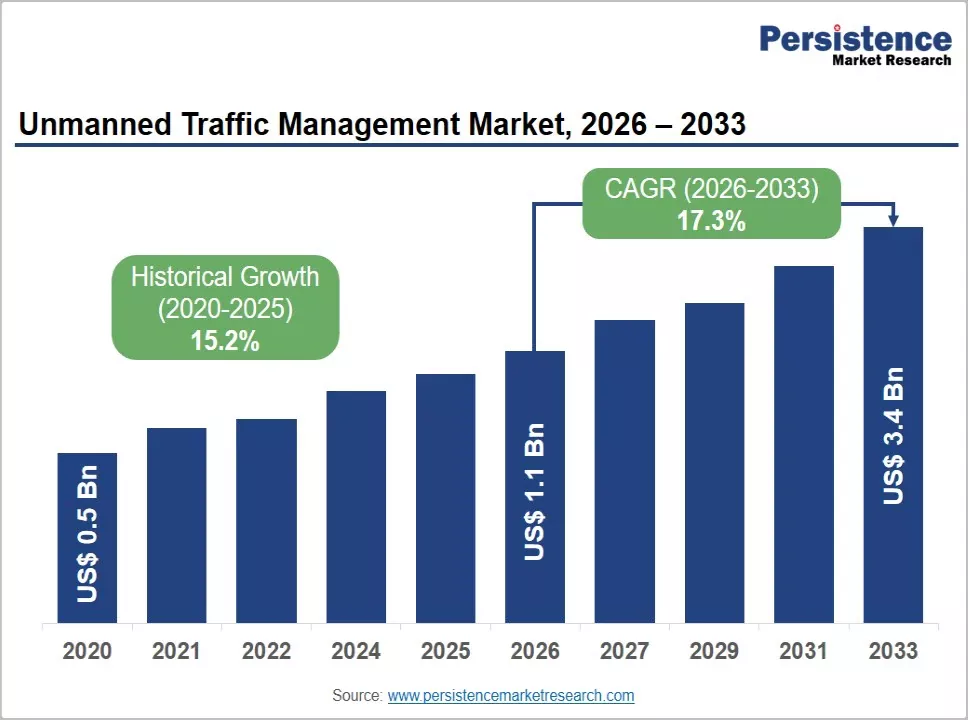
The global unmanned traffic management market size is likely to be valued at US$ 1.1 billion in 2026, and is estimated to reach US$ 3.4 billion by 2033, growing at a CAGR of 17.3% during the forecast period 2026–2033. Growth is underpinned by the rapid scale-up of commercial drone operations, the regulatory shift toward beyond visual line of sight (BVLOS) flying, and rising demand for digital airspace coordination across low-altitude corridors.
The market has been expanding at a double-digit pace, reflecting pilot programs and regulatory sandboxes that are still maturing. However, the forecast period anticipates stronger acceleration as drone delivery networks, public safety drone programs, and advanced air mobility trials move from testing into routine operations that require automated, interoperable traffic management services.
Key Industry Highlights
- Dominant Type: Persistent systems are set to command around 63% of the revenue share in 2026, while non-persistent systems are likely to grow the fastest at 18.6% CAGR through 2033, as temporary airspace coordination for events and emergency response gains traction.
- Leading Components: Software is expected to lead with 44% in 2026, while services are likely to be the fastest-growing at about 19.2% CAGR during 2026–2033, reflecting rising demand for managed UTM operations and system integration.
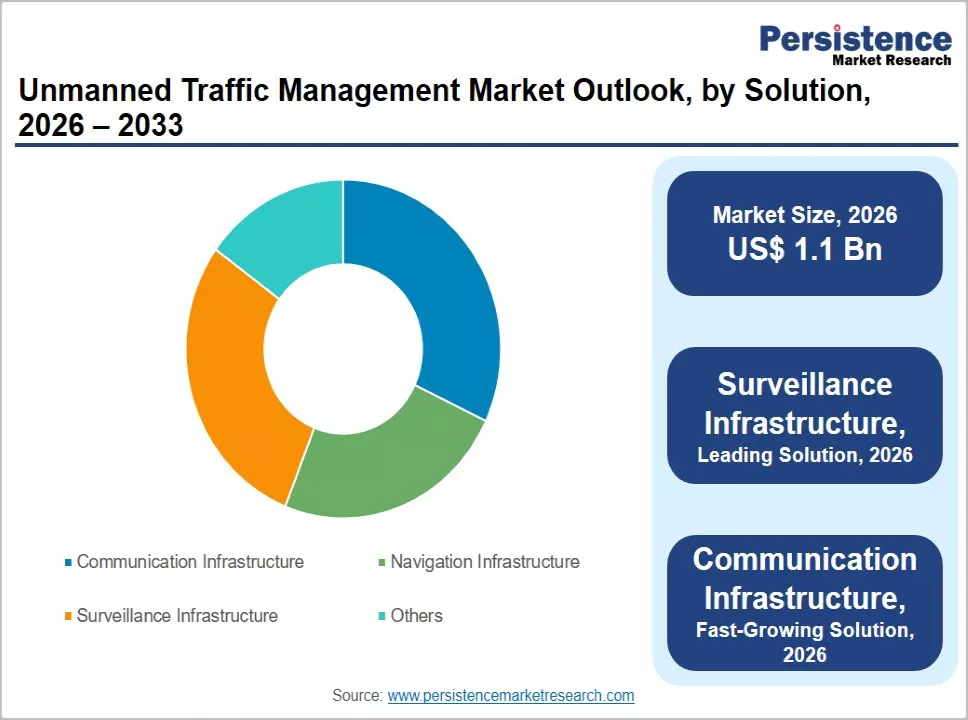
- Dominant Solution: Surveillance infrastructure is anticipated to lead with an estimated 37% share in 2026, while communication infrastructure is slated to represent the fastest-growing solution at 18.9% CAGR from 2026 to 2033.
- Top End-Use: Surveillance & monitoring is poised to hold around 35% share in 2026, whereas logistics & transportation is likely to register the fastest growth at 19.8% CAGR through 2033, led by drone delivery expansion.
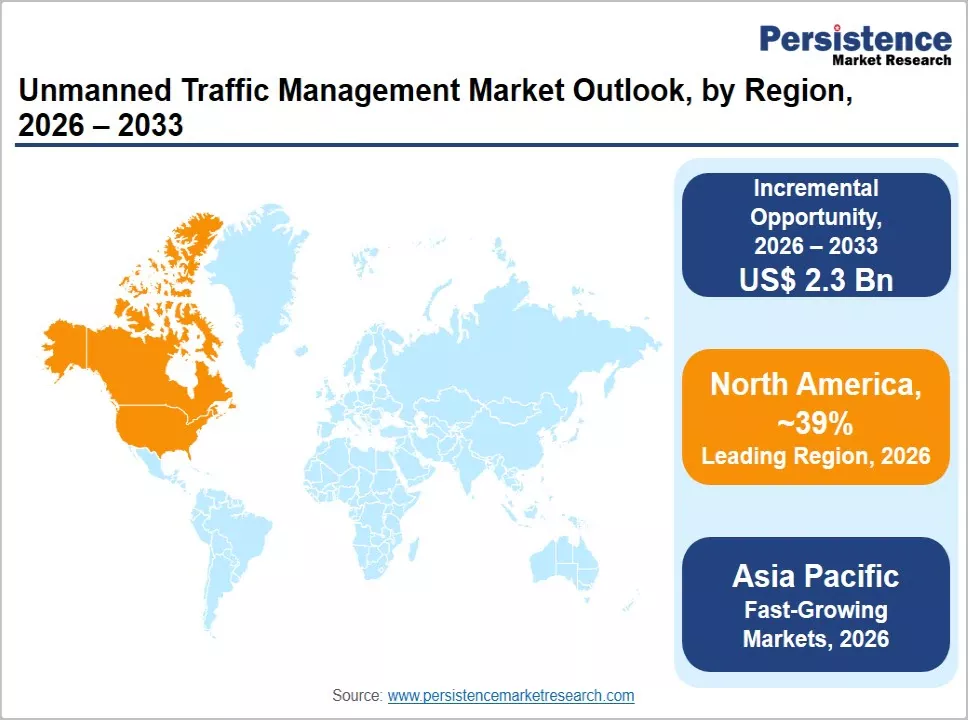
- Regional Leadership: North America is poised to dominate with an estimated 39% share in 2026, while Asia Pacific is expected to register the fastest growth at 19.4% CAGR through 2033, led by low-altitude economy initiatives in China and India.
- Competitive Environment: Competitive dynamics include federated UTM partnerships, acquisitions of automated drone operators by logistics and port players, and standards-based interoperability trials across Europe, North America, and India.
DRO Analysis
Drivers: BVLOS Regulatory Momentum and Drone Delivery Scale-Up as Primary Growth Catalyst
Regulatory movement toward routine beyond visual line of sight operations is the leading force driving the unmanned traffic management market growth, as aviation authorities recognize that manual, operator-by-operator separation cannot support dense low-altitude traffic. The U.S. has advanced a proposed BVLOS operating framework, the European Union has operationalized its U-space regulatory package, and civil aviation authorities in the U.K., Canada, India, and Australia are issuing concepts of operation that depend on digital traffic services.
Drone delivery operators, utilities, and public safety agencies are increasingly flying overlapping routes, creating immediate demand for flight authorization, strategic deconfliction, geofencing, and Remote ID data exchange. Operators that have already scaled to thousands of monthly overlapping flights rely on UTM services to coordinate shared airspace automatically.
Remote ID, Interoperability Standards, and Advanced Air Mobility Readiness
Mandatory Remote ID compliance, ASTM-based data exchange standards, and cross-border interoperability testing are converting UTM from experimental pilots into regulated infrastructure. Airspace service providers are also positioning their platforms for advanced air mobility, where drones, air taxis, and conventional aircraft must share data through federated architectures. This convergence of regulatory clarity, rising commercial drone volumes, and standardized interfaces ensures sustained growth for the unmanned traffic management market in the coming years.
Restraints: Airspace Integration Complexity and Cybersecurity Vulnerability
Integrating UTM with legacy air traffic management systems remains a major challenge for the market. Regulators must reconcile automated, privately operated service suppliers with the safety culture and accountability structures of conventional air traffic control, and timelines for new rules, performance standards, and service-supplier certification remain long. Fragmented national frameworks also force platform providers to customize products country by country, delaying commercial scale-up and raising compliance costs, especially for smaller software vendors and regional airspace authorities.
Navigation Resilience, Privacy, and Public Acceptance
UTM platforms depend on continuous data links and satellite navigation, making them exposed to jamming, spoofing, and data-integrity attacks that can undermine separation assurance. Concerns about drone noise, privacy, and surveillance also slow community acceptance and local permitting. Operators must therefore invest in resilient positioning, encrypted communications, and detection layers, which raise project budgets and extend implementation timelines, particularly for municipal and regional deployments with limited technical expertise.
Opportunities: Expanding Low-Altitude Economy Programs and Emerging Market Adoption
Governments across Asia Pacific, the Middle East, and Africa are building low-altitude economy strategies that treat drones as national infrastructure for logistics, agriculture, healthcare, and inspection. Public funding for test corridors, drone testing hubs, and certification frameworks is creating greenfield demand for UTM platforms that can be deployed without legacy constraints. India plans to introduce a refined BVLOS certification framework by the end of 2026, while state-level testing hubs and venture funding for autonomous delivery start-ups are expanding the domestic pipeline. China continues to scale city-level low-altitude airspace management platforms.
Managed Services and Cross-Industry Use Cases
Airports, ports, utilities, and agricultural cooperatives increasingly prefer subscription-based UTM services rather than building in-house capabilities. This shift favors managed services, cloud-based airspace dashboards, and integrated detect-and-avoid offerings. Partnerships between UTM providers, telecom operators, and radar vendors are also creating bundled communication, navigation, and surveillance packages, opening additional revenue pockets in training, analytics, and long-term service contracts.
Category-wise Insights
Type Analysis
Why Do Persistent Systems Lead the Unmanned Traffic Management Market?
Persistent unmanned traffic management systems are the leading type segment, expected to hold about 63% of the market revenue share in 2026. These systems operate continuously within defined airspace, integrating ground-based radar, communication networks, and cloud services to provide round-the-clock monitoring, authorization, and conflict alerts. Their dominance reflects investment by civil aviation authorities, airports, and air navigation service providers in permanent digital infrastructure for corridors, ports, and urban districts. Persistent deployments also generate recurring software and maintenance revenue, providing predictable demand as drone traffic scales.
Non-persistent systems are likely to grow the fastest through 2033 at about 18.6% CAGR. Deployable on demand, these portable systems provide temporary airspace management for disaster response, large public events, infrastructure inspections, and remote agricultural operations where permanent infrastructure is not economical. Advances in compact radar, cellular connectivity, and cloud-hosted software are shrinking setup times, enabling emergency services and defense agencies to establish managed airspace within hours. Growing wildfire, flood, and security-event responses are strengthening adoption.
Component Analysis
Why Does Software Lead Unmanned Traffic Management Components?
Software is the leading component segment, projected to capture about 44% of the market revenue share in 2026. UTM software performs flight planning, strategic deconfliction, dynamic geofencing, Remote ID processing, and data exchange between service suppliers and regulators. Cloud-native architectures and open application programming interfaces allow providers to update capabilities rapidly as rules evolve, while subscription models create recurring revenue. Growing integration of artificial intelligence for conflict prediction, route optimization, and anomaly detection is further increasing software value per deployment.
Services represent the fastest-growing component segment, anticipated to achieve a 19.2% CAGR during the 2026–2033 period. Demand spans system integration, managed UTM operations, regulatory consulting, training, and round-the-clock monitoring, as many aviation authorities and municipalities lack in-house expertise. Hardware, covering radar, sensors, receivers, and communication units, continues to grow steadily on airport and port deployments but faces price pressure as detection equipment becomes increasingly commoditized.
Solution Analysis
Why Does Surveillance Infrastructure Dominate Unmanned Traffic Management Solutions?
Surveillance infrastructure is poised to lead with an estimated 37% share in 2026, as safe separation depends on knowing where cooperative and non-cooperative aircraft are located. This segment includes radar, ADS-B receivers, Remote ID receivers, acoustic and optical sensors, and network-based tracking services. Regulatory requirements for drone identification and rising concerns about unauthorized flights over airports and critical infrastructure keep procurement active, while sensor fusion improves detection reliability in complex urban environments.
Communication infrastructure is the fastest-growing solution segment, expected to showcase an approximate 18.9% CAGR through 2033. Cellular networks, including 5G, provide the command-and-control and telemetry links required for BVLOS operations at scale, and telecom operators are increasingly partnering with UTM providers. Navigation infrastructure continues to progress through augmentation systems and alternative positioning methods designed to mitigate satellite navigation degradation, an issue attracting growing attention as jamming and spoofing incidents rise.
End-Use Analysis
Which End-Use Segment Dominates Unmanned Traffic Management?
Surveillance and monitoring is the largest end-use segment, projected to account for about 35% of the market in 2026. Police, border security, infrastructure inspection, and emergency response agencies operate drones as first responders and require airspace coordination to avoid conflicts with manned aircraft. Programs that pair UTM with radar and counter-UAS tools, such as municipal drone-as-first-responder initiatives, are expanding across North America and Europe, producing steady public-sector demand.
Logistics and transportation is the fastest-growing end-use segment, expected to register about 19.8% CAGR through 2033. Retailers, food-delivery platforms, and healthcare logistics networks are expanding drone delivery into new metropolitan areas, increasing overlapping flights that must be coordinated automatically. Agriculture and forestry applications, including crop spraying, field mapping, and forest fire surveillance, are also scaling, particularly in India, China, and Brazil, where large farmland areas and labor shortages favor drone adoption.
Regional Insights
Why Is North America Expected to Lead the Unmanned Traffic Management Market?
North America is projected to account for approximately 39% of the global unmanned traffic management market in 2026, making it the largest regional market. The region benefits from early regulatory progress, mature commercial drone operators, and sustained federal investment in airspace modernization. The June 2025 U.S. executive order on drone competitiveness and the Federal Aviation Administration's proposed BVLOS operating framework are expected to accelerate commercial scale-up, while mandatory Remote ID has already created a data foundation for traffic services. The presence of leading UTM providers, telecom partners, and drone delivery operators is likely to strengthen regional leadership through 2033.
U.S. Unmanned Traffic Management Market Size
The U.S. is estimated to account for approximately 84% of the North America unmanned traffic management market in 2026. Market growth is likely to be supported by FAA-led UAS traffic management development, the expansion of drone delivery networks by large retailers and logistics firms, and growing public safety drone programs. Federal funding for drone research and testing projects, together with rising adoption of drone-as-first-responder programs, is expected to widen demand for airspace awareness, radar integration, and automated authorization services. Rapid commercial BVLOS approvals are also likely to raise the volume of flights managed through third-party service suppliers.
Canada Unmanned Traffic Management Market Size
Canada is projected to represent approximately 16% of the North America unmanned traffic management market in 2026. Market expansion is expected to be driven by Transport Canada's expanded BVLOS regulations, remote community delivery use cases, and growing interoperability testing among domestic providers. Live trials in Edmonton have demonstrated cooperative UTM data exchange using ASTM standards, positioning Canadian vendors for cross-border compatibility. Resource, energy, and agricultural operators spread across vast geographies are also anticipated to adopt UTM-enabled drone inspections through 2033.
Europe Unmanned Traffic Management Market Trends and Insights
Europe is estimated to account for approximately 17% of the global unmanned traffic management market in 2026. The region's market is expected to benefit from the U-space regulatory framework, which defines services such as network identification, geo-awareness, flight authorization, and traffic information for drone operations. The European Union Aviation Safety Agency's proposals for a "U-space light" category are likely to ease adoption in lower-density airspace, while the European Commission's review of Drone Strategy 2.0 is expected to sustain policy momentum. National programs in Spain, the Netherlands, and the U.K., where the CAA has proposed a federated ASTM-based architecture, are also advancing deployment.
Germany Unmanned Traffic Management Market Size
Germany is anticipated to account for approximately 22% of the Europe unmanned traffic management market in 2026. Demand is expected to be supported by national air navigation service provider activity in UTM, port and logistics drone projects, and research into emergency-response drone operations. Acquisitions in automated drone services, such as CONDOR Group's purchase of HHLA Sky in November 2026, signal rising investment in industrial drone operations at ports and logistics hubs. Strong industrial automation, regulatory rigor, and urban air mobility pilots are projected to support market expansion through 2033.
Why Is Asia Pacific Expected to Register the Fastest Growth in the Unmanned Traffic Management Market?
Asia Pacific is projected to account for approximately 24% of the global unmanned traffic management market in 2026, and is anticipated to register the fastest growth, expanding at an estimated CAGR of 19.4% through 2033. Market expansion is likely to be driven by low-altitude economy initiatives, large-scale drone manufacturing, and growing adoption of drones in agriculture, logistics, and infrastructure inspection. China and India are expected to remain the primary demand centres, while Japan, South Korea, Indonesia, and Australia are advancing BVLOS approvals and food and parcel delivery trials.
China Unmanned Traffic Management Market Size
China is estimated to represent approximately 41% of the Asia Pacific unmanned traffic management market in 2026. The country's market is expected to benefit from national emphasis on the low-altitude economy, a dominant domestic drone manufacturing base, and city-level airspace management platforms that integrate drone registration, flight approval, and monitoring. Cities such as Shenzhen and Jinan are expanding drone delivery networks, with Jinan integrating autonomous drone delivery with ground-based robotic vehicles. Government support for domestic technology providers is anticipated to sustain China's regional leadership through 2033.
India Unmanned Traffic Management Market Size
India is projected to account for approximately 18% of the Asia Pacific unmanned traffic management market in 2026. The market is expected to witness strong expansion, supported by the Drone Rules 2021, the Digital Sky platform, and the production-linked incentive scheme for drones. The Civil Aviation Minister has indicated a refined BVLOS certification framework by the end of 2026, while Karnataka is planning a drone testing hub for BVLOS and other complex operations. Venture funding, such as Airbound's US$ 37 million raise to scale autonomous drone delivery, and agricultural drone schemes are also likely to increase demand for airspace management.
Competitive Landscape
The global unmanned traffic management market structure is moderately fragmented, with aerospace and air traffic management leaders such as Thales, Airbus, Frequentis, and Collins Aerospace competing alongside specialist UTM software providers including Unifly, ANRA Technologies, OneSky, and Aloft Technologies. Established players leverage relationships with air navigation service providers, certification expertise, and integrated surveillance portfolios. They are also known to invest heavily in R&D for federated architectures, detect-and-avoid capabilities, and AI-driven conflict management.
Drone operators such as Wing and regional specialists are shaping standards through large-scale operational deployments, while telecom and radar companies are entering through bundled communication and surveillance offerings. Barriers such as safety certification, regulatory approvals, and integration with air traffic control limit new entrants, but cloud-based platforms are enabling software-centric start-ups to participate. Market consolidation is expected to increase gradually as larger firms acquire niche providers and drone operators acquire service companies, while interoperability partnerships continue to expand across regions.
Key Market Developments
- In October 2026, the UK Civil Aviation Authority issued UTM architecture proposals for consultation, adopting a federated approach to data sharing based on ASTM standards.
- In July 2026, the European Union Aviation Safety Agency issued proposals to introduce a "U-space light" category of drone traffic management systems for lower-density airspace.
- In June 2026, Flytrex scaled its shared airspace framework with another operator through a UTM service, reaching nearly 10,000 overlapping drone delivery flights per month.
Companies Covered in Unmanned Traffic Management Market
- Thales Group
- Airbus SE
- Frequentis AG
- Collins Aerospace (RTX Corporation)
- L3Harris Technologies, Inc.
- Indra Sistemas, S.A.
- Unifly NV
- ANRA Technologies
- OneSky Systems Inc.
- Aloft Technologies, Inc.
- Wing Aviation LLC
Frequently Asked Questions
The global unmanned traffic management market is valued at US$ 1.1 billion in 2026 and is projected to reach US$ 3.4 billion by 2033, expanding at a CAGR of 17.3% during 2026–2033.
The rapid scale-up of commercial drone operations, the regulatory shift toward BVLOS flying, and rising demand for digital airspace coordination across low-altitude corridors are driving the market.
Persistent systems lead types with about 63% share, software leads components with about 44%, surveillance infrastructure leads solutions with about 37%, and surveillance & monitoring leads end-uses with about 35% in 2026.
North America dominates the market with an estimated 39% share in 2026, supported by early regulatory progress, mature drone operators, and federal airspace modernization, while Asia Pacific is projected to grow fastest at 19.4% CAGR through 2033.
Low-altitude economy programs in emerging markets, managed UTM services, drone delivery expansion, and integration with advanced air mobility are key market opportunities.


