




- Automotive
- Connected Motorcycles Market
Connected Motorcycles Market Size, Share, and Growth Forecast 2026 - 2033
Connected Motorcycles Market by Communication Type (Vehicle-to-Vehicle (V2V), Vehicle-to-Infrastructure (V2I)), Network Type (Cellular, Dedicated Short Range Communication (DSRC)), Connectivity Type (Embedded, Integrated, Tethered), Application, and Regional Analysis, 2026 - 2033

Connected Motorcycles Market Size and Trend Analysis
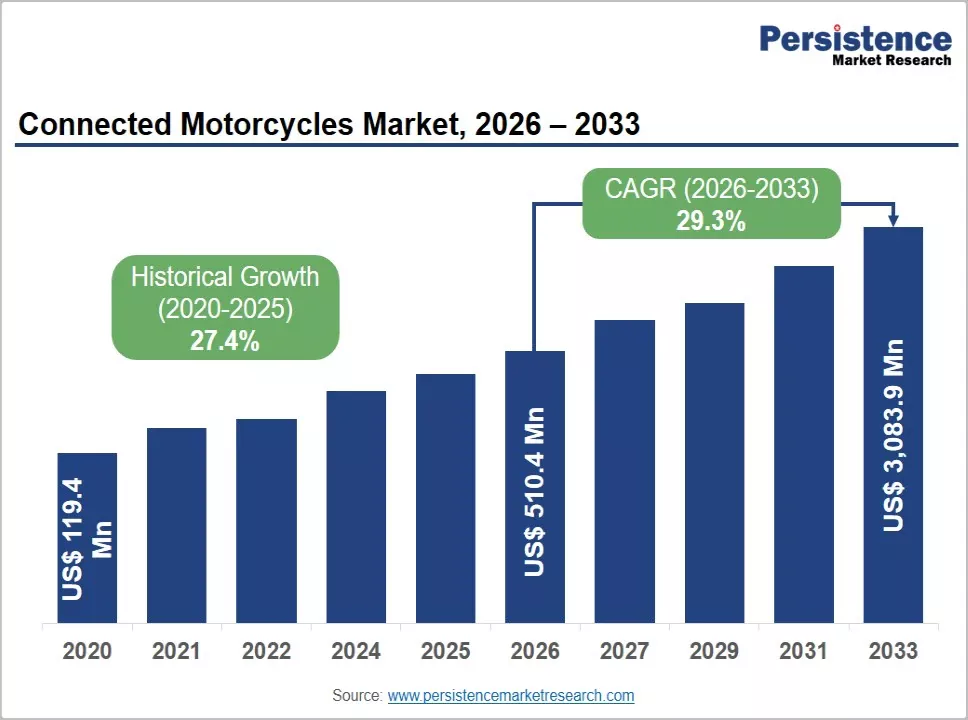
The global connected motorcycles market size is likely to be valued at US$ 510.4 million in 2026, and is estimated to reach US$ 3,083.9 million by 2033, growing at a CAGR of 29.3% during the forecast period 2026 - 2033.
Growth is underpinned by the growing focus on rider safety, the rapid integration of radar-based assistance and smartphone-linked digital dashboards, and emerging vehicle-to-everything (V2X) standards that include powered two-wheelers across developed and emerging economies.
The market registered a strong historical CAGR of 27.4% during 2020 - 2025 from a small base, reflecting early-stage technology adoption, limited standardization, and the high cost of sensors for compact vehicles. However, the forecast period anticipates exceptional acceleration as motorcycle manufacturers commercialize connected safety systems across model ranges, cybersecurity regulations extend to two-wheelers, and V2X infrastructure expands.
Key Industry Highlights
- Dominant Communication Type: Vehicle-to-vehicle (V2V) is set to command around 57% of the revenue share in 2026, while vehicle-to-infrastructure (V2I) is likely to grow the fastest at about 31.4% CAGR through 2033, as roadside units and intersection services become widely available.
- Leading Network Type: DSRC is expected to lead with 54% in 2026, supported by established low-latency deployments, while cellular networks are likely to be the fastest-growing at about 33.4% CAGR during 2026 - 2033, reflecting the global shift toward cellular V2X.
- Dominant Connectivity Type: Tethered connectivity is anticipated to lead with an estimated 44% share in 2026, while embedded systems are slated to represent the fastest-growing connectivity segment at 34.6% CAGR from 2026 to 2033.
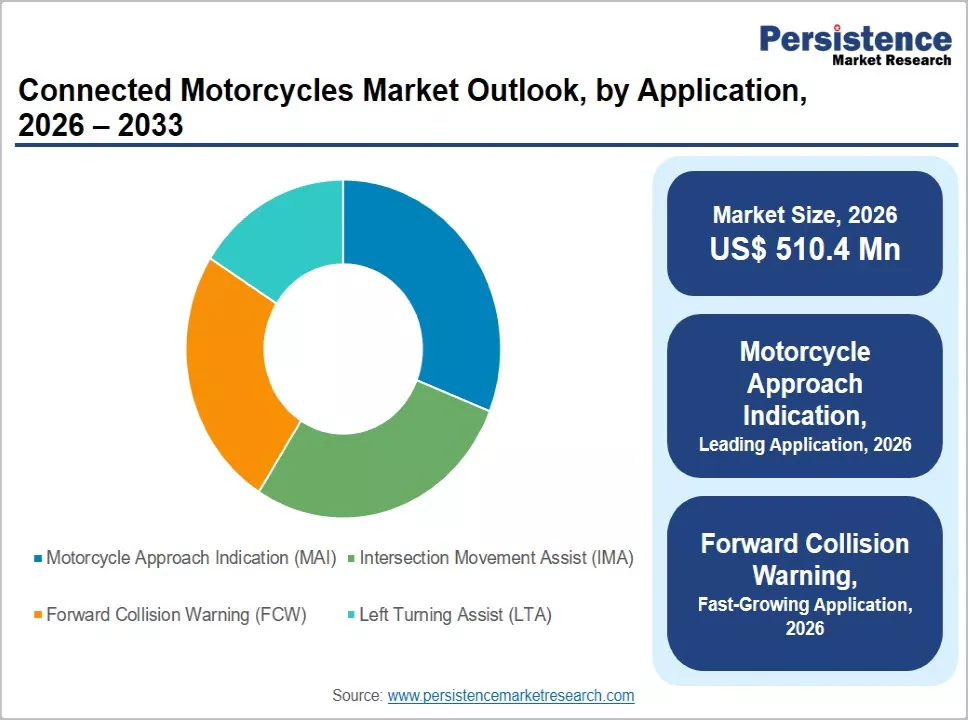
- Leading Application: Forward collision warning is poised to hold about 34% share in 2026, while motorcycle approach indication is projected to be the fastest-growing application at 32.8% CAGR through 2033.
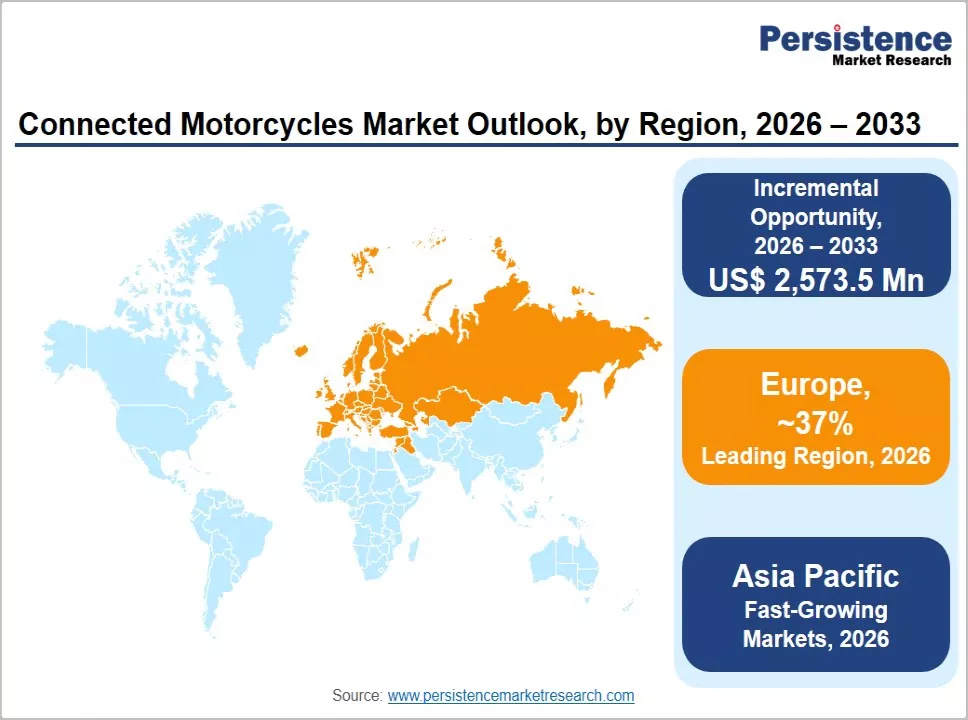
- Regional Leadership: Europe is poised to dominate with an estimated 37% share in 2026, while Asia Pacific is expected to register the fastest growth at 33.5% CAGR through 2033, led by large two-wheeler volumes in India and China.
- Competitive Environment: Competitive dynamics include radar and gateway innovations by tier-one suppliers, manufacturer consortia on V2X standards, and growing cybersecurity partnerships.
DRO Analysis
Drivers: Rider Safety Imperatives and Radar-Based Assistance as Primary Growth Catalyst
Rider safety is the leading force driving the connected motorcycles market growth, as motorcyclists remain among the most vulnerable road users and manufacturers face rising pressure to reduce accidents. Radar-based advanced rider assistance systems have moved from premium touring models to broader ranges, with adaptive cruise control, blind-spot detection, and forward collision warning now offered by several leading brands.
These sensors create the data foundation for connected safety, and manufacturers are increasingly combining them with cloud services, telematics, and V2X communication. Government road safety programs and insurers are also encouraging the adoption of technologies that reduce collisions at intersections and during lane changes, strengthening the business case for connected platforms. Growing consumer interest in navigation, ride data, and remote vehicle monitoring is also encouraging manufacturers to offer connectivity as a core feature.
V2X Standardization and Group Ride Connectivity
The Connected Motorcycle Consortium, whose members include BMW Motorrad, Honda, KTM, Yamaha, Suzuki, and Triumph, has worked on motorcycle-specific V2X specifications to ensure that two-wheelers can exchange warnings with cars and infrastructure. Demonstrations by Ducati and Audi using cellular V2X chipsets have shown how cars, motorcycles, and roadside units can communicate directly. Cloud-based communication for group rides, which helps riders maintain safe spacing and share hazard information, is another emerging use case that increases demand for connected hardware and software through 2033.
Restraints: Cost, Space Constraints, and Cybersecurity Vulnerabilities
The cost and complexity of integrating connectivity into compact vehicles remain significant challenges for the connected motorcycles market. Motorcycles have limited space, weight allowances, and power budgets, and sensors, antennas, and control units must withstand vibration, heat, moisture, and exposure to the elements. Radar and V2X modules add noticeable cost to vehicles that are often highly price-sensitive, particularly in emerging markets where entry-level commuter motorcycles dominate. The fragmentation of technology choices, including DSRC and cellular standards, also complicates development for global model platforms.
Cybersecurity and Infrastructure Gaps
As motorcycles gain Bluetooth, Wi-Fi, smartphone integration, and cloud links, these connections create new entry points for cyberattacks that could affect critical electronics. Cybersecurity requirements under UN Regulation No. 155 are scheduled to apply to newly developed two-wheelers from December 2027 and to all new registrations from June 2029, adding development and validation costs. In addition, V2X benefits depend on the penetration of compatible cars and roadside units, which remains limited in many regions. Until a critical mass of connected vehicles and infrastructure is reached, the safety value proposition of V2X for riders will remain partially realized.
Opportunities: Emerging Market Two-Wheelers, Electric Motorcycles, and Connected Services
Emerging economies in Asia, Latin America, and Africa account for the largest share of global motorcycle sales, creating a vast base for connected features as incomes rise and smartphone use grows. Manufacturers are introducing digital clusters with smartphone connectivity, navigation, and ride data, which serve as an entry point for more advanced embedded telematics. Electric motorcycles and scooters are especially suited to connected platforms because they already include battery management systems, software-defined controls, and over-the-air update capability.
Subscription Services and Fleet Applications
Connected motorcycles open pathways for subscription-based services such as theft tracking, crash notification, remote diagnostics, and ride analytics. Delivery, rental, and shared mobility fleets are adopting telematics to monitor safety, utilization, and maintenance, which creates demand for embedded devices. Insurance providers are also exploring usage-based products linked to riding behavior, and these new revenue streams are expected to expand the addressable market for hardware, software, and data service providers through 2033. Partnerships between manufacturers, telecom operators, and insurers are likely to speed up the commercialization of these services.
Category-wise Insights
Communication Type Analysis
Why Does Vehicle-to-Vehicle Communication Lead the Connected Motorcycles Market?
Vehicle-to-vehicle communication is the leading communication type segment, expected to hold about 57% of the connected motorcycles market revenue share in 2026. V2V allows motorcycles and cars to exchange position, speed, and heading information directly, enabling warnings in situations where a rider is hidden from a driver's view. It does not depend on roadside installations, which makes it easier to deploy. Safety concepts such as motorcycle approach indication and forward collision warning rely mainly on V2V messaging, supporting steady demand from manufacturers. Compact antennas and low-power chipsets are also making it increasingly practical to fit V2V modules within the limited space of a motorcycle.
Vehicle-to-infrastructure communication is likely to grow the fastest through 2033. V2I enables motorcycles to receive signal phase and timing, road works, speed limit, and hazard information from roadside units and traffic management centers. As public agencies expand C-V2X roadside deployments and integrate them into tolling and traffic management, the infrastructure layer will give riders more complete situational awareness, particularly at intersections.
Network Type Analysis
Why Does DSRC Lead Network Types in Connected Motorcycles?
DSRC leads the network type segment, projected to capture about 54% of the revenue share in 2026. It offers very low latency and direct device-to-device communication without reliance on cellular coverage, which suits time-critical collision avoidance. Early pilot projects, demonstration fleets, and European cooperative intelligent transport deployments have relied on DSRC-based technology, giving it an installed base advantage in the current period. Ongoing interoperability testing between car and motorcycle systems is expected to determine how quickly the market converges on common standards.
Cellular networks represent the fastest-growing network type segment, anticipated to achieve about 33.4% CAGR during the 2026 - 2033 period. Cellular V2X combines direct communication with network-based services over 4G and 5G, offering a clearer evolution path to higher bandwidth and lower latency. Spectrum allocation decisions in the U.S. and large-scale rollouts in China are shifting momentum toward cellular, and motorcycle makers that cooperate with chipset suppliers on C-V2X are well positioned to benefit.
Connectivity Type Analysis
Why Does Tethered Connectivity Lead Connectivity Types?
Tethered connectivity is poised to lead with an estimated 44% share in 2026, favored for its low cost and ability to use the rider's smartphone as a gateway for navigation, music, calls, and data. Many manufacturers offer color TFT dashboards that link to smartphone apps, which allows connected features without adding a dedicated modem. This approach is particularly suited to mid-range and entry-level motorcycles where cost is a major consideration. Smartphone apps also allow manufacturers to deliver ride tracking, maintenance reminders, and community features that deepen customer engagement.
Embedded connectivity is the fastest-growing type in connected motorcycles, expected to showcase an approximate 34.6% CAGR through 2033. Built-in modems support theft tracking, emergency calling, remote diagnostics, and over-the-air updates without depending on a smartphone. They also enable continuous data for insurers and fleet managers. Integrated systems, which combine onboard connectivity with the vehicle control architecture, remain important for premium touring and adventure models.
Application Analysis
Why Does Forward Collision Warning Lead Connected Motorcycle Applications?
Forward collision warning is the leading application segment, expected to hold about 34% of the market revenue share in 2026. The function uses front radar and, increasingly, V2X messages to alert riders of slowing or stopped traffic ahead. Rear-end and frontal collisions are among the most common serious accident types, and the function is available across several recent models, which supports high adoption.
Motorcycle approach indication is likely to be the fastest-growing application, expected to rise at about 32.8% CAGR through 2033, as car manufacturers integrate warnings for approaching motorcycles. Intersection movement assist and left turning assist address some of the most dangerous scenarios, where drivers fail to notice oncoming motorcycles at junctions. Wider vehicle penetration of V2X is expected to enable these applications at scale. Insurers and road safety agencies are expected to promote these functions as awareness of junction-related collisions grows.
Regional Insights
North America Connected Motorcycles Market Trends and Insights
North America is anticipated to account for an estimated 26% of the global connected motorcycles market in 2026. The region's industry is likely to benefit from strong demand for premium touring and cruiser motorcycles with advanced electronics, active federal support for V2X deployment, and the transition of the 5.9 GHz spectrum to cellular V2X. Growing roadside deployments, such as the first U.S. "Day One Deployment District" in Atlanta in September 2025, are expected to create practical test environments for vulnerable road user protection.
Manufacturers and technology suppliers are also expected to intensify competition through 2033. Aftermarket connectivity kits and dealer-installed telematics are also expected to support adoption among existing riders.
U.S. Connected Motorcycles Market Size
The U.S. is estimated to account for approximately 84% of the North America connected motorcycles market in 2026. Market growth is likely to be supported by a large base of touring and adventure riders, established telematics services from leading brands, and federal and state connected vehicle initiatives. Increasing cooperation between motorcycle manufacturers, chipset suppliers, and road authorities on vulnerable road user safety is anticipated to promote adoption of V2X-enabled systems, while rising insurance interest in telematics data is likely to support further investments through 2033.
Canada Connected Motorcycles Market Size
Canada is projected to represent approximately 16% of the North America connected motorcycles market in 2026. Market expansion is expected to be driven by a strong touring culture, demand for navigation and remote diagnostics on long-distance routes, and the introduction of electric motorcycles. Winter storage and seasonal riding patterns are likely to boost interest in theft tracking and remote monitoring features. Growth in 5G coverage along major corridors is anticipated to support wider adoption through 2033. Growing electrification of urban scooters and commuter bikes is also expected to open a new customer base for embedded connectivity.
Europe Connected Motorcycles Market Trends and Insights
Europe is estimated to account for approximately 37% of the global connected motorcycles market in 2026. The region's market is expected to benefit from the presence of leading motorcycle brands and tier-one suppliers, the activities of the Connected Motorcycle Consortium, and stringent safety and cybersecurity regulations. Series production of second-generation radar-based rider assistance systems, including systems introduced by KTM for model year 2026, is likely to widen the pool of connected-ready motorcycles.
European suppliers are likely to retain competitive advantages through engineering expertise and close cooperation with automakers on V2X. Insurance incentives for rider assistance features and a growing emphasis on group riding events are also encouraging adoption.
Germany Connected Motorcycles Market Size
Germany is anticipated to account for approximately 27% of the Europe connected motorcycles market in 2026. Demand is expected to be supported by the presence of BMW Motorrad, Bosch, and Continental, a large community of touring riders, and strong engineering capabilities in sensors and electronic control units. Cybersecurity regulation timelines for two-wheelers are likely to encourage investment in secure gateways and software update capabilities. Growth in group ride features and premium connected services is projected to support market expansion through 2033.
Why Is Asia Pacific Expected to Be the Fastest-Growing Region in the Connected Motorcycles Market?
Asia Pacific is projected to account for approximately 29% of the global connected motorcycles market in 2026, and is anticipated to register the fastest growth, expanding at an estimated CAGR of 33.5% through 2033. Market expansion is likely to be driven by the world's largest motorcycle volumes, rising incomes, smartphone-based digital clusters, and growing electric two-wheeler sales. India and China are expected to remain the primary demand centers, while Japan, Southeast Asia, and Taiwan are also likely to expand adoption of connected safety and telematics features. Government road safety programs and the rapid growth of ride-hailing and delivery two-wheeler fleets are also expected to raise demand for telematics.
China Connected Motorcycles Market Size
China is estimated to represent approximately 41% of the Asia Pacific connected motorcycles market in 2026. The country's market is expected to benefit from large-scale domestic production, expanding export-oriented brands of mid-size motorcycles, and rapid rollout of 5G and C-V2X infrastructure. Manufacturers are likely to add smartphone connectivity, navigation, and remote services as competitive differentiators, while electric scooter platforms are projected to adopt embedded connectivity to support app-based services through 2033. Rapid expansion of cross-border motorcycle exports is also encouraging Chinese brands to meet European connectivity and safety expectations.
India Connected Motorcycles Market Size
India is projected to account for approximately 27% of the Asia Pacific connected motorcycles market in 2026. The market is expected to witness strong expansion, supported by the world's largest two-wheeler market, growing demand for premium and mid-size motorcycles, and the rapid expansion of electric two-wheelers. Domestic manufacturers are increasingly offering smartphone-linked clusters with navigation, ride statistics, and remote features. Rising participation by Indian companies in global motorcycle brands is also likely to strengthen local engineering of connected platforms. Growth in connected two-wheeler fleets for food delivery and logistics is also expected to add volume for embedded telematics devices.
Competitive Landscape
The global connected motorcycles market structure is moderately fragmented, with the top vendors, including Robert Bosch, Continental, BMW Motorrad, and Yamaha Motor, controlling around 35% of the revenue share. These established players have been leveraging their extensive safety engineering expertise, relationships with motorcycle manufacturers, and integrated hardware-software platforms. They are also known to invest heavily in R&D to maintain technological leadership in radar, V2X communication, and cybersecurity.
Regional and niche competitors such as Honda, KTM, Ducati, Kawasaki, Harley-Davidson, and TVS Motor are focusing on model-specific connected features, premium touring packages, and digital ecosystems. Barriers such as safety validation and complex integration in compact vehicles limit new entrants, but chipset and software specialists are participating through V2X modules and cloud platforms. Market consolidation is expected to increase gradually as global suppliers acquire sensor and software capabilities, while manufacturers continue collaborating via consortia and technology partnerships.
Chipset suppliers and navigation software providers are also deepening collaboration with manufacturers to supply connectivity modules and map data.
Key Market Developments
- In November 2026, Bosch introduced the Central Gateway cybersecurity system for motorcycles in three configurations, designed to isolate safety-critical electronics from external connections such as Bluetooth, Wi-Fi, and cloud services, and highlighted radar-based rider assistance and TFT Connect on the latest Triumph Tiger 1200.
- In December 2025, Bosch said its second-generation radar-based rider assistance systems had entered series production at KTM for model year 2026 and outlined cloud-based communication solutions to make group rides safer.
- In September 2025, Atlanta became home to the first "Day One Deployment District" for cellular V2X technology in the U.S., creating a reference roadside deployment for connected-vehicle safety applications.
Companies Covered in Connected Motorcycles Market
- Robert Bosch GmbH
- Continental AG
- BMW Motorrad
- Honda Motor Co., Ltd.
- Yamaha Motor Co., Ltd.
- KTM AG
- Kawasaki Heavy Industries, Ltd.
- Ducati Motor Holding S.p.A.
- Harley-Davidson, Inc.
- TVS Motor Company Limited
Frequently Asked Questions
The global connected motorcycles market is valued at US$ 510.4 million in 2026 and is projected to reach US$ 3,083.9 million by 2033, expanding at a CAGR of 29.3% during 2026 - 2033.
Growing focus on rider safety, rapid adoption of radar-based assistance and smartphone-linked digital dashboards, and emerging V2X standards that include powered two-wheelers are driving the market. Expanding V2X infrastructure and cybersecurity regulation for two-wheelers are further supporting demand across developed and emerging economies.
V2V leads communication types with about 57% share, DSRC leads network types with about 54%, tethered connectivity leads connectivity types with about 44%, and forward collision warning leads applications with an estimated 34% in 2026. V2I, cellular networks, embedded systems, and motorcycle approach indication are the fastest-growing segments, at about 31.4%, 33.4%, 34.6%, and 32.8% CAGR respectively.
Europe dominates the market with an estimated 37% share in 2026, supported by leading motorcycle brands, tier-one suppliers, and strict safety and cybersecurity regulations. Asia Pacific is projected to be the fastest-growing region at a 33.5% CAGR through 2033.
Rising two-wheeler demand in emerging economies, electric motorcycles, subscription-based connected services, and fleet and insurance telematics are key market opportunities. Growing smartphone penetration and rising incomes in emerging economies are also expected to open new demand pockets.
The market is moderately fragmented, with Robert Bosch, Continental, BMW Motorrad, and Yamaha Motor controlling around 35% of the revenue share.


