




- Automotive
- Connected Trucks Market
Connected Trucks Market Size, Share, and Growth Forecast 2026–2033
Connected Trucks Market by Communication Type (Vehicle to Vehicle, Vehicle to Cloud, Vehicle to Infrastructure), Vehicle Type (Light Commercial Vehicle, Heavy Commercial Vehicle), and Regional Analysis, 2026–2033

Connected Trucks Market Size and Trend Analysis
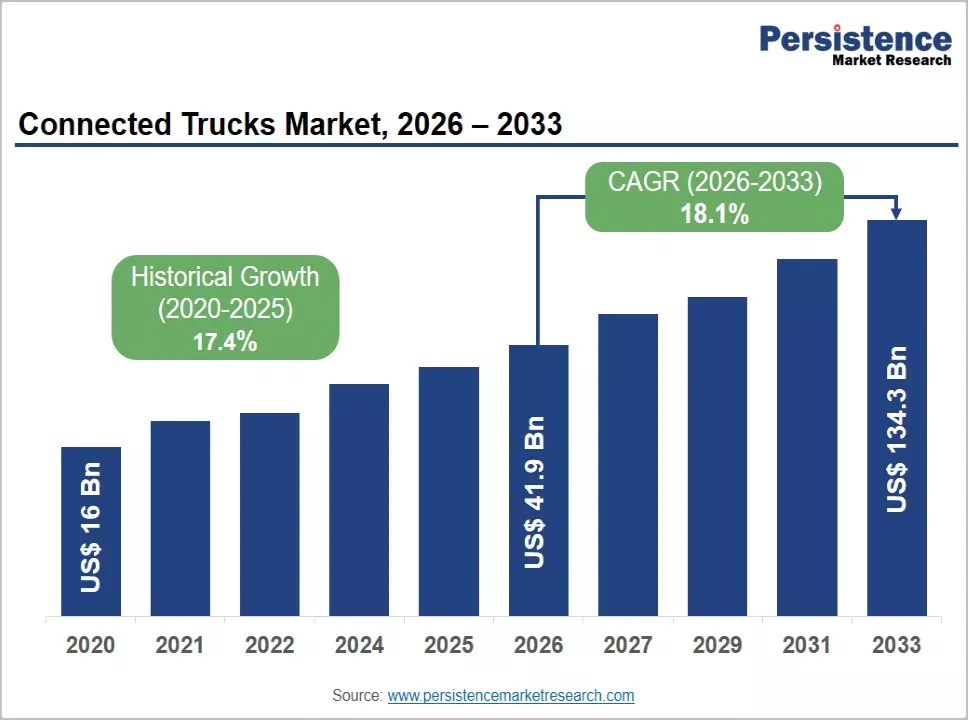
The global connected trucks market size is likely to be valued at US$ 41.9 billion in 2026 and is projected to reach US$ 134.3 billion by 2033, growing at a CAGR of 18.1% during the forecast period between 2026 and 2033. Connected trucks are no longer only tracked by a fleet telematics box. They are becoming data-rich vehicles that report engine health, location, driver behavior, trailer status, and energy use in real time, and that receive software updates without a visit to the workshop.
The forecast period is defined by factory-fitted connectivity from truck makers, open data platforms that let fleets use the software of their choice, over-the-air updates, and the first high-speed links between tractors and trailers. Truck makers, component suppliers, fleet operators, telematics providers, and insurers should read this as a data-led category in which uptime, safety, and operating cost determine competitive position.
Key Industry Highlights
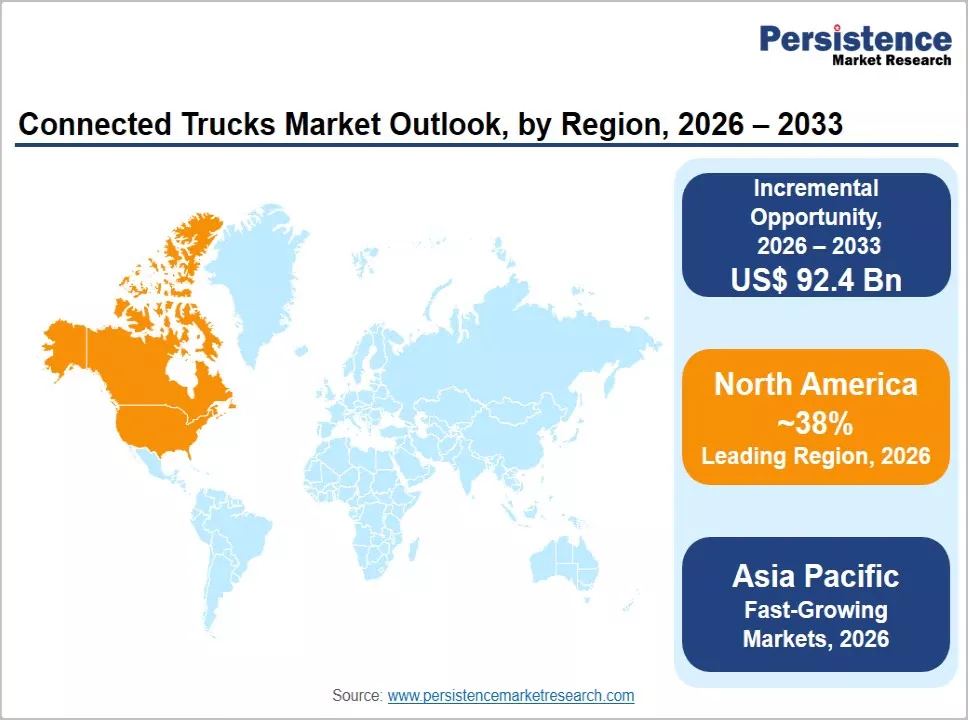
- Dominant Region and Fastest-growing Region: North America holds 38% of the market revenue in 2026, supported by electronic logging rules, large long-haul fleets, and factory-fitted connectivity from Daimler Truck North America and Volvo, while Asia Pacific is projected to be the fastest-growing region at an estimated 20.6% CAGR through 2033, driven by China and India.
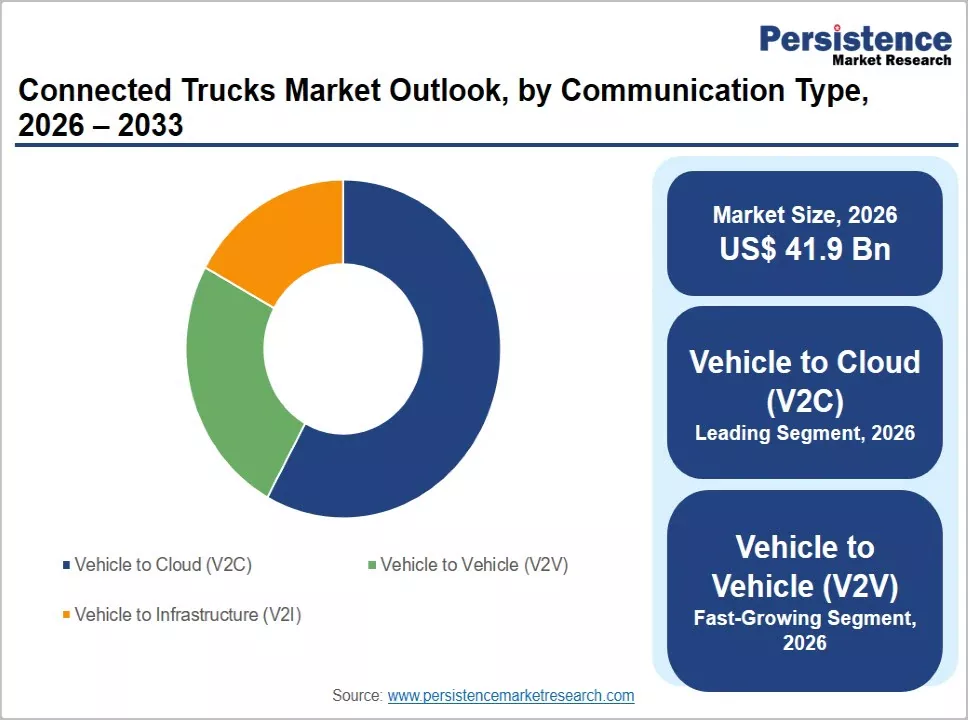
- Leading Communication Type: Vehicle to Cloud accounts for about 58% of 2026 revenue, as telematics, remote diagnostics, fleet management, and over-the-air updates all depend on links between the truck and cloud platforms. Daimler Truck has connected more than 1 million trucks and buses to its global digital platform.
- Leading Vehicle Type: Heavy commercial vehicles account for around 68% of revenue, reflecting the high value of uptime and fuel savings on long-haul and vocational trucks, and the greater content of connected hardware and software per vehicle.
- Fastest-growing Segments and Emerging Opportunity: Vehicle to Vehicle communication and light commercial vehicles are the fastest-growing segments. ZF presented a new high-speed truck-trailer link at IAA Transportation 2026, and Volvo Trucks North America said in June 2026 that its system can send as many as 10,000 over-the-air updates a day.
DRO Analysis
Driver- Fleet Cost Pressure, Regulatory Mandates, and Factory-Fitted Connectivity
Fleets face high fuel, labor, and maintenance costs, and connected data gives them a direct way to reduce downtime and improve safety. Truck makers now fit connectivity at the factory, so fleets can activate services without adding hardware: Geotab and Daimler Truck North America expanded their integration so that Freightliner trucks with Cummins powertrains can be connected over the air.
Freightliner's 2027 Cascadia, announced in May 2026, offers a Digital Dash that can run Platform Science's Virtual Vehicle, linking drivers, dispatchers, and apps. Rules such as electronic logging devices in the U.S. and second-generation smart tachographs in Europe also make connected hardware standard.
Restraint- Cybersecurity Risk, Data Ownership Disputes, and Trailer Connectivity Gaps
Every connected truck is a potential entry point for cyberattacks, and industry bodies such as the National Motor Freight Traffic Association have warned about freight fraud and telematics supply chain risks. Disputes between truck makers, fleets, and independent telematics firms over data ownership and access slow adoption of open platforms.
Connectivity between the tractor and the trailer is still limited, because traditional connectors carry little data, and ZF has called for open and unbiased standards to avoid what it describes as connector chaos. Many small fleets also lack the budget and skills to turn data into savings.
Opportunity- Over-the-Air Updates, Truck-Trailer Data Links, and Electric Truck Services
Over-the-air software updates, high-speed truck-trailer links, and services for electric trucks represent the largest white space. Volvo Trucks North America is developing a new tractor-trailer connector for high-speed wireless data and plans to promote it as a connectivity standard in the U.S. and Canada, while ZF's Truck Trailer Link targets the same gap.
Electric trucks need range prediction, battery monitoring, pre-conditioning, and charge management, and Daimler Truck offers these services for its battery-powered trucks, creating new recurring revenue for software and data providers. Insurers, lenders, and used-truck buyers are also starting to value verified vehicle data, which widens the set of customers for connected truck platforms.
Category-wise Analysis
Why Does Vehicle to Cloud Communication Command a Majority of the Global Connected Trucks Market?
Vehicle to cloud communication is projected to lead the segment, holding nearly 58% of market share in 2026. Every major telematics, diagnostics, and fleet service depends on a link between the truck and a cloud platform, and truck makers have built large platforms for this purpose. Daimler Truck operates a global connectivity platform across all its brands, Volvo manages updates across its connected fleet, and suppliers such as Robert Bosch, Continental, ZF, and Denso provide telematics units, sensors, and software. Cloud links also support predictive maintenance, driver coaching, and fuel and route optimization, which show a clear return for fleets.
Vehicle to vehicle communication is likely to be the fastest-growing segment, driven by interest in platooning, cooperative collision warnings, and safer driving in convoys. Vehicle to Infrastructure communication supports tolling, smart corridors, port and depot access, and traffic signal information, and is growing as cities and highway operators invest in roadside equipment. These direct links depend on cellular and short-range standards, and their adoption depends on regulation and infrastructure rollout. Pilot projects on motorway corridors and in logistics hubs are testing whether shared data can cut fuel use and reduce rear-end collisions, which would strengthen the business case for fitting the technology as standard.
Vehicle Type Insights
What Is Driving Heavy Commercial Vehicle Dominance Across the Connected Trucks Industry?
Heavy commercial vehicles are expected to lead the segment, holding about 68% of market share in 2026. Long-haul tractors and vocational trucks run high mileage and carry costly loads, so even small gains in fuel economy, uptime, and safety create large savings. Daimler Truck North America reports a large base of connected Cascadia trucks, while Volvo, Daimler AG, and component suppliers such as Continental, ZF, and Magna International add more connected hardware to each tractor, from telematics gateways to advanced braking and driver assistance systems.
Light commercial vehicles are likely to be the fastest-growing vehicle type, supported by e-commerce delivery, urban logistics, and growing electric van fleets. Delivery operators need real-time routing, driver monitoring, and charging management for large numbers of small vehicles. Telematics specialists such as Sierra Wireless supply connectivity modules, and Denso, HARMAN, and Delphi Technologies provide in-vehicle platforms that scale across vans and light trucks.
Regional Insights
North America Connected Trucks Market Trends and Insights
North America is forecast to dominate the regional market, account for around 38% of the connected trucks market in 2026. The region has large long-haul fleets, electronic logging rules, and the world's most developed ecosystem of telematics providers, and truck makers have moved to open their platforms to third parties. Daimler Truck North America, Volvo Trucks North America, and component suppliers lead the shift to factory-fitted connectivity, while driver shortages and rising insurance costs make fleet data more valuable.
U.S. Connected Trucks Market Size
The U.S. is estimated to hold around 90% of the North America regional market in 2026. Large freight fleets, strong telematics software providers, and rapid adoption of over-the-air updates support demand, and Daimler Truck North America signed a strategic partnership with Class8 in February 2026 to expand its digital freight services.
Canada Connected Trucks Market Size
Canada is expected to account for over 10% of the North America regional market in 2026. Cross-border trucking, resource transport, and long distances make remote diagnostics and tracking valuable, and Volvo has said it plans to promote its truck-trailer connector as a standard in both the U.S. and Canada.
Europe Connected Trucks Market Trends and Insights
Europe is anticipated to command around 17% of market share in 2026. The region has strict safety and emissions rules, second-generation smart tachographs, and a strong supplier base led by Robert Bosch, Continental, and ZF. Truck makers such as Daimler Truck and Volvo are using connected data for electric truck services, while road charging and cross-border logistics increase the value of real-time tracking.
Germany Connected Trucks Market Size
Germany is projected to account for around 27% of the Europe regional market in 2026. Daimler Truck, ZF, Robert Bosch, and Continental are based here, and ZF used IAA Transportation 2026 in Hanover to present its software and connectivity roadmap for software-defined commercial vehicles.
U.K. Connected Trucks Market Size
The U.K. is estimated to account for nearly 13% of the Europe regional market in 2026. A large road freight sector, strong telematics and insurance providers, and pressure to cut emissions support connected truck adoption, and fleets are using data to prepare for electric trucks. Operators are comparing routes, duty cycles, and depot charging needs before they order battery-powered vehicles, which makes accurate historical data a valuable input.
Which Region Will Drive the Fastest Connected Trucks Growth Through 2033?
Asia Pacific is forecast to be the fastest-growing region, capture around 24% of market share in 2026 and expanding at an estimated 20.6% CAGR through 2033. Fast-growing freight volumes, government pressure for safer roads, and the push by truck makers to fit connectivity as standard in new vehicles are driving growth, while falling module costs bring telematics within reach of smaller fleets.
China Connected Trucks Market Size
China is projected to hold 41% of the Asia Pacific regional market in 2026. The country has the world's largest truck market and strong domestic platforms for fleet management, and regulators encourage remote monitoring of heavy vehicles to improve road safety.
India Connected Trucks Market Size
India is expected to account for around 18% of the Asia Pacific regional market in 2026. Growth in road freight, expressway construction, and truck makers' telematics services is spreading connectivity beyond large fleets to owner-drivers, and cellular coverage along main corridors supports adoption. Domestic truck makers and global suppliers are also adding driver-behaviour and fuel-monitoring tools aimed at cost-conscious operators, which helps smaller fleets justify the monthly subscription.
Competitive Landscape
The global connected trucks market is moderately consolidated, with truck makers, tier-one suppliers, and telematics specialists all competing for fleet data. Robert Bosch, Continental, ZF, Daimler AG, and Volvo AB lead on hardware, software, and platform scale, while Denso, HARMAN, Magna International, Delphi Technologies, and Sierra Wireless compete through modules, in-vehicle systems, and connectivity components.
Competitive intensity is rising as truck makers open their platforms to independent telematics firms, suppliers add over-the-air update management, and new standards for truck-trailer links emerge. Winning requires secure and reliable connectivity, open data access, strong partnerships with fleets and software providers, and clear savings in uptime, fuel, and safety. Partnerships are common, as shown by Daimler Truck North America's work with Geotab, Platform Science, and Class8, which lets fleets choose the software they prefer while keeping the truck maker's factory-fitted hardware.
Key Industry Developments
- In June 2026, Volvo Trucks North America expanded automatic over-the-air software updates across its connected fleet, adding unattended update capability. The automated system reviews the connected fleet each day and can dispatch as many as 10,000 software updates daily. Volvo also said it is developing a new tractor-trailer connector for high-speed wireless data and plans to promote it as a connectivity standard in the U.S. and Canada.
- In September 2026, ZF presented a set of software and connectivity technologies for software-defined commercial vehicles at IAA Transportation 2026 in Hanover, covering over-the-air update management, condition monitoring, and a new high-speed Truck Trailer Link. The company has called for open, unbiased standards for tractor-trailer connectivity to prevent incompatible connectors across the industry.
Companies Covered in Connected Trucks Market
- Continental AG
- Daimler AG
- Delphi Technologies
- Denso Corporation
- HARMAN International
- Magna International Inc.
- Robert Bosch GmbH
- Sierra Wireless, Inc.
- Volvo AB
- ZF Friedrichshafen AG
Frequently Asked Questions
The global connected trucks market is valued at US$ 41.9 billion in 2026.
Fleet cost pressure, regulatory mandates, factory-fitted connectivity, and over-the-air updates, partly offset by cybersecurity risk, data ownership disputes, and limited truck-trailer connectivity.
Vehicle to Cloud communication holds around 58% of the market. Telematics, remote diagnostics, fleet management, and software updates all depend on links between the truck and cloud platforms.
North America lead with a 38% share in 2026, driven by electronic logging rules, large long-haul fleets, and factory-fitted connectivity from truck makers, while Asia Pacific is the fastest-growing region.
The largest opportunities are over-the-air software updates, high-speed truck-trailer data links, services for electric trucks, and fleet data analytics.
Leading companies include Robert Bosch, Continental, ZF Friedrichshafen, Daimler AG, and Volvo AB. The market is moderately consolidated, with truck makers, suppliers, and telematics specialists competing on platform scale, open data access, and fleet savings.


