




- Telecommunications
- Cellular Capacity and Coverage Optimization Market
Cellular Capacity and Coverage Optimization Market Size, Share, and Growth Forecast, 2026 - 2033
Cellular Capacity and Coverage Optimization Market by Deployment Technology (Deployment of Small Cells, Carrier Wi‑Fi, Others), Optimization Software (Self‑Organizing Networks (SON), Others), Application, Deployment Model and Regional Analysis for 2026 - 2033

Cellular Capacity and Coverage Optimization Market Size and Trends Analysis
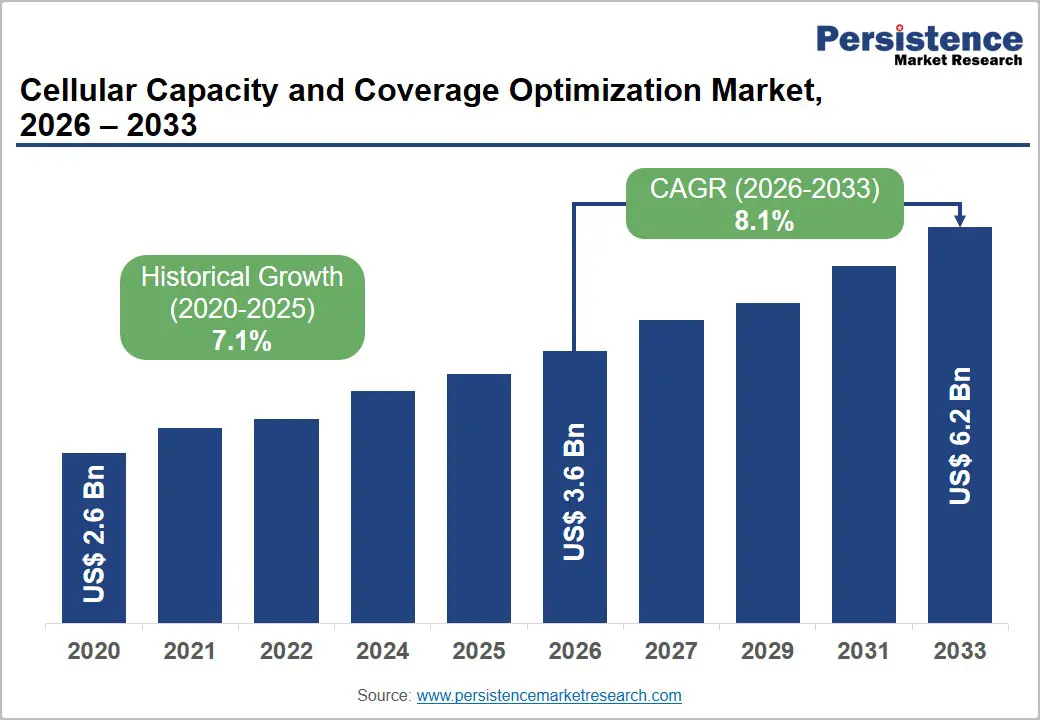
The global cellular capacity and coverage optimization market size is likely to be valued at US$3.6 billion in 2026 and is expected to reach US$6.2 billion by 2033, growing at a CAGR of 8.1% during the forecast period from 2026 to 2033, driven by rapid 5G deployment, increasing mobile data consumption, rising investments in network densification, and growing adoption of AI-powered radio access network (RAN) optimization technologies.
Expanding enterprise connectivity requirements and continued investments in indoor wireless infrastructure are also strengthening long-term market demand.
Key Industry Highlights:
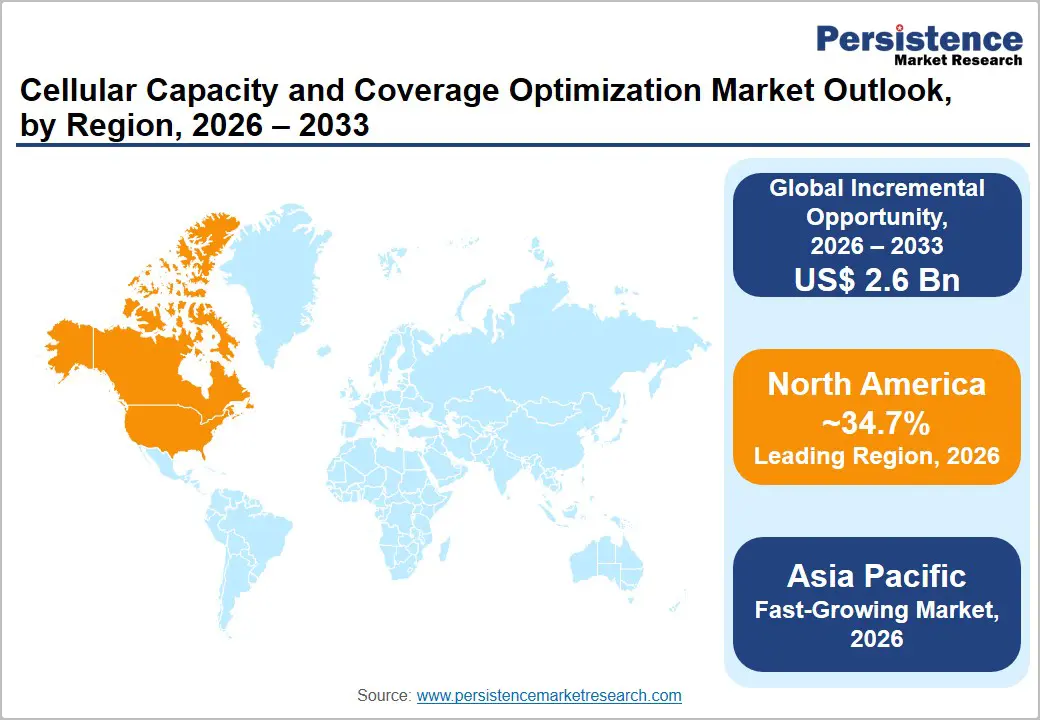
- Leading Region: North America is projected to account for 34.7% of the market share in 2026, supported by advanced 5G deployment, AI-enabled network optimization, and strong investments in private wireless networks and cloud-native RAN infrastructure.
- Fastest-growing Region: Asia Pacific is expected to register the highest CAGR through 2033, driven by rapid 5G rollouts, expanding mobile broadband adoption, and government-backed digital infrastructure initiatives across China, India, Japan, and South Korea.
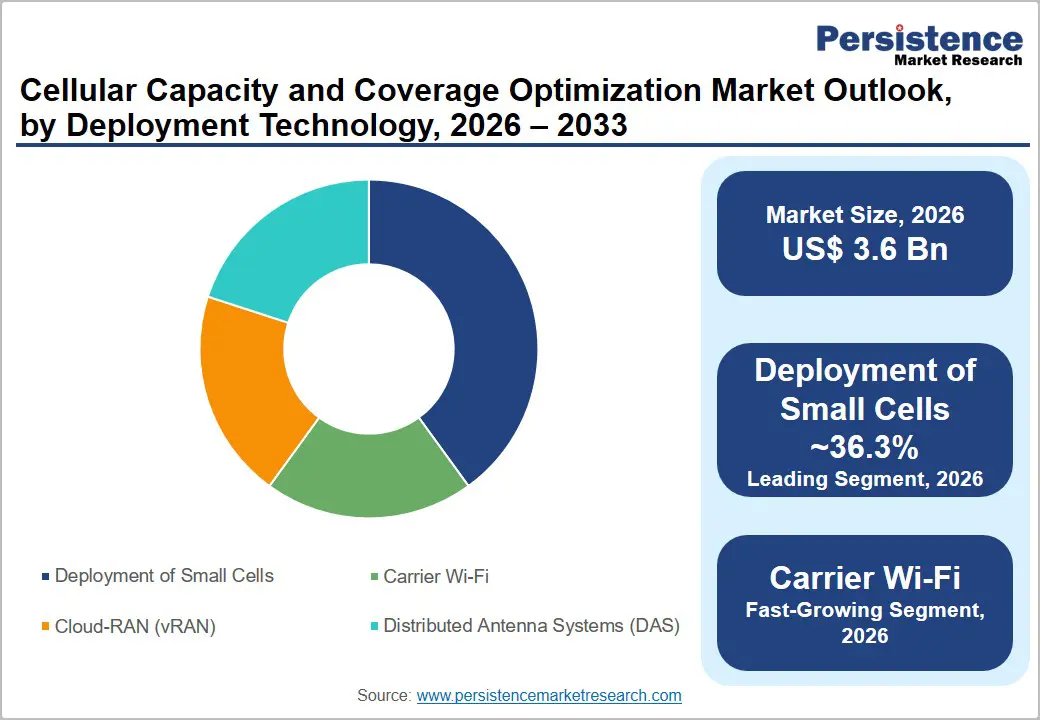
- Dominant Deployment Technology: The deployment of small cells technology is anticipated to account for 36.3% of the market share in 2026, supported by increasing deployments across urban centers, enterprise campuses, airports, stadiums, and smart city projects.
- Leading Optimization Software: Self-Organizing Networks (SON) are anticipated to hold 28.6% of the market share in 2026, driven by automated network configuration, traffic balancing, and performance optimization capabilities for increasingly complex 5G networks.
DRO Analysis
Drivers - Growing 5G Data Traffic and Increasing Indoor Capacity Requirements
One of the primary drivers of the cellular capacity and coverage optimization market is the rapid growth of mobile data traffic generated by 5G networks. Global telecommunications authorities report that 5G population coverage continues to expand steadily, while mobile data traffic is increasingly shifting toward 5G infrastructure. Although wider coverage has improved network accessibility, indoor environments, including commercial buildings, transportation hubs, hospitals, universities, and entertainment venues, continue to experience capacity constraints due to higher user density and increasing bandwidth demand. As a result, operators are deploying small cells, distributed antenna systems, carrier Wi-Fi, and intelligent traffic management solutions to improve network quality, enhance customer experience, and maximize spectrum utilization without significantly increasing macro network infrastructure.
Increasing Adoption of AI-Based Network Automation and 5G Standalone Architecture
The migration toward 5G Standalone (SA) networks is accelerating the adoption of artificial intelligence and machine learning across network operations. Modern optimization platforms continuously analyze network traffic, predict congestion, automate parameter tuning, and improve radio resource allocation with minimal human intervention. Cloud-native RAN architectures combined with AI-driven optimization enable operators to reduce operational expenses while improving service reliability and network performance. Industry collaborations involving telecommunications equipment manufacturers, semiconductor companies, and software providers are accelerating the commercialization of AI-RAN technologies, enabling operators to transition from reactive network management toward predictive and fully automated optimization models.
Restraint - Complex Network Deployment and High Infrastructure Costs
Despite strong market fundamentals, deployment complexity remains one of the largest challenges for network optimization projects. Small-cell networks and distributed antenna systems require substantially more installation sites than conventional macro base stations, increasing capital investment and project execution complexity. Network deployments also face regulatory approval processes, municipal permitting requirements, site acquisition challenges, and infrastructure sharing limitations. In many regions, inconsistent spectrum policies and zoning regulations extend deployment timelines and increase implementation costs. These structural barriers may delay network expansion projects, particularly in developing markets and densely populated urban environments where infrastructure deployment is more challenging.
Opportunities - Expansion of Carrier Wi-Fi and Converged Wireless Networks
Carrier Wi-Fi is evolving beyond traditional traffic offloading to become an integral component of converged wireless infrastructure. Enterprises, transportation facilities, educational campuses, healthcare institutions, and smart cities increasingly require seamless mobility between Wi-Fi and cellular networks. Technologies such as OpenRoaming, Passpoint authentication, and intelligent traffic steering enable users to transition between networks without service interruption while improving overall network efficiency. Growing investments in Wi-Fi 7, private wireless networks, and integrated connectivity platforms are creating new opportunities for vendors specializing in authentication systems, network analytics, policy management, and intelligent traffic optimization.
Expanding Rural Connectivity and Government Broadband Initiatives
Government-supported broadband expansion programs continue to create significant opportunities for cellular coverage optimization vendors. Many emerging economies are investing heavily in nationwide 5G deployment, rural broadband infrastructure, and digital transformation initiatives aimed at reducing connectivity gaps. Expansion of mobile broadband coverage into underserved regions requires optimized radio planning, intelligent spectrum utilization, and cost-efficient infrastructure deployment. These initiatives are expected to increase demand for cloud-based optimization software, managed network services, AI-driven network planning, and automated performance management solutions across both public and private telecommunications networks.
Category-wise Analysis
Deployment Technology Insights
Deployment of small cells is anticipated to account for 36.3% of the market share in 2026, making it the leading deployment technology. The ability of small cells to enhance capacity and indoor coverage in high-density areas drives widespread adoption across shopping malls, airports, stadiums, enterprise campuses, and smart cities. For example, operators such as Verizon, AT&T, and China Mobile continue expanding small-cell networks to support urban 5G densification and improve network performance.
Carrier Wi-Fi is expected to witness the fastest growth as operators increasingly offload mobile traffic to improve capacity and reduce operating costs. Technologies such as OpenRoaming and Passpoint enable seamless connectivity across airports, hotels, universities, and commercial campuses. Companies, including Boingo Wireless and Cisco, are expanding carrier-grade Wi-Fi deployments to complement 5G networks and deliver enhanced indoor coverage.
Optimization Software Insights
Self-Organizing Networks (SON) are anticipated to capture 28.6% of the market share in 2026, maintaining their leadership in optimization software. SON automates network configuration, traffic balancing, and parameter optimization, reducing operational costs while improving service quality. Major telecom vendors such as Ericsson, Nokia, and Huawei have integrated SON capabilities into their network management platforms to support increasingly complex 5G deployments.
AI/ML-driven RAN optimization is projected to be the fastest-growing software segment as operators adopt predictive analytics and automated network intelligence for 5G Standalone networks. AI-powered platforms enable dynamic spectrum allocation, congestion prediction, and closed-loop optimization. Recent AI-RAN initiatives from Samsung, Nokia, NVIDIA, and Ericsson demonstrate the industry's shift toward intelligent, software-driven network optimization.
Regional Insights
North America Cellular Capacity and Coverage Optimization Market Trends
North America is expected to account for 34.7% of the market share in 2026, driven by global adoption of advanced 5G infrastructure, AI-enabled network optimization, private wireless networks, and cloud-native RAN technologies. Continued investments in small-cell deployments, intelligent network management, and spectrum modernization support sustained market growth across commercial, industrial, and public-sector applications.
U.S. Cellular Capacity and Coverage Optimization Market Trends
The U.S. is expected to dominate the North America market, accounting for approximately 80% of the regional market in 2026, due to aggressive 5G expansion by major telecom operators, widespread deployment of small cells, and increasing adoption of AI-driven network optimization. Investments in private 5G networks, Open RAN, and cloud-native infrastructure continue to strengthen network capacity across enterprise campuses, manufacturing facilities, airports, and smart cities.
Canada Cellular Capacity and Coverage Optimization Market Trends
Canada is expected to account for nearly 12% of the market share in 2026, supported by continued investments in 5G infrastructure, including spectrum modernization and rural broadband expansion initiatives. Telecommunications providers are increasingly deploying cloud-based network management solutions, carrier Wi-Fi, and small-cell networks to enhance coverage in urban areas while extending reliable connectivity to underserved and remote communities.
Europe Cellular Capacity and Coverage Optimization Market Trends
Europe continues to experience steady market growth, supported by expanding 5G coverage, infrastructure-sharing initiatives, and harmonized spectrum management policies. Ongoing investments in Open RAN, nationwide broadband expansion, and digital infrastructure modernization continue to increase demand for advanced network optimization solutions. However, varying regulatory frameworks and infrastructure replacement costs continue to influence deployment timelines across the region.
Germany Cellular Capacity and Coverage Optimization Market Trends
Germany remains Europe's largest market, supported by strong investments in industrial 5G, smart manufacturing, and enterprise private wireless networks. The country's focus on Industry 4.0 continues to drive demand for advanced network optimization technologies.
U.K. Cellular Capacity and Coverage Optimization Market Trends
The U.K. is accelerating nationwide 5G deployment through network modernization and increased investments in Open RAN technologies. Public and private sector initiatives aimed at improving digital connectivity continue to support long-term market growth.
France Cellular Capacity and Coverage Optimization Market Trends
France continues expanding nationwide broadband and 5G infrastructure through government-backed digital transformation programs. Growing enterprise adoption of AI-enabled network management and cloud-native telecommunications infrastructure is supporting market expansion.
Spain Cellular Capacity and Coverage Optimization Market Trends
Spain has emerged as one of Europe's faster-moving 5G markets, supported by strong fiber infrastructure, expanding standalone 5G deployments, and proactive spectrum management. Continued investments in smart city projects and digital connectivity are driving additional demand for network optimization solutions.
Asia Pacific Cellular Capacity and Coverage Optimization Market Trends
Asia Pacific is expected to remain the fastest-growing regional market throughout the forecast period. Rapid urbanization, increasing smartphone adoption, expanding enterprise digitalization, and significant investments in telecommunications infrastructure continue to accelerate demand for advanced cellular capacity and coverage optimization technologies. The region's strong manufacturing ecosystem and government-supported broadband expansion further strengthen long-term market growth.
China Cellular Capacity and Coverage Optimization Market Trends
China leads the regional market with extensive 5G infrastructure deployment, large-scale base station construction, and significant investments in AI-enabled telecommunications networks. Continuous expansion of industrial digitalization and smart city initiatives is driving sustained demand for network optimization solutions.
Japan Cellular Capacity and Coverage Optimization Market Trends
Japan continues investing in advanced wireless technologies, Open RAN, and AI-powered network automation to support high-capacity enterprise and consumer applications. The country's mature telecommunications sector remains an early adopter of next-generation network optimization technologies.
India Cellular Capacity and Coverage Optimization Market Trends
India is one of the fastest-growing markets due to rapid nationwide 5G deployment, increasing mobile broadband penetration, and government-led digital connectivity initiatives. Growing investments in rural broadband, enterprise digitalization, and telecommunications infrastructure are creating significant opportunities for optimization solution providers.
South Korea Cellular Capacity and Coverage Optimization Market Trends
South Korea maintains one of the world's most advanced 5G ecosystems, supported by early adoption of standalone 5G, AI-driven network management, and high mobile data consumption. Operators continue investing in network densification and intelligent automation technologies.
Singapore Cellular Capacity and Coverage Optimization Market Trends
Singapore continues strengthening its digital infrastructure through nationwide standalone 5G deployment, smart nation initiatives, and enterprise digital transformation. Demand for cloud-native network optimization and private wireless infrastructure continues to grow.
Competitive Landscape
The global cellular capacity and coverage optimization market remains moderately fragmented, with competition driven by established telecommunications infrastructure providers, software developers, cloud networking companies, and managed service providers. Market participants continue expanding their portfolios through AI-enabled network optimization, cloud-native RAN solutions, intelligent automation platforms, and managed network services. Competitive differentiation increasingly depends on software capabilities, automation technologies, service integration, and long-term operator partnerships rather than hardware offerings alone.
Leading companies continue focusing on AI-driven automation, cloud-native network architecture, managed services, software-defined optimization, and strategic partnerships to strengthen competitive positioning. Investment priorities include intelligent network analytics, Open RAN, private wireless infrastructure, and integrated wireless connectivity solutions that improve operational efficiency while supporting long-term digital transformation initiatives.
Key Industry Developments:
- In March 2025, Nokia announced the launch of its AI-RAN Center and expanded collaborations with NVIDIA, KDDI, SoftBank, and T-Mobile US to accelerate the development of AI-powered Radio Access Networks (AI-RAN), enabling advanced network optimization, improved resource utilization, and new platform-as-a-service opportunities for mobile operators.
In March 2025, Samsung Electronics announced a strategic collaboration with NVIDIA to advance AI-RAN technologies, aiming to integrate AI computing into virtualized RAN infrastructure and enhance automation, network efficiency, and intelligent capacity optimization for next-generation mobile networks.
Companies Covered in Cellular Capacity and Coverage Optimization Market
- Ericsson
- Nokia Corporation
- Huawei Technologies Co., Ltd.
- Samsung Networks
- ZTE Corporation
- Cisco Systems, Inc.
- Mavenir Systems, Inc.
- Airspan Networks Holdings LLC
- Fujitsu Limited
- NEC Corporation
- CommScope Holding Company, Inc.
- Corning Incorporated
- Boingo Wireless, Inc.
- Celona, Inc.
- Parallel Wireless, Inc.
- Ciena Corporation
Frequently Asked Questions
The global cellular capacity and coverage optimization market is projected to be valued at US$3.6 billion in 2026.
The cellular capacity and coverage optimization market is expected to reach US$6.2 billion by the end of 2033.
Key trends include increasing deployment of small cells, adoption of AI/ML-driven RAN optimization, expansion of carrier Wi-Fi, growth of cloud-native and Open RAN architectures, and rising investments in private 5G networks and intelligent network automation.
Deployment of small cells is the leading deployment technology segment and is anticipated to account for 36.3% of the market share in 2026, supported by growing urban network densification and increasing indoor connectivity requirements.
The cellular capacity and coverage optimization market is projected to grow at a CAGR of 8.1% from 2026 to 2033.
Major companies with strong technology portfolios include Ericsson, Nokia, Cisco Systems, Samsung Networks, and Huawei Technologies.


