




- Beverages
- Beer Pasteurization Equipment Market
Beer Pasteurization Equipment Market Size, Share, and Growth Forecast 2026 - 2033
Beer Pasteurization Equipment Market by Equipment Type (Plate & Frame Heat Exchangers, Tubular Heat Exchangers, Scraped Surface Heat Exchangers, Immersion Pasteurizers, Chamber Pasteurizers, Flow-through Pasteurizers, Tunnel Pasteurizers), Technology, Automation Level, Capacity, End-user, and Regional Analysis, 2026 - 2033

Beer Pasteurization Equipment Market Size and Trend Analysis
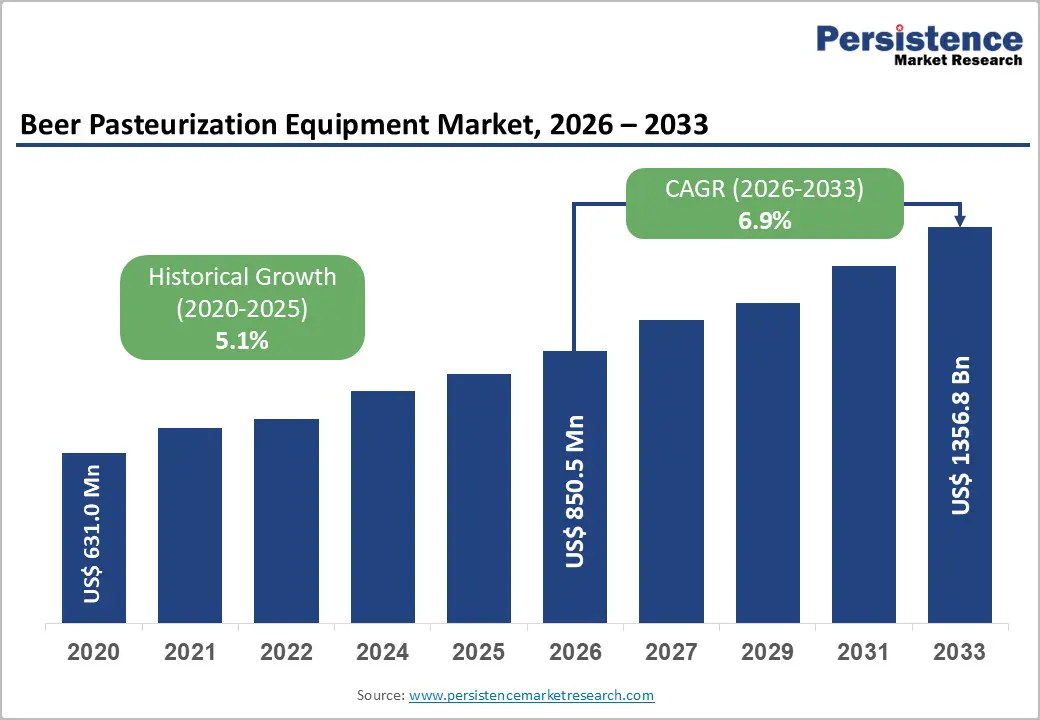
The global beer pasteurization equipment market size is likely to be valued at US$ 850.5 million in 2026 and is expected to reach US$ 1,356.8 million by 2033, growing at a CAGR of 6.9% during the forecast period from 2026 to 2033.
The growth of this market is primarily propelled by the rapid global expansion of the craft brewing industry and the escalating demand for shelf-stable, microbiologically safe beer.
Key Highlights:
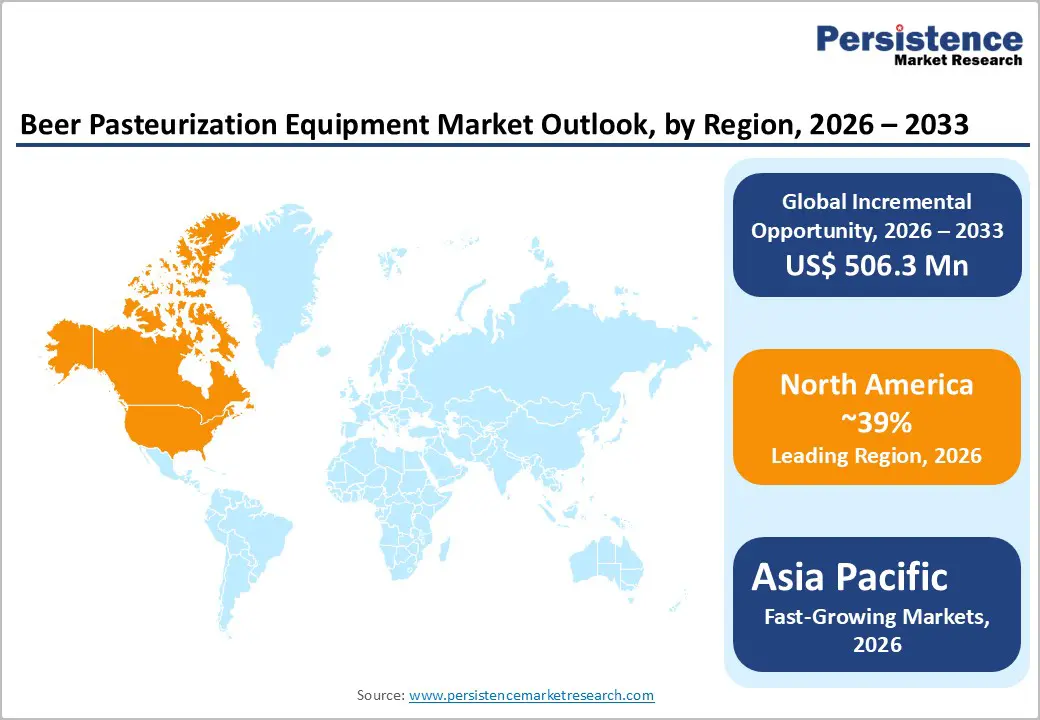
- Leading Region: North America dominates the beer pasteurization equipment market with 39% share, driven by over 9,500 active U.S. craft breweries, robust FDA food safety regulations, and continuous brewery modernization investments across commercial and craft segments.
- Fastest Growing Region: Asia Pacific is the fastest-growing market with rising CAGR of 8.2%, led by China's massive beer production volumes, India's rapidly rising beer consumption, and accelerating ASEAN brewery establishment, supported by favorable manufacturing cost structures.
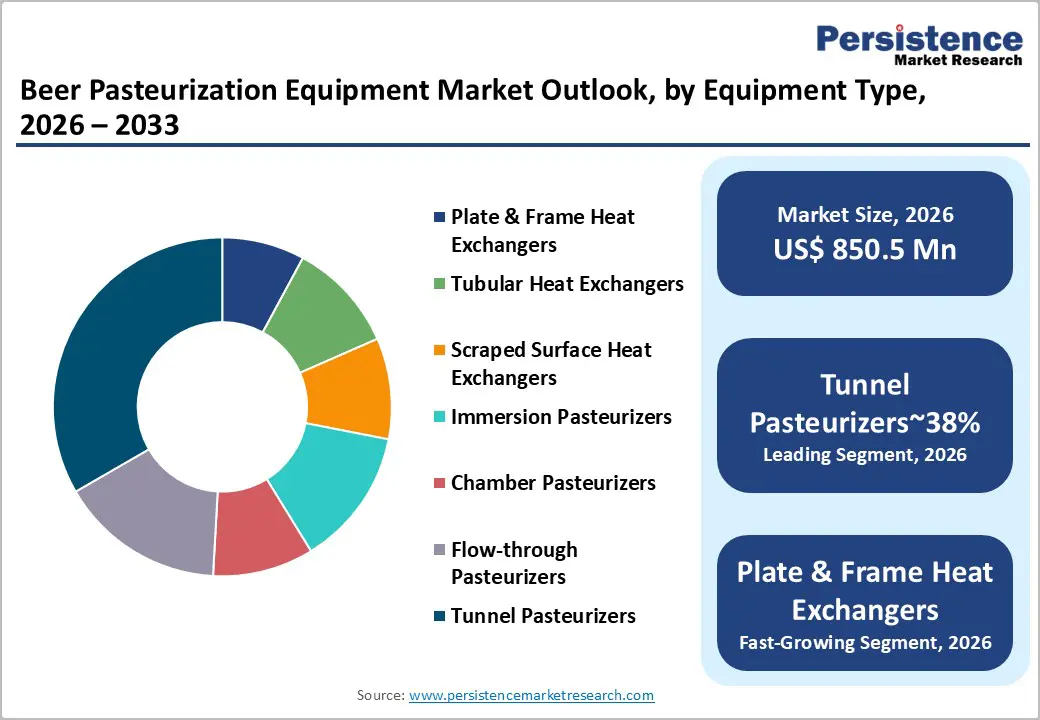
- Dominant Segment: Tunnel Pasteurizers lead the Equipment Type category with approximately 38% share, favored by large and regional breweries for their high throughput, consistent PU delivery, and established compatibility with industrial bottling and canning lines.
- Fastest Growing Segment: Flash Pasteurization (HTST) is the fastest-growing technology segment, driven by rising craft brewery adoption seeking to preserve premium flavor profiles while achieving regulatory food safety compliance across the U.S. and European markets.
- Key Market Opportunity: Integration of Industry 4.0 technologies, IoT sensors, AI-based quality control, and predictive maintenance into pasteurization systems presents a high-value opportunity, enabling up to 25% energy savings and substantial operational efficiency gains for breweries globally.
Market Dynamics
Drivers - Rapid Expansion of the Global Craft Brewing Industry
The global surge in craft beer consumption represents a foundational driver of demand for beer pasteurization equipment. The Brewers Association reported that craft beer retail sales in the U.S. reached approximately US$ 28.4 Billion in 2022, underscoring the segment's economic weight. In Europe, the European Beer Consumers Union (EBCU) highlights that microbreweries grew by over 30% between 2015 and 2022 across the continent.
As emerging craft brewers scale their production and distribution, the need to extend shelf life without compromising flavor drives investments in both tunnel and flash pasteurization systems. This trend is particularly pronounced in the Asia Pacific region, where a rise in middle-income group population and evolving taste preferences are spurring new brewery launches, catalyzing equipment procurement across all capacity tiers.
Tightening Food Safety and Quality Regulations Globally
Stringent food safety regulations imposed by authorities such as the U.S. Food and Drug Administration (FDA), the European Food Safety Authority (EFSA), and the Food Safety and Standards Authority of India (FSSAI) are compelling breweries worldwide to invest in certified pasteurization equipment. The FDA's Food Safety Modernization Act (FSMA) mandates hazard analysis and preventive controls for all food and beverage manufacturers.
Non-compliance can result in product recalls, operational shutdowns, and substantial financial penalties, incentivizing breweries, from microbreweries to large-scale industrial facilities, to prioritize certified, automated pasteurization solutions. This regulatory environment is expected to sustain consistent capital expenditure on advanced pasteurization equipment throughout the forecast period, particularly in markets undergoing rapid food safety framework modernization.
Restraints - High Capital Investment and Total Cost of Ownership
One of the primary barriers limiting market penetration, especially among small and mid-sized breweries, is the substantial upfront capital investment required to procure and install advanced pasteurization systems. Industrial-grade tunnel pasteurizers, for instance, can cost between US$ 200,000 and US$ 1 Million depending on capacity and automation features, according to equipment manufacturer references.
For microbreweries with limited capital reserves, this investment creates a significant financial bottleneck. Operating expenses, including energy consumption, pasteurization accounts for a considerable share of a brewery's total energy use, and ongoing maintenance further compounds the total cost of ownership, discouraging adoption among budget-constrained operators in developing economies.
Technical Complexity and Skilled Workforce Shortage
The operation and maintenance of advanced pasteurization equipment, particularly fully automated and digitally integrated systems, require technically skilled personnel. A persistent shortage of trained food process engineers and equipment technicians in several high-growth markets, including parts of Southeast Asia, Africa, and Latin America, limits effective deployment of sophisticated equipment.
The International Labour Organization (ILO) has acknowledged widening skills gaps in manufacturing sectors across emerging economies. This operational constraint can lead to suboptimal equipment performance, higher downtime, and increased maintenance costs, thus deterring investment in high-end systems and slowing overall market adoption in these regions.
Opportunities - Rising Adoption of Flash Pasteurization (HTST) Technology in Craft Breweries
Flash Pasteurization, also known as High-Temperature Short-Time (HTST) technology, is rapidly gaining traction as a preferred pasteurization method among craft and premium beer producers who prioritize flavor profile preservation. Unlike conventional tunnel pasteurization, HTST subjects beer to high temperatures for mere seconds, minimizing thermal degradation and preserving the aromatic compounds that define craft beer's unique characteristics.
The Institute of Food Technologists (IFT) has noted the growing industry interest in HTST for sensitive beverages. As the number of craft breweries worldwide continues to grow, with over 25,000 craft breweries estimated globally, equipment manufacturers developing compact, modular, energy-efficient HTST systems are well-positioned to capture a significant and fast-expanding share of the market, especially from premium and specialty beer producers targeting quality-conscious consumers.
Digitalization and Industry 4.0 Integration in Brewing Operations
The accelerating adoption of Industry 4.0 technologies, including IoT-enabled process monitoring, predictive maintenance algorithms, and AI-driven quality control, presents a substantial opportunity for beer pasteurization equipment manufacturers. Smart pasteurization systems equipped with real-time sensors and cloud-based data analytics can enhance process efficiency, reduce energy consumption by up to 25%, and minimize product waste.
The World Economic Forum (WEF) has identified food and beverage processing as a key sector for digital transformation. Companies such as Krones AG and GEA Group AG are already embedding digital twins and automated control systems into their pasteurization portfolios, signaling a broader market shift toward intelligent, connected brewing infrastructure that delivers both operational and sustainability benefits.
Category-wise Analysis
Equipment Type Insights
Among all equipment type segments, tunnel pasteurizers hold the leading market share, accounting for approximately 38% of the global beer pasteurization equipment market. Tunnel pasteurizers are widely adopted by large-scale and regional breweries owing to their ability to handle packaged beer (bottles and cans) at high throughput rates while delivering consistent Pasteurization Units (PUs) across the product. The technology is supported by established infrastructure compatibility, making upgrades and replacements straightforward for mature brewery facilities.
Leading manufacturers such as Krones AG and KHS GmbH offer advanced tunnel pasteurizer systems with precise temperature control and reduced water consumption, aligning with both operational efficiency and sustainability goals increasingly mandated by large brewing corporations and regulatory bodies globally.
Technology Insights
Tunnel Pasteurization technology remains the dominant segment within the technology category, commanding an estimated market share of approximately 62%. Its widespread dominance is attributable to its proven reliability for in-package pasteurization of bottled and canned beer, making it the preferred choice among large commercial breweries and regional brewing operations with established filling lines.
The process delivers a uniform thermal treatment essential for complying with FDA and EFSA food safety benchmarks. While Flash Pasteurization (HTST) is gaining ground, particularly among craft brewers, the tunnel method continues to dominate due to its higher operational familiarity, extensive supplier ecosystem, and compatibility with existing high-speed bottling and canning lines in large production facilities.
Automation Level Insights
The fully automatic segment leads the automation level category, representing approximately 55% of the market. This dominance is driven by large-scale and contract breweries that require high-throughput, consistently reliable, and minimally labor-dependent operations. Fully automated pasteurization systems integrate with supervisory control and data acquisition (SCADA) platforms and enterprise resource planning (ERP) systems, enabling end-to-end production monitoring and traceability.
According to the International Society of Automation (ISA), automated food processing solutions are experiencing growing demand as manufacturers seek to address labor shortages while improving process precision. The trend toward automation is further supported by declining costs of PLC-based control systems and expanded availability of integrated sensor technologies across global supply chains.
Capacity Insights
The high capacity segment commands the dominant position in the Capacity category, holding approximately 48% of the market share. This segment primarily serves large breweries and contract brewing facilities that operate at industrial scale with annual production volumes exceeding 100,000 hectoliters. The scale advantages, including lower per-unit pasteurization costs and compatibility with high-speed filling lines, make high-capacity equipment the preferred choice for commercial brewers.
Key global players such as Anheuser-Busch InBev and Heineken N.V. consistently invest in high-capacity pasteurization upgrades as part of broader brewery modernization programs. Rising global beer consumption, as tracked by the Kirin Beer University Report, further supports continued capital investment in high-capacity thermal processing infrastructure.
End-user Insights
Large Breweries represent the leading end-user segment, accounting for approximately 42% of the global beer pasteurization equipment market. These entities, defined as breweries producing above 750,000 barrels annually, operate highly integrated production environments requiring industrial-grade pasteurization solutions capable of continuous operation with minimal downtime.
According to the Brewers Association, large-scale commercial brewers continue to dominate global beer production volumes, with the top 10 brewing conglomerates collectively accounting for over 50% of global beer output. The segment's procurement cycles are characterized by large-ticket capital equipment investments, long-term supplier relationships, and standardized maintenance contracts, all of which underpin stable, recurring revenue streams for pasteurization equipment manufacturers with proven large-scale installation experience.
Regional Insights
North America Beer Pasteurization Equipment Trends
North America remains the leading regional market for beer pasteurization equipment, anchored by the United States' highly developed commercial brewing ecosystem. The U.S. is home to the world's highest concentration of craft breweries, with the Brewers Association reporting over 9,500 active craft breweries in 2023. Federal regulatory frameworks, including the FDA's Food Safety Modernization Act (FSMA) and mandatory Hazard Analysis and Critical Control Points (HACCP) compliance, drive consistent investment in certified, automated pasteurization infrastructure.
The region also serves as an innovation hub, with companies such as JBT Corporation and DME Brewing Solutions pioneering energy-efficient and compact pasteurization systems tailored to craft-scale operations. The growing popularity of canned craft beer, which witnessed a 200% increase in production since 2016 according to the Brewers Association, is simultaneously expanding demand for in-package tunnel pasteurizers and inline flash pasteurization systems, cementing North America's position as a high-value market.
Europe Beer Pasteurization Equipment Trends
Europe represents a mature yet innovation-driven market for beer pasteurization equipment, with Germany leading regional demand owing to its deep brewing heritage and a nationwide network of over 1,500 breweries as reported by the German Brewers' Association. The European Union's General Food Law and country-specific food safety directives harmonize quality standards across member states, compelling breweries to maintain and upgrade pasteurization systems to ensure compliance. The United Kingdom and Belgium are also prominent markets driven by premium ale and lager exports.
Sustainability considerations are significantly influencing procurement decisions in Europe. The European Green Deal and related carbon reduction targets are pushing brewery operators to prioritize energy-efficient pasteurization technologies. Manufacturers such as Alfa Laval AB and GEA Group AG have responded by developing heat recovery systems integrated into pasteurization units that reduce thermal energy consumption by up to 30%, positioning European companies at the forefront of sustainable brewing technology development.
Asia Pacific Beer Pasteurization Equipment Trends
Asia Pacific is the fastest-growing regional market, driven by rapidly expanding beer consumption in China, India, and the broader ASEAN region. According to the Kirin Beer University Report 2023, China remains the world's largest beer market by volume, producing over 35 million kiloliters annually, with industrial-scale breweries continually investing in modern thermal treatment infrastructure. India's beer market is growing at a significantly elevated pace, fueled by a young demographic population and rising urban disposable incomes, creating new demand for both commercial and craft pasteurization systems.
In Japan, established brewing majors such as Asahi and Kirin continue to invest in next-generation automation and IoT-integrated pasteurization equipment. The region also benefits from strong manufacturing advantages, with countries such as China and South Korea producing competitively priced pasteurization components, thereby supporting local equipment procurement and reducing capital barriers for emerging regional breweries. ASEAN markets such as Vietnam and Thailand are experiencing accelerated growth in brewery establishments, creating new and sustained demand for scalable pasteurization solutions.
Competitive Landscape
The global beer pasteurization equipment market exhibits a moderately consolidated structure, with a handful of established multinationals, including Krones AG, GEA Group AG, Alfa Laval AB, and KHS GmbH, collectively commanding a significant share of revenue. These players compete on the basis of technological differentiation, service network breadth, energy efficiency credentials, and digital integration capabilities. Market leaders are increasingly pursuing strategic partnerships, acquisitions of regional players, and R&D investments in modular and smart pasteurization platforms. A tier of specialized manufacturers, such as Sander Hansen A/S and Kasper Schultz A/S, maintains strong niche positioning through application-specific expertise and responsive after-sales service, creating a competitive dynamic that rewards both scale and specialization.
Key Developments:
- March 2025: Krones AG launched its updated Paststar pasteurizer series featuring AI-assisted PU control and integrated heat recovery modules, targeting large-scale and contract brewing facilities seeking to reduce energy costs while achieving precise microbiological stability across diverse beer formats.
- November 2024: GEA Group AG announced the expansion of its food processing technology center in Düsseldorf to accelerate development of next-generation compact flash pasteurization units, with a particular focus on craft brewery applications and emerging market deployments.
- July 2023: Alfa Laval AB signed a strategic supply agreement with a major Asia Pacific brewing consortium to deliver modular heat exchanger-based pasteurization systems, marking a significant expansion of its regional footprint and leveraging the surge in brewery establishments across Southeast Asia.
Beer Pasteurization Equipment Market Report - Key Insights & Scope
| Key Insights | Details |
|---|---|
| Historical Market Value (2020) | US$ 631.0Mn |
| Current Market Value (2026) | US$ 850.5 Mn |
| Projected Market Value (2033) | US$ 1,356.8 Mn |
| CAGR (2026 - 2033) | 6.9% |
| Leading Region | North America, 39% share |
| Dominant Equipment Type | Tunnel Pasteurizers, 38% share |
| Top-ranking End User | Large Breweries, 42% |
| Incremental Opportunity | US$ 506.3 Mn |
Companies Covered in Beer Pasteurization Equipment Market
- Krones AG
- GEA Group AG
- Alfa Laval AB
- SPX FLOW Inc.
- KHS GmbH
- Ziemann Holvrieka GmbH
- JBT Corporation
- SACMI Group
- Kasper Schultz A/S
- Sander Hansen A/S
- Unibrau A/S
- DME Brewing Solutions
- Micro Matic USA Inc.
- Co.Mac S.r.l.
- Czech Brewery System s.r.o.
- Paul Mueller Company
- Feldmeier Equipment Inc.
- Bucher Industries AG
Frequently Asked Questions
The global Beer Pasteurization Equipment Market is estimated to be valued at US$ 850.5 Million in 2026 and is projected to reach US$ 1,356.8 Million by 2033, expanding at a CAGR of 6.9% during the 2026 - 2033 forecast period. The historical market grew at a 5.1% CAGR from 2020 to 2025, reflecting sustained demand driven by brewing industry expansion and tightening food safety compliance requirements.
The two principal demand drivers are the rapid global expansion of the craft brewing industry, with over 9,500 craft breweries in the U.S. alone as of 2023, and the escalating enforcement of food safety regulations by bodies such as the FDA and EFSA. These factors collectively compel breweries at all scales to invest in reliable, compliant pasteurization infrastructure.
Tunnel Pasteurizers dominate the equipment type segment, holding approximately 38% of the market. Their dominance is underpinned by high throughput capability, compatibility with bottling and canning lines, and proven ability to deliver consistent Pasteurization Units (PUs), making them the preferred choice for large-scale commercial and regional brewing operations globally.
North America is the leading regional market, anchored by the United States' dense craft brewery landscape, robust FDA-driven food safety compliance requirements, and the strong innovation ecosystem nurtured by companies such as JBT Corporation and DME Brewing Solutions. The region's high level of brewery modernization activity ensures consistent capital equipment demand.
The most significant opportunity lies in the integration of Industry 4.0 technologies, including IoT-enabled monitoring, AI-driven quality control, and predictive maintenance, into pasteurization systems. Smart systems can reduce energy consumption by up to 25% and minimize product waste, delivering compelling ROI for breweries globally. The fast-growing Flash Pasteurization (HTST) segment also presents substantial opportunity among craft and premium beer producers.
Prominent companies operating in the global Beer Pasteurization Equipment Market include Krones AG, GEA Group AG, Alfa Laval AB, SPX FLOW Inc., KHS GmbH, Ziemann Holvrieka GmbH, JBT Corporation, SACMI Group, Kasper Schultz A/S, Sander Hansen A/S, and DME Brewing Solutions, among others. These players compete on technological innovation, energy efficiency, global service networks, and the ability to deliver scalable solutions across all brewery sizes.


