




- Industrial Goods & Service
- Automotive Drive Plate Market
Automotive Drive Plate Market Size, Share, and Growth Forecast, 2026 - 2033
Automotive Drive Plate Market by Product Design (Stock-Style Stamped Steel Drive Plates, One-Piece Billet Drive Plates, Others), Material (Carbon Steel & Alloy Steel, High-Strength & Micro-Alloyed Steel, Others), Vehicle, and Regional Analysis for 2026 - 2033

Automotive Drive Plate Market Size and Trends Analysis
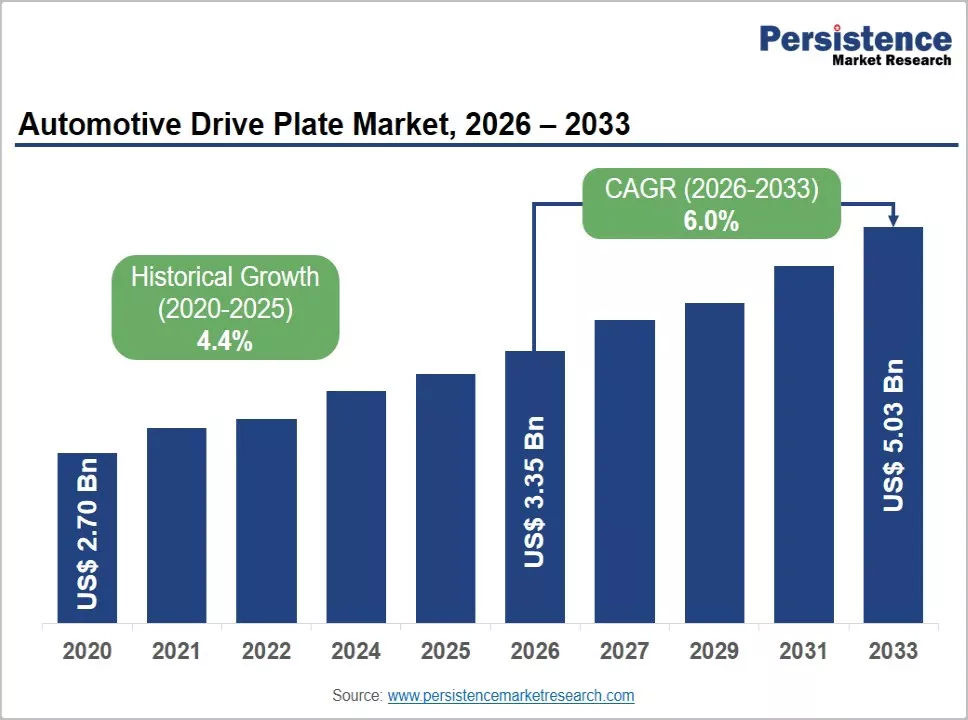
The global automotive drive plate market size is likely to be valued at US$3.35 billion in 2026 and is expected to reach US$5.03 billion by 2033, growing at a CAGR of 6.0% during the forecast period from 2026 to 2033, driven by continued production of internal-combustion and hybrid vehicles, increasing adoption of automatic transmissions, and replacement requirements across the installed vehicle fleet.
Vehicle electrification is changing the composition of powertrain demand rather than eliminating mechanical powertrain requirements immediately, while lightweighting and higher torque requirements are encouraging manufacturers to develop stronger and more precisely engineered drive plates. Asia Pacific is the leading and fastest-growing regional market, supported by its large vehicle-production base and expanding automotive manufacturing ecosystem.
Key Industry Highlights:
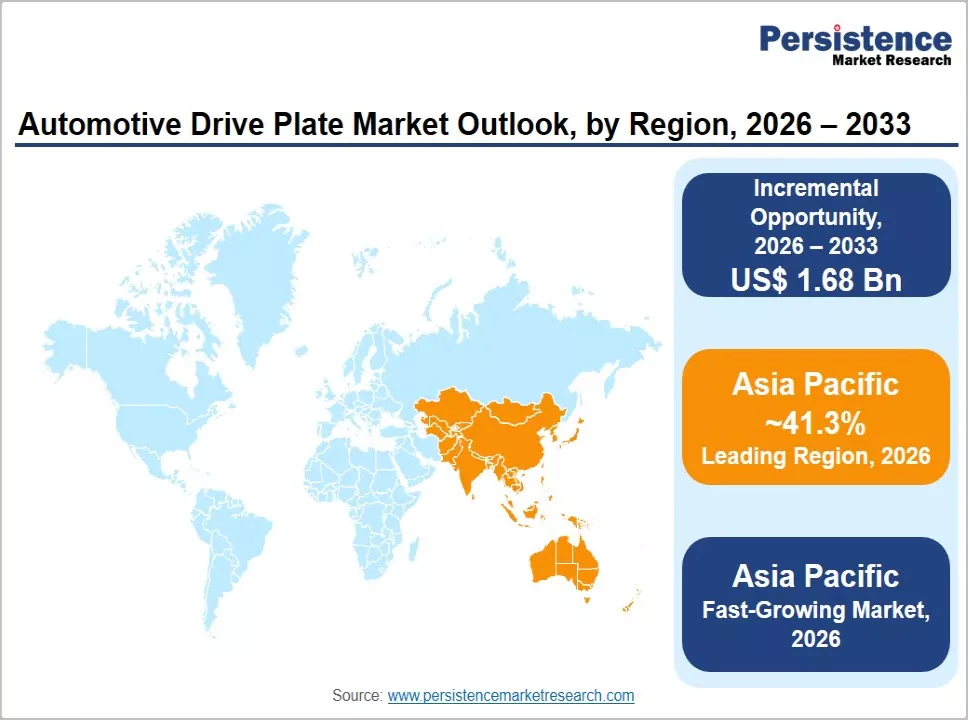
- Leading Region: Asia Pacific is projected to account for 41.3% of the market, supported by large-scale vehicle production, transmission localization, hybrid adoption, and a substantial installed vehicle base.
- Fastest-growing Region: Asia Pacific, driven by expanding automotive manufacturing in China and India, increasing automatic-transmission penetration, hybrid powertrain development, and investments in localized transmission production.
- Dominant Product Design: Stock-style stamped steel drive plates, anticipated to account for 53.2% of the market share, supported by their cost efficiency, high-volume manufacturability, established OEM validation, and widespread use in automatic-transmission vehicles.
- Leading Material: Carbon steel and alloy steel, anticipated to hold 62.1% of the market share due to their established stamping processes, fatigue performance, broad vehicle compatibility, and cost advantages.
DRO Analysis
Drivers - Increasing Automatic-Transmission and Hybrid Penetration Is Expanding Demand for High-Performance Drive Interfaces
The expanding use of automatic and electrified transmissions is strengthening demand for accurately engineered drive plates. The U.S. Department of Energy notes that hybrid-electric vehicles combine an internal-combustion engine with electric propulsion and a transmission capable of transferring mechanical power from the engine and/or electric motor to the wheels. In Europe, hybrid-electric vehicles represented 34.5% of new passenger-car registrations in 2025, while battery-electric vehicles accounted for 17.4%. ZF's 8HP evo development also demonstrates the industry's shift toward transmission systems compatible with multiple hybrid architectures, including 48V mild-hybrid and higher-voltage plug-in-hybrid configurations.
For drive-plate manufacturers, the expansion of hybrid and automatic-transmission platforms increases requirements for fatigue resistance, dimensional accuracy, rotational balance, and torque-handling capability. Frequent engine start-stop cycles can expose components to repeated mechanical and thermal loading. Suppliers that can combine lightweight construction with higher fatigue strength and application-specific damping can therefore address a wider range of next-generation transmission platforms.
Vehicle Production in Asia Pacific Is Sustaining a Large OEM Demand Base
Asia Pacific's manufacturing scale provides the automotive drive plate market with a broad original-equipment demand base. China produced 34.53 million vehicles in 2025, including 16.63 million new-energy vehicles, according to Chinese government data citing the China Association of Automobile Manufacturers. India recorded approximately 4.3 million passenger-vehicle sales in FY2024-25, while commercial-vehicle sales reached approximately 957,000 units. Japan produced 8.23 million motor vehicles in 2024, including 7.14 million passenger cars.
These production and sales volumes support recurring demand for stamped drive plates, torque-transfer components, and replacement products. Asia Pacific also benefits from extensive steel-processing capabilities, transmission manufacturing, component localization, and cost-efficient automotive supply chains. The region's large installed vehicle base creates an additional aftermarket opportunity as vehicles transition from warranty coverage into independent repair channels. For manufacturers, proximity to vehicle and transmission assembly facilities can reduce logistics costs and improve responsiveness to OEM production schedules.
Restraint - Electrification Reduces the Addressable Content of Conventional Drive Plates in Battery-Electric Vehicles
Battery-electric vehicles generally eliminate the engine-to-transmission mechanical interface used by conventional internal-combustion powertrains, constraining long-term demand for some traditional drive-plate configurations. The International Energy Agency reported that electric vehicles represented approximately 25% of new-car sales globally in 2025, compared with more than 20% in 2024. In China, electric cars exceeded half of annual car sales in 2025.
This trend creates structural exposure for suppliers concentrated in conventional automatic-transmission components. The impact is particularly significant in markets where battery-electric vehicles are rapidly replacing ICE vehicles. Suppliers can reduce this exposure by diversifying into hybrid-compatible components, damping systems, e-drive interfaces, clutches, and other drivetrain technologies. Higher engineering and validation costs also remain a constraint because suppliers may need to support several powertrain configurations on the same vehicle platform.
Opportunities - Hybrid Powertrains Create an Intermediate Growth Segment for Advanced Drive Plates
Hybridization creates an important opportunity because hybrid vehicles retain an internal-combustion engine while incorporating electric motors and increasingly sophisticated transmission architectures. The International Energy Agency reported strong growth in plug-in hybrid sales in China during 2024, with sales increasing approximately 80% and expanding faster than battery-electric vehicle sales. ZF's hybrid-compatible 8HP transmission architecture further demonstrates the increasing diversity of 48V, plug-in-hybrid, and full-hybrid configurations.
This development creates opportunities for drive-plate manufacturers to develop products capable of handling frequent engine restarts, rapid torque transitions, higher cyclic loading, and tighter NVH requirements. High-strength stamped plates, optimized damping structures, precision-balanced components, and hybrid-specific mounting configurations can increase product value. Suppliers with engineering relationships with transmission manufacturers can also participate earlier in platform development, increasing their potential to secure long-term OEM programs.
Lightweight Materials and Advanced Manufacturing Can Increase Component Value per Vehicle
Weight reduction remains an important vehicle-efficiency strategy. The U.S. Department of Energy indicates that a 10% reduction in vehicle weight can improve fuel economy by approximately 6-8%, depending on vehicle characteristics and operating conditions. Advanced high-strength steel provides manufacturers with an established route to reduce mass while retaining the manufacturing advantages associated with steel.
For drive plates, this trend supports investment in high-strength and micro-alloyed steels, optimized stamping geometries, selective thickness reduction, precision balancing, and application-specific material designs. The opportunity is particularly relevant to hybrid vehicles, where manufacturers must balance the additional mass of electric motors and batteries with overall vehicle efficiency. Premium aftermarket and racing applications provide additional opportunities for billet and specialty-material drive plates where durability, stiffness, and torque capacity can justify higher unit costs.
Category-wise Analysis
Product Design Insights
Stock-style stamped steel drive plates are anticipated to account for 53.2% of the market share in 2026, supported by their extensive use in high-volume passenger cars and light commercial vehicles. These conventional flexplates are typically formed from sheet steel with precisely positioned mounting holes, reinforcement features, and starter ring-gear teeth. Established stamping processes provide consistent dimensional control, high throughput, and cost efficiency for OEM programs. The design remains widely used across automatic-transmission applications because it combines low manufacturing costs, proven durability, established OEM validation, and compatibility with multiple transmission architectures.
Examples include stamped steel flexplates used in high-volume sedans, SUVs, pickups, and light commercial vehicles. Replacement demand also remains relevant as thermal cycling, vibration, flexing, and torque loading can contribute to fatigue over a vehicle's operating life. Manufacturers therefore prioritize runout control, ring-gear integrity, balance, material quality, and application-specific fit.
Lightweight and hybrid-optimized drive plates are anticipated to be the fastest-growing product-design category, driven by changing powertrain architectures and increasing requirements for mass optimization. Hybrid systems introduce frequent engine start-stop events and rapid transitions between combustion-engine and electric-motor torque, increasing requirements for fatigue strength, vibration control, dimensional stability, and precise balancing.
ZF's 8HP evo hybrid transmission platform illustrates the shift toward transmission systems compatible with multiple hybrid architectures, while Schaeffler's portfolio includes hybrid powertrain and damping technologies for mild-hybrid and plug-in-hybrid applications. These developments create opportunities to optimize mass distribution, material strength, balancing, ring-gear attachment, and damping characteristics. One-piece and two-piece billet drive plates remain important for performance vehicles, racing applications, and specialized builds where higher strength and precision justify higher costs.
Material Insights
The carbon steel and alloy steel segment is anticipated to account for 62.1% of the market share in 2026, reflecting their established forming processes, broad vehicle compatibility, predictable fatigue characteristics, and cost efficiency. Drive plates require a balance of stiffness, controlled flexibility, dimensional stability, fatigue strength, and resistance to repeated thermal and rotational loading, making steel particularly suitable for mainstream stamped designs.
Examples include stamped steel flexplates used in passenger cars, SUVs, pickup trucks, and commercial vehicles with automatic transmissions. Manufacturers can integrate mounting patterns, reinforcement features, and starter ring-gear structures into repeatable steel-stamping processes. High-strength and micro-alloyed steel grades are also gaining attention because they can support thinner sections while maintaining structural and fatigue performance.
Composite and fiber-reinforced materials are anticipated to be the fastest-growing material category, supported by lightweighting objectives and efforts to reduce rotating mass. Advanced materials can provide weight-reduction opportunities where their structural strength, thermal resistance, fatigue performance, and manufacturing characteristics meet application requirements. Adoption remains concentrated in hybrid, performance, racing, and specialized vehicles, where lower mass and optimized rotational characteristics can provide measurable benefits.
Aluminum alloys and specialty coated metals serve application-specific requirements, while steel continues to dominate mainstream production. Key barriers to wider composite adoption include material cost, joining requirements, manufacturing yield, fatigue validation, recyclability, and OEM qualification cycles. Suppliers that demonstrate durability and scalable manufacturing can expand these materials beyond specialized applications.
Regional Insights
North America Automotive Drive Plate Market Trends
North America remains a major demand center for automotive drive plates, with the United States as the largest market. Demand is supported by high vehicle ownership, extensive automatic-transmission use, large pickup and SUV volumes, and a mature replacement market. The region also benefits from an established OEM and Tier-1 supply chain for stamping, machining, balancing, and powertrain components.
U.S. Automotive Drive Plate Market Trends
The U.S. market continues to provide a substantial installed base for conventional drive plates, particularly across automatic-transmission passenger vehicles, pickups, SUVs, and light commercial vehicles. At the same time, hybridization is creating demand for components capable of handling higher cycling and more frequent torque transitions. In June 2025, ZF introduced the 8HP evo, an updated automatic transmission designed for multiple hybrid architectures, including 48V and 400V systems. This development supports continued demand for engineered mechanical interfaces within hybrid powertrains rather than an immediate shift away from them.
Canada Automotive Drive Plate Market Trends
Canada strengthens the regional supply chain through automotive-component manufacturing, particularly in Ontario. Magna's expansion across Ontario, including battery-enclosure production for electric vehicles, illustrates how suppliers are redirecting manufacturing capabilities toward electrification while retaining advanced metal-forming expertise. These investments reinforce the region's broader shift toward lightweight structures, precision forming, and diversified powertrain components.
Europe Automotive Drive Plate Market Trends
Europe represents a mature, engineering-intensive market shaped strongly by emissions regulations and the transition toward electrified powertrains. Germany, France, Spain, and the U.K. remain important manufacturing and aftermarket centers.
Germany Automotive Drive Plate Market Trends
Germany is the region's principal automotive manufacturing hub. Domestic passenger-car production reached 4.15 million units in 2025, up 2% from 2024, while electric vehicles represented approximately 40% of domestic passenger-car production. Plug-in-hybrid production also increased 54%, demonstrating the coexistence of electrified and combustion-based architectures.
This mixed powertrain environment supports demand for both conventional and hybrid-compatible drive plates. ZF's 8HP evo development further reflects Germany's focus on integrating mechanical transmission systems with hybrid architectures, creating opportunities for lightweight, precisely balanced, and fatigue-resistant components.
France Automotive Drive Plate Market Trends
France remains an important vehicle-production and component-engineering market within Europe. Its manufacturing base is increasingly influenced by electrification, while the existing fleet continues to support replacement demand for conventional drivetrain components. Suppliers therefore have opportunities in hybrid-compatible components, high-strength steel products, precision balancing, and aftermarket applications.
Asia Pacific Automotive Drive Plate Market Trends
Asia Pacific is the leading and fastest-growing region, accounting for approximately 41.3% of the global market, equivalent to roughly US$1.38 billion in 2026. Its position reflects large-scale vehicle production, component localization, competitive manufacturing costs, expanding automatic-transmission adoption, and hybrid growth.
China Automotive Drive Plate Market Trends
China is the region's largest automotive manufacturing base, producing approximately 34.53 million vehicles in 2025, including 16.63 million new-energy vehicles. The rapid expansion of EV production reduces demand for conventional engine-to-transmission drive plates, but plug-in hybrids and range-extended vehicles continue to require mechanical powertrain interfaces. Supplier investment is increasingly shifting toward electrified technologies; for example, Magna opened a new Wuhu facility for electric-drive production supporting Chery, demonstrating the growing localization of EV-component manufacturing.
India Automotive Drive Plate Market Trends
India recorded 4.3 million passenger-vehicle sales in FY2024-25, the highest level reported by the industry, while commercial-vehicle sales reached approximately 957,000 units. The country retains a large ICE vehicle base while automatic transmissions and electrified powertrains expand.
In February 2026, AISIN announced a JPY 32 billion investment in India to expand its existing facility and establish a new Maharashtra plant for local automatic-transmission and CVT production. The investment is expected to strengthen transmission localization and create additional opportunities for drive-plate, clutch, machining, and related Tier-2 suppliers.
Overall, Asia Pacific's combination of production scale, localization, hybrid adoption, and aftermarket demand provides the strongest expansion base for automotive drive-plate suppliers.
Competitive Landscape
The automotive drive plate market includes large Tier-1 powertrain suppliers, specialist transmission-component manufacturers, and aftermarket and performance-component manufacturers. Major participants compete through OEM relationships, manufacturing scale, transmission-system integration, materials expertise, engineering capabilities, quality performance, aftermarket coverage, and regional production networks.
Large powertrain companies benefit from their ability to supply multiple components and participate in complete transmission or drivetrain programs. Specialist manufacturers compete through application coverage, precision manufacturing, aftermarket availability, and performance-oriented products.
Competitive strategies center on technology diversification, localized manufacturing, OEM platform retention, cost control, and aftermarket coverage. Established suppliers increasingly combine mechanical components with broader powertrain systems, hybrid technologies, advanced damping, digital manufacturing, and regional production. Specialist manufacturers differentiate through material innovation, billet construction, application-specific engineering, performance certification, and broad replacement coverage.
Key Industry Developments:
- In June 2025, ZF introduced its 8HP evo hybrid transmission concept, an enhanced version of its 8-speed automatic transmission designed to support multiple hybrid architectures.
Companies Covered in Automotive Drive Plate Market
- ZF Friedrichshafen AG
- Schaeffler AG
- Valeo SE
- BorgWarner Inc.
- AISIN Corporation
- EXEDY Corporation
- Linamar Corporation
- American Axle & Manufacturing, Inc.
- Eaton Corporation plc
- F.C.C. Co., Ltd.
- NSK Ltd.
- TREMEC
- Skyway Precision Inc.
- Sonnax Transmission Company
- Tilton Engineering
- Holley Performance Products
Frequently Asked Questions
The global automotive drive plate market is likely to be valued at US$3.35 billion in 2026.
The automotive drive plate market is expected to reach US$5.03 billion by 2033.
Key trends include increasing hybrid-powertrain adoption, lightweighting, high-strength steel utilization, advanced stamping and balancing technologies, and development of hybrid-optimized drive plates. Demand for conventional stamped steel products remains supported by automatic-transmission vehicles and the replacement market.
Stock-style stamped steel drive plates are anticipated to lead the product-design segment, accounting for approximately 53.2% of the market.
Carbon steel and alloy steel are anticipated to lead the material segment, accounting for approximately 62.1% of the market.
Passenger cars are anticipated to lead the vehicle segment, accounting for approximately 65-70% of the market.
The automotive drive plate market is projected to grow at a 6.0% CAGR from 2026 to 2033.
Major players include ZF Friedrichshafen AG, Schaeffler AG, AISIN Corporation, Valeo SE, and BorgWarner Inc.


