




- Industrial Goods & Service
- Seed Bank Market
Seed Bank Market Size, Share, and Growth Forecast 2026–2033
Seed Bank Market by Crop Type (Traditional Crops (Cereals/Grains), Endangered & Rare Crops, Others), Storage Type (Mid-Term Storage, Long-Term Storage), Technology (Conventional Breeding Seeds, Biotech/Genetically Modified (GM)), and Regional Analysis, 2026–2033

Seed Bank Market Size and Trend Analysis
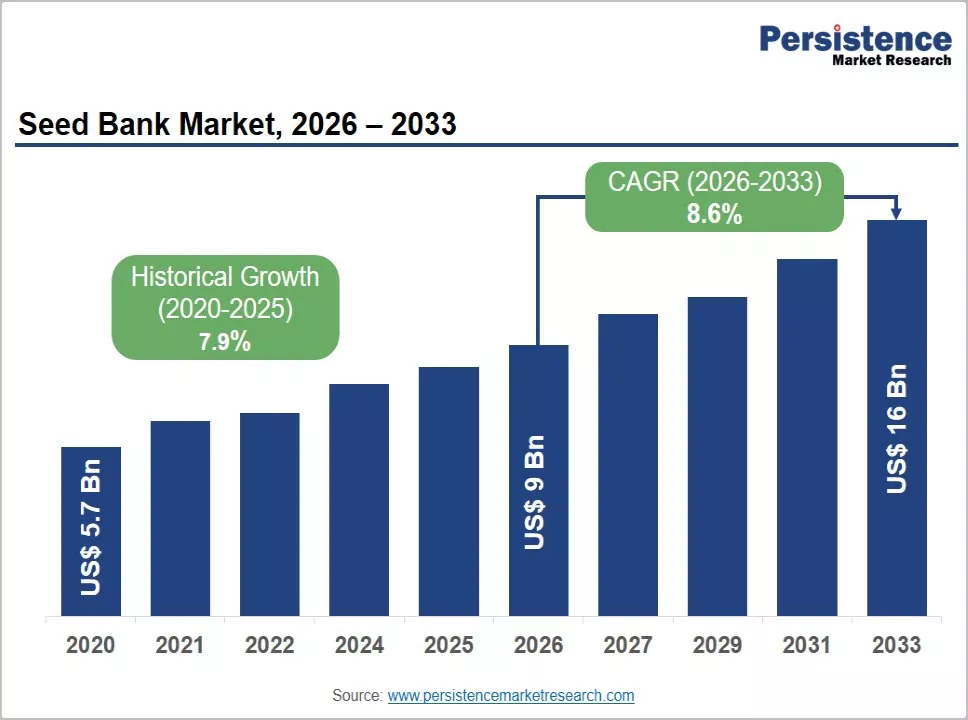
The global seed bank market size is likely to be valued at US$ 9.0 billion in 2026 and is projected to reach US$ 16.0 billion by 2033, growing at a CAGR of 8.6% during the forecast period between 2026 and 2033. The market is evolving from passive conservation into an active source of genetic value for plant breeding and food security planning.
The forecast period shows a more commercial tone: seed companies are mining stored diversity for disease resistance and climate-resilient traits, governments are backing national genebanks, and backup deposits at global facilities are growing every year. Breeding houses, genebank operators, and agricultural policymakers should read this as a steadily compounding category in which storage quality, cryopreservation capability, and access to well-characterized germplasm determine long-term competitiveness.
Key Industry Highlights
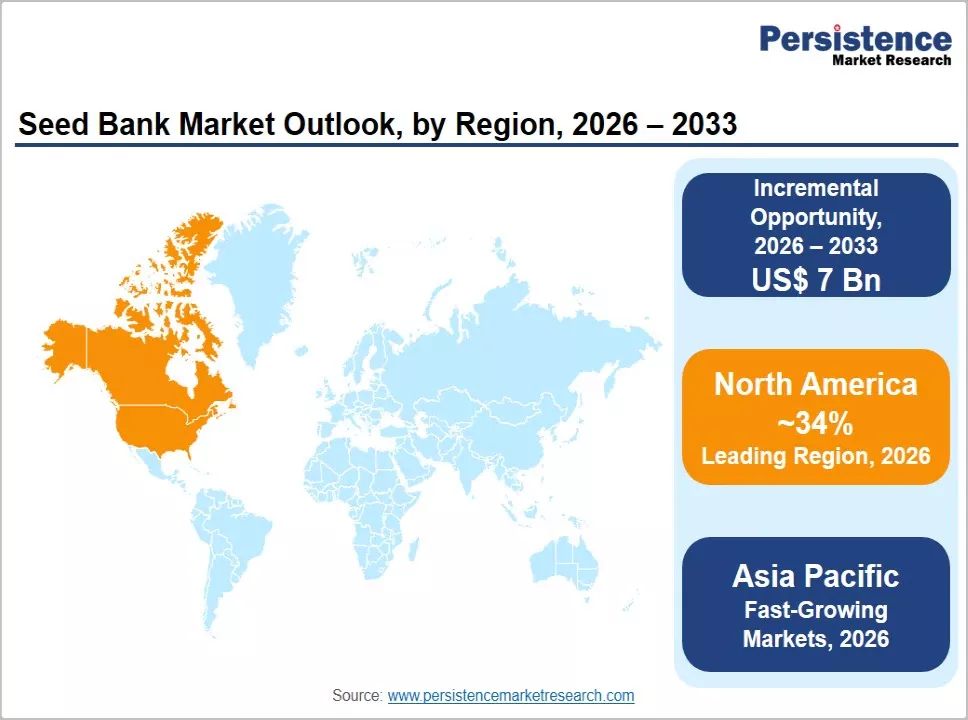
- Dominant Region: North America hold 34% of the seed bank market in 2026, supported by large private seed portfolios, federal genebank networks, and heavy breeding investment in corn, soybean, and wheat. The concentration of leading seed companies in the region means its research priorities shape global trait pipelines.
- Fastest-growing Region: Asia Pacific is projected to fastest growing at an estimated 10.2% CAGR through 2033, as China and India expand national genebanks, modernise seed systems, and invest in climate-resilient varieties. Government programmes for crop diversity and public-private breeding partnerships underpin regional momentum.
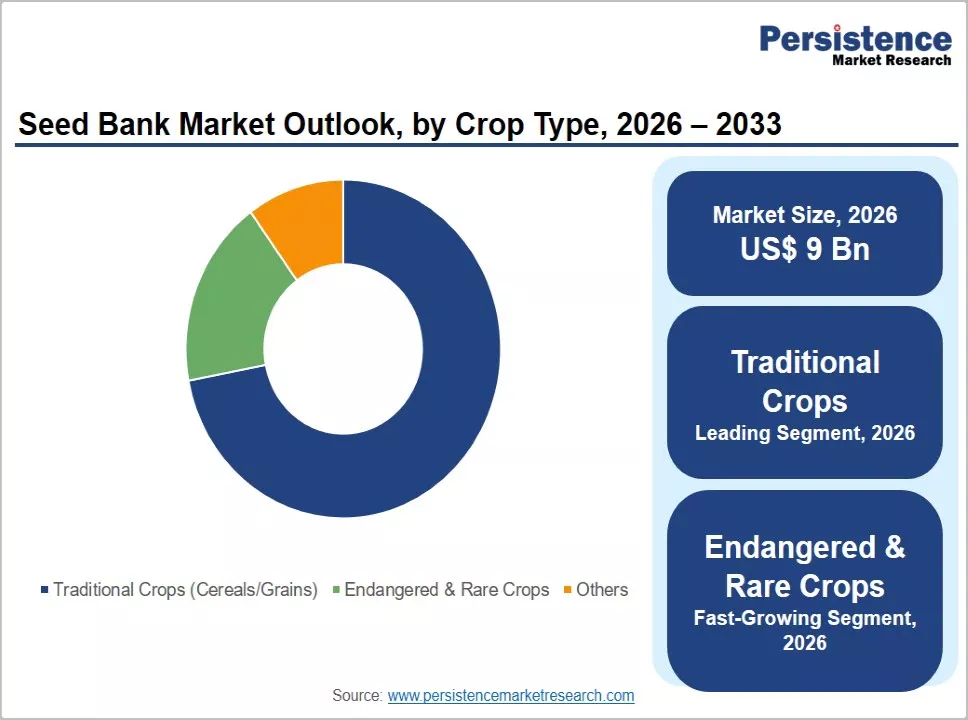
- Leading Crop Type: Traditional crops, mainly cereals and grains, account for about 72% of 2026 revenue, reflecting their central role in global calories and the scale of breeding programs for rice, wheat, maize, and barley. Bayer AG, Syngenta Group, and Groupe Limagrain anchor commercial activity in these crops.
- Fastest-growing Crop Type and Emerging Opportunity: Endangered and rare crops are the fastest-growing segment as governments, botanical institutions, and community seed networks secure neglected species. The Svalbard Global Seed Vault now holds more than 1.4 million samples, and new deposits of crops such as olive show how quickly coverage is widening.
DRO Analysis
Driver- Climate Resilience, Food Security Priorities, and Rising Genebank Deposits
Climate volatility is making stored genetic diversity a strategic asset. Breeders need heat-, drought-, and disease-tolerant traits that often exist only in landraces and wild relatives held in genebanks. Deposits are growing steadily. The Svalbard Global Seed Vault received 15,387 new samples from 11 genebanks in June 2026, bringing its total to 1,401,285, and a further deposit of more than 16,000 samples from 21 genebanks followed in October 2026. Government and institutional funding for national collections, together with breeders' rising use of stored germplasm to build elite lines, is expanding demand for storage capacity, regeneration services, and characterization data.
Restraint- High Storage, Regeneration, and Compliance Costs
Maintaining viable seed collections is expensive. Mid-term and long-term facilities need continuous refrigeration, back-up power, periodic viability testing, and regeneration of ageing accessions, while cryopreservation requires specialized equipment and trained staff. Access and benefit-sharing rules under international agreements add legal complexity to transfers of germplasm, and funding for public genebanks is often uneven. Species that cannot be dried and frozen, such as many tropical fruit and tuber crops, are harder to store and slow the broadening of collections.
Opportunity- Gene Editing, Digital Characterization, and Cryopreservation of Rare Crops
Technology is turning stored seed into searchable, usable genetic information. Vylor, the seed and genetics business separated from Corteva, announced a collaboration with Rainbow Crops in September 2026 to accelerate development of gene-edited corn traits, an example of how conserved diversity feeds modern breeding platforms. Genome sequencing and phenotyping of accessions help breeders find useful alleles faster, while cryopreservation opens a route to securing vegetatively propagated and recalcitrant species. Services that pair secure storage with data, regeneration, and traits discovery offer the most attractive revenue pockets.
Category-wise Analysis
Why Do Traditional Crops Command a Majority of the Global Seed Bank Market?
Traditional crops, including cereals and grains, are projected to lead the segment, holding nearly 72% of market share in 2026. Rice, wheat, maize, barley, and sorghum are the foundation of global food supply, and both public genebanks and private breeders concentrate resources on them. Large commercial seed companies such as Bayer AG, Syngenta Group, Groupe Limagrain, and KWS SAAT SE & Co. KGaA maintain extensive in-house germplasm collections for these crops and continually draw on them to develop higher-yielding, stress-tolerant varieties.
Endangered and rare crops are likely to be the fastest-growing segment, propelled by concern over genetic erosion and by dedicated conservation funding. First-time depositors, including Guatemala and Niger in February 2026, and the first-ever deposit of olive seeds at Svalbard illustrate how quickly under-represented species are being added. Community seed networks, botanical institutions, and national programs are driving this expansion, although revenues remain smaller than those of staple crops.
Storage Type Insights
What Is Driving Mid-Term Storage Dominance Across the Seed Bank Industry?
Mid-term storage is expected to lead the segment, holding about 58% of market share in 2026. Working collections used by breeders need frequent access, moderate cooling, and quick retrieval, which makes mid-term chambers the practical choice for seed companies and national programs. Commercial breeders such as Corteva Agriscience, BASF SE, Sakata Seed Corporation, and Enza Zaden rely on these facilities to maintain parental lines and active germplasm for upcoming variety development.
Long-term storage, including cryopreservation, is likely to be the fastest-growing segment, driven by backup obligations and the need to preserve species that cannot be stored conventionally. The Svalbard Global Seed Vault, which holds more than 1.4 million samples from over 130 genebanks, acts as the anchor for global duplicate storage, and national agencies are investing in liquid-nitrogen systems for tissues and shoot tips. Ukraine's deposit of 773 samples in October 2026, its first since 2022, reflects the security value placed on long-term backup.
Technology Insights
Why Do Conventional Breeding Seeds Hold the Largest Share of the Global Seed Bank Market?
Conventional breeding seeds are projected to lead the segment, accounting for around 68% of market share in 2026. Most conserved accessions are landraces, open-pollinated varieties, and bred lines that can be directly crossed, and regulatory barriers for these materials are low. Companies such as Groupe Limagrain, KWS SAAT SE & Co. KGaA, Rijk Zwaan, Bejo Zaden B.V., and Takii & Co., Ltd. use conventional pipelines extensively, particularly in vegetables, sugar beet, and cereals.
Biotech and genetically modified seeds are likely to be the fastest-growing segment, supported by gene-editing platforms, trait stacking, and expanding approvals in large agricultural economies. Corteva Agriscience, Bayer AG, Syngenta Group, and Longping High-Tech are investing in trait discovery that begins with stored diversity and ends in commercial hybrids. Regulatory treatment of gene-edited crops is still shifting by country, which is the main swing factor for adoption speed.
Regional Insights
North America Seed Bank Market Trends and Insights
North America is forecast to dominate the regional market, accounting for around 34% of the seed bank market share in 2026. The region combines large private breeding programs with strong federal conservation infrastructure, and a highly mechanized farm sector that rapidly adopts new varieties. Restructuring among leading seed companies, including the separation of Corteva's seed business as Vylor in October 2026, is reshaping how germplasm assets are managed and funded.
U.S. Seed Bank Market Size
The U.S. is estimated to hold around 87% of the North America regional market in 2026. The country hosts the USDA's national genetic resources preservation laboratory and the headquarters of several leading seed developers, and corn, soybean, and wheat breeding drive strong demand for stored germplasm.
Canada Seed Bank Market Size
Canada is expected to account for over 13% of the North America regional market in 2026. The national plant gene resource program supports canola, wheat, and barley breeding, and cold-climate crops adapted to short seasons add distinctive value to Canadian collections.
Europe Seed Bank Market Trends and Insights
Europe is anticipated to command around 19% of the seed bank market in 2026. The region is home to leading vegetable and field crop breeders and hosts the Svalbard Global Seed Vault in Norway, and strong public funding for genetic resources supports conservation. Policy debate on new genomic techniques and seed marketing rules influences how quickly gene-edited material reaches farmers.
Germany Seed Bank Market Size
Germany is projected to account for around 25% of the Europe regional market in 2026. Strong breeders such as KWS SAAT SE & Co. KGaA, together with the national genebank at Gatersleben, anchor demand for cereals, sugar beet, and oilseed material, and regulators and breeders remain closely engaged on genome-editing rules.
U.K. Seed Bank Market Size
The U.K. is estimated to account for nearly 14% of the Europe regional market in 2026. The Royal Botanic Gardens, Kew's Millennium Seed Bank is one of the world's largest wild plant seed collections, and the country's research institutions contribute to crop wild relative conservation and characterization.
Which Region Will Drive the Fastest Seed Bank Growth Through 2033?
Asia Pacific is forecast to be the fastest-growing region, capturing around 24% of market share in 2026 and expanding at an estimated 10.2% CAGR through 2033. Governments are expanding national genebanks, seed multiplication networks, and breeding programs to protect food security under climate stress. Domestic seed companies are scaling hybrid portfolios, and multinational firms are forming local partnerships to access regional germplasm and distribution.
China Seed Bank Market Size
China is projected to hold 44% of the Asia Pacific regional market in 2026. National crop genebanks rank among the world's largest, and leading domestic breeders such as Longping High-Tech are investing in hybrid rice, corn, and biotech traits as seed-industry policy encourages domestic innovation.
India Seed Bank Market Size
India is expected to account for around 22% of the Asia Pacific regional market in 2026. The national genebank maintains long-term storage and a cryobank for the country's crop diversity, while private breeders such as Mahyco and Advanta Seeds (UPL) are expanding hybrid corn, cotton, and vegetable portfolios for a very large farm base.
Competitive Landscape
The global seed bank market is moderately consolidated at the commercial level, with a handful of global seed groups holding the broadest germplasm collections. Bayer AG, Corteva Agriscience (whose seed business now operates as Vylor), Syngenta Group, BASF SE, and Groupe Limagrain lead through large breeding programs and trait platforms.
KWS SAAT SE & Co. KGaA, Sakata Seed Corporation, Advanta Seeds (UPL), DLF Seeds A/S, Enza Zaden, Takii & Co., Ltd., Longping High-Tech, Mahyco, Rijk Zwaan, and Bejo Zaden B.V. hold strong positions in specific crops and regions. Public genebanks and the Svalbard backup facility act as complementary conservators rather than competitors. Competitive advantage rests on collection depth, quality of characterization data, cryopreservation capability, and the speed at which stored diversity is converted into marketable varieties.
Key Industry Developments
- In October 2026, Vylor Inc. completed its separation from Corteva Inc. and launched as an independent, publicly traded advanced seed and genetics company, with its shares beginning trading on the New York Stock Exchange (NYSE) under the ticker symbol VYLR. The company announced a US$19 billion technology pipeline, comprising 12 planned technology platform launches across corn, soybeans, and wheat over the next decade.
- In January 2026, Maharashtra Foundation inaugurated a Computer Training Center and Seed Bank at Pimparwadi village in Junnar Taluka, Pune District, Maharashtra, under its Fifth Integrated Village Development Project. The foundation provided two fully equipped computers to the Lokshikshan Kendra to improve access to computer education for village youth, women, and students, who previously had to travel 28 kilometers to access training facilities. The center scheduled training sessions from Monday to Friday for villagers and women and on weekends for students.
Companies Covered in Seed Bank Market
- Advanta Seeds (UPL)
- Bayer AG
- BASF SE
- Bejo Zaden B.V.
- Corteva Agriscience
- DLF Seeds A/S
- Enza Zaden
- Groupe Limagrain
- KWS SAAT SE & Co. KGaA
- Longping High-Tech
- Mahyco (Maharashtra Hybrid Seeds Company)
- Rijk Zwaan
- Sakata Seed Corporation
- Syngenta Group
- Takii & Co., Ltd.
Frequently Asked Questions
The global seed bank market is valued at US$ 9.0 billion in 2026.
Climate resilience and food security priorities, growing breeder use of stored germplasm, rising deposits to national and global genebanks, and advances in gene editing and characterization, partly offset by high storage and regeneration costs.
Traditional crops, mainly cereals and grains, hold around 72% of the market. Their central role in global calories and the scale of breeding programs for rice, wheat, and maize concentrate conservation and commercial investment.
North America leads with a 34% share in 2026, driven by large private breeding portfolios, strong federal genebank infrastructure, and intensive corn, soybean, and wheat development.
The largest opportunities are gene-edited and trait-focused breeding built on stored diversity, cryopreservation of rare and hard-to-store species, and data services that characterize germplasm for breeders.
Leading companies include Bayer AG, Corteva Agriscience, Syngenta Group, BASF SE, and Groupe Limagrain. The market is moderately consolidated, with global groups leading in broad crop portfolios and regional specialists strong in vegetables and local crops.


