




- Industrial Goods & Service
- Food Delivery Lockers Market
Food Delivery Lockers Market Size, Share, and Growth Forecast 2026–2033
Food Delivery Lockers Market by Type (Heated Lockers, Refrigerated Lockers, Ambient Temperature Lockers), by Application (Restaurants, Grocery Stores, Meal Kit Services, and Others), and Regional Analysis, 2026–2033

Food Delivery Lockers Market Size and Trend Analysis
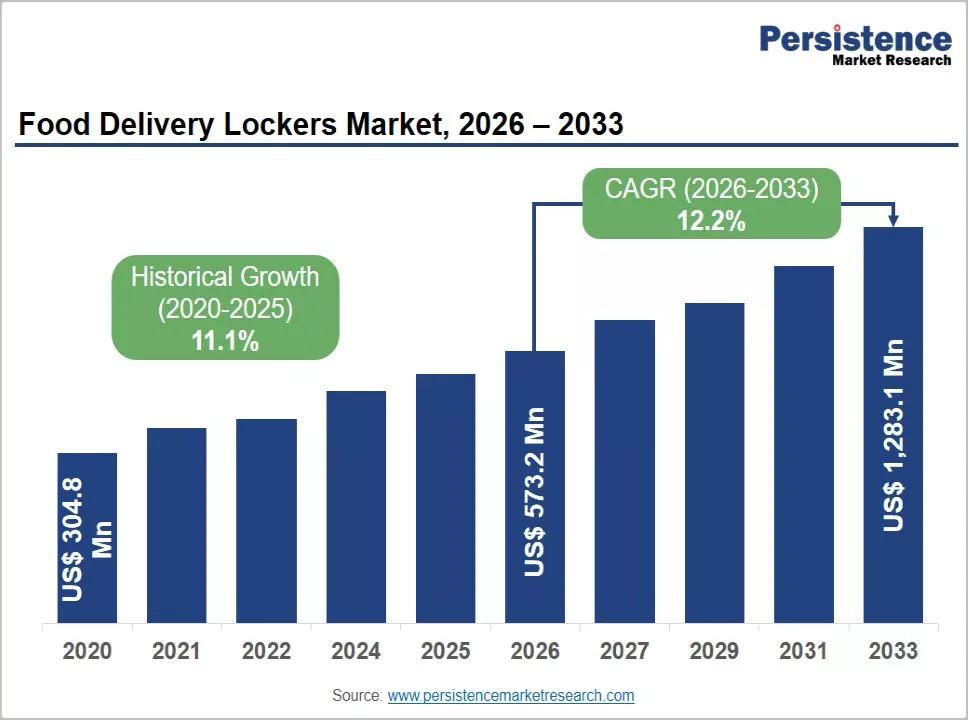
The global food delivery lockers market size is likely to be valued at US$ 573.2 million in 2026, and is estimated to reach US$ 1,283.1 million by 2033, growing at a CAGR of 12.2% during the forecast period 2026–2033.
Growth is underpinned by the expansion of online food ordering, rising labor costs in restaurants and grocery stores, and growing consumer preference for contactless, time-flexible pickup.
The market has been experiencing healthy growth, reflecting early adoption concentrated among large chains and pilot programs. However, the forecast period anticipates robust acceleration as modular, lower-cost locker systems reach independent operators, grocers scale click-and-collect and delivery driver handoff, and lockers expand into offices, campuses, venues, and community food programs. Rising investment by restaurant technology providers, grocers, and community organizations is also widening the range of use cases, from fast casual pickup to after-hours grocery access.
Key Industry Highlights
- Dominant Type: Heated lockers are set to command around 46% of the revenue share in 2026, while refrigerated lockers are likely to grow the fastest at 13.4% CAGR through 2033, as grocery, meal kit, and fresh food pickup scale.
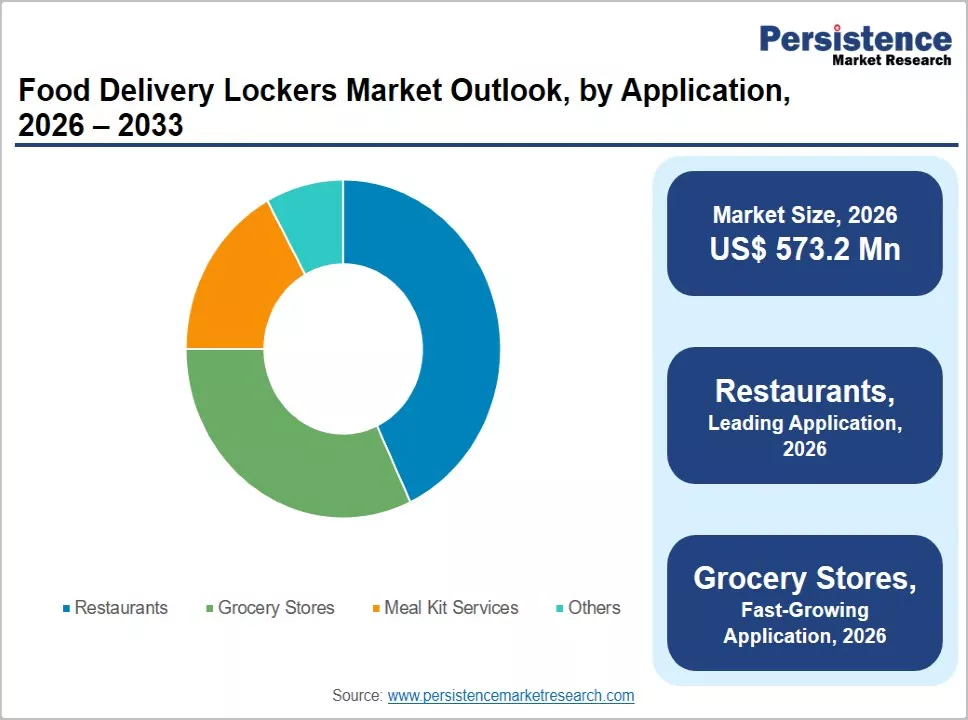
- Leading Application: Restaurants are expected to lead with 52% in 2026, while meal kit services are likely to be the fastest-growing application at about 13.5% CAGR during 2026–2033, reflecting subscription-based fresh food delivery.
- Technology Shift: Modular, app-connected lockers with order tracking, QR code access, and remote temperature monitoring are anticipated to account for a rising share of new installations, replacing manual handoff counters and unmanaged shelving.
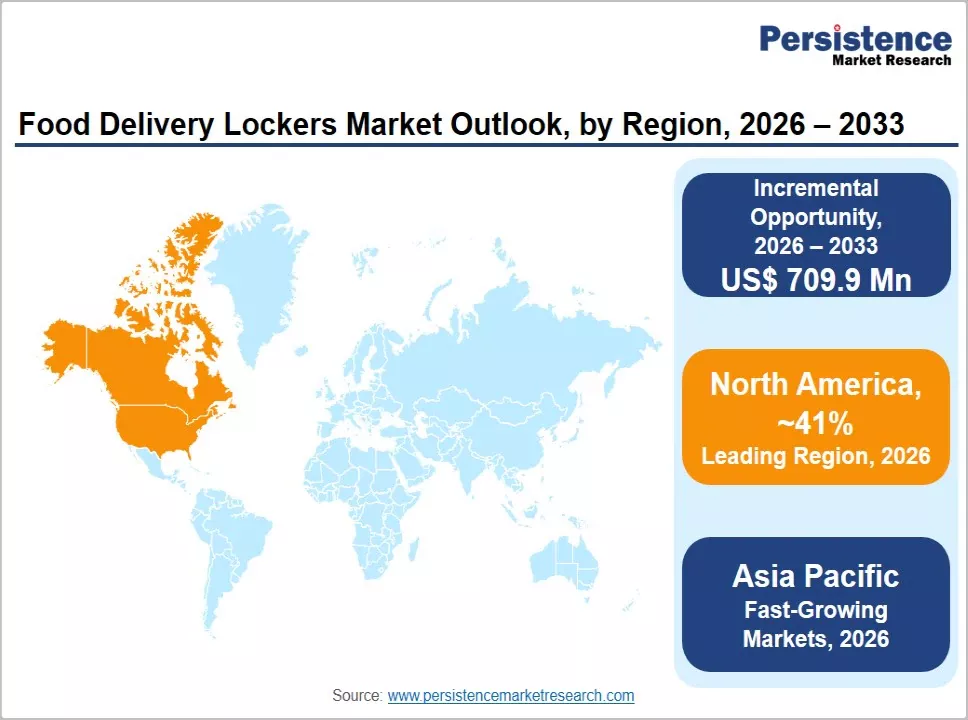
- Regional Leadership: North America is poised to dominate with an estimated 41% share in 2026, while Asia Pacific is expected to register the fastest growth at 13.8% CAGR through 2033, led by urban delivery platforms in China and India.
- Competitive Environment: Competitive dynamics include modular product launches, grocery and delivery driver pilot programs, and partnerships between locker manufacturers, restaurant technology providers, and delivery platforms.
DRO Analysis
Drivers: Online Ordering Growth and Labor Efficiency as Primary Growth Catalyst
The growth of digital ordering and third-party delivery is the leading force driving the food delivery lockers market, as restaurants and grocers struggle to manage rising order volumes at counters and curbsides. Without dedicated handoff solutions, prepared orders can sit on shelves, leading to cold food, mix-ups, theft, and crowding.
Smart lockers store each order in a labeled compartment that opens through a code or QR scan, letting customers and delivery drivers collect meals without waiting for staff. This reduces labor tied up in order handoff, shortens driver wait times, and protects food quality, producing measurable gains in customer satisfaction and throughput during peak hours. Pilot programs by large grocery retailers have reported driver wait times cut nearly in half.
Contactless Preference and Extended Service Hours
Consumers continue to value contactless pickup and the flexibility to collect orders outside staffed hours. Lockers allow operators to extend service into evenings, overnight, and unstaffed locations such as offices, apartment complexes, and campuses without adding labor. Integration with ordering platforms, point-of-sale systems, and notification tools creates a seamless experience, ensuring sustained growth in the food delivery lockers market in the coming years. Operators are also using locker data on pickup times and order volumes to refine staffing and kitchen planning.
Restraints: High Upfront Cost and Food Safety Compliance Complexity
High upfront investment is a major challenge for the food delivery lockers market, particularly for independent restaurants and small grocers. Temperature-controlled units, installation, electrical work, software subscriptions, and maintenance can create significant costs, and the return on investment depends on order volume and the extent to which lockers replace labor. Space constraints in older or smaller restaurants further limit installation options, while outdoor units require weatherproofing and security measures that raise project budgets.
Opportunities: Grocery Fulfillment, Community Food Access, and Venue Expansion
Grocery retailers are using temperature-controlled lockers for online order pickup and delivery driver handoff, enabling stores to prepare orders in advance and keep drivers out of congested pickup zones. Refrigerated lockers are also being adopted by food banks and community organizations to provide after-hours grocery pickup with dignity and privacy, supported by grants and public funding. These applications broaden the customer base beyond restaurants and create demand for multi-temperature lockers combining ambient, refrigerated, and frozen compartments.
Modular Designs, Venues, and Subscription Services
Modular and scalable locker arrays that can be configured to fit different floor plans and expanded over time are lowering barriers to adoption. Venues such as stadiums, aquariums, airports, universities, and hospitals are deploying lockers to speed concessions pickup and reduce lines, while meal kit and prepared meal subscription services are exploring lockers to make deliveries more secure and convenient. Software-as-a-service models, remote monitoring, and analytics create recurring revenue opportunities for manufacturers and technology providers. Pilot projects in universities and hospitals are also demonstrating how lockers can reduce cafeteria congestion and improve service during peak meal periods.
Category-wise Insights
Type Analysis
Why Do Heated Lockers Lead the Food Delivery Lockers Market?
Heated lockers are the leading type segment, expected to hold about 46% of the food delivery lockers market revenue share in 2026. Restaurant takeout and delivery are the largest source of locker demand, and most orders are hot meals such as pizza, burgers, bowls, and fried foods that lose quality quickly when left on open shelves. Heated compartments maintain stable temperatures, support hold timers, and keep food ready for customers and delivery drivers who arrive at different times. Units are designed in countertop, floor-standing, and built-in formats with touchscreens, QR code readers, and ordering system integration. Because quick-service and fast casual chains are driving rollouts across multiple locations, heated lockers benefit from repeat orders, standardized specifications, and a mature supplier base. Ambient temperature lockers, which suit packaged goods, baked items, beverages, and non-perishable orders, remain a lower-cost option with steady demand in offices, campuses, and retail environments.
Refrigerated lockers represent the fastest-growing type segment, anticipated to achieve 13.4% CAGR during the 2026–2033 period. These lockers hold chilled groceries, salads, meal kits, dairy, and prepared foods at safe temperatures, and some models combine multiple zones in a single array to handle ambient, chilled, and frozen goods. Grocery retailers, food banks, and subscription services are using them to enable unattended pickup and driver handoff, reducing the need for staffed counters and cold storage space near entrances. Growth is supported by the expansion of online grocery, delivery partnerships, and public funding for community food access, while improvements in remote temperature monitoring, energy efficiency, and food safety logging are making refrigerated units easier to operate and audit.
Application Analysis
Which Application Dominates the Food Delivery Lockers Market?
Restaurants dominate the application segment, projected to capture about 52% of the revenue share in 2026. Quick-service, fast casual, and casual dining restaurants face a growing share of digital orders that must be handed off to customers and multiple delivery platform drivers at once. Smart food lockers streamline this process by separating pickup from the ordering counter, preventing mix-ups and theft, and reducing crowding for dine-in guests. Operators also use exterior lockers to offer pickup outside operating hours. Recent product introductions with modular, scalable configurations let restaurants add capacity without extensive remodeling, supporting adoption among both chains and independent operators. Restaurants also use locker data to track pickup times, identify bottlenecks, and improve kitchen workflows, strengthening the business case for investment.
Meal kit services are likely to grow the fastest through 2033, at about 13.5% CAGR. Subscription meal providers deliver perishable ingredients and prepared meals that must be kept cold until collected, and refrigerated lockers in apartment buildings, offices, and neighborhood hubs reduce missed deliveries and spoilage risk. Grocery stores represent a significant and expanding application, using lockers for click-and-collect and delivery driver pickup, while other applications such as workplaces, universities, hospitals, event venues, and community food programs broaden the market. Venues have begun to adopt food pickup lockers to shorten concession lines, illustrating how the technology is expanding beyond traditional restaurant settings.
Regional Insights
Why Is North America Expected to Lead the Food Delivery Lockers Market?
North America is projected to account for approximately 41% of the global food delivery lockers market in 2026, making it the largest regional market. The region's industry is likely to benefit from high penetration of online food ordering, a large base of quick-service restaurant chains, labor cost pressures, and the presence of leading locker manufacturers. Restaurant technology providers and retailers are piloting and scaling lockers across restaurants, grocery stores, and venues, while community organizations are installing refrigerated lockers for after-hours food access. Competition among established equipment makers and software-focused entrants is also expected to intensify through 2033. Venue operators, universities, and hospitals are also adding lockers to shorten concession and cafeteria lines.
U.S. Food Delivery Lockers Market Size
The U.S. is estimated to account for approximately 84% of the North America food delivery lockers market in 2026. Market growth is likely to be supported by the dominance of third-party delivery platforms, expansion of fast casual chains, and rising labor and occupancy costs that encourage automation of pickup. Providers have introduced modular locker arrays that can be installed without remodeling, while grocery retailers and food banks are installing temperature-controlled units. Food code requirements for hot and cold holding temperatures are also expected to favor purpose-built, monitored locker systems through 2033. Large restaurant chains are expected to standardize on a limited set of locker formats across locations, supporting repeat equipment orders and service contracts.
Canada Food Delivery Lockers Market Size
Canada is projected to represent approximately 16% of the North America food delivery lockers market in 2026. Market expansion is expected to be driven by grocery retailers deploying smart lockers for delivery driver pickup, rapid growth in online grocery, and urban restaurant delivery. A large national grocer's pilot, announced in May 2026, reported driver wait times cut nearly in half and reduced congestion in pickup zones, supporting wider rollout. Cold winters and urban density are also anticipated to favor indoor and temperature-controlled lockers through 2033. Provincial food-security programs and community food hubs are also expected to explore refrigerated lockers for after-hours collection.
Europe Food Delivery Lockers Market Trends and Insights
Europe is estimated to account for approximately 14% of the global food delivery lockers market in 2026. The region's market is expected to benefit from established parcel locker networks, high urban density, and the expansion of food delivery platforms and grocery click-and-collect services. European locker technology firms offer automated pickup towers and temperature-controlled lockers to retailers, while strict food hygiene requirements under European Union regulation are likely to encourage use of monitored cold and hot holding. Sustainability goals are also expected to support lockers that consolidate trips and reduce failed deliveries. Cross-border retail groups are likely to standardize locker platforms across multiple countries to simplify operations.
Germany Food Delivery Lockers Market Size
Germany is anticipated to account for approximately 26% of the Europe food delivery lockers market in 2026. Demand is expected to be supported by the country's large grocery retail sector, wide availability of delivery platforms, and familiarity with automated pickup stations for parcels. Retailers and restaurant operators are exploring lockers to manage labor shortages and extend service hours, while workplace canteens and universities provide additional installation opportunities. Adherence to stringent hygiene and energy efficiency standards is projected to shape product requirements and support market expansion through 2033. Municipal and university pilots are also anticipated to help demonstrate return on investment for smaller operators.
Why Is Asia Pacific Expected to Register the Fastest Growth in the Food Delivery Lockers Market?
Asia Pacific is projected to account for approximately 25% of the global food delivery lockers market in 2026, and is anticipated to register the fastest growth, expanding at an estimated CAGR of 13.8% through 2033. Market expansion is likely to be driven by dense urban populations, widespread use of delivery super-apps, and rapid growth of quick commerce and cloud kitchens. China and India are expected to remain the primary demand centres, while Japan, South Korea, and Southeast Asian cities are also adopting automated pickup in offices and residential complexes.
China Food Delivery Lockers Market Size
China is estimated to represent approximately 42% of the Asia Pacific food delivery lockers market in 2026. The country's market is expected to benefit from massive food delivery volumes, high smartphone penetration, and large office and campus clusters where delivery platforms have deployed smart meal pickup cabinets. Domestic hardware manufacturers offer competitively priced heated and refrigerated cabinets integrated with delivery platform apps, enabling rapid rollout. Continued expansion of instant retail and community group buying is projected to sustain China's regional leadership through 2033. Integration with mobile payment and delivery platform dispatch systems is anticipated to keep unit economics attractive.
India Food Delivery Lockers Market Size
India is projected to account for approximately 14% of the Asia Pacific food delivery lockers market in 2026. The market is expected to witness strong expansion from a small base, supported by rapid growth of food delivery platforms such as Swiggy and Zomato, rising adoption of quick commerce, and increasing use of cloud kitchens. Early deployments are likely to focus on corporate campuses, technology parks, and gated residential communities where order density is high. Declining hardware costs and local manufacturing are also expected to support adoption through 2033. Partnerships between platforms, property managers, and local manufacturers are anticipated to shorten rollout timelines.
Competitive Landscape
The global food delivery lockers market structure is moderately fragmented, with the top vendors, including Apex Order Pickup Solutions, Hatco, Panasonic, and Bell and Howell, controlling around 40% of the revenue share. These established players have been leveraging restaurant and grocery chain relationships, broad product ranges across heated, refrigerated, and ambient formats, and nationwide service networks. They are also known to invest in R&D for modular designs, remote monitoring, and integration with ordering and delivery platforms.
Regional and niche competitors such as Cleveron, Carter-Hoffman, GRUBBRR, Click n' Collect, Luxer One, and Quadient are focusing on specialized segments such as automated pickup towers, restaurant kiosks, parcel and food hybrid lockers, and grocery pickup. Barriers such as food safety compliance, hardware manufacturing, and software integration limit new entrants, though lower-cost designs and platform partnerships are enabling new participants. Market consolidation is expected to increase gradually as larger players acquire software and hardware specialists, while locker makers and delivery platforms continue collaborating. Software providers that offer analytics on order timing, pickup behavior, and temperature compliance are also gaining strategic importance in vendor selection.
Key Market Developments
- In May 2026, Loblaw reported strong results from the first pilot stores for its PC Express delivery smart lockers, with driver wait times cut nearly in half and most orders ready for pickup on arrival.
- In February 2026, Arlington Charities added new refrigerated lockers, funded by a grant from the Arlington Tomorrow Foundation, to launch an After-Hours Grocery Pickup Program.
- In May 2025, Apex Order Pickup Solutions expanded its smart food locker line with the modular, scalable Array series, enabling restaurants to add pickup capacity without expensive remodeling.
Companies Covered in Food Delivery Lockers Market
- Apex Order Pickup Solutions
- Hatco Corporation
- Panasonic Holdings Corporation
- Bell and Howell, LLC
- Cleveron AS
- Carter-Hoffman
- GRUBBRR
- Click n' Collect
- Luxer One
- Quadient S.A.
- Meituan
Frequently Asked Questions
The global food delivery lockers market is valued at US$ 573.2 million in 2026 and is projected to reach US$ 1,283.1 million by 2033, expanding at a CAGR of 12.2% during 2026–2033.
The expansion of online food ordering, rising labor costs in restaurants and grocery stores, and growing consumer preference for contactless, time-flexible pickup are driving the market.
Heated lockers lead types with about 46% share, while restaurants lead applications with about 52% in 2026.
North America dominates the market with an estimated 41% share in 2026, supported by high online ordering penetration and quick-service chains, while Asia Pacific is projected to grow fastest at 13.8% CAGR through 2033.
Grocery fulfillment, community food access programs, venue and campus deployments, and modular low-cost locker designs are key market opportunities.
The market is moderately fragmented, with Apex Order Pickup Solutions, Hatco, Panasonic, and Bell and Howell controlling around 40% of the revenue share.


