




- Telecommunications
- Satellite NTN Market
Satellite NTN Market Size, Share, and Growth Forecast, 2026 - 2033
Satellite NTN Market by Orbit Type (LEO (Low Earth Orbit), MEO (Medium Earth Orbit)), Technology (NR NTN (New Radio NTN), IoT NTN, Others), End-user Industry, and Regional Analysis for 2026 - 2033

Satellite NTN Market Size and Trends Analysis
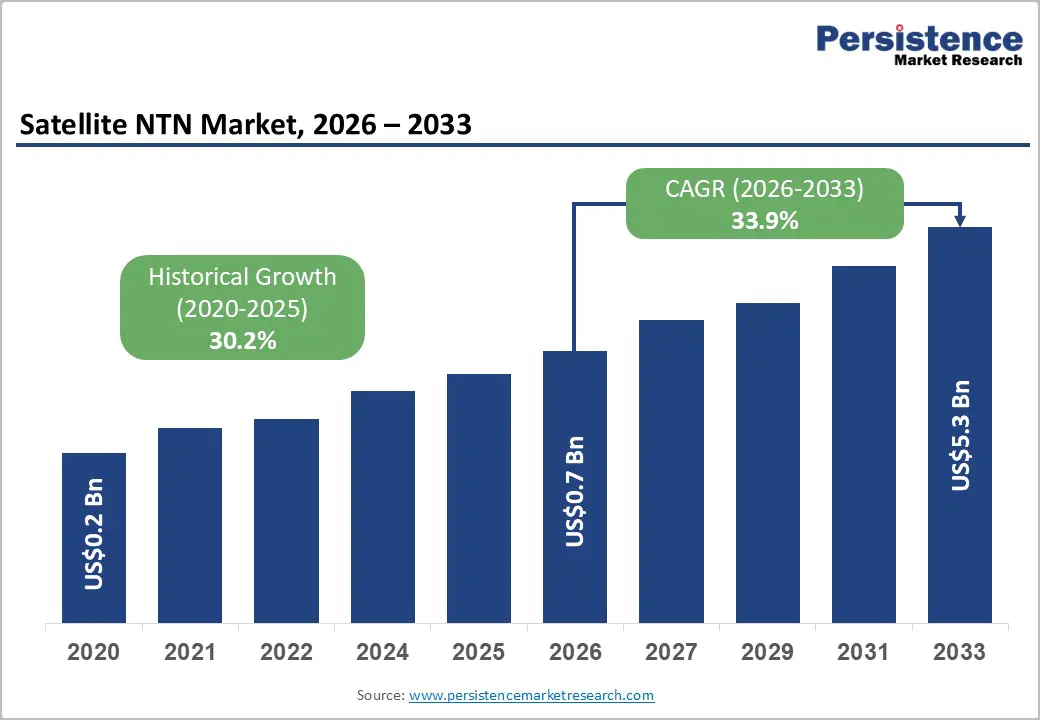
The global satellite NTN market size is likely to be valued at US$0.7 billion in 2026 and is expected to reach US$5.3 billion by 2033, growing at a CAGR of 33.9% between 2026 and 2033, driven by the shift of Satellite Non-Terrestrial Networks (NTN) from the development and standardization phase to widespread commercial deployment. Increasing integration with 5G networks, the emergence of direct-to-device satellite connectivity, and the growing adoption of satellite-enabled IoT communications are accelerating demand.
Furthermore, the commercialization of 3GPP-compliant NTN technologies is facilitating seamless interoperability between terrestrial and satellite infrastructures, supporting broader network coverage and enhanced connectivity services.
Key Industry Highlights:
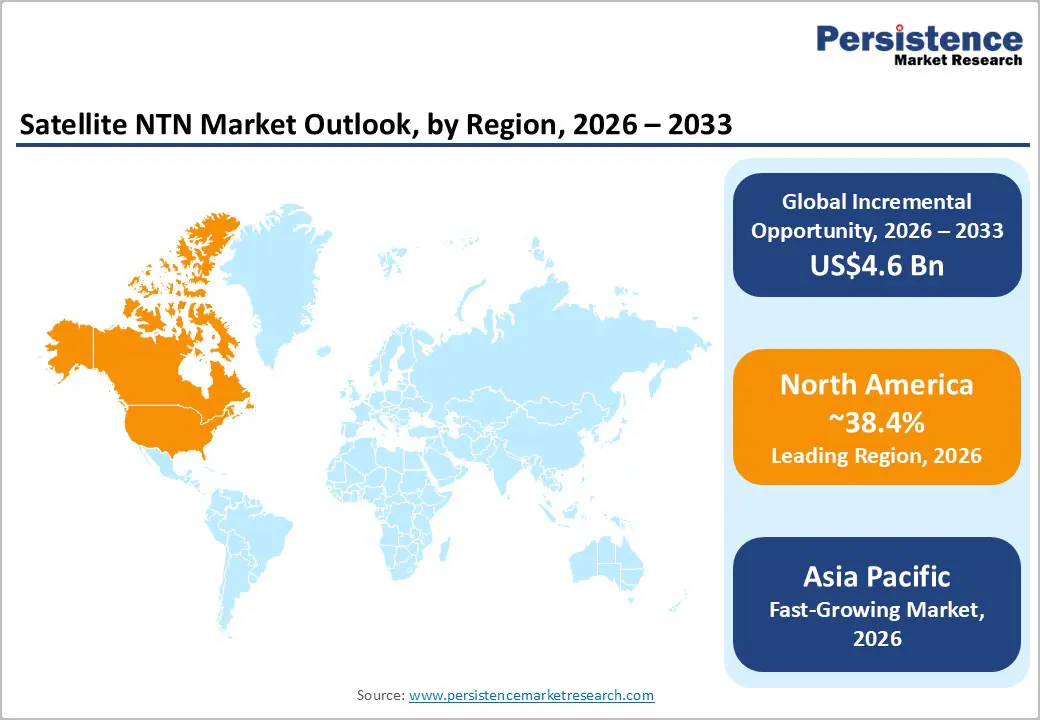
- Leading Region: North America is anticipated to account for 38.4% of market revenue in 2026, supported by strong satellite infrastructure, direct-to-device deployments, and a mature telecommunications ecosystem.
- Fastest-growing Region: Asia Pacific is projected to be the fastest-growing regional market through 2033, driven by expanding satellite communications investments, large-scale 5G adoption, and growing demand for connectivity across remote and underserved areas.
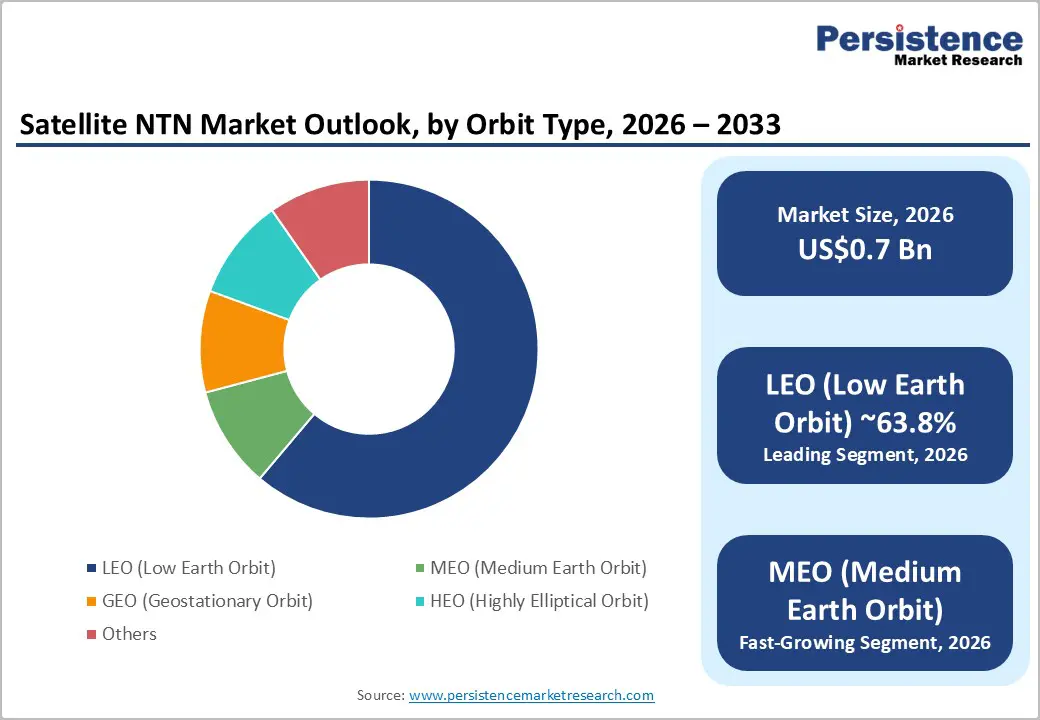
- Dominant Orbit Type: LEO (Low Earth Orbit) is anticipated to hold approximately 63.8% of the market share in 2026, owing to its low-latency performance and suitability for direct-to-device and broadband connectivity services.
- Leading Technology: NR NTN (New Radio Non-Terrestrial Network) is expected to lead with approximately 57.6% market share in 2026, driven by increasing integration with 5G networks, smartphone compatibility, and expanding satellite-terrestrial communication capabilities.
DRO Analysis
Driver - Standardized 5G NTN Integration Accelerates Commercial Adoption
The integration of NTN capabilities into the global 5G ecosystem has become one of the most influential growth drivers for the market. Through successive releases of 3GPP standards, including Release 17, Release 18, and ongoing developments in Release 19, satellite connectivity has become increasingly aligned with conventional mobile network infrastructure. These standards support direct-to-device communications, satellite backhaul, IoT connectivity, roaming capabilities, and enhanced mobility management.
The standardization process significantly reduces deployment complexity for mobile network operators, chipset manufacturers, and device vendors. As satellite connectivity becomes compatible with mainstream smartphones and IoT devices, the addressable market expands considerably beyond specialized satellite terminals. The resulting interoperability lowers operational risks, shortens commercialization timelines, and enables telecom operators to incorporate satellite services into existing network strategies. This convergence between terrestrial and satellite communications is expected to remain a major catalyst for long-term market expansion.
Growing Demand for Resilient and Ubiquitous Connectivity
The increasing need for uninterrupted communications across remote, rural, maritime, aviation, and disaster-prone environments is driving strong demand for Satellite NTN solutions. Traditional terrestrial infrastructure cannot economically serve every geographic region, creating substantial coverage gaps worldwide. Satellite NTN technology addresses these limitations by extending connectivity beyond conventional network boundaries.
Commercial deployments have demonstrated the viability of direct-to-device communications for emergency messaging, public safety operations, disaster response, and enterprise mobility. Telecommunications operators are increasingly partnering with satellite providers to improve network resilience and expand service availability. Rising reliance on connected assets, autonomous systems, and real-time operational visibility further strengthens demand. As governments and enterprises prioritize communication continuity and redundancy, NTN solutions are becoming an increasingly important component of national and commercial connectivity strategies.
Restraint - Regulatory Complexity and High Capital Requirements
Despite strong growth prospects, the Satellite NTN market faces significant challenges associated with regulatory compliance, spectrum management, and infrastructure investment requirements. Satellite operators must navigate complex licensing frameworks, international spectrum coordination processes, and varying regulatory requirements across jurisdictions.
The deployment of satellite constellations requires substantial capital expenditure for spacecraft manufacturing, launches, ground infrastructure, and network integration. Multi-orbit architectures introduce additional operational complexity and cost considerations. Long development cycles and uncertain regulatory approval timelines can delay commercial rollouts and affect investment returns.
Cross-border service provision remains particularly challenging due to differing national telecommunications regulations and spectrum allocation policies. These factors increase operational risks and may slow adoption rates in certain regions, particularly for newer market entrants with limited financial resources.
Opportunity - Expansion of IoT NTN Services across Industrial Applications
IoT NTN represents one of the most promising growth opportunities within the broader Satellite NTN ecosystem. Industries including logistics, agriculture, transportation, mining, utilities, and environmental monitoring increasingly require reliable connectivity in locations where terrestrial coverage remains limited or unavailable.
Satellite-enabled IoT networks provide low-power, wide-area connectivity for asset tracking, fleet management, predictive maintenance, livestock monitoring, and infrastructure monitoring applications. The growing adoption of connected sensors and industrial automation systems creates substantial demand for resilient communication networks capable of supporting remote operations.
As enterprises continue digital transformation initiatives, NTN-enabled IoT solutions are expected to become essential for maintaining operational visibility across geographically dispersed assets. The recurring revenue characteristics associated with large-scale IoT deployments further enhance the attractiveness of this opportunity for service providers.
Government and Defense Investments in Secure Multi-Orbit Networks
Governments worldwide are increasingly investing in sovereign satellite communications infrastructure to strengthen national security, critical infrastructure resilience, and strategic autonomy. Multi-orbit satellite architectures combining LEO, MEO, and GEO assets are emerging as preferred solutions for secure and redundant communications.
Defense organizations require highly reliable connectivity for intelligence gathering, surveillance operations, border security, emergency response, and mission-critical communications. Public-sector investments in secure satellite networks are creating opportunities across the entire NTN value chain, including spacecraft manufacturing, payload development, cybersecurity solutions, ground infrastructure, and terminal technologies. The growing emphasis on resilient communications infrastructure is expected to generate sustained demand for advanced NTN capabilities over the forecast period, creating long-term growth opportunities for technology providers and service operators.
Category-wise Analysis
Orbit Type Insights
LEO (Low Earth Orbit) is anticipated to account for approximately 63.8% of the market share in 2026, maintaining its position as the dominant orbit category. Its leadership is driven by lower latency, stronger signal quality, and compatibility with direct-to-device and broadband connectivity services. Major deployments from companies such as SpaceX Starlink, AST SpaceMobile, and Globalstar have accelerated adoption across consumer, enterprise, and government applications. LEO constellations are particularly effective for mobile communications, IoT connectivity, emergency response services, and network coverage extension, making them the preferred choice for next-generation NTN deployments.
MEO (Medium Earth Orbit) is expected to be the fastest-growing orbit segment through 2033, supported by increasing demand for navigation, satellite telephony, and aviation connectivity applications. MEO systems offer broader coverage than LEO while delivering lower latency than GEO satellites, creating an attractive balance between performance and cost efficiency. Growing investments in multi-orbit architectures, such as integrated LEO-MEO networks, are further boosting adoption. Governments and enterprises are increasingly leveraging MEO satellites to enhance network resilience, service continuity, and global coverage capabilities.
Technology Insights
NR NTN (New Radio Non-Terrestrial Network) is anticipated to hold approximately 57.6% of the market share in 2026, making it the leading technology segment. Its dominance stems from direct alignment with 5G standards and support for smartphone-based satellite connectivity, roaming, and backhaul services. The technology is gaining traction through collaborations between satellite operators and telecom providers, enabling seamless integration of satellite and terrestrial networks. As more device manufacturers incorporate NTN capabilities into 5G-enabled smartphones, NR NTN is expected to remain the foundation of future satellite-mobile communications.
IoT NTN is projected to be the fastest-growing technology segment. Growth is fueled by increasing demand for remote asset monitoring, fleet management, smart agriculture, and industrial automation. Companies such as Skylo, Iridium, and Globalstar are expanding satellite IoT solutions to support machine-to-machine communications in areas beyond terrestrial coverage. The ability to deliver reliable, low-power connectivity for millions of connected devices makes IoT NTN a critical enabler of large-scale digital transformation initiatives across industries. LTE NTN, payload technologies, and ground-segment solutions continue to support broader NTN ecosystem development.
Regional Insights
North America Satellite NTN Market Trends
North America is anticipated to account for 38.4% of the market share in 2026. The region benefits from a mature space ecosystem, advanced telecommunications infrastructure, strong venture capital investment, and extensive collaboration between satellite operators and mobile network providers. Growing adoption of direct-to-device communications, enterprise IoT services, and emergency connectivity solutions continues to strengthen market demand.
U.S. Satellite NTN Market Trends
The U.S. is expected to dominate the North American market, representing approximately 80.6% of regional revenue in 2026. The country hosts major industry participants including SpaceX, AST SpaceMobile, Iridium, Globalstar, Viasat, Qualcomm, and Skylo, creating one of the world's most comprehensive NTN ecosystems. Growth is supported by increasing commercial deployment of direct-to-device services, government investments in resilient communications infrastructure, and strong partnerships between satellite providers and telecommunications operators. The U.S. remains a global leader in satellite manufacturing, launch services, semiconductor development, and network innovation.
Canada Satellite NTN Market Trends
Canada is strengthening its position in the Satellite NTN market through investments in remote connectivity, Arctic communications, and satellite-based broadband services. The country's vast geographic landscape creates strong demand for NTN solutions to support rural communities, resource industries, transportation networks, and public safety operations. Government-backed connectivity initiatives and growing participation in space technology programs continue to drive market opportunities.
Europe Satellite NTN Market Trends
Europe is anticipated to remain one of the most strategically important Satellite NTN markets, driven by digital sovereignty initiatives, secure communications requirements, and advanced satellite manufacturing capabilities. Strong regulatory coordination, public-sector investment, and cross-border collaboration support market development across the region.
France Satellite NTN Market Trends
France serves as a major European hub for satellite manufacturing, system integration, and aerospace innovation. The country's leadership in satellite technology development and participation in large-scale connectivity programs continue to support regional market growth. France also plays a central role in advancing secure communications infrastructure and next-generation satellite networks.
Germany Satellite NTN Market Trends
Germany is a key market driven by industrial digitalization, advanced manufacturing capabilities, and telecommunications innovation. Growing adoption of NTN-enabled industrial IoT, smart mobility, and enterprise connectivity solutions is creating new growth opportunities. The country also benefits from strong collaboration between technology providers, telecom operators, and research institutions.
U.K. Satellite NTN Market Trends
The U.K. remains an important NTN market due to its strong telecommunications sector, satellite communications expertise, and ongoing investments in advanced connectivity solutions. Mobile operator partnerships and innovation programs focused on direct-to-device communications and integrated satellite-terrestrial networks continue to accelerate adoption.
Spain Satellite NTN Market Trends
Spain contributes significantly to regional growth through satellite engineering capabilities, aerospace infrastructure, and participation in European connectivity initiatives. The country is witnessing increasing demand for NTN services in transportation, maritime communications, and public-sector applications.
Asia Pacific Satellite NTN Market Trends
Asia Pacific is anticipated to be the fastest-growing regional market throughout the forecast period, supported by large subscriber populations, strong manufacturing capabilities, and expanding investments in satellite communications infrastructure. The region benefits from rapid digital transformation, increasing 5G deployment, and growing demand for connectivity across remote and underserved areas.
China Satellite NTN Market Trends
China is projected to account for approximately 45.4% of regional market revenue in 2026, reinforcing its position as the largest market within the region. China leads the Asia Pacific market through substantial investments in satellite communications, space infrastructure, and advanced manufacturing capabilities. Government support for satellite network deployment, expanding commercial space activities, and increasing demand for rural connectivity solutions continue to drive market growth. The country also benefits from a strong domestic ecosystem for satellite manufacturing and telecommunications equipment production.
Japan Satellite NTN Market Trends
Japan remains a major contributor to regional growth through technological innovation, advanced telecommunications infrastructure, and ongoing development of next-generation satellite communication systems. The country's focus on NTN integration, smart mobility, disaster-response communications, and advanced semiconductor technologies supports continued market expansion.
India Satellite NTN Market Trends
India is emerging as one of the most attractive growth markets for Satellite NTN solutions. Regulatory reforms, expanding satellite communication policies, and government initiatives aimed at improving digital connectivity are accelerating market development. Growing demand from rural broadband, agriculture, logistics, defense, and disaster management applications is creating substantial opportunities for NTN service providers.
The Asia Pacific region's combination of manufacturing strength, supportive policy frameworks, expanding telecommunications infrastructure, and growing enterprise demand positions it as the most dynamic growth engine in the global Satellite NTN market through 2033.
Competitive Landscape
The global satellite NTN market exhibits a moderately fragmented competitive structure characterized by a combination of satellite operators, telecommunications providers, semiconductor manufacturers, and technology platform developers. While several large players possess significant market influence, no single company currently controls the entire value chain. Companies capable of integrating satellite infrastructure with mainstream telecommunications ecosystems are expected to capture the greatest market share gains over the forecast period.
Leading companies are prioritizing standards-based innovation, ecosystem partnerships, direct-to-device service expansion, multi-orbit network development, and enterprise IoT growth opportunities. Strategic partnerships with mobile network operators remain a key market-entry approach. Companies are also investing heavily in spectrum assets, satellite manufacturing capacity, software-defined payloads, and integrated connectivity platforms to strengthen competitive positioning.
Key Industry Developments:
- In August 2025, Skylo and Google expanded satellite connectivity capabilities to the Pixel 10 Series and introduced the Pixel Watch 4 with two-way satellite emergency messaging. The launch demonstrated the growing integration of NTN services into mainstream consumer devices and wearable technology.
- In August 2025, Qualcomm introduced its Snapdragon W5+ Gen 2 and W5 Gen 2 wearable platforms featuring NB-NTN satellite support, making them the first wearable chipsets capable of enabling satellite messaging when cellular and Wi-Fi networks are unavailable.
Companies Covered in Satellite NTN Market
- SpaceX (Starlink)
- AST SpaceMobile
- Iridium Communications
- Viasat
- Eutelsat Group (OneWeb)
- SES S.A.
- Globalstar
- EchoStar Corporation (Hughes Network Systems)
- Skylo Technologies
- Qualcomm Incorporated
- MediaTek Inc.
- Airbus Defence and Space
- Thales Alenia Space
- Lynk Global
- Omnispace LLC
- MDA Space Ltd.
Frequently Asked Questions
The global satellite NTN market is anticipated to be valued at US$0.7 billion in 2026.
The satellite NTN market is projected to reach US$5.3 billion by 2033, supported by expanding satellite constellations, increasing enterprise adoption, and growing investments in secure government communications.
Key trends include the commercialization of 5G NR NTN technology, rapid deployment of direct-to-device satellite connectivity, expansion of IoT NTN services, increasing adoption of multi-orbit satellite architectures, and rising government investments in secure communication networks.
LEO (Low Earth Orbit) is the leading segment, accounting for approximately 63.8% of the market share, owing to its low-latency performance, high-capacity connectivity, and suitability for direct-to-device communication services.
The satellite NTN market is expected to grow at a CAGR of 33.9% between 2026 and 2033.
Major companies include SpaceX (Starlink), AST SpaceMobile, Iridium Communications, Eutelsat Group (OneWeb), and SES S.A.


