




- Healthcare Services
- Alcohol Abuse Monitoring Market
Alcohol Abuse Monitoring Market Size, Share, and Growth Forecast 2026 - 2033
Alcohol Abuse Monitoring Market by Monitoring System (Instrument, Software), End User (Hospitals, Government Departments, Drug Rehabilitation Centers, Drug Testing Laboratories), and Regional Analysis, 2026 - 2033

Alcohol Abuse Monitoring Market Size and Trends Analysis
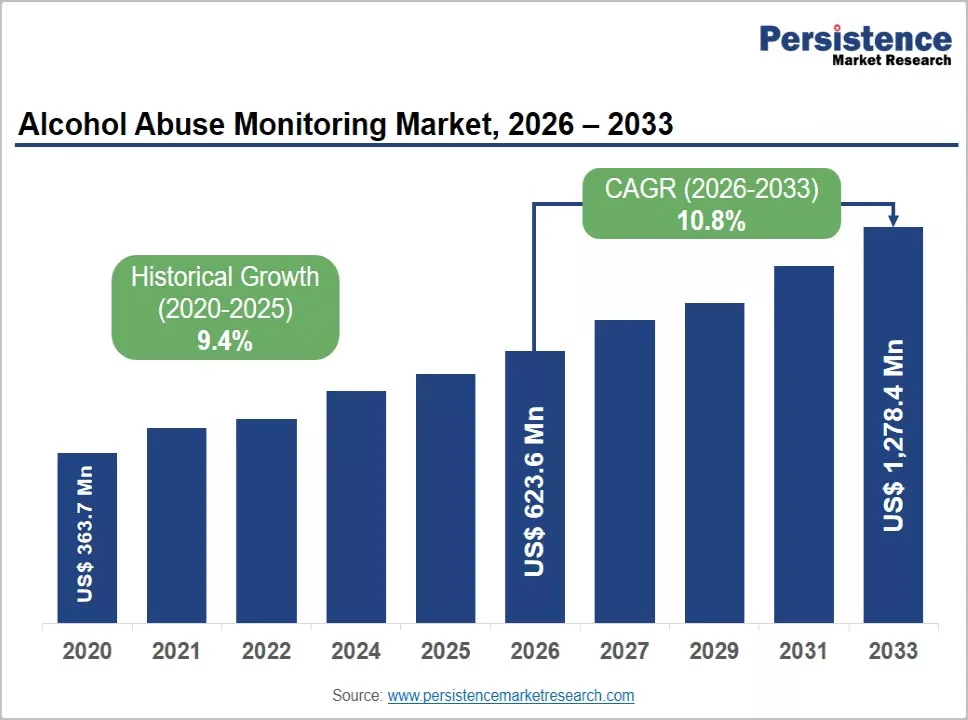
The global alcohol abuse monitoring market size is likely to be valued at US$623.6 million in 2026 and is estimated to reach US$1,278.4 million by 2033, growing at a CAGR of 10.8% during the forecast period from 2026 to 2033, driven by the rising burden of alcohol use disorders, wide adoption of court-ordered monitoring, expansion of remote addiction treatment, and increasing demand for connected alcohol testing devices.
Key Industry Highlights:
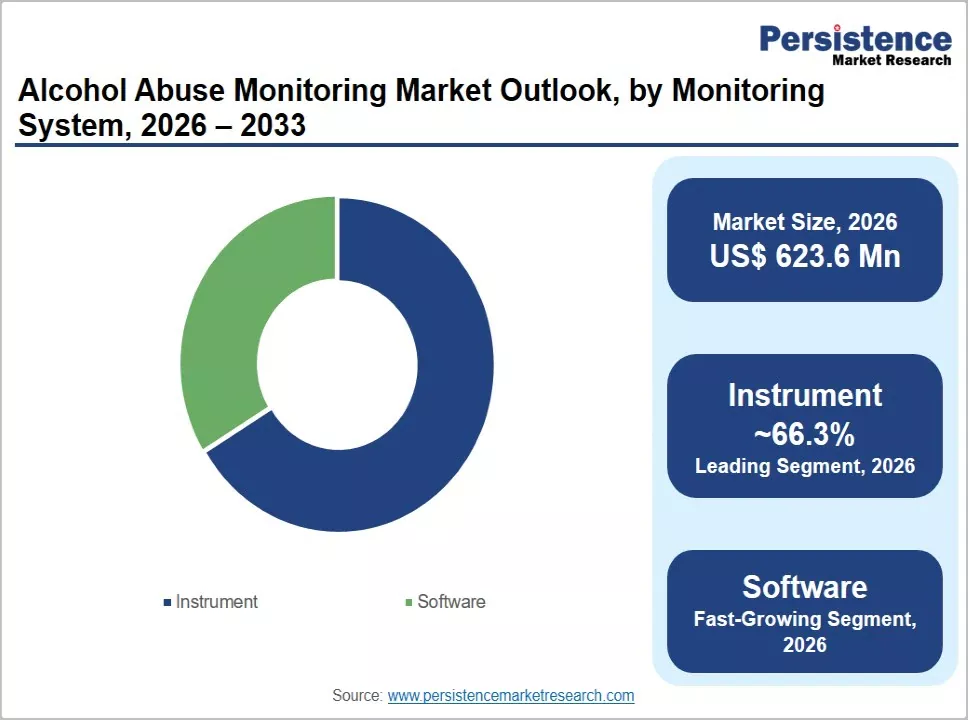
- Leading Monitoring System: Instruments, about 66.3% share in 2026, as these provide time-stamped alcohol readings and can support continuous or repeat testing without relying solely on self-reported drinking.
- Dominant End User: Government departments, around 40.2% share in 2026, as these use alcohol monitoring to enforce court orders, probation conditions, DUI requirements, and public-safety programs where documented compliance is important.
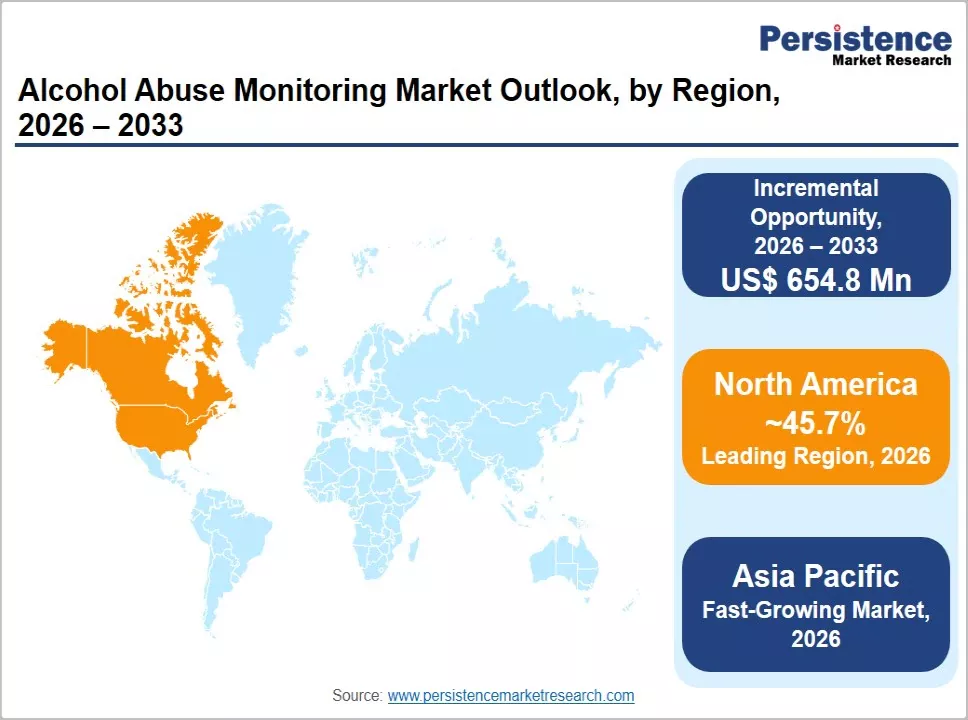
- Leading Region: North America, with about 45.7% share in 2026, owing to its mature DUI, probation, addiction-treatment, workplace-testing, and remote-monitoring infrastructure, supported by established technology suppliers.
- Fast-growing Region: Asia Pacific, as governments strengthen alcohol-control programs, healthcare access expands, and connected monitoring technologies become more available.
- New Launch: In August 2025, Soberlink introduced monthly rental options for its Connect Device, allowing customers to use the monitoring system without paying the full equipment cost upfront. The change was intended to make its technology more accessible in family law, addiction treatment, and workplace compliance programs.
DRO Analysis
Driver - Rising Alcohol Use Disorders to Push Demand for Continuous Monitoring
The large burden of alcohol use disorders is creating a stronger need for objective monitoring during treatment, recovery, and relapse prevention. The World Health Organization (WHO) estimates that about 400 million people aged 15 and older lived with alcohol use disorders, including 209 million with alcohol dependence, based on 2019 data. Alcohol consumption was also linked to about 2.6 million deaths globally in the same year. These figures are encouraging healthcare providers to look beyond occasional screening.
Continuous monitoring can show when drinking occurs between clinical visits, which can help providers identify relapse and adjust treatment. A 2025 pilot study involving 29 people receiving treatment across three South London alcohol services found that wearable transdermal alcohol sensors could be used to collect continuous alcohol data and support contingency-management approaches. This is opening a larger role for wearable monitoring in outpatient treatment, recovery programs, and long-term follow-up.
Wide Use of Electronic Supervision to Augment Device Adoption
Government use of electronic alcohol monitoring is creating a direct and recurring source of demand for monitoring devices and related software. England and Wales provide a key example. Alcohol monitoring had 5,130 people assigned to monitoring equipment at the end of June 2026, up from 4,141 at the end of July 2025. The government also recorded 68,638 new alcohol monitoring orders since the program began.
These systems can continuously monitor alcohol use and identify potential breaches of abstinence conditions. The expansion of such programs is also encouraging suppliers to improve tamper detection, connectivity, reporting, and remote data review. The WHO's 2026 progress report on its SAFER initiative further identifies drink-driving countermeasures, screening, treatment, and stronger alcohol-related monitoring systems as important areas for national action.
Restraint - Sensor Delays and Environmental Effects May Limit Confidence
Transdermal monitoring offers continuous testing, but it does not measure blood alcohol concentration directly. Alcohol must first pass through the body and appear in perspiration, so the timing and strength of the signal can differ from breath or blood measurements. Research also shows that sensor performance can vary with drinking conditions and the surrounding environment.
A 2025 study of a rapid-sampling wearable found strong accuracy for detecting drinking, but its ability to identify specific high-risk BAC levels was more variable. External alcohol exposure and other environmental factors can also require careful signal interpretation. These limitations increase the need for validation, data analysis, and trained review, particularly when monitoring results are used for legal or clinical decisions.
Opportunity - Wearable Sensor Advances to Make Monitoring Less Intrusive
The development of flexible, wearable alcohol sensors presents an opportunity to move monitoring away from bulky or highly visible equipment. New sensor designs are being studied for direct measurement of alcohol-related biomarkers in sweat, allowing devices to collect data passively. This could make continuous monitoring more practical for people receiving addiction treatment, participating in research studies, or following recovery plans.
The opportunity is not limited to detecting whether alcohol was consumed. High-frequency data could help establish drinking patterns and identify changes over time. Research has already shown that transdermal sensors can be worn comfortably by people receiving alcohol treatment, although technical and clinical limitations still need to be addressed. Future products that combine smaller sensors with wireless connectivity could hence expand the use of alcohol monitoring in community-based care.
Digital Platforms to Combine Alcohol Data with Behavioral Monitoring
Another opportunity lies in combining alcohol measurements with digital health information. A connected platform can bring together sensor readings, breath-test results, treatment schedules, self-reported cravings, and other behavioral information. This can give clinicians a more complete view of a patient's recovery between appointments.
The 2025 South London study specifically explored the use of continuous transdermal alcohol data alongside contingency management, showing how monitoring can become part of an intervention rather than simply a compliance tool. Smartphone-based ecological momentary assessment can further add information about mood, cravings, social situations, and possible drinking triggers. This creates opportunities for software companies to develop personalized alerts, relapse-risk analysis, remote counseling workflows, and automated treatment support.
Category-wise Analysis
Monitoring System Insights
Instruments are predicted to lead with a share of about 66.3% in 2026, as breathalyzers, transdermal bracelets, and other dedicated devices generate objective alcohol readings without relying entirely on user self-reporting. Their preference is also supported by their suitability for legal and clinical settings, where automated testing, tamper detection, time-stamped results, and documented readings can provide stronger evidence of compliance than manual reporting.
Software is estimated to be the fastest-growing segment over the forecast period, as monitoring programs need to manage large volumes of test results rather than simply collect an alcohol reading. Modern platforms can organize alerts, testing schedules, participant records, compliance reports, and historical results in one dashboard. SCRAM IQ, for example, brings alcohol testing, drug monitoring, GPS information, and client engagement into a centralized platform. This reduces data silos and can lower the administrative burden on probation teams and treatment providers.
End-User Insights
Government departments are anticipated to dominate with a share of around 40.2% in 2026, as alcohol monitoring is closely linked to probation, courts, corrections, law enforcement, and public safety programs. In England and Wales, electronic monitoring supports probation services, prisons, courts, police, and the wide justice system. By June 2026, 5,130 people were assigned to alcohol monitoring orders, and more than 68,000 alcohol monitoring orders had been imposed since the program began. Government agencies also need objective evidence when monitoring court or license conditions.
Drug rehabilitation centers are expected to remain in the second position in 2026, as these need to extend supervision beyond the clinic. Continuous transdermal sensors can provide information about drinking patterns between appointments, which can help treatment teams identify relapse events and possible triggers. The 2025 South London feasibility trial specifically examined wearable transdermal sensors as part of alcohol treatment after detoxification.
Regional Insights
North America Alcohol Abuse Monitoring Market Trends
North America is predicted to dominate with a global share of approximately 45.7% in 2026, as it has an established ecosystem of breath testing, transdermal monitoring, ignition interlocks, remote treatment, and court-supervision programs, supported by mature digital infrastructure and strong demand from justice and healthcare users. The U.S. also has a large addressable need. NIAAA reported 27.9 million people with past-year alcohol use disorder in 2024, while CDC data indicate that excessive alcohol use contributes to about 178,000 deaths annually in the country.
U.S. Alcohol Abuse Monitoring Market Trends
A share of nearly 62.9% is expected to be held by the U.S. in 2026 in North America, as alcohol monitoring is used across several separate applications, including DUI programs, probation, family courts, addiction treatment, workplace programs, and personal recovery. This creates demand for both mandatory and voluntary monitoring. The country also has a mature supplier base. Companies such as SCRAM Systems, Soberlink, Lifeloc, and Intoxalock offer different combinations of breath testing, transdermal monitoring, reporting, and compliance services. Lifeloc's 2025 filing, for example, describes sales across law enforcement, workplace, corrections, OEM, and consumer markets.
Asia Pacific Alcohol Abuse Monitoring Market Trends
Asia Pacific is anticipated to be the fastest-growing region, as governments strengthen alcohol-control programs, healthcare systems expand addiction services, and digital health technologies become more accessible. The region also has a large population base, which creates significant demand for scalable screening and monitoring solutions. The WHO's South-East Asia program has specifically emphasized evidence-based alcohol control, treatment, and monitoring. In 2026, the WHO's SAFER progress report highlighted screening, brief intervention, treatment, drink-driving countermeasures, and stronger monitoring as important elements of alcohol policy.
China Alcohol Abuse Monitoring Market Trends
China will likely lead in Asia Pacific in 2026 with a regional share of about 38.6%, supported by rising interest in road-safety enforcement, workplace safety, healthcare monitoring, and digital health technologies. Portable breath-testing equipment is relevant because it can be deployed outside hospitals and laboratories. The opportunity is also linked to the wider shift toward connected monitoring. Devices that can transmit results and create digital records are better suited to large organizations than standalone testing equipment. This favors suppliers that combine sensors with software, data management, and remote reporting.
India Alcohol Abuse Monitoring Market Trends
In 2026, India is projected to account for a share of just about 25.5% in Asia Pacific, as it has a large population exposed to alcohol-related health and social risks, creating a substantial need for screening, treatment support, and monitoring. A Government of India and NDDTC-AIIMS survey estimated that about 5.2% of Indians, or more than 5.7 crore people, were affected by harmful or dependent alcohol use. The same government report found that treatment access was very limited, with only about one in 38 people with alcohol dependence reporting treatment.
Europe Alcohol Abuse Monitoring Market Trends
Europe will witness steady growth over the forecast period with a share of roughly 16.5% in 2026 globally, as it has a strong policy focus on reducing alcohol-related harm, which supports demand for screening, monitoring, treatment, and road-safety technologies. The European Commission states that alcohol-related harm accounts for more than 7% of all ill health and early deaths in the EU. The region also maintains the European Information System on Alcohol and Health with WHO cooperation, providing a structured basis for monitoring alcohol-related trends.
Germany Alcohol Abuse Monitoring Market Trends
Germany is predicted to register a substantial regional share of approximately 34.3% in 2026, because it has a large road-safety monitoring requirement, creating demand for accurate breath alcohol testing and related instruments. Destatis recorded about 34,800 alcohol-related road accidents in Germany in 2025, with 170 deaths and 17,900 injuries linked to alcohol-related traffic accidents. This creates continuing demand for reliable roadside testing, workplace testing, and professional alcohol measurement systems.
U.K. Alcohol Abuse Monitoring Market Trends
A share of nearly 22.8% is predicted to be held by the U.K. in 2026 in Europe, as alcohol monitoring has become a formal component of the justice and probation system. The Alcohol Abstinence and Monitoring Requirement allows electronic monitoring of alcohol abstinence for qualifying offenders, while alcohol monitoring on license can be used for selected people released from custody.
Competitive Landscape
The global alcohol abuse monitoring market is fragmented, with competition spread across continuous transdermal monitors, portable breathalyzers, remote testing platforms, ignition-interlock systems, and monitoring software. SCRAM Systems, Soberlink, BACtrack, Lifeloc, Dräger, Intoxalock, and other specialist providers compete by improving detection accuracy, tamper detection, connectivity, reporting, and ease of use. The market is also moving beyond simple alcohol detection.
Vendors are combining instruments with cloud platforms, facial verification, real-time alerts, GPS data, and case-management tools. This is making the software layer more important in court, probation, treatment, and family-monitoring programs. SCRAM CAM, for example, combines continuous bracelet testing with data transmission, analyst review, and reporting, while Soberlink combines portable breath testing with facial recognition and real-time result sharing.
Key Industry Developments:
- In April 2026, Soberlink launched Soberlink 7.0, its seventh-generation alcohol monitoring device. The company positioned the product for family law, addiction treatment, and workplace compliance applications. The launch focused on improving remote sobriety monitoring while retaining the company's portable breath-testing approach.
- In March 2026, the U.K. Ministry of Justice announced a £100 million (approx. $133.6 million) expansion of electronic tagging, including increased use of GPS and alcohol monitoring for offenders. The government said thousands of additional offenders would be subject to enhanced monitoring.
- In January 2026, SCRAM Systems introduced its 2026 product roadmap, which included the new SCRAM CAM Connect continuous alcohol monitoring device. The company said the small device would use Wi-Fi connectivity, with cellular and GPS capabilities planned as part of a more connected supervision system.
Companies Covered in Alcohol Abuse Monitoring Market
- SCRAM Systems
- Soberlink
- BACtrack
- Lifeloc Technologies
- Dräger
- Intoxalock / Mindr
- Smart Start
- LifeSafer
- Alcohol Countermeasure Systems (ACS)
- Lion Laboratories
- AlcoPro
- Intoximeters
- Hound Labs
- Alcohol Monitoring Systems
- Draeger Safety
- Others
Frequently Asked Questions
The global alcohol abuse monitoring market is projected to be valued at US$623.6 million in 2026.
The alcohol abuse monitoring market is expected to reach US$1,278.4 million by 2033.
Key market trends include small wearable sensors, continuous transdermal testing, connected breathalyzers, and cloud-based monitoring.
Instruments are expected to be the leading monitoring system with a share of around 66.3% in 2026, as these combine alcohol detections with features such as tamper alerts, automated data capture, and digital reporting.
The alcohol abuse monitoring market is expected to grow at a CAGR of 10.8% from 2026 to 2033.
SCRAM Systems, Soberlink, and BACtrack are a few key market players.


