




- HVAC
- Air Conditioning Systems Market
Air Conditioning Systems Market Size, Share, and Growth Forecast 2026 - 2033
Air Conditioning Systems Market by Product Type (Package Air Conditioners, Split Air Conditioning Systems, Ductless Mini-Split Systems), Technology (Inverter, Non-Inverter), End Use (Residential, Commercial, Industrial), and Regional Analysis, 2026 - 2033

Air Conditioning Systems Market Size and Trend Analysis
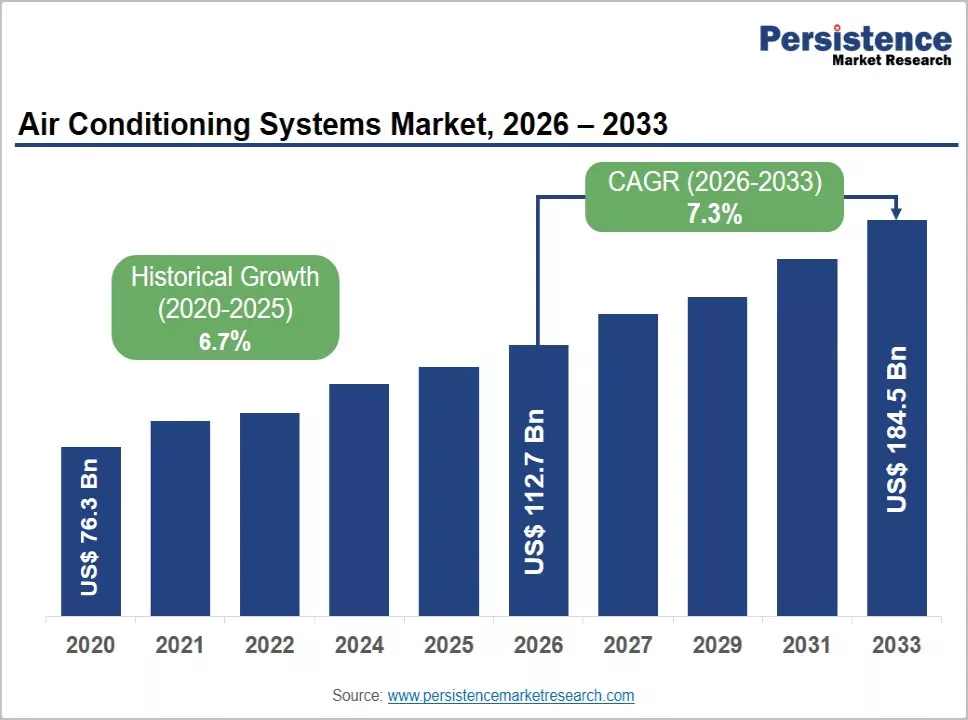
The global air conditioning systems market size is likely to be valued at US$ 112.70 billion in 2026 and is projected to reach US$ 184.55 billion by 2033, growing at a CAGR of 7.3% during the forecast period between 2026 and 2033.
The International Energy Agency (IEA) estimates that the number of air conditioning units in operation globally will reach 5.6 billion by 2050, up from approximately 2 billion todays, signaling sustained structural demand. Urbanization, rising disposable incomes in emerging economies, and tightening building energy codes are compressing adoption timelines, making this market a priority for HVAC manufacturers, real estate developers, and infrastructure-focused institutional investors.
Key Industry Highlights
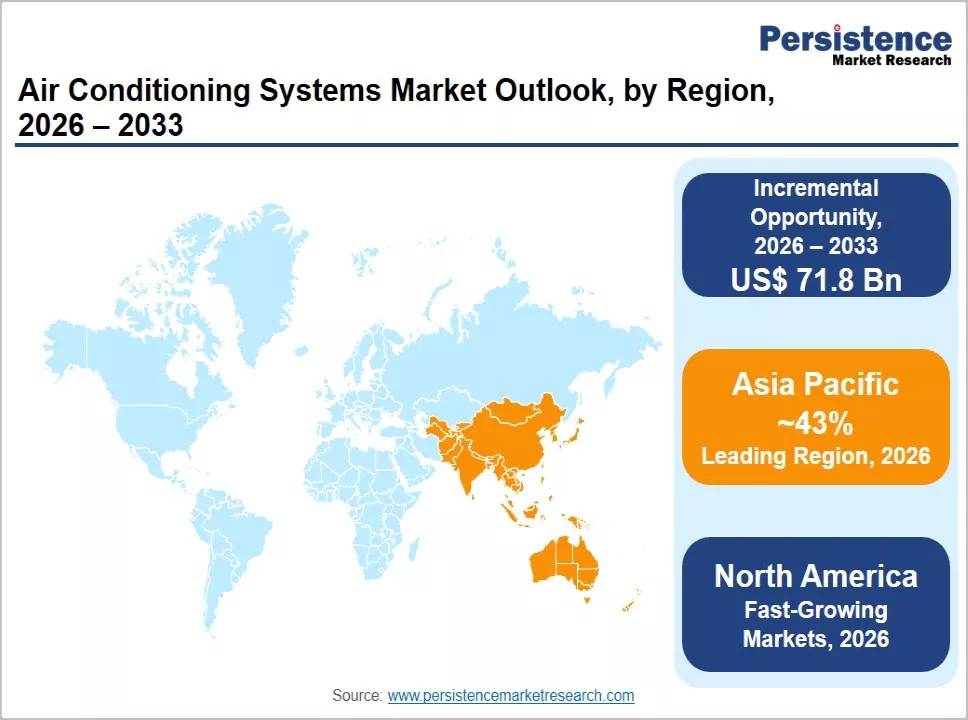
- Dominant Region: Asia Pacific holds 43% of air conditioning systems market share in 2026, and is expanding faster than any other region at an estimated 8.9% CAGR, driven by India's low penetration base and China's scale manufacturing advantage feeding both domestic and export demand.
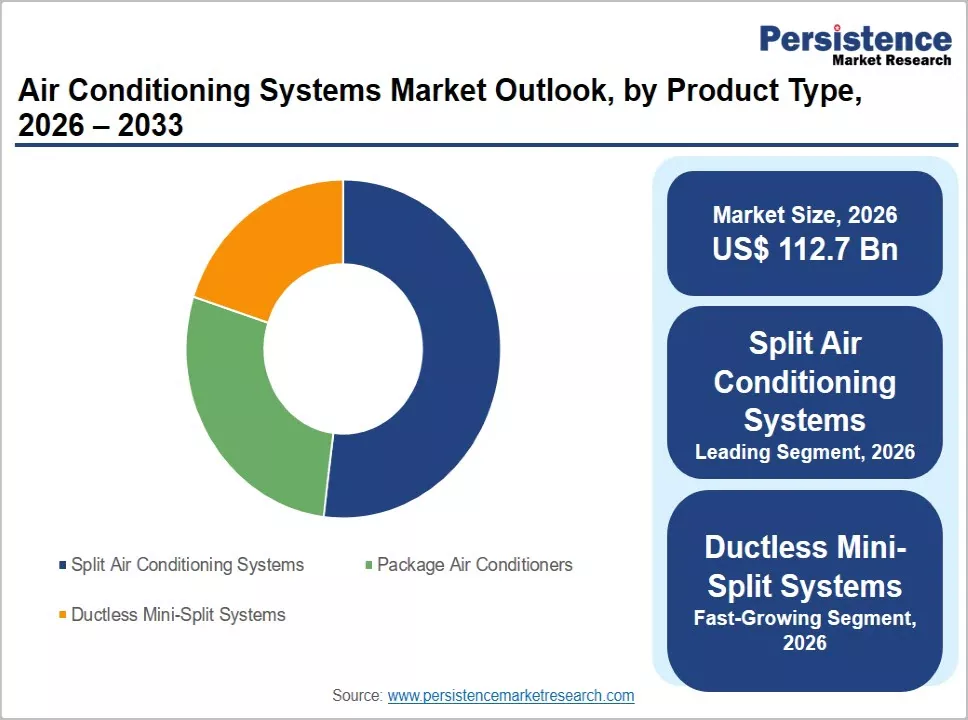
- Leading Product Type: Split air conditioning systems dominate the product landscape with a 52% share in 2026, driven by their versatility across residential and light commercial applications in emerging-market urban construction; this segment is unlikely to cede leadership through the forecast horizon given its entrenched distribution and installation ecosystem.
- Fastest-growing Technology: Inverter technology is structurally displacing fixed-speed systems as energy efficiency mandates from the DOE, EU, and IEA align globally, compressing the operational cost advantage of non-inverter units and accelerating product replacement cycles across all end-use segments.
- Fastest-growing Product Type: Ductless mini-split systems are the fastest-growing product type in the air conditioning systems industry, specifically benefiting from the North American whole-home electrification trend, where the absence of existing duct infrastructure makes traditional central systems cost-prohibitive a gap that manufacturers including Mitsubishi Electric and LG Electronics are actively targeting.
- Fastest-growing End use: The industrial end-use segment represents the most strategically compelling incremental opportunity through 2033, as semiconductor fabrication, data centre densification, and pharmaceutical cold chain expansion create demand for precision-grade cooling systems with performance specifications and pricing power well above the residential or light commercial norm.
DRO Analysis
Drivers- Surging Urbanization and Residential Construction in Emerging Economies
Urban population growth across South and Southeast Asia is generating sustained demand for residential cooling systems. UN-Habitat data indicates that Asia alone will add approximately 1.2 billion urban residents by 2050, the majority concentrated in climatic zones where mechanical cooling is not optional but physiologically necessary.
India's Pradhan Mantri Awas Yojana (PMAY) housing program, targeting 20 million affordable urban homes, has directly expanded the addressable market for entry-level split and window AC units among first-time buyers. Developers across Tier 2 and Tier 3 Indian cities are pre-installing air conditioning infrastructure as a standard feature, shifting purchasing decisions upstream to the construction supply chain rather than the retail consumer.
Restraint- High Upfront Capital Cost and Uneven Consumer Financing Access
Split and ducted central systems carry installed costs that remain prohibitive for a large portion of the addressable population in price-sensitive markets. In Sub-Saharan Africa and parts of Southeast Asia, the installed cost of a mid-range split system factoring labor, electrical upgrades, and equipment frequently exceeds three months of median household income.
Consumer financing infrastructure is underdeveloped in these regions, limiting the conversion of latent demand into actual unit sales. The World Bank has flagged energy access and affordability as co-constraints that slow electrification and cooling penetration in lower-middle-income economies.
Opportunity- Smart HVAC Integration and Building Automation Convergence
The convergence of air conditioning systems with Building Management Systems (BMS) and Internet of Things (IoT) connectivity platforms is opening a high-value upgrade cycle in commercial real estate. Demand-responsive cooling where systems dynamically adjust output based on occupancy sensors, external temperature data, and grid signals is becoming a bankable energy efficiency measure for commercial landlords seeking to meet LEED and BREEAM certification thresholds.
Honeywell International and Siemens Smart Infrastructure have expanded their connected HVAC portfolios specifically to address retrofit opportunities in ageing commercial building stock across North America and Europe. Investors in commercial property should treat smart AC integration as a material factor in both asset valuation and operating cost projections through 2033.
Category-wise Analysis
Why Do Split Air Conditioning Systems Command the Largest Share of the Global Market?
Split air conditioning systems are projected to lead the segment hold nearly 52% of market share in 2026. Their dominance reflects a compelling combination of installation flexibility, targeted room-level cooling, and a price-performance ratio that suits both urban apartments and suburban single-family homes. Property developers across India's high-density residential sector routinely specify wall-mounted split units per bedroom as a standard fixture, while small and medium-sized commercial tenants retail outlets, clinics, and professional offices favor splits for their low installation complexity and independent zone control. The segment's depth across both developed and emerging markets insulates it from concentrated demand-side risk.
Ductless mini-split systems are likely to be the fastest-growing product category. Their acceleration is driven by the North American retrofit market, where older residential housing stock lacks ducting infrastructure. Mitsubishi Electric expanded its Zuba-Central and Mr. Slim ductless product lines significantly in 2023, targeting energy-conscious homeowners undertaking whole-home electrification who face the cost prohibition of full duct installation.
Technology Insights
Non-inverter technology is estimated to dominate the technology segment account around 58% of market share in 2026. This segment retains market leadership primarily in price-sensitive emerging economies where the lower unit acquisition cost outweighs lifecycle energy savings. Commercial operators in markets such as Vietnam, Bangladesh, and parts of sub-Saharan Africa running intermittent cooling schedules where systems operate only during business hours find fixed-speed compressor technology economically rational when total operating hours are low. Wholesale and institutional buyers procuring large volumes for affordable housing projects similarly prioritize sticker cost over efficiency ratings.
Inverter technology is likely to be the fastest-growing segment in the air conditioning systems industry. Variable-speed compressor systems deliver energy savings of 30–50% versus fixed-speed equivalents, per IEA benchmarks, making them the preferred specification under the EU's EPBD and DOE SEER2 standards. LG Electronics launched its updated DualCool Inverter series in 2024 with enhanced ENERGY STAR ratings, targeting North American and European residential replacement cycles accelerating under efficiency mandate timelines.
What Is Driving Industrial End Use Growth in the Market?
The residential is anticipated to lead the end use segment command about 55% of market share in 2026. Residential dominance is structural: the sheer volume of housing units globally, combined with rising AC penetration in markets where ownership rates remain below 30% including India at approximately 8% per IEA data creates a demand base that commercial and industrial segments cannot match in absolute unit terms. First-time homebuyers in Southeast Asia and the Middle East are driving entry-level split system sales, while replacement demand sustains volume in mature markets such as the U.S. and Japan.
Industrial end use is likely to be the fastest-growing segment. Precision temperature control requirements in data center cooling, pharmaceutical cold chain facilities, and semiconductor fabrication plants are generating demand for high-capacity, process-critical air conditioning infrastructure. Samsung Electronics and TSMC semiconductor facility expansions across Arizona and Texas in 2023–2024 have directly increased demand for industrial-grade precision cooling systems with stringent humidity and temperature tolerance specifications.
Regional Insights
North America Air Conditioning Systems Market Trends and Insights
North America is forecast to command nearly 24% of the air conditioning systems market in 2026. The region's market is shaped by a large, ageing installed base approaching end-of-life replacement cycles and a regulatory environment anchored by DOE efficiency standards and state-level Title 24 building codes in California that is systematically redirecting demand toward higher-efficiency systems. Heat pump adoption is complicating traditional AC market boundaries, as units qualifying under both categories capture an expanding share of replacement decisions.
U.S. Air Conditioning Systems Market Size
The U.S. is projected to account around 85% of the North America regional market in 2026. Demand is propelled by one of the world's highest residential AC penetration rates approximately 90% of homes per U.S. Energy Information Administration (EIA) data with replacement cycles now overlapping with efficiency upgrade mandates. The Inflation Reduction Act (IRA) tax credits for high-efficiency cooling equipment are further accelerating premium product adoption through 2033.
Canada Air Conditioning Systems Market Size
Canada is expected to capture nearly 15% of the North America regional market in 2026. Canada's historically lower AC penetration rate driven by temperate northern climates is rising as heat dome events in British Columbia and Ontario increase residential demand. Natural Resources Canada's energy efficiency labelling program is guiding buyers toward inverter-based systems, supporting premium segment growth through the forecast period.
Europe Air Conditioning Systems Market Trends and Insights
Europe is anticipated to command about 10% of market share in 2026, representing US$ 22.54 Billion. The region is undergoing a structural market transition: historically low AC penetration in Northern and Central Europe is rising sharply following successive extreme heat summers since 2022, while the European Commission's REPowerEU plan is accelerating heat pump and high-efficiency cooling investment across member states. Regulatory alignment with the EU Ecodesign Regulation is simultaneously winnowing out low-efficiency product SKUs.
Germany Air Conditioning Systems Market Size
Germany is expected to account nearly 21% of the Europe regional market in 2026. Germany's combination of dense commercial building stock and an aggressive building decarbonization agenda under the Gebäudeenergiegesetz (GEG) building energy law is generating strong demand for integrated heating and cooling solutions. Industrial cooling for automotive and chemical sector facilities provides a stable baseline demand that insulates the market from purely weather-driven variability.
U.K. Air Conditioning Systems Market Size
The U.K. is likely to hold around 16% of the Europe regional market in 2026. The UK's Future Homes Standard, targeting implementation by 2025, mandates significant reductions in carbon emissions from new residential construction, structurally favoring heat pump-integrated cooling over standalone conventional systems. Post-Brexit alignment uncertainty on F-gas regulations governing refrigerant phase-down timelines adds a near-term procurement planning dimension for commercial facility managers.
Which Region Will Likely Dominate the Air Conditioning Systems Market Through 2033?
Asia Pacific is forecast to dominate and capture around 43% of market share during the forecast period between 2026 to 2033. Rising middle-class incomes, dense urban construction, and climatic conditions across South and Southeast Asia combine to produce demand conditions unmatched in any other geography. China's domestic manufacturing scale and India's policy-driven housing expansion are the twin engines of this trajectory.
China Air Conditioning Systems Market Size
China is projected to hold nearly 38% of the Asia Pacific regional market in 2026. Midea and Haier Group dominate domestic distribution channels, benefiting from deep manufacturing integration and competitive pricing that sustains high unit volumes despite slowing real estate construction starts. China's 14th Five-Year Plan targets on green building certification are sustaining inverter system demand within the premium residential and commercial segments through 2025 and beyond.
India Air Conditioning Systems Market Size
India is estimated to hold around 17% of the Asia Pacific regional market in 2026. India's AC penetration rate remains among the lowest globally relative to its climatic exposure, and the government's National Cooling Action Plan (NCAP) explicitly targets expanding access while shifting the installed base toward low-global-warming-potential refrigerants. Voltas a Tata Group subsidiary and India's largest room AC brand by volume is expanding manufacturing capacity in anticipation of sustained double-digit domestic demand growth.
Competitive Landscape
The global air conditioning systems market operates as a moderately concentrated global oligopoly, with Daikin Industries, Ltd., Carrier, Midea, LG Electronics, and Mitsubishi Electric collectively commanding a substantial share of global revenues. Competition is waged primarily across three dimensions: energy efficiency ratings securing regulatory compliance and procurement preference, distribution network depth in rapidly growing emerging markets, and smart connectivity integration differentiating premium product tiers.
Panasonic Corporation, Samsung Electronics Co. Ltd., and Johnson Controls – Hitachi Air Conditioning Company occupy strong positions in specific regional and application segments. Smaller regional players including Voltas in India and Trane Technologies plc in North America defend market share through service infrastructure depth rather than technology primacy.
Key Industry Developments
- In October 2026, Samsung India launched the Infinite One-Way Cassette Air Conditioner, expanding its commercial air conditioning portfolio with an AI-powered cooling solution designed for premium homes, offices, hospitality venues, and commercial spaces. The new air conditioner combined Wide WindFree Cooling Technology, Ambient Edge Lighting, and SmartThings connectivity to deliver intelligent climate control and enhanced interior aesthetics. The product featured nine ambient lighting modes inspired by human circadian rhythms, including warm, natural, and cool lighting options, while its Smart Lighting Intensity mode automatically adjusted brightness according to surrounding conditions.
- In January 2025, Panasonic Corporation launched its OASYS Residential Central Air Conditioning System in the U.S. through its Heating & Ventilation A/C Company. Designed for highly airtight and well-insulated homes, the system integrated a Mini Split Air Conditioner, Energy Recovery Ventilator (ERV), and DC motor-driven transfer fans to deliver efficient heating, cooling, and ventilation. Panasonic developed the solution to reduce energy consumption for heating and air conditioning by more than 50% compared with conventional systems.
Companies Covered in Air Conditioning Systems Market
- DAIKIN INDUSTRIES, Ltd.
- Carrier.
- Haier Group
- Johnson Controls - Hitachi Air Conditioning Company
- Lennox International Inc.
- LG Electronics.
- Midea.
- Mitsubishi Electric India Pvt. Ltd.
- Panasonic Corporation
- Samsung Electronics Co. Ltd.
- ALFA LAVAL
- Electrolux
- Trane Technologies plc
- Whirlpool
- Voltas, Inc.
Frequently Asked Questions
The global air conditioning systems market is valued at US$ 112.70 billion in 2026.
Escalating frequency of extreme heat events are increasing first-time AC adoption in historically under-penetrated markets, thereby pushing market growth.
Split air conditioning systems hold the largest share at 52% in 2026, favored for their room-level zone control, ease of retrofit installation in existing buildings, and competitive price points accessible to mid-income residential buyers.
Asia Pacific dominates the market with a 43% share in 2026, anchored by China's large-scale domestic manufacturing base and India's rapidly expanding urban residential construction pipeline.
The highest-value opportunity in the market lies in smart HVAC integration within commercial real estate, where building owners seeking LEED and BREEAM certification are investing in demand-responsive cooling connected to building automation platforms.
Daikin Industries, Ltd., Carrier, Midea, LG Electronics, and Mitsubishi Electric are the leading companies.


