




- Nutraceuticals & Functional Foods
- Spirulina Market
Spirulina Market Size, Share, Growth, and Regional Forecast, 2026 - 2033
Spirulina Market by Spirulina Type (Arthrospira Platensis, Arthrospira Maxima and Others), by Form (Powder, Tablet, Capsule, Liquid, and Flakes), by Application (Nutraceuticals, Food & Beverages, Cosmetics & Personal Care, Animal Feed & Aquaculture, Pharmaceuticals, and Others) by Distribution Channel (Supermarkets, Online Retail, Specialty Stores, Pharmacies, and Others), and Regional Analysis from 2026 - 2033

Spirulina Market Share and Trend Analysis
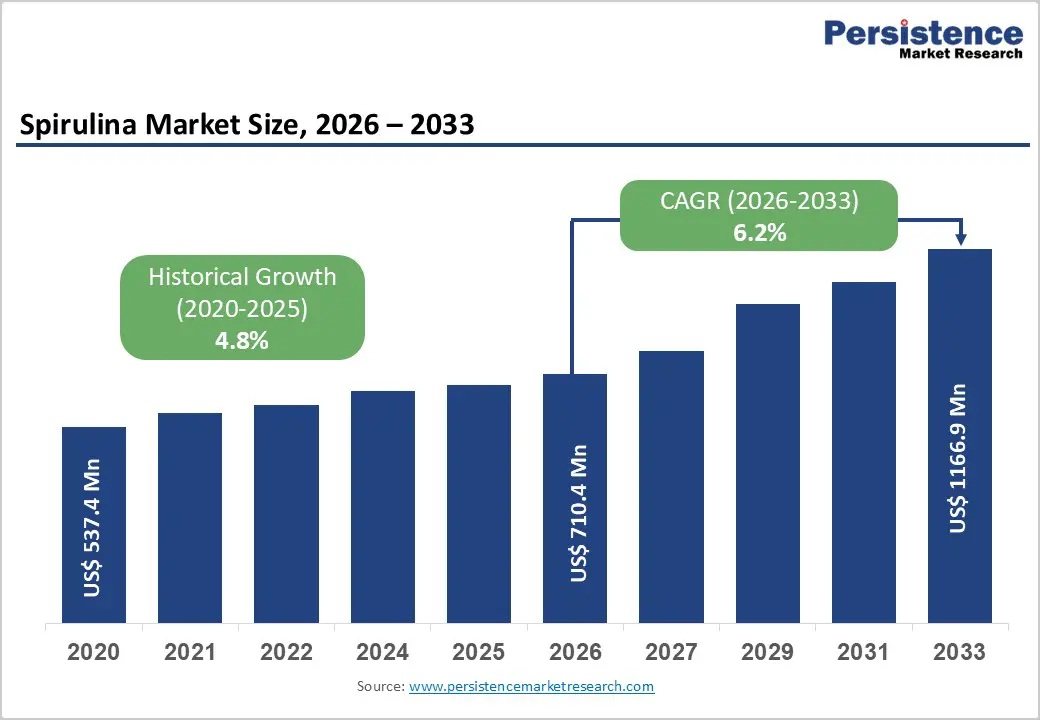
The global spirulina market size is estimated to grow from US$ 710.4 million in 2026 to US$ 1166.9 million by 2033. The market is projected to record a CAGR of 6.2% during the forecast period from 2026 to 2033. Growing global interest in nutrient-dense, plant-based ingredients is significantly shaping the trajectory of spirulina demand across multiple industries.
Widely recognized for its high protein content, essential micronutrients, and antioxidant properties, spirulina is increasingly incorporated into dietary supplements, functional foods, and beverages. Changing consumer preferences toward preventive healthcare and natural wellness solutions have accelerated its adoption, particularly in formats such as powders, capsules, and fortified consumables.
Rising urban population and fast-paced lifestyles are encouraging the use of convenient, ready-to-consume nutrition products, further supporting market penetration. Additionally, food manufacturers are exploring spirulina as a multifunctional ingredient to enhance nutritional value, improve product positioning, and cater to clean-label requirements.
Technological advancements in algae cultivation and processing are also enabling better yield efficiency and consistent quality across large-scale production systems. Additionally, growing demand for sustainable protein alternatives is strengthening its relevance in modern food systems. Expanding distribution networks, increasing consumer awareness, and ongoing innovation in application areas are expected to support steady long-term growth.
Key Industry Highlights:
- Leading Region: North America holds 48.5% of global revenue, supported by strong nutraceutical consumption, advanced algae production capabilities, and high awareness of superfood-based supplements.
- Fastest-Growing Region: Asia Pacific is the fastest-growing market, driven by increasing health awareness, expanding middle-class population, and rising demand for plant-based nutritional products.
- Leading Type Segment: Arthrospira platensis dominates with 73.9% share, attributed to its superior nutritional profile, high protein concentration, and suitability for large-scale commercial cultivation.
- Fastest-Growing Type Segment: Arthrospira maxima is witnessing strong growth due to increasing interest in alternative strains and expanding applications in specialized formulations.
- Leading Form Segment: Powder leads the segment due to its versatility, extended shelf life, and ease of incorporation into supplements, foods, and beverages.
- Fastest-Growing Form Segment: Tablet is gaining traction as consumers prefer convenient, pre-measured formats that support easy daily intake and portability.
| Global Market Attributes | Key Insights |
|---|---|
| Spirulina Market Size (2026E) | US$ 710.4 Mn |
| Market Value Forecast (2033F) | US$ 1166.9 Mn |
| Projected Growth (CAGR 2026 to 2033) | 6.2% |
| Historical Market Growth (CAGR 2020 to 2025) | 4.8% |
Market Dynamics
Driver - Rising Demand for Plant-Based Superfoods and Nutrient-Rich Dietary Supplements
A key force accelerating industry expansion is the increasing global shift toward plant-based nutrition and functional superfoods. Spirulina, recognized for its high protein content, essential amino acids, vitamins, and antioxidants, is gaining strong traction among health-conscious consumers.
The growing prevalence of lifestyle-related conditions such as obesity, fatigue, and immunity concerns has significantly boosted demand for natural dietary supplements that support preventive healthcare. Urbanization and evolving dietary habits have led consumers to seek convenient yet nutritionally dense products, driving the adoption of spirulina in powders, tablets, capsules, and ready-to-mix beverages.
Additionally, the rapid expansion of the global nutraceutical industry and e-commerce health platforms has improved accessibility and consumer awareness. Food and beverage manufacturers are also incorporating spirulina into smoothies, energy bars, and fortified foods to enhance nutritional profiles.
Sustainability considerations further contribute to market growth, as spirulina requires minimal land and water compared to traditional protein sources. Increasing investments in algae cultivation technologies and product innovation are reinforcing supply capabilities, supporting long-term demand growth across both developed and emerging markets.
Restraints - Production Challenges and Quality Standardization Issues in Algae Cultivation
One of the primary constraints affecting market development is the complexity associated with large-scale spirulina cultivation and quality control. Production requires highly controlled environmental conditions, including optimal temperature, pH levels, and light exposure, making it sensitive to climatic fluctuations and operational inconsistencies. Any deviation in these parameters can impact yield quality, contamination risks, and overall productivity.
Additionally, maintaining standardized nutrient composition across batches remains a challenge for manufacturers, particularly in open pond systems where environmental exposure can lead to variability. Contamination from unwanted microorganisms or heavy metals can also raise safety concerns, necessitating stringent quality testing and monitoring processes. These requirements increase production costs and limit scalability for smaller producers.
Moreover, the high cost of spirulina compared to conventional protein sources, which can limit its adoption in price-sensitive markets. Regulatory frameworks governing dietary supplements and food ingredients further add complexity, as manufacturers must comply with strict safety, labeling, and certification standards. Together, these production and regulatory challenges can hinder rapid market expansion.
Opportunity - Expanding Applications in Functional Foods, Natural Colorants, and Sustainable Nutrition
Significant growth potential lies in the diversification of spirulina applications beyond traditional supplements into functional foods, beverages, and natural ingredient systems. Increasing demand for clean-label and naturally derived ingredients has positioned spirulina as a valuable alternative to synthetic additives, particularly as a natural blue and green colorant in food and beverage products.
This application is gaining traction as regulatory bodies and consumers push for reduced use of artificial dyes. The rising popularity of plant-based diets and alternative proteins also presents strong opportunities for spirulina as a sustainable protein source. Food manufacturers are exploring its incorporation into meat substitutes, dairy alternatives, and high-protein snacks to enhance nutritional value while maintaining environmental sustainability.
Emerging markets offer additional growth avenues due to improving economic conditions, rising health awareness, and expanding retail infrastructure. Advancements in cultivation technologies, including closed-loop systems and photobioreactors, are improving production efficiency and scalability. Furthermore, ongoing research into spirulina’s potential benefits in pharmaceuticals, cosmetics, and biotechnology applications continues to unlock new commercial possibilities, supporting long-term market expansion.
Category-wise Analysis
By Spirulina Type Insights
Arthrospira platensis is projected to hold 52.3% of the global spirulina market revenue in 2026, establishing it as the dominant species in commercial production. Its leadership is primarily driven by its high protein concentration, rich phycocyanin content, and balanced amino acid composition, making it highly suitable for nutraceutical and food applications. The species is widely cultivated due to its adaptability to controlled environments and higher yield efficiency compared to alternatives.
Additionally, its compatibility with large-scale open pond and photobioreactor systems supports cost-effective mass production. Growing demand for plant-based protein and functional superfoods has further strengthened its adoption across dietary supplements, fortified foods, and beverages. Manufacturers also favor this strain due to its stability in processing and ease of incorporation into powders, tablets, and extracts. Continuous advancements in cultivation technologies and strain optimization are further enhancing productivity, reinforcing its dominant market position globally.
By Application Insights
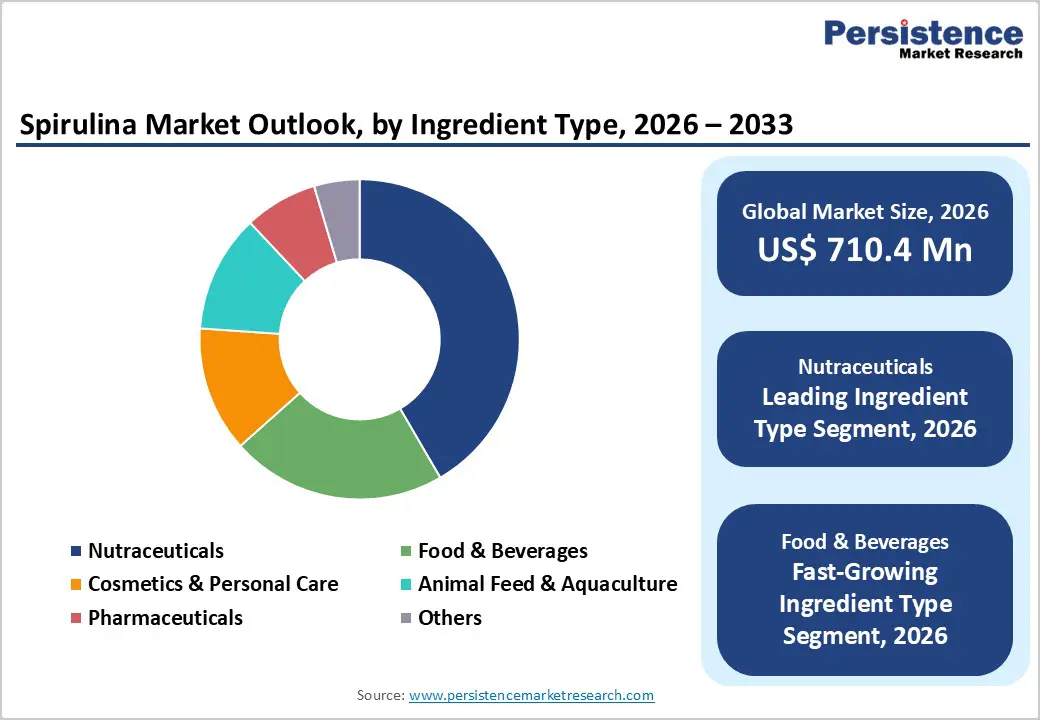
The nutraceuticals segment is expected to account for 41.6% of the global spirulina market in 2026, driven by its widespread use in dietary supplements and functional nutrition products. Spirulina’s rich composition of proteins, vitamins, antioxidants, and essential minerals makes it a preferred ingredient in preventive healthcare formulations.
Increasing consumer focus on immunity enhancement, energy boosting, and overall wellness has significantly boosted its consumption in capsule, tablet, and powder formats. The rise of lifestyle-related health concerns and the shift toward natural, plant-based supplements have further accelerated demand within this segment. Nutraceutical manufacturers are increasingly incorporating spirulina into combination products such as multivitamins, detox supplements, and protein blends.
Additionally, the expansion of e-commerce health platforms and global supplement brands has improved accessibility and consumer awareness. Innovation in flavored and easy-to-consume formats is also supporting wider adoption, solidifying nutraceuticals as the leading application segment.
By Distribution Channel Insights
Supermarkets are estimated to capture 27.3% of total spirulina market revenue in 2026, highlighting their importance as a primary retail channel. These outlets offer extensive product visibility, enabling consumers to access a wide variety of spirulina-based products including powders, tablets, and fortified food items under one roof.
Their structured retail environment supports brand comparison, promotional pricing, and impulse purchasing behavior. The increasing availability of health and wellness sections within supermarkets has further enhanced product placement for spirulina-based supplements and foods. In addition, established supply chain systems ensure consistent stock availability and efficient distribution across urban and semi-urban regions. Retail chains are also expanding their private-label health product offerings, contributing to competitive pricing and wider adoption. The growing consumer inclination toward convenient, one-stop shopping experiences continues to strengthen the role of supermarkets in spirulina distribution globally.
Regional Insights
North America Spirulina Market Trends
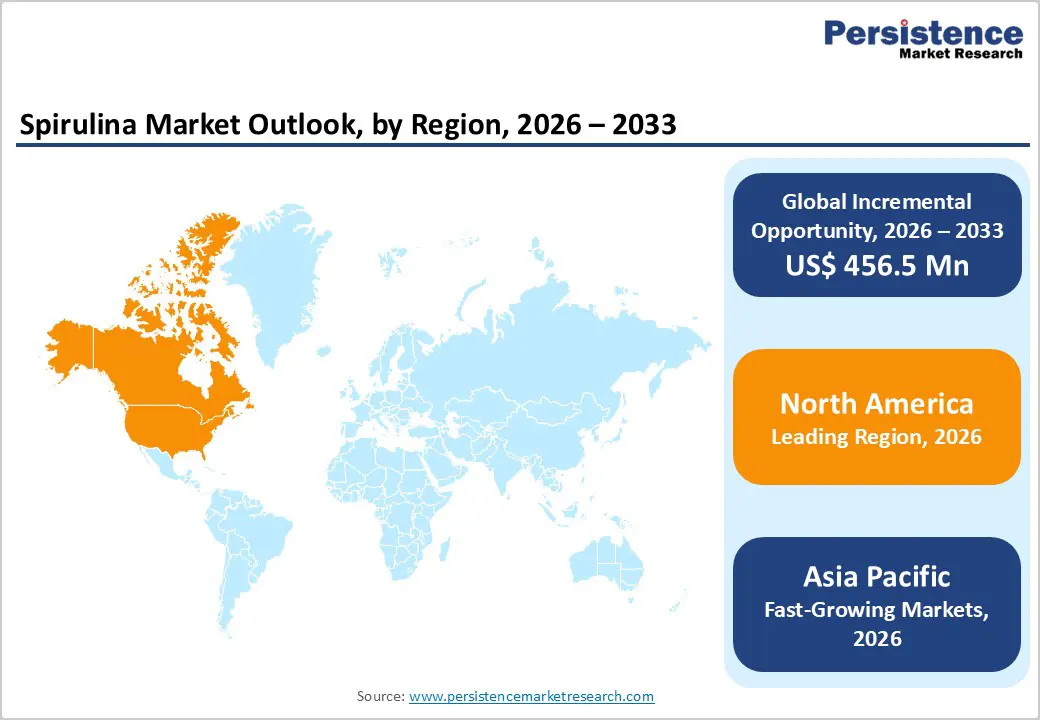
North America is projected to account for 48.5% of the global spirulina market revenue in 2026, making it the leading regional market. This dominance is supported by a well-established nutraceutical industry, high consumer awareness regarding superfoods, and strong demand for plant-based dietary supplements.
The United States plays a central role, driven by a mature health and wellness ecosystem and widespread consumption of functional nutrition products. Consumers in the region increasingly prefer natural and organic supplements, leading to higher adoption of spirulina in protein powders, energy drinks, and immunity-boosting formulations.
The presence of advanced cultivation facilities and technological capabilities also enables large-scale, high-quality production. Moreover, strong distribution networks, including online platforms and retail chains, ensure widespread product availability. Continuous innovation in algae-based ingredients, along with increasing investment in sustainable food sources, further supports regional growth. The integration of spirulina into mainstream health products continues to reinforce North America’s leadership position.
Europe Spirulina Market Trends
Europe represents a mature yet steadily expanding market for spirulina, supported by increasing demand for natural, organic, and sustainable food ingredients. Countries such as Germany, France, the United Kingdom, Italy, and Spain contribute significantly due to strong consumer inclination toward clean-label and plant-based products.
The region’s regulatory framework emphasizes product quality, traceability, and labeling transparency, encouraging manufacturers to develop high-standard spirulina formulations. There is growing interest in spirulina as a natural colorant and protein source across food and beverage applications.
Additionally, consumers are actively seeking environmentally sustainable alternatives, which aligns with spirulina’s low-resource cultivation profile. The nutraceutical sector remains a key contributor, with rising consumption of dietary supplements supporting steady demand.
Research institutions and food technology companies across Europe are also exploring innovative applications of microalgae in functional foods. Although growth is moderate compared to emerging markets, consistent product innovation and sustainability-driven consumption patterns ensure stable expansion across the region.
Asia Pacific Spirulina Market Trends
Asia Pacific is anticipated to be the fastest-growing regional market, registering a CAGR of approximately 8.4% from 2026 to 2033. Rapid urbanization, rising disposable incomes, and increasing awareness of nutritional supplements are key factors driving regional demand. Countries such as China, India, Japan, and South Korea are witnessing significant growth in spirulina consumption, particularly in dietary supplements and functional foods.
The region benefits from favorable climatic conditions for large-scale spirulina cultivation, enabling cost-efficient production. Local manufacturers are expanding production capabilities, while international companies are strengthening their presence through partnerships and distribution networks. Increasing health consciousness, along with government initiatives promoting nutritional security, is further supporting market growth.
The expansion of e-commerce platforms has also improved product accessibility across urban and rural areas. Additionally, rising demand for plant-based proteins and sustainable food sources is accelerating adoption, positioning Asia Pacific as a high-growth region in the global spirulina market.
Competitive Landscape
The global spirulina market is highly competitive, with strong participation from companies such as Cyanotech Corporation, Sensient Technologies Corporation, NB Laboratories Pvt. Ltd., DIC Corporation, Fuqing King Dnarmsa Spirulina Co., Ltd., and Evergreen Agro Creations. These players leverage strong cultivation capabilities, advanced processing technologies, and global distribution networks.
Competitive strategies focus on organic certification, high-purity formulations, and functional ingredient development for nutraceuticals and food applications. Companies are investing in sustainable algae farming, product innovation, and capacity expansion to meet rising global demand for plant-based proteins and natural ingredients.
Key Developments:
- In May 2025, ScotBio advanced plans to expand into new markets by developing a high-value food ingredient derived from spirulina. In collaboration with the Scottish Centre for Food Development and Innovation, the company evaluated its functional properties, including emulsifying and binding capabilities for food applications. The project received feasibility funding support from the Industrial Biotechnology Innovation Centre.
- In June 2024, Khalifa Economic Zones Abu Dhabi partnered with Astha Biotech by signing a lease agreement to establish a new facility in KEZAD Al Ain. The development is aimed at strengthening regional production capabilities and supporting the growth of biotechnology and sustainable ingredient manufacturing in the UAE.
Companies Covered in Spirulina Market
- Cyanotech Corporation
- Sensient Technologies Corporation
- NB Laboratories Pvt. Ltd.
- DIC Corporation
- Fuqing King Dnarmsa Spirulina Co., Ltd.
- Evergreen Agro Creations
- Indian Agri Farm
- Alpspure Lifesciences Private Limited
- Ideal Natural Extract
- Lifevision Healthcare
- Grenera Nutrients Private Limited
- Far East Bio-Tec Co., Ltd.
- E.I.D. - Parry (India) Limited
- Earthrise Nutritionals, LLC
- Zhejiang Binmei Biotechnology Co., Ltd.
- Others
Frequently Asked Questions
The global spirulina market is projected to be valued at US$ 710.4 Mn in 2026.
Rising demand for plant-based, nutrient-dense superfoods and preventive healthcare solutions is driving spirulina adoption globally.
The global spirulina market is poised to witness a CAGR of 6.2 % between 2026 and 2033.
Expansion into high-value applications such as natural food colorants, cosmetics, and sustainable protein solutions presents significant growth opportunities.
Cargill, Incorporated, Archer-Daniels-Midland Company (ADM), Associated British Foods plc (AB Mauri), Puratos Group, International Flavors & Fragrances Inc. (IFF), and Bakels Group are some of the key players in the spirulina market.


