Natural Food Colors Market Size, Share, Growth, and Regional Forecast, 2026 to 2033

Natural Food Colors Market by Product Type (Carotenoids, Anthocyanins, Curcumin, Carmine, Chlorophyll, Others), by Form (Dry, Liquid), by End-user (Beverages, Bakery & Confectionery, Processed Foods, Meat Products, Pharmaceuticals & Nutraceuticals, Others), by Regional Analysis, 2026 - 2033

ID: PMRREP27616
Calendar

January 2026

199 Pages

Author : Amol Patil

Key Industry Highlights

  • Leading Region: North America, holding approximately 37% market share, driven by aggressive removal of synthetic dyes, retailer-led clean-label mandates, and strong investment in fermentation-derived and application-optimized natural color solutions.
  • Fastest-Growing Region: Asia Pacific, supported by rapid adoption of packaged foods, rising preference for plant-based ingredients, local sourcing advantages, and strong regulatory encouragement for natural additives across India, China, Japan, and South Korea.
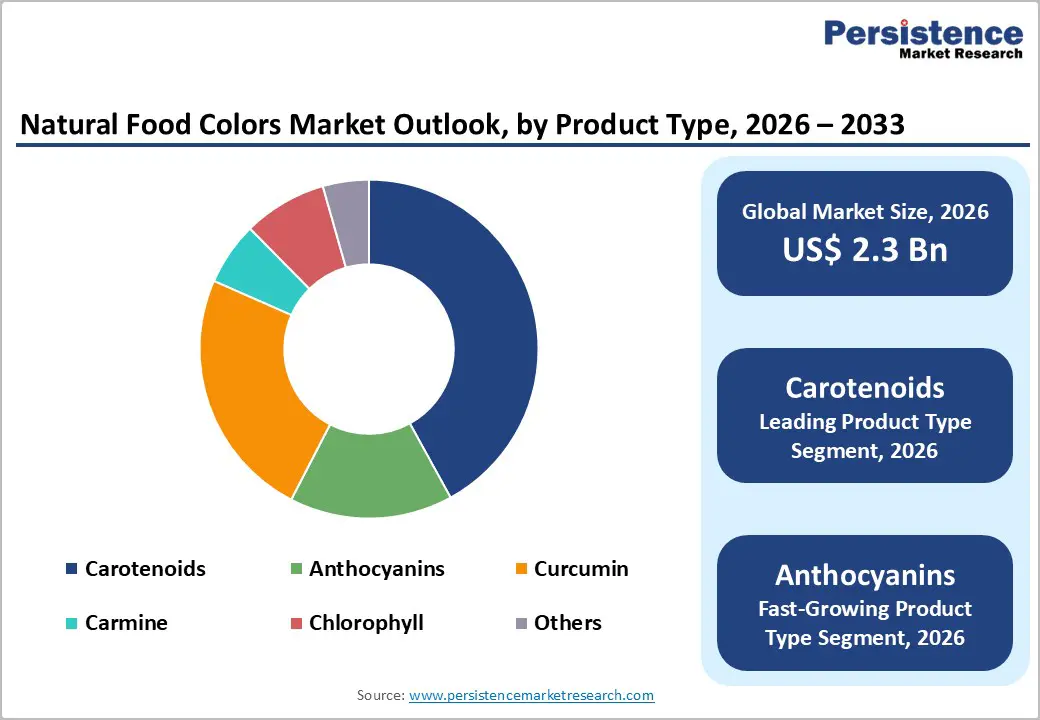
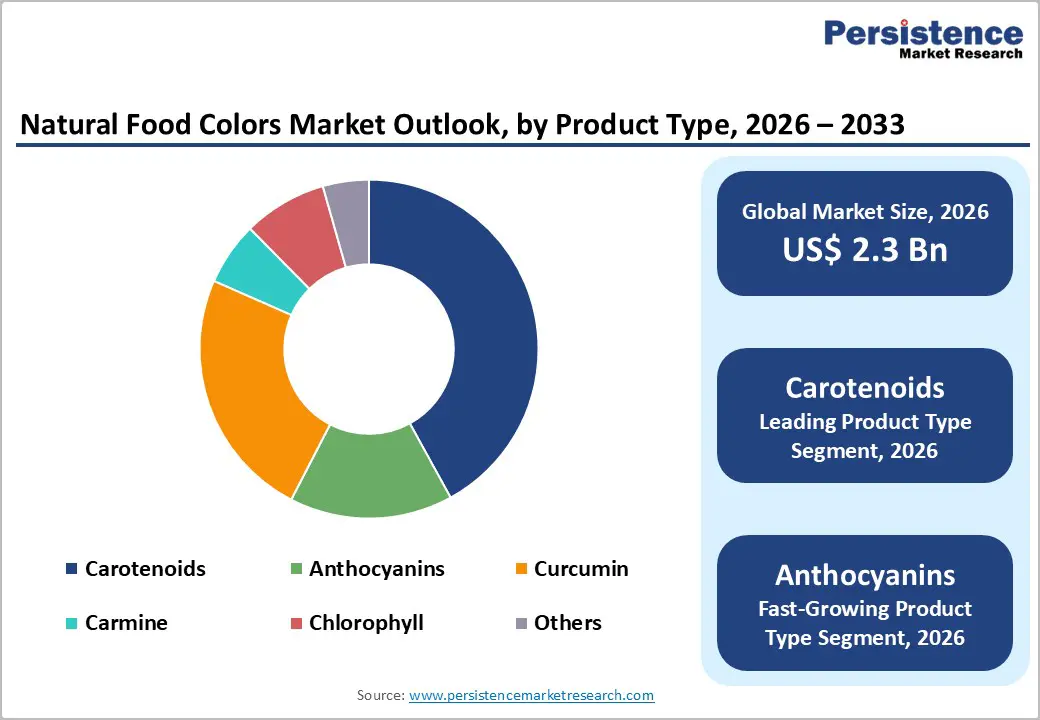
  • Dominant Product Type Segment: Carotenoids, accounting for around 41% market share, favored for their formulation versatility, stability across food matrices, broad color spectrum, and compatibility with clean-label and health-positioned products.
  • Fastest-Growing End-user Segment: Meat Products, propelled by reformulation away from artificial curing agents, rising clean-label processed meat demand, and increased use of natural pigments to achieve consistent visual cues in fresh and processed formats.
  • Market Drivers: Growing preference for natural ingredients perceived as safer alternatives, reinforced by ingredient transparency, retailer audits, regulatory tightening, and consumer distrust of synthetic additives in everyday foods.
  • Market Opportunities: Customization of color solutions for plant-based meat and dairy, enabling realistic visual transitions, allergen-free compliance, and application-specific differentiation for both established players and innovation-driven startups.
  • Key Developments: In June 2025, Kraft Heinz committed to eliminating FD&C colors from its U.S. portfolio by 2027. In May 2025, the U.S. FDA approved three new natural color additives. In February 2025, Oterra expanded regional capabilities with a new blending and application center in Kerala, India.
Key Insights Details
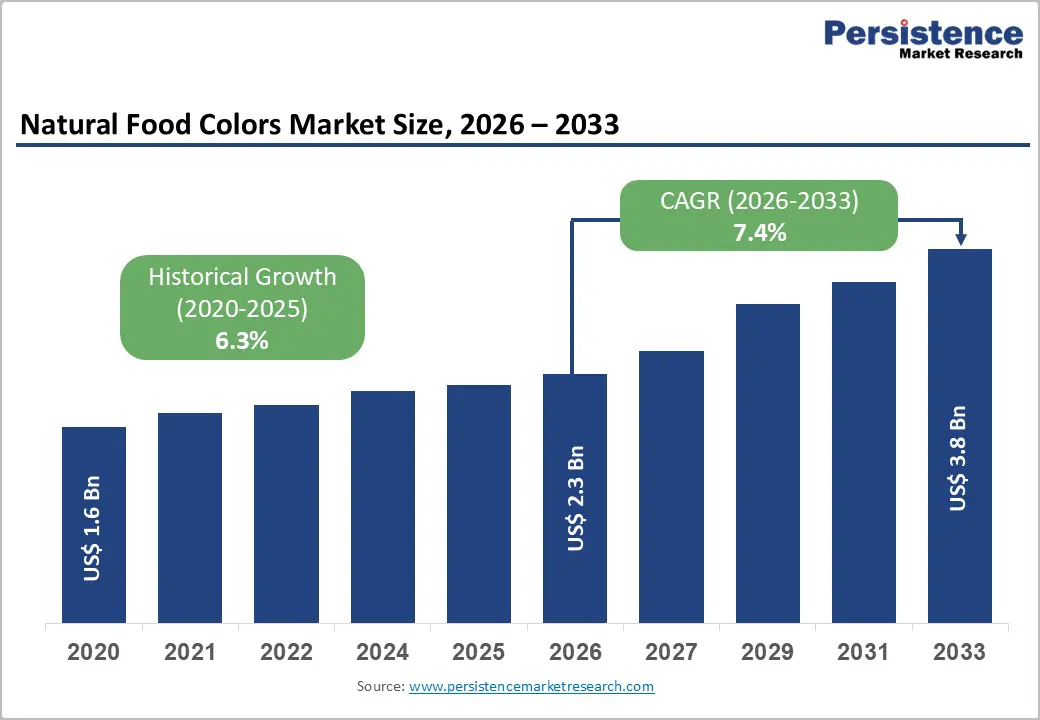
Natural Food Colors Market Size (2026E) US$ 2.3 Bn
Market Value Forecast (2033F) US$ 3.8 Bn
Projected Growth (CAGR 2026 to 2033) 7.4%
Historical Market Growth (CAGR 2020 to 2025) 6.3%

natural-food-colors-market-size-2026–2033

Market Dynamics

Driver - Growing preference for natural ingredients perceived as safer alternatives

Consumer trust is being reshaped by ingredient transparency, pushing food brands toward colors derived from recognizable botanical and microbial sources. Shoppers increasingly associate plant-based pigments with lower health risks, fewer chemical residues, and improved long-term safety, particularly in products consumed by children and health-conscious adults. This perception is accelerating reformulation efforts as manufacturers respond to scrutiny over synthetic additives, particularly in beverages, confectionery, and dairy products. Natural food colors benefit from alignment with clean-label narratives that prioritize simplicity, traceability, and minimal processing.

Regulatory tightening and retailer-led ingredient audits further reinforce this shift, prompting food producers to proactively replace artificial dyes. Natural pigments also support brand storytelling around wellness, sustainability, and authenticity. As ingredient literacy improves globally, perceived safety is evolving into a competitive differentiator, making natural food colors an essential input rather than an optional enhancement.

Restraints - Limited color spectrum & consistency

Achieving vibrant, repeatable shades remains a persistent challenge for natural food colors due to biological variability in raw materials. Pigment concentration can fluctuate with climate, harvest timing, and crop genetics, leading to batch-to-batch inconsistency. This variability complicates large-scale food production where uniform appearance is critical for brand identity, shelf appeal, and consumer trust across regions.

Functional limitations also restrict the available color range, particularly for stable blues, intense reds, and heat-resistant greens. Many natural pigments degrade under light, oxygen, or thermal processing, narrowing their applicability in baked goods, ready meals, and long shelf-life beverages. These constraints increase formulation complexity, raise production costs, and slow adoption among manufacturers seeking predictable performance at an industrial scale.

Opportunity - Formulations Customization of Color Solutions for Plant-Based Meat and Dairy

Visual realism has become central to the success of plant-based meat and dairy, creating strong demand for customized color systems that mimic animal-derived products. Natural food color suppliers are uniquely positioned to develop tailored pigment blends that replicate raw-to-cooked meat transitions, dairy whiteness, and fermented product hues. This opens space for innovation-led partnerships between ingredient developers and alternative protein brands.

Startups can compete by focusing on application-specific solutions rather than commodity pigments, using fermentation-derived colors, encapsulation, and pH-responsive systems. Customized formulations also allow alignment with allergen-free, vegan, and non-GMO requirements. As plant-based categories diversify, color customization shifts from aesthetics to functionality, enabling differentiation while supporting clean-label positioning and sensory authenticity at scale.

Category-wise Analysis

By Product Type, carotenoids dominate the global market

Carotenoids holds approx. 41% market share as of 2025, reflecting their unmatched versatility across food and beverage applications. Their stability across fat-based systems, beverages, bakery, and dairy enables broad usage without extensive reformulation. Sources such as beta-carotene, paprika, and annatto deliver vibrant yellow to red shades while supporting consumer expectations around familiar, plant-derived ingredients.

Beyond coloration, carotenoids offer added value through antioxidant associations and nutritional positioning, enhancing their appeal to health-focused brands. Their compatibility with emulsions and dry blends simplifies manufacturing integration, reducing technical risk for producers. As global demand for visually appealing yet clean-label products rises, carotenoids continue to outperform alternatives by balancing color intensity, functional reliability, and regulatory acceptance.

By End-user, Meat Products are anticipated to register strong growth during the forecast period

Meat products are projected to grow at a CAGR of 10.2% during the forecast period as processors intensify reformulation to replace artificial curing and appearance agents. Natural food colors are increasingly used to achieve consistent redness, browning effects, and cooked visual cues in fresh, processed, and ready-to-eat meat products. This shift is driven by retailer pressure, regulatory scrutiny, and evolving consumer expectations around ingredient integrity.

Rising demand for clean-label processed meats and hybrid meat products further accelerates adoption. Natural pigments derived from vegetables, fruits, and fermentation sources enable manufacturers to preserve visual appeal while aligning with simplified ingredient decks. As meat brands modernize portfolios, natural color solutions become integral to premium positioning and market differentiation.
natural-food-colors-market-outlook-by-product-type-2026–2033

Region-wise Insights

North America Natural Food Colors Market Trends

North America holds approximately. 37% market share in the global natural food colors market, supported by strong clean-label penetration and regulatory momentum. In the United States, food brands are actively removing synthetic dyes from beverages, snacks, and children’s products, accelerating demand for stable natural alternatives. Investment in fermentation-derived pigments and application labs is improving color performance across complex formulations.

Canada is seeing parallel momentum, with natural colors gaining traction in dairy, bakery, and plant-based foods amid stricter ingredient disclosure norms. Cross-border harmonization of labeling standards encourages wider adoption, while foodservice chains push suppliers toward naturally colored offerings. Innovation in encapsulation and processing stability continues to strengthen North America’s role as a testing ground for next-generation natural color technologies.

Asia Pacific Natural Food Colors Market Trends

Asia Pacific natural food colors market is expected to grow at a CAGR of 11.3% as regional diets evolve toward packaged and functional foods. India is witnessing rising use of turmeric, paprika, and beet-derived colors in snacks, dairy, and beverages, driven by familiarity with plant-based ingredients. Local sourcing strengthens cost competitiveness and supply security.

China is accelerating adoption through regulatory encouragement and rapid expansion of natural ingredient manufacturing. Japan emphasizes precision coloring for confectionery and beverages, favoring clean, subtle hues aligned with premium aesthetics. South Korea’s innovation-driven food sector integrates natural colors into fermented and functional products. Collectively, regional diversity supports rapid experimentation, making Asia Pacific a key growth engine for natural color suppliers.
natural-food-colors-market-outlook-by-region-2026–2033

Competitive Landscape

The global natural food colors market remains moderately consolidated, with leading players controlling core pigment technologies while regional specialists address local sourcing and application needs. Major companies focus on clean-label compliance, investing in traceable raw materials, plant-based certifications, and regulatory alignment across markets. Product innovation centers on fermentation-derived colors, stability enhancement, and region-specific flavor-color pairings.

Sustainability has become strategic, with suppliers improving water use, waste valorization, and renewable sourcing. B2B partnerships with food manufacturers enable co-development of customized solutions, while export-oriented firms adapt formulations to diverse regulatory frameworks. Government regulations increasingly shape competitive advantage, favoring companies with strong compliance infrastructure and transparent ingredient sourcing networks.

Key Developments:

  • In June 2025, The Kraft Heinz Company committed to eliminating FD&C colors from its U.S. portfolio, halting new launches with synthetic dyes immediately and targeting full removal by the end of 2027, signaling a major industry shift toward natural colors.
  • In May 2025, the U.S. FDA approved three new natural color additives derived from flowers, algae, and other Product Types, broadening formulation options for food manufacturers seeking clean-label alternatives.
  • In February 2025, Oterra inaugurated a new color blending and application center in Kerala, strengthening its regional capabilities to support rising demand for natural color solutions across India, Asia Pacific, and the Middle East.

Companies Covered in Natural Food Colors Market

  • ADM
  • Sensient Technologies Corporation
  • Givaudan SA
  • IFF
  • Symrise AG
  • DSM-Firmenich AG
  • Kerry Group PLC
  • BASF SE
  • ROHA
  • Oterra A/S
  • Kalsec Inc.
  • Others
Frequently Asked Questions

The global natural food colors market is projected to be valued at US$ 2.3 Bn in 2026.

Growing preference for natural ingredients perceived as safer alternatives is a key driver for the global Natural Food Colors market.

The global Natural Food Colors market is poised to witness a CAGR of 7.4% between 2026 and 2033.

Formulations Customization of Color Solutions for Plant-Based Meat and Dairy is key opportunity.

Major players in the global Natural Food Colors market include ADM, Sensient Technologies Corporation, Givaudan SA, IFF, Symrise AG, DSM-Firmenich AG, Kerry Group PLC, and others.

Global Natural Food Colors Market Report Scope
Report Attribute Details
Historical Data/Actuals 2020 - 2025
Forecast Period 2026 - 2033
Market Analysis Value: US$ Bn
Geographical Coverage
  • North America
  • Europe
  • East Asia
  • South Asia and Oceania
  • Middle East and Africa
  • Latin America
Segmental Coverage
  • Product Type
  • Form
  • End-user
  • Region
Competitive Analysis
  • ADM
  • Sensient Technologies Corporation
  • Givaudan SA
  • IFF
  • Symrise AG
  • DSM-Firmenich AG
  • Kerry Group PLC
  • BASF SE
  • ROHA
  • Oterra A/S
  • Kalsec Inc.
  • Others
Report Highlights
  • Market Forecast and Trends
  • Competitive Intelligence & Share Analysis
  • Growth Factors and Challenges
  • Strategic Growth Initiatives
  • Future Opportunities and Revenue Pockets
  • Market Analysis Tools
Market Segmentation

By Product Type

  • Carotenoids
  • Anthocyanins
  • Curcumin
  • Carmine
  • Chlorophyll
  • Others

By Form

  • Dry
  • Liquid

By End-user

  • Beverages
  • Bakery & Confectionery
  • Processed Foods
  • Meat Products
  • Pharmaceuticals & Nutraceuticals
  • Others

By Region

  • North America
  • Europe
  • East Asia
  • South Asia and Oceania
  • Latin America
  • Middle East and Africa

Related Reports

  1. Executive Summary
    1. Global Natural Food Colors Market Snapshot 2026 and 2033
    2. Market Opportunity Assessment, 2026 - 2033, US$ Bn
    3. Key Market Trends
    4. Industry Developments and Key Market Events
    5. Demand Side and Supply Side Analysis
    6. PMR Analysis and Recommendations
  2. Market Overview
    1. Market Scope and Definitions
    2. Market Dynamics
      1. Driver
      2. Restraint
      3. Opportunities
      4. Trends
    3. Macro-Economic Factors
    4. Forecast Factors - Relevance and Impact
    5. COVID-19 Impact Assessment
  3. Value Added Insights
    1. Value Chain analysis
    2. Key Market Players
    3. Key Promotional Strategies by key players
    4. PESTLE Analysis
    5. Porter's Five Forces Analysis
    6. Regulatory Landscape
  4. Price Trend Analysis, 2025
    1. Region-wise Price Analysis
    2. Price by Segments
    3. Price Impact Factors
  5. Global Natural Food Colors Market Outlook: Historical (2020 - 2025) and Forecast (2026 - 2033)
    1. Key Highlights
    2. Global Natural Food Colors Market Outlook: Product Type
      1. Introduction/Key Findings
      2. Historical Market Size (US$ Bn) Analysis by Product Type, 2020-2025
      3. Current Market Size (US$ Bn) Forecast, by Product Type, 2026-2033
        1. Carotenoids
        2. Anthocyanins
        3. Curcumin
        4. Carmine
        5. Chlorophyll
        6. Others
      4. Market Attractiveness Analysis: Product Type
    3. Global Natural Food Colors Market Outlook: Form
      1. Introduction/Key Findings
      2. Historical Market Size (US$ Bn) Analysis by Form, 2020-2025
      3. Current Market Size (US$ Bn) Forecast, by Form, 2026-2033
        1. Dry
        2. Liquid
      4. Market Attractiveness Analysis: Form
    4. Global Natural Food Colors Market Outlook: End Use
      1. Introduction/Key Findings
      2. Historical Market Size (US$ Bn) Analysis by End Use, 2020-2025
      3. Current Market Size (US$ Bn) Forecast, by End Use, 2026-2033
        1. Beverages
        2. Bakery & Confectionery
        3. Processed Foods
        4. Meat Products
        5. Pharmaceuticals & Nutraceuticals
        6. Others
      4. Market Attractiveness Analysis: End Use
  6. Global Natural Food Colors Market Outlook: Region
    1. Key Highlights
    2. Historical Market Size (US$ Bn) Analysis by Region, 2020-2025
    3. Current Market Size (US$ Bn) Forecast, by Region, 2026-2033
      1. North America
      2. Europe
      3. East Asia
      4. South Asia & Oceania
      5. Latin America
      6. Middle East & Africa
    4. Market Attractiveness Analysis: Region
  7. North America Natural Food Colors Market Outlook: Historical (2020 - 2025) and Forecast (2026 - 2033)
    1. Key Highlights
    2. Pricing Analysis
    3. North America Market Size (US$ Bn) Forecast, by Country, 2026-2033
      1. U.S.
      2. Canada
    4. North America Market Size (US$ Bn) Forecast, by Product Type, 2026-2033
      1. Carotenoids
      2. Anthocyanins
      3. Curcumin
      4. Carmine
      5. Chlorophyll
      6. Others
    5. North America Market Size (US$ Bn) Forecast, by Form, 2026-2033
      1. Dry
      2. Liquid
    6. North America Market Size (US$ Bn) Forecast, by End Use, 2026-2033
      1. Beverages
      2. Bakery & Confectionery
      3. Processed Foods
      4. Meat Products
      5. Pharmaceuticals & Nutraceuticals
      6. Others
  8. Europe Natural Food Colors Market Outlook: Historical (2020 - 2025) and Forecast (2026 - 2033)
    1. Key Highlights
    2. Pricing Analysis
    3. Europe Market Size (US$ Bn) Forecast, by Country, 2026-2033
      1. Germany
      2. Italy
      3. France
      4. U.K.
      5. Spain
      6. Russia
      7. Rest of Europe
    4. Europe Market Size (US$ Bn) Forecast, by Product Type, 2026-2033
      1. Carotenoids
      2. Anthocyanins
      3. Curcumin
      4. Carmine
      5. Chlorophyll
      6. Others
    5. Europe Market Size (US$ Bn) Forecast, by Form, 2026-2033
      1. Dry
      2. Liquid
    6. Europe Market Size (US$ Bn) Forecast, by End Use, 2026-2033
      1. Beverages
      2. Bakery & Confectionery
      3. Processed Foods
      4. Meat Products
      5. Pharmaceuticals & Nutraceuticals
      6. Others
  9. East Asia Natural Food Colors Market Outlook: Historical (2020 - 2025) and Forecast (2026 - 2033)
    1. Key Highlights
    2. Pricing Analysis
    3. East Asia Market Size (US$ Bn) Forecast, by Country, 2026-2033
      1. China
      2. Japan
      3. South Korea
    4. East Asia Market Size (US$ Bn) Forecast, by Product Type, 2026-2033
      1. Carotenoids
      2. Anthocyanins
      3. Curcumin
      4. Carmine
      5. Chlorophyll
      6. Others
    5. East Asia Market Size (US$ Bn) Forecast, by Form, 2026-2033
      1. Dry
      2. Liquid
    6. East Asia Market Size (US$ Bn) Forecast, by End Use, 2026-2033
      1. Beverages
      2. Bakery & Confectionery
      3. Processed Foods
      4. Meat Products
      5. Pharmaceuticals & Nutraceuticals
      6. Others
  10. South Asia & Oceania Natural Food Colors Market Outlook: Historical (2020 - 2025) and Forecast (2026 - 2033)
    1. Key Highlights
    2. Pricing Analysis
    3. South Asia & Oceania Market Size (US$ Bn) Forecast, by Country, 2026-2033
      1. India
      2. Southeast Asia
      3. ANZ
      4. Rest of SAO
    4. South Asia & Oceania Market Size (US$ Bn) Forecast, by Product Type, 2026-2033
      1. Carotenoids
      2. Anthocyanins
      3. Curcumin
      4. Carmine
      5. Chlorophyll
      6. Others
    5. South Asia & Oceania Market Size (US$ Bn) Forecast, by Form, 2026-2033
      1. Dry
      2. Liquid
    6. South Asia & Oceania Market Size (US$ Bn) Forecast, by End Use, 2026-2033
      1. Beverages
      2. Bakery & Confectionery
      3. Processed Foods
      4. Meat Products
      5. Pharmaceuticals & Nutraceuticals
      6. Others
  11. Latin America Natural Food Colors Market Outlook: Historical (2020 - 2025) and Forecast (2026 - 2033)
    1. Key Highlights
    2. Pricing Analysis
    3. Latin America Market Size (US$ Bn) Forecast, by Country, 2026-2033
      1. Brazil
      2. Mexico
      3. Rest of LATAM
    4. Latin America Market Size (US$ Bn) Forecast, by Product Type, 2026-2033
      1. Carotenoids
      2. Anthocyanins
      3. Curcumin
      4. Carmine
      5. Chlorophyll
      6. Others
    5. Latin America Market Size (US$ Bn) Forecast, by Form, 2026-2033
      1. Dry
      2. Liquid
    6. Latin America Market Size (US$ Bn) Forecast, by End Use, 2026-2033
      1. Beverages
      2. Bakery & Confectionery
      3. Processed Foods
      4. Meat Products
      5. Pharmaceuticals & Nutraceuticals
      6. Others
  12. Middle East & Africa Natural Food Colors Market Outlook: Historical (2020 - 2025) and Forecast (2026 - 2033)
    1. Key Highlights
    2. Pricing Analysis
    3. Middle East & Africa Market Size (US$ Bn) Forecast, by Country, 2026-2033
      1. GCC Countries
      2. South Africa
      3. Northern Africa
      4. Rest of MEA
    4. Middle East & Africa Market Size (US$ Bn) Forecast, by Product Type, 2026-2033
      1. Carotenoids
      2. Anthocyanins
      3. Curcumin
      4. Carmine
      5. Chlorophyll
      6. Others
    5. Middle East & Africa Market Size (US$ Bn) Forecast, by Form, 2026-2033
      1. Dry
      2. Liquid
    6. Middle East & Africa Market Size (US$ Bn) Forecast, by End Use, 2026-2033
      1. Beverages
      2. Bakery & Confectionery
      3. Processed Foods
      4. Meat Products
      5. Pharmaceuticals & Nutraceuticals
      6. Others
  13. Competition Landscape
    1. Market Share Analysis, 2025
    2. Market Structure
      1. Competition Intensity Mapping
      2. Competition Dashboard
    3. Company Profiles
      1. ADM
        1. Company Overview
        2. Product Portfolio/Offerings
        3. Key Financials
        4. SWOT Analysis
        5. Company Strategy and Key Developments
      2. Sensient Technologies Corporation
      3. Givaudan SA
      4. IFF
      5. Symrise AG
      6. DSM-Firmenich AG
      7. Kerry Group PLC
      8. BASF SE
      9. ROHA
      10. Oterra A/S
      11. Kalsec Inc.
      12. Others
  14. Appendix
    1. Research Methodology
    2. Research Assumptions
    3. Acronyms and Abbreviations

Research Methodology Framework for Market Research Excellence

At Persistence Market Research, we implement a comprehensive, validated, and multi-dimensional approachto market analysis that delivers actionable insights across complex market landscapes. Our methodology combines the analytical rigor of leading consulting firms with innovative research techniques, ensuring robust market assessments that guide strategic decision-making with confidence.

Core Research Philosophy

Our methodology is built on four foundational pillars:

Research Philosophy Image

At Persistence Market Research, our methodology is designed to transcend conventional market studies by combining analytical rigor, multi-source validation, and future-focused insights.

We integrate advanced research frameworks, robust data collection strategies, cutting-edge analytics, and innovative technologies to deliver a 360-degree view of complex markets.

We integrate advanced research frameworks, robust data collection strategies, cutting-edge analytics, and innovative technologies to deliver a 360-degree view of complex markets.

Each stage spanning from strategic scoping and hypothesis-building to competitive intelligence, quality validation, and actionable recommendations is engineered to provide clients with unmatched clarity, precision, and confidence in decision-making.

By embedding innovation and technology at the core, our approach ensures that insights are not only comprehensive but also predictive, empowering businesses to seize opportunities, mitigate risks, and achieve sustainable growth

Research Philosophy Image

Capturing Key Information and Events

During this phase, key research objectives focus on essential information and data points for assessing the market, including:

Research Philosophy Image

TAM-SAM-SOM Framework Implementation

We employ both top-down and bottom-up approaches to ensure accurate market sizing.

Top-Down Market SizingBottom-Up Market Sizing
Universe Definition: Total global/regional market identificationUnit Economics: Average transaction values, purchase frequencies, customer lifecycle
Segmentation Filters: Geographic, demographic, and behavioral constraintsCustomer Segmentation: Detailed buyer persona development and sizing
Market Share Analysis: Competitive landscape assessment and share allocationPenetration Analysis: Market penetration rates by segment and geography
Growth Rate Application: Historical trends and forward-looking growth assumptionsScaling Methodology: Extrapolation techniques with confidence intervals

Validation & Cross-Verification

  • Triangulation: Comparing top-down and bottom-up results for consistency
  • Sensitivity Analysis: Testing key assumptions and parameter variations
  • Peer Benchmarking: Comparison with analogous markets and industry benchmarks
  • Expert Review: External validation through industry specialist consultation

Research Philosophy Image

Forecasting & Projection Modeling

Our proprietary forecasting models incorporate multiple variables and scenarios.

Forecasting Components

  • Historical Trend Analysis: 10-year historical growth patterns and cyclical variations
  • Driver-Based Modeling: Economic indicators, demographic shifts, technology adoption
  • Scenario Planning: Base case, optimistic, and conservative projections
  • Monte Carlo Simulations: Probability-weighted outcomes and risk assessments

Model Validation

  • Back-Testing: Historical accuracy assessment over 3–5-year periods
  • Cross-Validation: Multiple modeling approaches for result comparison
  • External Benchmarking: Comparison with established market forecasts
  • Continuous Calibration: Quarterly model updates based on new data

Comprehensive Data Collection Strategy

Our secondary research phase establishes a robust knowledge base utilizing diverse, credible sources.

Secondary Data Sourcess

  • Industry Publications & Reports
  • Government & Regulatory Data
  • Financial Intelligence (filings & reports)
  • Academic Research & Digital Intelligence

Quality Assurance Protocol

  • Source credibility assessment and publication date validation
  • Data consistency checks across multiple sources
  • Bias identification and neutralization techniques
  • Information gap tracking for primary research prioritization

Research Philosophy Image

Primary Research Excellence

Our primary research methodology employs best-in-class techniques to capture unique market insights.

Quantitative Research Methods

  • Large-Scale Surveys: Statistically representative samples with 95% confidence intervals
  • Survey Methodology: Multi-channel deployment (online, telephone, in-person)
  • Question Architecture and Response Optimization

Qualitative Research Methods

  • Executive Interviews
  • Focus Groups
  • Expert Consultations

Quality Assurance & Validation Framework

Multi-Stage Validation Process

  • Source Verification and Consistency Testing
  • Outlier Detection and Bias Assessment
  • Peer Review Process and External Validation
  • Sensitivity Analysis and Confidence Intervals

Research Philosophy Image

Methodology Validation & Credibility

Our research methodology has been extensively validated through:

  • Academic Partnerships: Collaborations with top-tier business schools and research institutions
  • Client Success Stories: Documented case studies demonstrating research impact and ROI
  • Continuous Benchmarking: Performance comparison with leading global research firms

This comprehensive methodology framework positions Persistence Market Research at the forefront of market intelligence, combining the analytical sophistication of top-tier consulting firms with innovative research techniques. Our approach ensures that every market assessment delivers precise, actionable, and strategically valuable insights that drive business success in competitive market environments.

Ready to unlock your market potential? Contact our research experts to discuss how our validated methodology can transform your strategic decision-making with data-driven market intelligence.

Copyright © 2026 Persistence Market Research. All Rights Reserved

Connect With Us -