




- Automotive Components & Materials
- Two-wheeler Tires Market
Two-wheeler Tires Market Size, Share, and Growth Forecast 2026 - 2033
Two-wheeler Tires Market by Tire Type (Tubed Tire - Front Tire, Rear Tire; Tubeless Tire - Front Tire, Rear Tire), by Rim Size (Up to 12 inches, 12-17 inches, Above 17 inches), Price Segment (Budget, Mid-Range, Premium), Sales Channel (OEM, Offline Aftermarket, Online Aftermarket), Vehicle Type (Motorcycles, Scooters & Mopeds, Bicycles & E-bikes), and Regional Analysis, 2026 - 2033

Two-wheeler Tires Market Size and Trend Analysis
The global two-wheeler tires market size is expected to be valued at US$ 15.2 billion in 2026 and projected to reach US$ 26.9 billion by 2033, growing at a CAGR of 8.5% between 2026 and 2033. This robust growth is driven by surging two-wheeler vehicle sales across emerging economies, rapid urbanization accelerating demand for affordable personal mobility, and the explosive rise of electric two-wheelers generating new replacement tire cycles.
According to the International Organization of Motor Vehicle Manufacturers (OICA), global two-wheeler production exceeded 58 million units in 2023, underpinning structural tire demand. Technological advances in tubeless tire safety and growing premium segment adoption further support above-average market expansion through the forecast period.
Key Industry Highlights
- Leading Region: Asia Pacific held 62% of the global market in 2025, anchored by China's 350+ million electric two-wheeler fleet, India's 18 million annual new registrations, and Southeast Asia's massive OEM assembly base driving sustained volume demand.
- Fastest Growing Region: Middle East & Africa is the fastest-growing region with 10.2% CAGR through 2033, driven by rapid motorization, urbanization, and growing adoption of motorcycles as affordable personal transport across Sub-Saharan Africa and Gulf urban centers.
- Dominant Vehicle Type: Motorcycles command 55% market share in 2025, generating the highest OEM and replacement tire volumes globally, with OICA-reported production exceeding 58 million units annually, sustaining recurring and compounding tire demand.
- Fastest Growing Vehicle Type: Bicycles & E-bikes is the fastest-growing vehicle type (2026 - 2033), supported by European e-bike sales exceeding 5 million units annually and global urban mobility policies favoring micro-mobility alternatives to conventional motor vehicles.
- Opportunity: Purpose-engineered electric two-wheeler tires and online aftermarket channel investment represent the highest-growth strategic opportunities, combining premium pricing potential with the structural expansion of the global e-two-wheeler fleet through 2033.
Market Dynamics
Drivers - Surging Two-Wheeler Sales in Emerging Economies Driving Structural Tire Demand
The most powerful demand driver for the global Two-wheeler Tires market is the sustained volume growth of two-wheeler vehicle sales across Asia Pacific, Latin America, and Africa, regions where motorcycles and scooters represent the primary mode of personal and commercial transportation. According to the International Organization of Motor Vehicle Manufacturers (OICA), two-wheelers account for more than 70% of total motorized vehicle registrations in countries such as India, Vietnam, Indonesia, and Thailand.
India alone registered over 18 million two-wheelers in the fiscal year 2023-24 per the Society of Indian Automobile Manufacturers (SIAM). Each vehicle requires at a minimum two tires at the point of OEM supply, followed by multiple replacement cycles over its operating life, creating a compounding, durable demand base that sustains tire market growth regardless of broader economic cycles. Urbanization and rising disposable incomes in these markets further accelerate the transition from non-motorized to motorized two-wheelers, directly expanding the addressable tire market.
Electric Two-Wheeler Proliferation Creating New High-Growth Tire Replacement Cycles
The rapid global proliferation of electric two-wheelers (E2Ws) is creating a structurally new and high-value tire demand stream, as electric motorcycles, e-scooters, and e-bikes exhibit distinct performance requirements, including higher torque handling, lower rolling resistance, and enhanced puncture resistance, compared to conventional internal combustion engine vehicles.
According to the International Energy Agency (IEA), global electric two-wheeler and three-wheeler stock surpassed 280 million units in 2023, with China accounting for the majority of global e-two-wheeler sales. In India, the FAME-II and subsequent PM E-Drive schemes have catalyzed e-scooter adoption, with electric two-wheeler sales growing by over 30% year-on-year in FY2024 per SIAM. Tire manufacturers that invest in purpose-engineered E2W tire formulations, optimized for battery weight distribution, silent running, and durability, are positioned to capture a rapidly expanding, technically differentiated product segment through 2033.
Restraints - Raw Material Price Volatility, Natural Rubber and Petrochemical Inputs
Tire manufacturing is heavily dependent on natural rubber, synthetic rubber, carbon black, and various petrochemical-derived compounds, all of which exhibit significant price volatility linked to commodity cycles, geopolitical disruptions, and climate-related agricultural impacts. The Association of Natural Rubber Producing Countries (ANRPC) reports that natural rubber prices experienced multi-year highs in 2022-2023, driven by supply disruptions in key producing nations including Thailand, Indonesia, and Côte d'Ivoire.
For two-wheeler tire manufacturers operating on thin margins in volume-driven segments, sustained raw material inflation directly compresses profitability and constrains R&D investment in performance tire innovation.
Intensifying Competition from Low-Cost Asian Manufacturers Eroding Branded Margins
The global two-wheeler tire market faces persistent margin pressure from the proliferation of low-cost tire manufacturers primarily based in China and Southeast Asia, which compete aggressively on price in both OEM supply and aftermarket channels. According to U.S. International Trade Commission (USITC) data, Chinese tire manufacturers supply a significant and growing share of global aftermarket volume across multiple tire categories.
These manufacturers have leveraged scale, low-cost labor, and improving quality to capture share from established branded players in price-sensitive two-wheeler tire segments, particularly in Africa, Latin America, and parts of Southeast Asia, structurally compressing average selling prices and margins for premium tire producers.
Opportunities - Premium and Performance Tire Segment Growth Driven by Sports and Adventure Motorcycles
The premium price segment represents the fastest-growing tier within the Two-wheeler Tires market, fueled by a global surge in sales of high-displacement motorcycles, adventure touring bikes, and performance-oriented street motorcycles. According to the Motorcycle Industry Council (MIC), U.S. motorcycle registrations in the heavyweight and adventure touring categories have demonstrated consistent growth, while in Europe, premium motorcycle segments, led by brands such as BMW Motorrad, KTM, and Ducati, have experienced record sales in 2023-2024.
Premium motorcycle consumers prioritize tire performance, safety, and longevity over price, enabling tire manufacturers such as Michelin, Bridgestone, and Pirelli to command significant price premiums. Investment in high-performance tire compounds, asymmetric tread patterns, and track-to-road technology provides manufacturers a clear pathway to expand margins while growing brand equity in this technically sophisticated and rapidly expanding customer segment.
Online Aftermarket Channel Expansion Enabling Direct Consumer Access and Margin Uplift
The online aftermarket sales channel is the fastest-growing distribution channel in the Two-wheeler Tires market, reshaping competitive dynamics and creating significant margin expansion opportunities for tire manufacturers that invest in e-commerce and DTC capabilities. According to the U.S. Census Bureau, automotive parts and accessories e-commerce in the U.S. has grown at approximately 12-15% annually since 2020.
In Asia Pacific, platforms such as Amazon, Flipkart, Shopee, and Tokopedia have made tire purchasing increasingly accessible to two-wheeler owners in tier-2 and tier-3 cities, expanding the total addressable replacement tire market. Tire brands investing in fitment tools, virtual product selection platforms, and certified installer network integration are building durable online channel advantages. Additionally, digital channels enable manufacturers to gather purchase behavior data, reduce intermediary dependence, and launch premium SKUs with enhanced consumer education, all translating into measurable revenue and margin improvements through 2033.
Category-wise Analysis
Tire Type Insights
Tubeless Tires lead the Tire Type category with an estimated market share of approximately 58% in 2025, a position driven by their superior safety profile, convenience, and growing OEM adoption by motorcycle and premium scooter manufacturers globally. Tubeless tires eliminate the risk of sudden deflation, a critical safety advantage at high speeds, while enabling tire pressure monitoring system (TPMS) compatibility that is increasingly required by regulators.
According to SIAM and ACEM (Association des Constructeurs Européens de Motocycles), the majority of new motorcycle and maxi-scooter models launched from 2020 onward are equipped with tubeless tires as standard. While tubed tires retain dominance in budget motorcycle segments and bicycles in developing markets, the structural migration toward tubeless, driven by OEM upgrades and consumer preference for maintenance-free convenience, confirms tubeless as the segment leader with strong forecast growth prospects.
Rim Size Insights
The 12-17 inches rim size segment leads the rim size category with an estimated 62% market share in 2025. This size range encompasses the vast majority of mainstream commuter motorcycles, mid-displacement bikes, and everyday scooters, the highest-volume two-wheeler segments globally. Vehicles in this category include the globally dominant Honda CB Series, Bajaj Pulsar, Hero Splendor, and Yamaha FZ models, all of which utilize 17-inch rims as standard fitment. The 12-17 inch segment also covers most scooter platforms, including popular models from Honda, TVS, and Suzuki.
The above 17 inches segment is the fastest-growing, driven by increasing sales of adventure touring motorcycles and heavyweight bikes in North America and Europe where premium motorcycle registrations have reached multi-year highs.
Price Segment Analysis
The mid-range price segment leads the two-wheeler tires market with approximately 46% market share in 2025, reflecting the structural dominance of mid-tier motorcycles and scooters in both OEM and replacement demand globally. Mid-range tires offer consumers an optimal balance of performance, durability, and affordability, key purchase criteria in the largest two-wheeler markets including India, Indonesia, Brazil, and Vietnam.
Major brands, including MRF, CEAT, TVS Shrichakra, Apollo Tyres, and Maxxis command the mid-range segment with strong brand equity and extensive distribution networks. The Premium segment is the fastest-growing price tier, driven by surging demand for high-displacement motorcycles, adventure bikes, and performance scooters across both mature and emerging markets, with consumers increasingly willing to pay for superior grip, handling, and longer service life.
Sales Channel Insights
The OEM (Original Equipment Manufacturer) sales channel leads with approximately 52% of the two-wheeler tire market in 2025. OEM supply relationships, governed by long-term agreements between tire manufacturers and two-wheeler OEMs, provide stable, high-volume revenue with guaranteed off-take. Leading OEM tire suppliers, including Bridgestone, Michelin, MRF, and Continental, maintain deep-rooted partnerships with major motorcycle manufacturers. OEM specification on flagship models also generates powerful brand pull-through in the aftermarket, as consumers frequently replace with the same brand as originally fitted. The Online Aftermarket is the fastest-growing channel, with e-commerce penetration in automotive parts and accessories growing at double digits annually, supported by improved digital retail infrastructure and consumer comfort with online tire purchasing across Asia Pacific and North America.
Vehicle Type Insights
Motorcycles dominate the Vehicle Type category with an estimated 55% market share in 2025, reflecting their status as the world's most widely produced and registered motorized two-wheeler category. According to OICA, motorcycle production consistently accounts for the majority of global two-wheeler output, with the largest volumes concentrated in China, India, Indonesia, and Vietnam.
Each motorcycle requires two tires with typical replacement intervals of 15,000-25,000 km for rear tires and longer for front tires, generating recurring replacement demand. Bicycles & E-bikes represent the fastest-growing vehicle type segment, driven by the global e-bike boom, with the European Cyclists' Federation reporting e-bike sales in Europe exceeding 5 million units annually, creating expanding demand for performance and durability-optimized bicycle tires.
Regional Insights
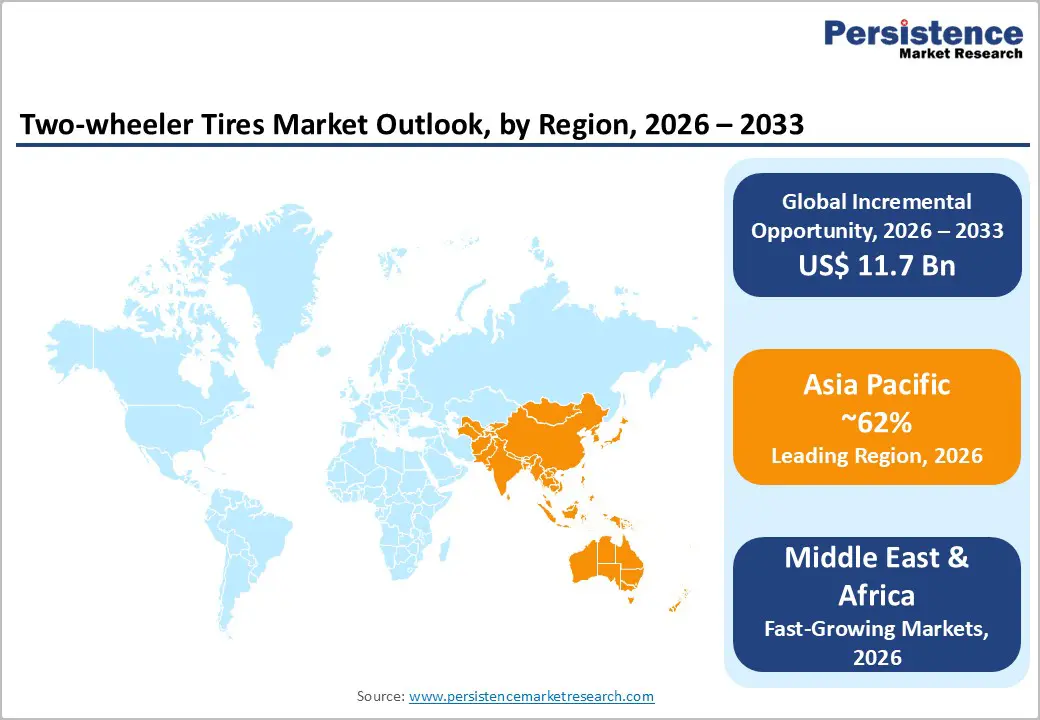
Asia Pacific leads the global Two-wheeler Tires market with approximately 62% of total market share in 2025. Middle East & Africa is the fastest-growing region, projected to expand at an estimated CAGR of approximately 10.2% between 2026 and 2033.
North America Two-wheeler Tires Market Trends and Insights
North America represents a mature, premium-oriented two-wheeler tire market characterized by strong demand for high-performance and adventure motorcycle tires. Growth is driven by rising heavyweight motorcycle registrations and an expanding e-bike culture across urban centers. The Online Aftermarket channel is gaining significant traction, with U.S. consumers increasingly purchasing tires through e-commerce platforms and certified installer networks.
U.S. Two-wheeler Tires Market Size
The U.S. accounts for approximately 81% of North American two-wheeler tire demand, with an estimated market share of 7% of the global total in 2025. The U.S. Motorcycle Industry Council (MIC) reports over 9 million registered motorcycles, supporting strong replacement tire demand. Growth in adventure and touring bike segments fuels premium tire sales.
Europe Two-wheeler Tires Market Trends and Insights
Europe is a significant and premium-leaning two-wheeler tire market, driven by a strong motorcycle touring culture, growing e-bike adoption, and stringent safety regulations encouraging tubeless tire fitment. The EU's Urban Mobility Framework is accelerating electric scooter deployment in major cities, generating new specialized tire demand. Sustainability-focused tire compound development is a key competitive theme among European-market players.
Germany Two-wheeler Tires Market Size
Germany holds approximately 20-22% of the European Two-wheeler Tires market in 2025, supported by its strong motorcycle manufacturing heritage and Europe's largest registered motorcycle fleet at over 4.5 million units. Premium tire brands Continental and Michelin command significant OEM and aftermarket share in the German market, driven by high average selling prices in the performance segment.
U.K. Two-wheeler Tires Market Size
The U.K. represents approximately 12-14% of European market share, with 1.3 million registered powered two-wheelers per DVLA data. Growing urban commuter motorcycle adoption and an expanding e-bike market, supported by the UK Government's E-bike Loan Scheme, are driving tire replacement demand, with online aftermarket channels capturing increasing share of tire purchases.
Netherlands Two-wheeler Tires Market Size
The Netherlands, home to one of Europe's highest bicycle and e-bike usage rates, represents approximately 5-6% of the European market but is among the fastest-growing country markets. With over 23 million bicycles in circulation per Dutch Cycling Embassy data, and rapidly expanding e-bike adoption, the Netherlands generates disproportionately high demand for performance bicycle and e-bike tire SKUs.
Asia Pacific Two-wheeler Tires Market Trends and Insights
Asia Pacific dominates the global Two-wheeler Tires market, driven by the world's largest two-wheeler manufacturing and ownership base. China leads in absolute volume, producing over 20 million two-wheelers annually and maintaining the world's largest electric two-wheeler fleet. India, Indonesia, Vietnam, and Thailand collectively represent the engine of regional growth, with OEM demand consistently outpacing global averages due to structural mobility needs and rising incomes.
China Two-wheeler Tires Market Size
China accounts for approximately 35-37% of the Asia Pacific Two-wheeler Tires market in 2025, the single largest country market globally. China's dominance reflects both its massive domestic two-wheeler fleet and its status as the world's leading electric two-wheeler market, with the China Association of Automobile Manufacturers (CAAM) reporting over 350 million electric two-wheelers in operation. This creates substantial, recurring tire replacement demand.
India Two-wheeler Tires Market Size
India is the second-largest country market, representing approximately 22-25% of Asia Pacific tire demand in 2025. With over 18 million new two-wheeler registrations annually per SIAM, India generates the world's highest OEM two-wheeler tire volumes. Domestic tire manufacturers MRF, CEAT, Apollo, TVS Shrichakra, and JK Tyre collectively command over 70%.
Southeast Asia Two-wheeler Tires Market Size
Southeast Asia, led by Vietnam, Indonesia, Thailand, and Malaysia, accounts for approximately 18-20% of Asia Pacific market share in 2025. The sub-region hosts major two-wheeler OEM assembly plants for Honda, Yamaha, Suzuki, and Kawasaki, generating high OEM tire volumes. Replacement demand is expanding rapidly as the installed vehicle fleet ages, with the online aftermarket channel growing at over 18% annually across the sub-region.
Competitive Landscape
The global two-wheeler tires market exhibits a moderately consolidated structure in premium and OEM segments, where a limited number of global manufacturers maintain strong positioning through advanced technology, brand equity, and long-standing OEM relationships. In contrast, the mid-range and budget segments remain highly fragmented, particularly across Asia, with numerous regional players competing on price, distribution reach, and localized manufacturing advantages.
From a strategic perspective, companies are focusing on strengthening OEM partnerships to secure consistent volumes while expanding their aftermarket presence to capture higher margins. Product innovation remains a key differentiator, with growing emphasis on tubeless designs, durability, and EV-specific tire compounds tailored to torque and battery efficiency requirements. Additionally, the rapid expansion of digital and online sales channels is reshaping distribution strategies, enabling direct consumer engagement. Regional players continue to leverage cost competitiveness and dense dealer networks, while global manufacturers prioritize premiumization and technology-led differentiation to sustain market share.
Key Developments
- April 2026: Dunlop introduced the ScootSmart 2 scooter tyre, an all-season product engineered for improved grip, braking, and handling, targeting urban riders with enhanced wet-weather performance and broader size coverage across scooter segments.
- February 2026: Balkrishna Industries (BKT) entered India’s consumer tyre market with a new on-highway portfolio, launching two-wheeler tyres and targeting rapid scale-up through distribution expansion and long-term capacity investments under its Vision 2030 strategy.
- January 2026: Michelin introduced the new X-Ice Snow+ tire, designed to deliver improved braking, extended tread life, and optimized fuel efficiency and EV range for winter driving conditions.
Two-wheeler Tires Market - Key Insights
| Key Insights | Details |
|---|---|
| Historical Market Value (2020) | US$ 9.7 Billion |
| Current Market Value (2026) | US$ 15.2 Billion |
| Projected Market Value (2033) | US$ 26.9 Billion |
| CAGR (2026 - 2033) | 8.5% |
| Leading Region | Asia Pacific, 62% market share (2025) |
| Dominant Tire Type | Tubeless Tires, 58% market share (2025) |
| Top-ranking Vehicle Type | Motorcycles, 55% market share (2025) |
| Incremental Opportunity (2026 - 2033) | US$ 11.7 Billion |
Companies Covered in Two-wheeler Tires Market
- Bridgestone Corporation
- Michelin,
- Continental Reifen Deutschland GmbH
- Pirelli & C. S.p.A.
- Sumitomo Rubber Industries Ltd.
- ZC Rubber
- Maxxis UK
- APOLLO Tyres Ltd.
- MRF Tyres
- JK Tyre
- CEAT
- TVS Shrichakra Limited
- Cheng Shin Rubber Industries Co. Ltd.
- Toyo Tire Corp.
- The Goodyear Tire & Rubber Company
- Dunlop Tires
- Metzeler
- Shinko Tires
- Others
Frequently Asked Questions
The global two-wheeler tires market is estimated at US$ 15.2 billion in 2026, with strong growth projected to reach US$ 26.9 billion by 2033.
Key drivers include rising two-wheeler sales in emerging markets and rapid growth of electric two-wheelers increasing both OEM and replacement tire demand.
Asia Pacific leads with around 62% market share, supported by high vehicle production and growing electric two-wheeler adoption.
Major opportunities lie in EV-specific tire development and expansion of online aftermarket sales channels.
Key players include Bridgestone Corporation, Michelin, Continental AG, Pirelli, Sumitomo Rubber Industries, MRF Tyres, CEAT, Apollo Tyres, TVS Srichakra, JK Tyre, ZC Rubber, Maxxis, Toyo Tire Corporation, and The Goodyear Tire & Rubber Company.


