




- Clothing, Footwear, & Accessories
- Watches Market
Watches Market Size, Share, and Growth Forecast, 2026 - 2033
Watches Market by Price (Luxury Watches, Smartwatches, Others), Product Type (Quartz Watches, Smart/Hybrid Watches, Others), Demographics, Distribution Channel, and Regional Analysis for 2026 - 2033

Watches Market Size and Trends Analysis
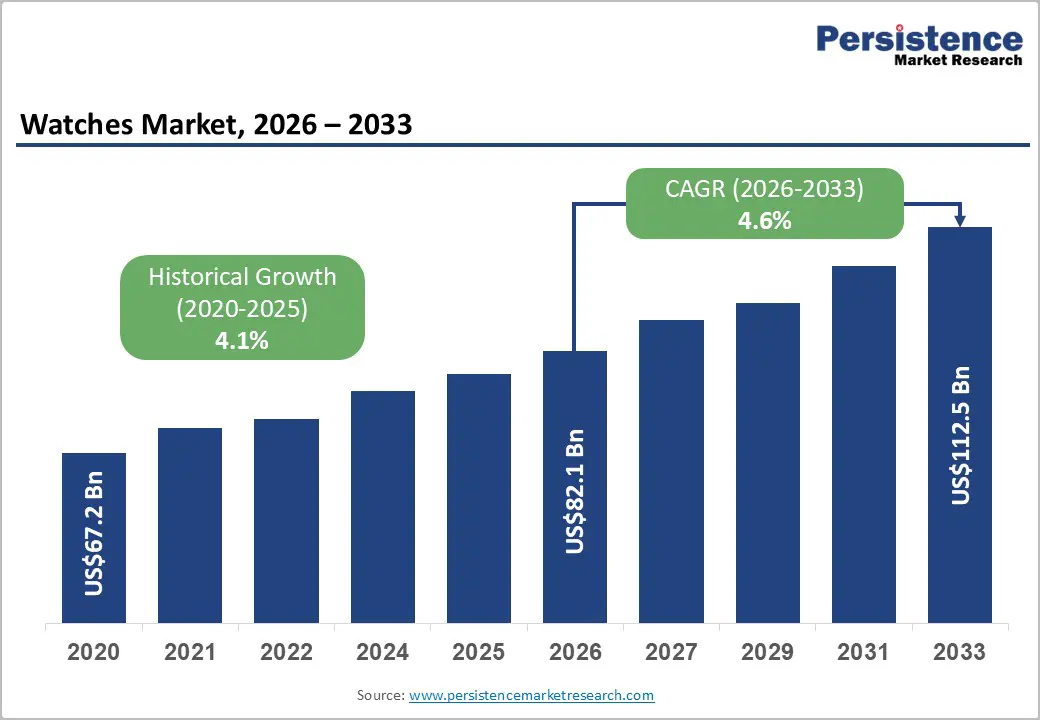
The global watches market size is likely to be valued at US$ 82.1 billion in 2026 and is expected to reach US$ 112.5 billion by 2033, growing at a CAGR of 4.6% during the forecast period from 2026 to 2033, driven by rising premiumization in luxury watches, increasing adoption of smart and hybrid watches, and stable demand for quartz-based products in mass-market categories.
Consumer preferences are evolving toward multifunctional and fashion-oriented watches, while digital commerce and personalized retail experiences are reshaping distribution strategies. Growth is also supported by expanding middle-class populations in Asia Pacific and increasing integration of health-monitoring technologies into wearable devices.
Key Industry Highlights:
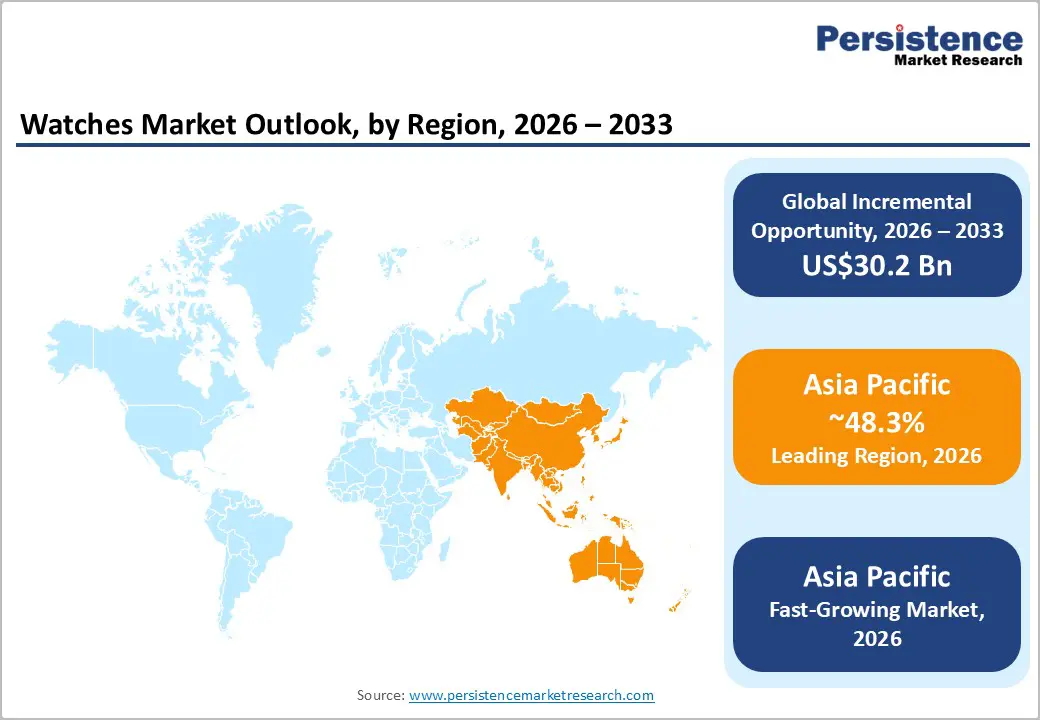
- Leading Region: Asia Pacific is projected to account for approximately 48.3% revenue share in 2026, supported by strong demand across China, Japan, India, and ASEAN countries, alongside large-scale manufacturing advantages.
- Fastest-growing Region: Asia Pacific is also projected to remain the fastest-growing region, due to rising disposable incomes, urbanization, and increasing smartwatch adoption.
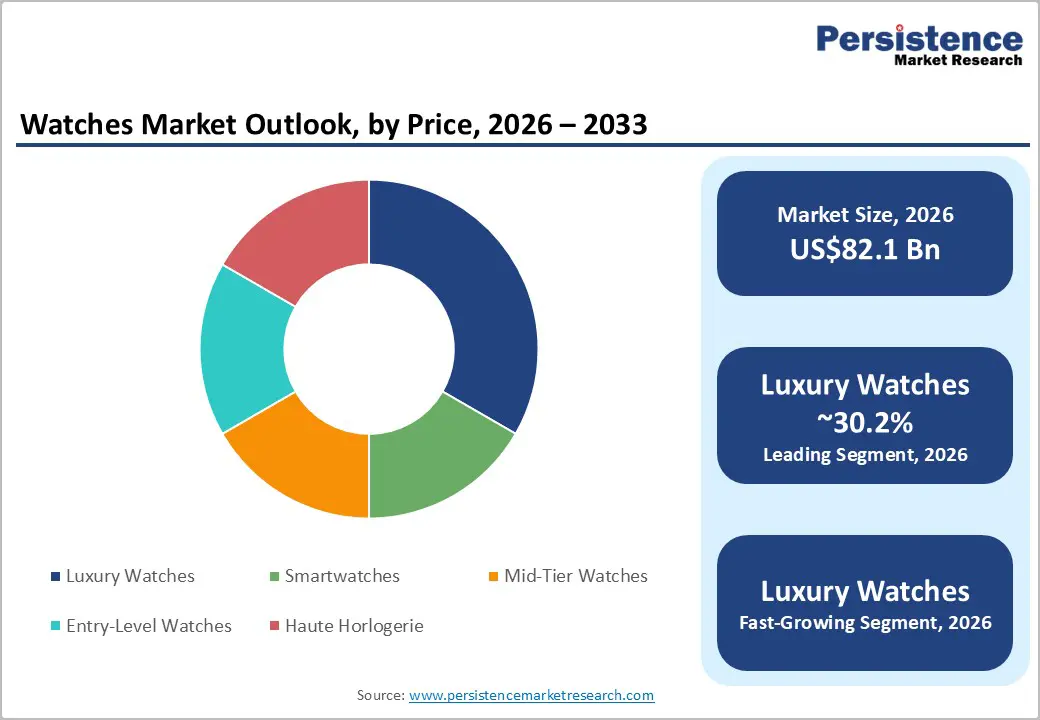
- Dominant Price: Luxury watches are anticipated to account for approximately 30.2% of market share due to strong demand for premium mechanical and collectible timepieces.
- Leading Product Type: Quartz watches are estimated to dominate, holding nearly 59.3% market share in 2026, driven by affordability, durability, reliability, and widespread adoption across mass-market consumer categories.
DRO Analysis
Driver - Premiumization and Rising Demand for Luxury Timepieces
Premiumization remains one of the strongest growth drivers for the watches market, particularly in the luxury and collectible segments. High-income consumers increasingly view luxury watches as long-term lifestyle assets, status symbols, and collectible investments rather than simple timekeeping products. Demand for premium Swiss watches continues to remain resilient despite broader economic fluctuations because affluent consumers prioritize craftsmanship, exclusivity, and brand heritage. Luxury brands are strengthening pricing power through limited-edition launches, mono-brand boutiques, and controlled distribution channels.
The U.S. continues to represent one of the largest consumption markets for premium watches, while Asia Pacific markets such as China, Japan, and India are witnessing rising demand from affluent urban consumers. Luxury sports watches and heritage mechanical collections are particularly gaining traction among younger professionals and high-net-worth individuals. The increasing popularity of pre-owned luxury watches is also improving liquidity in the premium segment, encouraging first-time buyers to enter the market. As a result, luxury brands are maintaining higher operating margins than mass-market competitors and reinforcing long-term market value growth.
Growing Adoption of Smartwatches and Connected Wearables
The expansion of smartwatches and connected wearable ecosystems is significantly broadening the consumer base for watches globally. Consumers increasingly prefer multifunctional devices that combine communication, fitness tracking, wellness monitoring, navigation, and smartphone integration. Health-related features such as heart-rate monitoring, sleep tracking, blood oxygen measurement, and fitness analytics are becoming major purchase drivers across both developed and emerging economies.
Technology companies continue to invest heavily in wearable ecosystems, artificial intelligence integration, and software-based personalization features. Younger consumers and working professionals are driving smartwatch demand because these products provide both convenience and lifestyle integration. Aging populations are also contributing to demand growth as health-monitoring functions become increasingly important for elderly consumers.
Smartwatches are evolving beyond consumer electronics into wellness and productivity devices, creating recurring revenue opportunities through software subscriptions, application ecosystems, and connected services. This technological convergence is accelerating replacement cycles and expanding the addressable market beyond traditional analog watch buyers.
Restraint - Trade Pressures, Economic Uncertainty, and Margin Constraints
Trade-related uncertainties, import tariffs, and weakening consumer confidence continue to create challenges for premium watch manufacturers. Luxury watch brands are highly exposed to fluctuations in international trade policies because many premium products depend on cross-border manufacturing, distribution, and retail networks. Higher import duties on Swiss watches in major markets such as the United States have increased retail pricing pressure and reduced pricing flexibility for international brands.
The market is also facing slower discretionary spending growth in several mature economies due to inflationary pressures and cautious consumer sentiment. Premium watches are discretionary luxury purchases, making the segment vulnerable to economic slowdowns. Supply chain disruptions, currency fluctuations, and rising production costs are further impacting profitability for manufacturers relying on imported components and global sourcing strategies. These challenges are particularly affecting mid-sized premium brands that lack the pricing power and scale advantages of leading global luxury companies.
Opportunity - Expansion across Emerging Markets and Localized Product Strategies
Emerging economies present significant long-term growth opportunities for watch manufacturers due to rising disposable income levels, urbanization, and expanding middle-class populations. Countries such as India, Indonesia, Vietnam, Thailand, and the Philippines are experiencing increasing demand for both affordable premium watches and entry-level luxury products. Consumers in these markets are becoming more brand-conscious and are increasingly purchasing watches as fashion and lifestyle accessories.
Manufacturers are responding through localized pricing strategies, region-specific marketing campaigns, and expanded retail footprints. Domestic retailers and global brands are strengthening partnerships to improve penetration across Tier II and Tier III cities. Premium watchmakers are also introducing smaller case sizes, regionally inspired designs, and locally relevant product collections to increase consumer engagement. The growth of organized retail infrastructure and digital payment ecosystems in emerging economies is expected to further accelerate watch purchases over the forecast period.
Growth of Resale Platforms, Personalization, and Omnichannel Retail
The increasing popularity of authenticated resale platforms is creating new monetization opportunities across the watches market. Younger consumers are increasingly willing to purchase certified pre-owned luxury watches because they offer greater affordability and investment value. This trend is supporting secondary-market liquidity while helping brands attract new consumer segments. Luxury retailers are also entering the resale ecosystem through brand-certified pre-owned programs to retain greater control over pricing, authenticity, and customer relationships.
Personalization and omnichannel retail are becoming important competitive differentiators. Consumers increasingly expect seamless integration between online research, in-store experiences, and digital purchasing platforms. Retailers are investing in AI-powered product recommendations, virtual try-on technologies, customization options, and click-and-collect services. These strategies improve customer engagement, strengthen loyalty, and increase conversion rates across both luxury and mid-tier watch categories.
Category-wise Analysis
Price Insights
Luxury watches are anticipated to lead, accounting for approximately 30.2% of the market share in 2026. It is also expected to be the fastest-growing segment. Premium brands continue to dominate profitability because of high average selling prices, limited-edition production strategies, and strong consumer loyalty. Luxury mechanical watches from established Swiss manufacturers maintain significant pricing power due to their heritage positioning, craftsmanship, and exclusivity.
Demand remains particularly strong among affluent consumers in North America, Europe, China, Japan, and the Middle East. The growth of collector communities and secondary resale markets is further reinforcing luxury watch demand. Consumers increasingly perceive premium watches as long-term investment assets, especially within sports-luxury and heritage mechanical categories.
Product Type Insights
Quartz watches are estimated to dominate the market, accounting for approximately 59.3% of market share in 2026. Their widespread adoption is supported by affordability, durability, accuracy, and low maintenance requirements. Quartz watches remain particularly popular in school, office, utility, and everyday fashion applications.
Strong demand persists across Asia Pacific, Latin America, and parts of Europe where consumers prioritize practicality and cost efficiency. Brands with broad retail networks and affordable product portfolios continue to benefit from steady replacement demand. Quartz technology also supports mass production capabilities, enabling manufacturers to maintain competitive pricing across highly fragmented consumer segments.
Smart and hybrid watches represent the fastest-growing product segment due to increasing demand for wearable technology and connected lifestyle products. Health-monitoring functions, smartphone integration, GPS tracking, and fitness analytics continue to drive consumer adoption across both developed and emerging markets.
Technology companies and traditional watchmakers are increasingly collaborating to integrate advanced software capabilities with premium design aesthetics. Hybrid watches are gaining popularity among consumers seeking the appearance of traditional analog watches with selective smart functionality. Mechanical watches continue to maintain strong demand within luxury and collector segments, while digital watches remain relevant in sports, youth, and outdoor categories.
Regional Insights
North America Watches Market Trends
North America remains one of the most valuable regional markets for watches, supported by strong luxury consumption, advanced retail infrastructure, and high smartwatch adoption rates.
U.S. Watches Market Trends
The U.S. dominates the North American watches market due to its large affluent consumer base, strong luxury retail infrastructure, and high smartwatch adoption rates. The country represents one of the largest global markets for Swiss luxury watches, particularly within sports-luxury, premium mechanical, and collectible segments. Demand is driven by high-income consumers, working professionals, and younger technology-oriented buyers seeking multifunctional wearable devices. The U.S. also leads smartwatch innovation because of strong investment in wearable ecosystems, AI-driven health monitoring, and connected device integration.
Luxury brands continue expanding mono-brand boutiques, certified pre-owned platforms, and direct-to-consumer channels across major metropolitan regions such as New York, Los Angeles, Miami, and Chicago. E-commerce and omnichannel retail are reshaping consumer purchasing behavior, while subscription-based health and fitness ecosystems are increasing smartwatch retention rates. However, import tariffs and inflationary pressure remain key challenges for premium watchmakers operating in the country.
Canada Watches Market Trends
Canada represents a stable and mature watches market supported by rising luxury consumption, growing smartwatch penetration, and expanding online retail adoption. Urban consumers in Toronto, Vancouver, and Montreal are increasingly purchasing premium watches as fashion and lifestyle accessories. Demand for smartwatches is growing steadily due to increasing health awareness and fitness-oriented consumer behavior.
The Canadian market also benefits from strong cross-border luxury retail influence from the U.S. Consumers increasingly prefer omnichannel purchasing experiences that combine online convenience with physical retail engagement. Sustainability and ethical sourcing are becoming more important purchasing considerations among younger consumers, encouraging brands to strengthen transparency and responsible sourcing initiatives.
Europe Watches Market Trends
Europe remains the historical and manufacturing center of the global watches industry, with Switzerland continuing to dominate luxury watch production and global prestige positioning. The region benefits from strong expertise in mechanical watchmaking, movement engineering, and high-end craftsmanship.
Switzerland Watches Market Trends
Switzerland remains the global center of luxury watch manufacturing and high-end mechanical craftsmanship. The country dominates premium watch exports and continues to define global standards for precision engineering, heritage branding, and luxury positioning. Swiss watchmakers maintain strong pricing power through limited production strategies, exclusive product launches, and global retail control.
Luxury tourism and international demand remain critical growth drivers for the Swiss market. Manufacturers are also investing heavily in innovation, movement development, and sustainability initiatives to maintain a competitive advantage. Despite slower shipment growth in some export markets, Switzerland continues to represent the highest-value segment within the global watches industry.
Germany Watches Market Trends
Germany represents one of Europe’s most important markets for precision engineering and premium watch consumption. German consumers strongly prefer high-quality mechanical and functional watches that emphasize durability, craftsmanship, and technical performance. The country also supports a growing demand base for luxury sports watches and smart wearable devices.
Domestic engineering expertise and industrial manufacturing capabilities strengthen Germany’s role within the broader European watch ecosystem. Increasing demand for connected wearables among professionals and fitness-conscious consumers is also contributing to the smartwatch category expansion.
U.K. Watches Market Trends
The U.K. remains a major luxury retail destination within Europe, supported by strong consumer spending on premium fashion and accessories. London continues to function as a global hub for luxury watch retail, attracting both domestic and international buyers. Demand for pre-owned luxury watches is particularly strong in the U.K., owing to growing investment interest and collector culture.
Digital commerce and omnichannel retail continue to transform the competitive landscape in the country. Luxury retailers are increasingly focusing on experiential retail concepts, personalized services, and direct customer engagement to strengthen brand loyalty amid changing economic conditions.
France Watches Market Trends
France maintains a strong position within the European watches market, due to its luxury fashion ecosystem and affluent consumer base. Paris remains one of the world’s most important luxury retail centers, supporting strong demand for premium Swiss and designer watches. Fashion-oriented consumers increasingly seek watches that combine jewelry aesthetics with functionality.
The country also benefits from tourism-driven luxury sales and strong brand visibility through fashion and lifestyle industries. Luxury watchmakers continue investing in boutique expansion and exclusive product launches to strengthen their presence across major French cities.
Asia Pacific Watches Market Trends
Asia Pacific is projected to dominate the global watches market with approximately 48.3% of the revenue share in 2026, and also represents the fastest-growing regional market.
China Watches Market Trends
China remains one of the largest and most influential markets for luxury watches globally. Rising disposable incomes, affluent urban consumers, and a strong gifting culture continue to drive demand for premium mechanical watches and luxury sports models. Chinese consumers increasingly view luxury watches as status symbols and long-term investment assets.
The country also represents a major growth market for smartwatches and connected wearables due to high smartphone penetration and advanced digital ecosystems. Domestic technology companies are strengthening competition through affordable smartwatch offerings and integrated health-monitoring platforms.
Japan Watches Market Trends
Japan continues to lead the global market in quartz innovation, precision engineering, and advanced watch manufacturing capabilities. Japanese brands maintain strong global reputations for reliability, technological innovation, and affordability across both quartz and premium segments. Domestic consumers strongly value craftsmanship, minimalistic design, and product durability.
The country also maintains a significant presence in eco-drive, solar-powered, and hybrid watch technologies. Aging demographics and increasing health awareness are supporting smartwatch demand, particularly for wellness-monitoring applications.
Competitive Landscape
The global watches market remains fragmented across mass-market categories but relatively concentrated within luxury mechanical and smartwatch segments. Luxury value leadership is dominated by established Swiss watchmakers, while technology companies maintain strong positions within connected wearable categories. Competition is increasingly centered on innovation, retail control, product differentiation, and ecosystem integration. Mass-market quartz categories remain highly competitive because of low switching costs and price-sensitive consumer behavior.
Leading companies are prioritizing innovation, premiumization, digital retail expansion, and localized manufacturing strategies. Smartwatch manufacturers are focusing on AI-enabled health ecosystems and software integration, while luxury brands continue emphasizing exclusivity, heritage, and boutique expansion. Companies are also investing in resale platforms, personalization technologies, and omnichannel customer engagement to strengthen long-term consumer retention and recurring revenue opportunities.
Key Industry Developments:
- In June 2025, Casio Computer Co., Ltd. launched the EDIFICE EFK-100 series featuring the company’s first-ever mechanical movement in a Casio timepiece, marking a strategic expansion beyond traditional quartz and digital watch categories into premium mechanical watches.
- In January 2025, TAG Heuer announced its return as the Official Timekeeper of Formula 1 under a new 10-year partnership with LVMH, strengthening the brand’s global visibility in luxury sports watches and reinforcing its motorsport-focused positioning.
Companies Covered in Watches Market
- Rolex
- Apple
- Swatch Group
- Richemont
- Patek Philippe
- Audemars Piguet
- Seiko Group
- Citizen Watch Co.
- Casio Computer Co.
- TAG Heuer
- Omega SA
- Titan Company
- Fossil Group
- Garmin Ltd.
- Samsung Electronics
- Huawei Technologies Co., Ltd.
Frequently Asked Questions
The global watches market is estimated to be valued at US$82.1 billion in 2026.
The watches market is projected to reach approximately US$112.5 billion by 2033.
Key market trends include growing adoption of smart and hybrid watches, increasing demand for luxury collectible timepieces, expansion of certified pre-owned watch platforms, rising e-commerce penetration, and stronger consumer preference for personalized and health-monitoring wearable devices.
The luxury watches segment leads the market in value terms with approximately 30.2% market share, while quartz watches dominate product volume with nearly 59.3% global share due to affordability, reliability, and mass-market adoption.
The global watches market is projected to grow at a CAGR of 4.6% between 2026 and 2033.
Major companies include Rolex, Apple, Swatch Group, Citizen Watch Co., Seiko Group, and Casio Computer Co.


