




- Nutraceuticals & Functional Foods
- Vitamin D Ingredients Market
Vitamin D Ingredients Market Size, Share, and Growth Forecast, 2026 - 2033
Vitamin D Ingredients Market by Form (Powder, Liquid, Capsules & Tablets), Application (Feed & Pet Food, Animal Feed, Functional Food & Beverages, Pharmaceuticals, Personal Care), End-user (Adults, Pregnant Women, Children), and Regional Analysis for 2026 - 2033

Vitamin D Ingredients Market Size and Trends Analysis
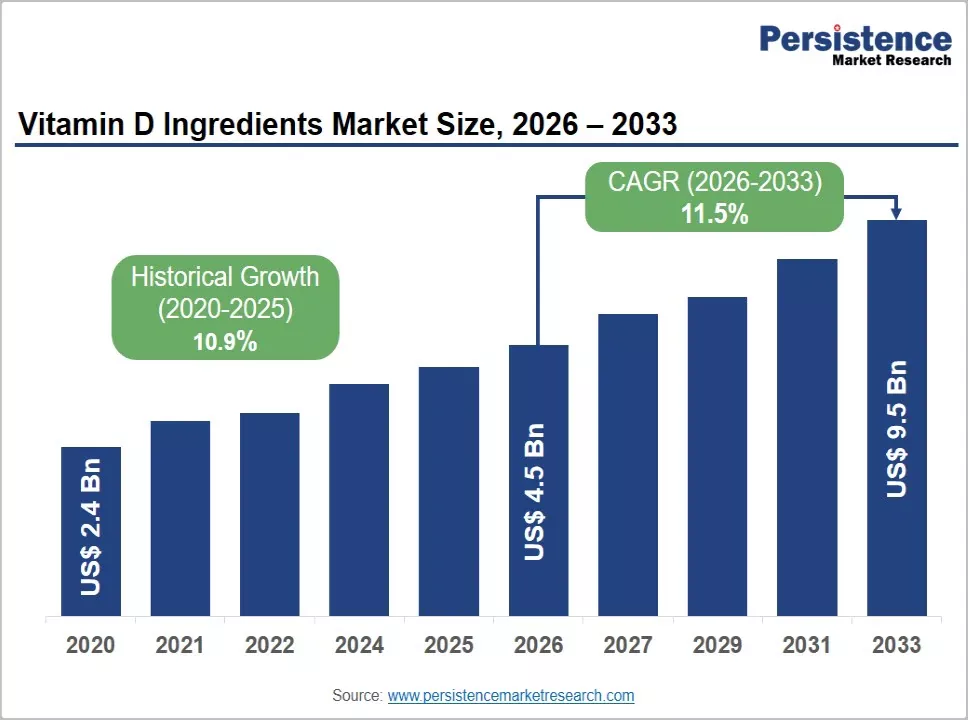
The global vitamin D ingredients market size is likely to be valued at US$ 4.5 billion in 2026 and is estimated to reach US$ 9.5 billion by 2033, growing at a CAGR of 11.5% during the forecast period 2026 - 2033. The market is driven by increasing demand for nutritional supplementation, food fortification, pharmaceutical formulations, and animal nutrition.
Demographic changes, including population aging and growing attention to nutritional requirements across life stages, are expected to expand demand for vitamin D ingredients. Regulatory frameworks governing food supplements and nutrient fortification influence product composition, quality assurance, and market access. Advances in microencapsulation, ingredient stabilization, and formulation technologies will support wider application across powders, liquids, capsules, and tablets. Expanding pharmaceutical, food-processing, and animal-feed infrastructure is expected to strengthen commercial opportunities.
Key Industry Highlights
- Leading Form: Powder is the leading segment, supported by convenient storage, easy handling, improved formulation stability, and widespread use in dietary supplements, fortified foods, and animal feed.
- Fastest-Growing Form: Liquid is likely to be the fastest-growing segment, fueled by rising demand for oral drops, convenient supplementation, flexible dosage formats, and specialized pharmaceutical formulations.
- Regional Leadership: North America is expected to dominate the global market, propelled by established dietary supplement distribution, pharmaceutical manufacturing capabilities, food fortification practices, and strong demand for nutritional ingredients.
- Competitive Environment: Established suppliers compete through quality, formulation technology, regulatory documentation, supply reliability, and cost efficiency.
- Innovation Trends: Microencapsulation, stable powder formulations, combined vitamin preparations, and expanded animal nutrition applications support product differentiation.
- Key Opportunity: Advanced formulations and regional manufacturing partnerships can expand application coverage and improve supply resilience, driven by demand for stable, standardized vitamin D ingredients.
Market Dynamics
Driver - Increasing Focus on Preventive Nutrition and Nutritional Supplementation
Growing attention to bone health, calcium absorption, and nutritional adequacy is expected to support demand for vitamin D ingredients across dietary supplements, pharmaceuticals, and fortified foods. Population aging strengthens this demand because older adults experience reduced capacity for skin synthesis of vitamin D, while changes in dietary habits and limited exposure to sunlight can increase reliance on external sources. The US National Institutes of Health Office of Dietary Supplements updated its vitamin D guidance in June 2025, identifying recommended dietary allowances of 600 IU per day for adults through age 70 and 800 IU per day for adults older than 70.
Commercial demand is expected to benefit from wider availability of supplements through pharmacies, healthcare providers, and online retail channels. Manufacturers can address this opportunity by offering standardized vitamin D3 oils, dry powders, and ready-to-formulate blends for different dosage formats. Product development can also focus on age-specific formulations and combinations with calcium or other micronutrients, subject to applicable regulations.
Restraint - Stability Requirements and Regulatory Compliance Costs
Vitamin D is sensitive to light, oxygen, heat, and moisture, making stability management essential during processing, storage, and distribution. Manufacturers must select suitable carriers, encapsulation systems, packaging materials, and storage conditions to preserve potency throughout the product's shelf life. These requirements can increase formulation costs and complicate production for applications involving high temperatures, moisture, or prolonged storage. Differences in product specifications across food, supplement, feed, and pharmaceutical applications can further increase manufacturing complexity.
Regulatory requirements also affect the documentation needed to demonstrate ingredient identity, purity, potency, safety, and suitability for intended uses. Companies selling into multiple jurisdictions may need separate compliance assessments, labeling reviews, and customer qualification processes.
Opportunity - Advanced Formulations and Improved Ingredient Stability
Ingredient suppliers can expand commercial opportunities through microencapsulation, spray drying, beadlet production, and improved carrier systems that protect vitamin D during processing and storage. These technologies can support more uniform distribution in premixes, improve handling characteristics, and simplify incorporation into tablets, capsules, powdered beverages, and fortified foods. Manufacturers can develop product grades for different applications, including water-dispersible powders, oils, gelatin-free formats, and pharmaceutical-grade ingredients. Application-specific products allow suppliers to compete on formulation performance and technical support rather than price alone.
A practical growth pathway involves partnering with food processors, supplement brands, and pharmaceutical manufacturers during early formulation development. Joint testing can identify the most suitable ingredient format for each processing environment and reduce the risk of product reformulation. Companies can also improve commercial reach by offering stability data, analytical documentation, and regulatory support alongside the ingredient.
Category-wise Analysis
Form Insights
Powder is expected to lead the form category, capturing around 48% of the market share in 2026, owing to its convenient handling, storage, transportation, and integration into nutritional premixes. Manufacturers use powdered vitamin D ingredients in dietary supplements, fortified foods, and animal feed formulations. Microencapsulation can improve stability and protect the active ingredient during processing and storage. Powder formats also support precise blending with other vitamins and minerals.
Liquid is likely to be the fastest-growing segment, driven by the rising demand for oral drops, liquid supplements, and flexible dosage formats. These preparations support convenient administration for consumers who have difficulty swallowing tablets or capsules. Liquid vitamin D ingredients can also serve pharmaceutical and nutritional product manufacturers seeking specialized formulations. Improvements in carrier systems, packaging, and stability management can help preserve ingredient potency during storage.
Application Insights
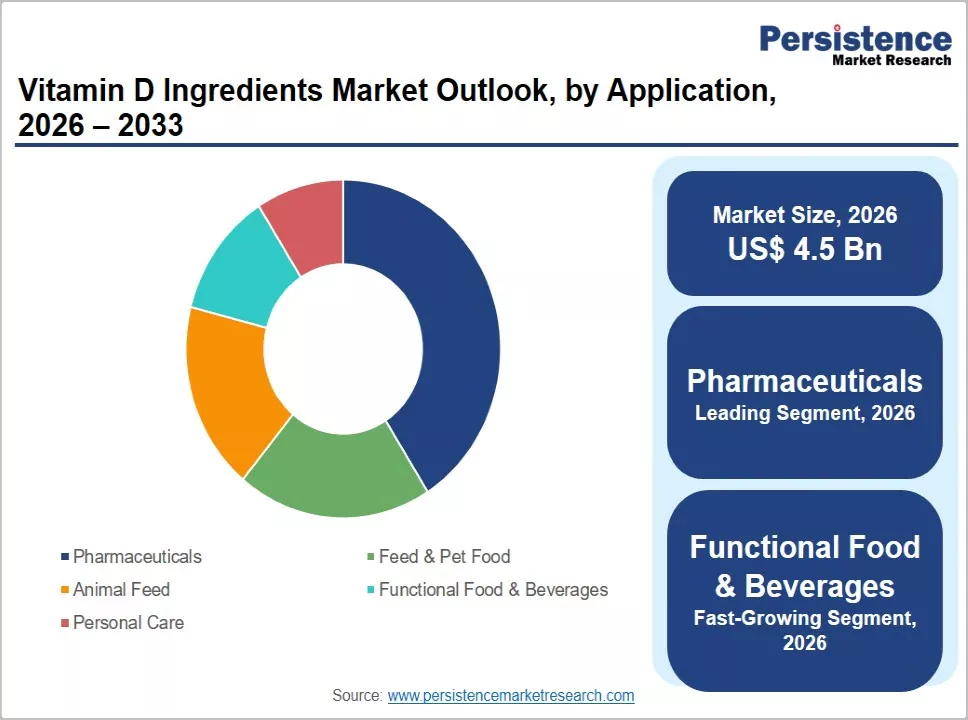
Pharmaceuticals represent the leading segment, holding around 41% of the market share in 2026, fueled by vitamin D supports for calcium absorption, bone mineralization, and the management of vitamin D deficiency. Manufacturers incorporate vitamin D ingredients into tablets, capsules, oral drops, and other formulations. Demand is influenced by healthcare recommendations, product availability, and clinical requirements. Pharmaceutical applications require accurate ingredient potency, controlled manufacturing processes, and appropriate quality documentation.
Functional foods and beverages represent the fastest-growing application, as manufacturers incorporate vitamin D into everyday products to support nutritional intake. Fortified milk, plant-based beverages, breakfast cereals, and selected nutritional drinks provide potential formulation opportunities. Consumer interest in convenient nutrition encourages product developers to explore fortified alternatives across different food categories. Ingredient suppliers can support this expansion through stable powders, dispersible formulations, and suitable liquid preparations.
End-user Insights
Adults are projected to dominate the market, accounting for 44% share in 2026. Vitamin D supports bone health, calcium absorption, and normal muscle function. Demand is influenced by dietary habits, supplement availability, age-related nutritional requirements, and healthcare recommendations. Manufacturers offer vitamin D through tablets, capsules, oral drops, and fortified foods. Product differentiation includes dosage formats, ingredient combinations, and formulation preferences.
Children represent the fastest-growing segment, as parents and healthcare professionals emphasize age-appropriate nutritional intake during development. Manufacturers can address this demand through oral drops, suitable liquid formulations, and products designed for pediatric use. Fortified foods may provide another route for incorporating vitamin D into children's diets. Product development must prioritize appropriate dosage levels, ingredient quality, safety, and clear labeling.
Regional Insights
North America Vitamin D Ingredients Market Trends
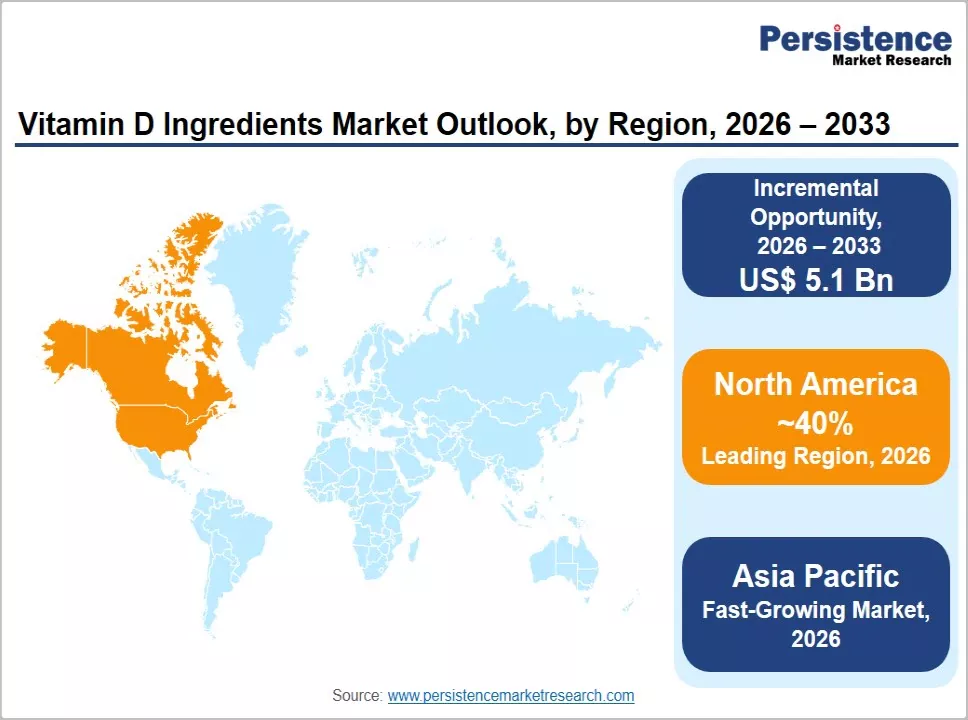
North America is anticipated to lead the global market, accounting for around 40% share in 2026, supported by dietary supplements, fortified foods, pharmaceutical manufacturing, and animal nutrition. The region benefits from developed distribution networks and established quality standards. The U.S. and Canada support demand through supplement retail and food processing. BASF and DSM-Firmenich supply relevant vitamin formulations. Future growth is expected to depend on product innovation, formulation stability, and demand for standardized ingredients.
U.S. Vitamin D Ingredients Market Insights
The U.S. is anticipated to dominate the North American market, capturing nearly 88% of the regional market share in 2026. The country’s market benefits from established supplement channels, pharmaceutical manufacturing, and food fortification. Manufacturers supply vitamin D3 in powders, oils, capsules, and tablets. The National Institutes of Health provides dietary intake guidance that supports nutritional product formulation. BASF is a relevant ingredient supplier. Product labeling, potency, and quality documentation will influence purchasing decisions.
Canada Vitamin D Ingredients Market Insights
Canada accounts for 12% of the North American market share in 2026. Demand is likely to reflect supplement consumption, food fortification, and pharmaceutical production. Seasonal variation in sunlight exposure also influences public interest in vitamin D intake. Suppliers must meet Canadian product and labeling requirements. Distribution partnerships can improve access to manufacturers and retailers. Growth opportunities include fortified foods, private-label supplements, and stable powder ingredients. Companies with reliable supply chains and appropriate regulatory documentation can strengthen customer relationships.
Europe Vitamin D Ingredients Market Trends
Europe is projected to hold a 30% share of the global market in 2026, supported by supplement manufacturing, pharmaceutical production, and food fortification. Regulatory frameworks influence permitted ingredient sources, product composition, and labeling. BASF and DSM-Firmenich participate in the regional supply chain. Demand is expected to benefit from specialized formulations and consistent quality standards. Growth opportunities include fortified foods, dietary supplements, and animal nutrition products.
Germany Vitamin D Ingredients Market Insights
Germany is projected to lead the European market, accounting for 23% of the regional market share in 2026, driven by its established chemical, pharmaceutical, and nutritional ingredient industries. BASF supports the regional supply chain through vitamin formulations and animal nutrition products. Demand is likely to benefit from specialized premixes and stable ingredient formats. Manufacturers can pursue opportunities in pharmaceutical ingredients, fortified foods, and feed applications. Regulatory compliance and manufacturing consistency will influence purchasing decisions.
U.K. Vitamin D Ingredients Market Insights
The U.K. is anticipated to hold about 20% share of the European market in 2026, benefiting from supplement distribution, pharmaceutical manufacturing, and consumer interest in nutritional products. Manufacturers require ingredients that meet applicable product safety, labeling, and quality requirements. Vitamin D powders and oils can serve supplement and fortified food applications. Private-label products and specialized formulations provide potential expansion opportunities. Suppliers can strengthen market access through distribution partnerships and regulatory support.
Asia Pacific Vitamin D Ingredients Market Trends
Asia Pacific is likely to be the fastest-growing market between2026, driven by expanding pharmaceutical manufacturing, packaged food production, dietary supplement distribution, and animal nutrition. China and India provide substantial manufacturing and consumer markets. Regional demand varies according to purchasing power, dietary habits, and regulatory frameworks. Ingredient suppliers can develop application-specific powders, oils, and premixes for local manufacturers.
China Vitamin D Ingredients Market Insights
China is expected to hold around 30% share of the Asia Pacific market in 2026, supported by expanding pharmaceutical manufacturing, supplement production, food processing, and animal nutrition. Domestic ingredient manufacturers and international suppliers serve different parts of the value chain. Demand is likely to benefit from standardized vitamin formulations and application-specific premixes. Manufacturers can expand through local distribution partnerships and customized product formats.
India Vitamin D Ingredients Market Insights
India is estimated to hold nearly 20% share of the Asia Pacific market in 2026. Local manufacturers can incorporate vitamin D ingredients into tablets, capsules, oral liquids, and premixes. Demand is expected to depend on affordability, product availability, and distribution reach. Suppliers can expand through partnerships with pharmaceutical companies and nutritional product manufacturers. Reliable sourcing and quality documentation will support customer qualification. Cost-efficient formulations may improve market access. Regulatory compliance remains essential across food, supplement, and pharmaceutical applications.
Competitive Landscape
The global vitamin D ingredients market is characterized by established nutritional ingredient suppliers, specialized vitamin manufacturers, and companies serving human nutrition, pharmaceutical, and animal-feed applications. Competition is influenced by production reliability, product purity, formulation technology, regulatory documentation, and distribution reach. BASF, dsm-firmenich, Zhejiang Garden Biochemical High-Tech, Zhejiang Medicine, and Fermenta Biotech are relevant companies to assess when evaluating manufacturing capabilities and competitive positioning. Their relative revenue shares within this specific market have not been verified.
Competitive differentiation depends on the ability to deliver consistent ingredient potency, suitable product formats, and reliable technical support. Manufacturers with established customer qualification processes can compete for recurring supply agreements across multiple end-use categories. Companies can strengthen their positions through microencapsulation, application-specific premixes, pharmaceutical-grade documentation, and regional distribution partnerships.
Key Industry Developments
- In July 2026, Fermenta Biotech received approval from the Food Safety and Standards Authority of India (FSSAI) for Vitadee Green, a plant-derived vitamin D3 ingredient for dietary supplements, nutraceuticals, fortified foods, and beverages. The company developed the ingredient using phytosterols extracted from a soy oil waste stream. The approval expanded options for vegetarian and vegan consumers and enabled Indian manufacturers to incorporate plant-based vitamin D3 into nutritional products.
- In October 2025, BASF launched Lutavit A/D3 1000/200 NXT, a microencapsulated formulation combining vitamins A and D3 for animal nutrition. The product delivered a consistent 5:1 ratio of vitamin A to D3 and offered an 18-month shelf life under standard storage conditions. BASF manufactured the formulation at its vitamin A production facility in Ludwigshafen, Germany. The product provided stability in premixes and pellets, supporting reliable vitamin delivery across animal nutrition applications.
Companies Covered in Vitamin D Ingredients Market
- BASF SE
- Royal DSM N.V.
- Zhejiang Garden Biochemical
- Fermenta Biotech Ltd
- Dishman Netherlands B.V.
- Barr Pharmaceuticals
- Lycored Limited
- Schiff Nutrition International, Inc.
- GlaxoSmithKline
- J.R. Carlson Laboratories
Frequently Asked Questions
The vitamin D ingredients market is projected to reach US$ 4.5 billion in 2026.
Market growth is driven by rising demand for dietary supplements, food fortification, pharmaceutical formulations, and animal nutrition products.
The market is poised to witness a CAGR of 11.5% from 2026 to 2033.
Key opportunities include microencapsulated formulations, fortified functional foods and beverages, specialized nutritional supplements, and expanding animal nutrition applications.
Some of the key market players include BASF SE, dsm-firmenich, Zhejiang Garden Biochemical High-Tech Co., Ltd., Zhejiang Medicine Co., Ltd., Fermenta Biotech Limited, and NHU Co., Ltd.


