




- Clothing, Footwear, & Accessories
- Vietnam Writing Instruments Market
Vietnam Writing Instruments Market Size, Share, Trends, Growth, Regional Forecasts 2026 - 2033
Vietnam Writing Instruments Market by Product Type (Pencil, Pen, Coloring Instruments, Highlighter & Markers, Others), End-Users (Students, Independent Professionals, Institutions, Others), Sales Channel (Hypermarkets/Supermarkets, Specialty Stores, Multi-brand Stores, Online Retailers, Other Sales Channels), and Regional Analysis from 2026 - 2033

Vietnam Writing Instruments Market Share and Trends Analysis
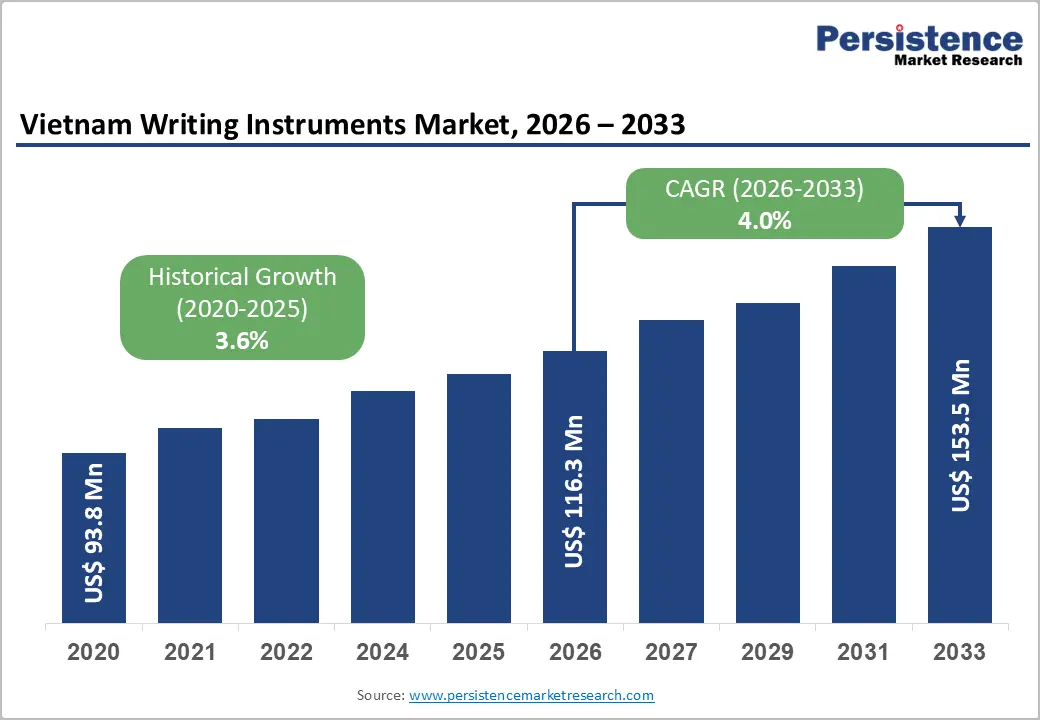
Vietnam's writing instrument market size is likely to be valued at US$ 116.3 million in 2026 and is projected to reach US$ 153.5 million by 2033, growing at a CAGR of 4.0% between 2026 and 2033.
Market expansion is driven by education infrastructure modernization, supporting near-universal primary and secondary enrollment, accelerating e-commerce development with strong online retail growth, and rising middle-class consumption shifting preferences toward premium writing instruments. Southern Vietnam leads with a substantial market share anchored by Ho Chi Minh City’s commercial infrastructure, while Central Vietnam is expected to achieve 4.4% CAGR supported by improving logistics and tourism-linked investments.
Key Industry Highlights:
- Pens lead with 58% share, while pencils grow at 3.8% CAGR, driven by primary school demand and mechanical pencil use among secondary students.
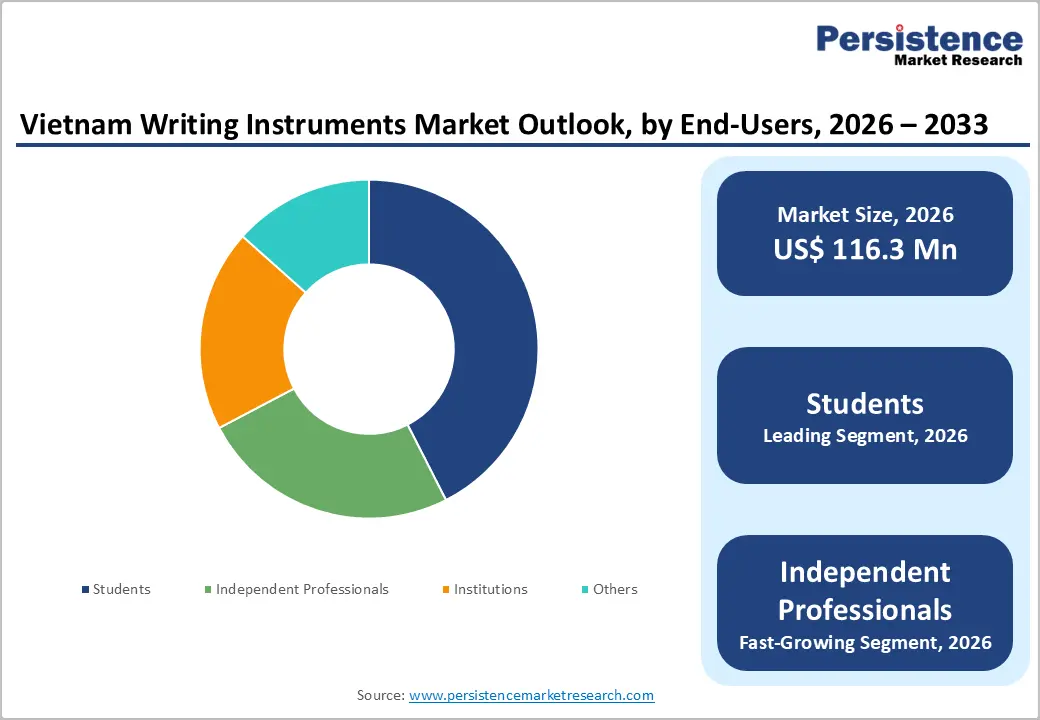
- Students account for 43% of demand, while independent professionals grow at 4.1% CAGR, supported by small business formalization and professional services growth.
- Online retailers lead with 30% share, while specialty stores grow at 4.2% CAGR, driven by premium positioning and experiential pop-up events.
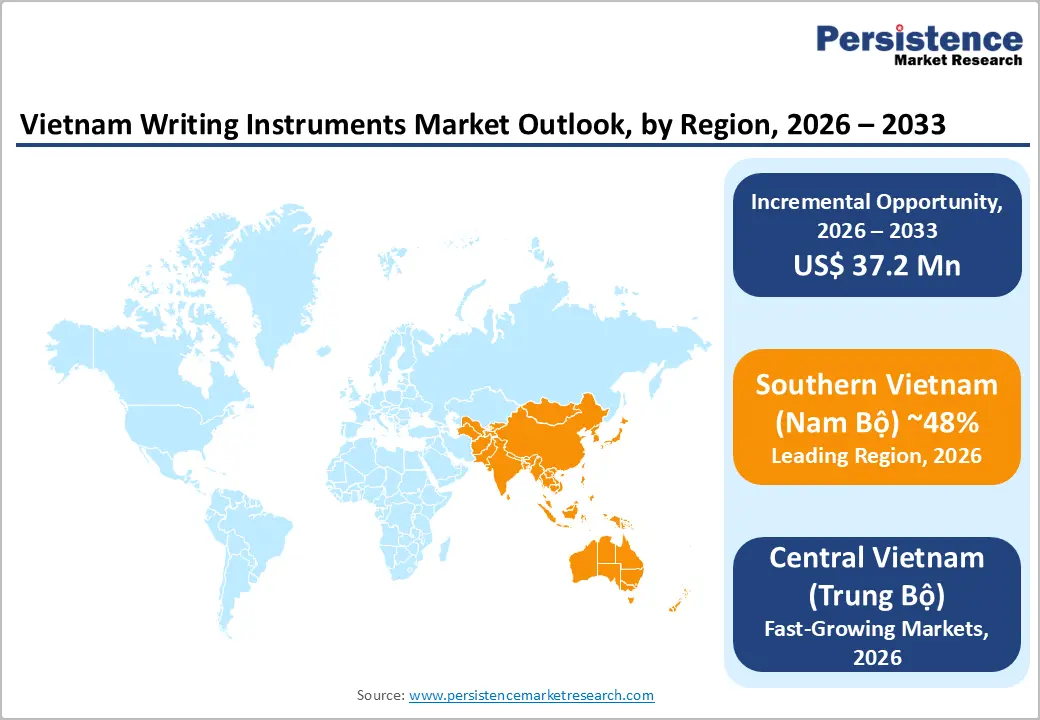
- Southern Vietnam holds 48% market share, while Central Vietnam grows at 4.4% CAGR supported by logistics improvements and tourism-linked investments.
- KOKUYO’s Thien Long acquisition and pop-up expansions reinforce strategic consolidation and premium brand positioning for regional leadership.
| Key Insights | Details |
|---|---|
|
Vietnam Writing Instruments Market Size (2026E) |
US$ 116.3 million |
|
Market Value Forecast (2033F) |
US$ 153.5 million |
|
Projected Growth CAGR (2026-2033) |
4.0% |
|
Historical Market Growth (2020-2025) |
3.6% |
Market Dynamics Analysis
Drivers - Systematic Education Infrastructure Expansion and Universal Student Population Coverage
Vietnam’s education sector demonstrates systematic expansion with near-universal primary and secondary enrollment, generating sustained baseline demand for writing instruments across diverse demographics and regions. Primary net enrollment reached 98.0% by 2014, ensuring broad access to fundamental writing tools for classroom use. Lower secondary enrollment exceeds 90% and upper secondary enrollment exceeds 70%, expanding the student population that requires diverse instruments for advanced subjects. Youth literacy stands at 97%, above lower-middle-income averages, supporting literacy-driven consumer behavior. Government initiatives emphasizing educational modernization and quality learning materials stimulate institutional demand for writing instruments across public schools. Vietnam’s office supplies market benefits from institutional purchases, with educational institutions accounting for ~20% of revenue, reflecting substantial procurement power. Rising middle-class disposable incomes further support household-level investments in school supplies, including pens, pencils, and specialty instruments, reinforcing steady market growth and diversified product adoption across academic and home settings.
Rising Expansion of Middle-income Groups and Premium Product Adoption Supporting Design Differentiation
Rising middle-class expansion and increasing disposable incomes are systematically driving a shift in consumer preferences from commodity writing instruments toward premium, design-differentiated products that support brand positioning and higher-margin business models. Vietnam's urban consumption concentration in Ho Chi Minh City, Hanoi, and Da Nang creates affluent consumer segments that support premium product adoption, with consumer psychology demonstrating quality and aesthetic preferences that exceed basic functionality requirements. Private and international school expansion creates institutional demand for premium writing instruments, supporting differentiated positioning and competitive institutional advantages. A cosmopolitan youth population, increasingly exposed to global product trends, supports the adoption of international premium brands and innovative product designs that meet aspirational consumer preferences. Professional services sector expansion including healthcare, finance, and technology creating specialized workplace requirements for quality writing instruments, supporting documentation and communication. Corporate gifting markets create specialized demand for customized and branded writing instruments supporting organizational branding and professional communication requirements.
Restraint - Price Sensitivity and Rural-Urban Income Disparities Constraining Premium Segment Expansion
Writing instruments market expansion is constrained by significant consumer price sensitivity particularly across rural and semi-urban population segments, with cost-focused purchasing decisions limiting premium product adoption and restricting higher-margin business model viability. Stationery prices in Vietnam remain substantially lower than those in regional markets, indicating strong cost-competition dynamics and limited pricing power, which support premium positioning. Rural-urban income disparities create geographic market segmentation where rural populations prioritize basic functionality over quality or design differentiation due to budget constraints. Secondary school completion decline from primary universal enrollment creates a reduced addressable market for student-targeted premium writing instruments. Limited formal employment opportunities in rural areas constrain professional workforce development, restricting independent professional segment growth and limiting premium writing instruments demand.
Counterfeit Products and Informal Retail Segments Undermining Brand Integrity and Growth Scalability
Writing instruments market development is constrained by substantial counterfeit product infiltration and unorganized retail sector presence, creating brand integrity challenges and limiting organized sector growth acceleration particularly for premium brands and quality-focused suppliers. Poor quality goods flooding digital platforms create an increasingly strict consumer psychology and skepticism regarding product authenticity and quality consistency. Unorganized retail segments operating outside regulatory frameworks enable counterfeit distribution and undermine brand positioning. E-commerce platform booth consolidation demonstrates market trend favoring large sellers and established retailers, disadvantaging smaller distributors and specialist retailers. Supply chain complexity and logistics infrastructure limitations in secondary and tertiary markets constrain product availability, consistency, and support counterfeit infiltration through informal channels.
Opportunity - Premium Segment Expansion and Specialty Instrument Market Development
Rising middle-class expansion and education investment create market opportunity for premium writing instruments, specialty products, including ergonomic designs and environmentally sustainable offerings, addressing emerging consumer preferences beyond basic commodity products. KOKUYO's strategic expansion, including the August 2024 Pop-up Shop in Ho Chi Minh City, attracting 1,000+ customer groups over seven days, demonstrates a strong consumer appetite for premium brands and differentiated products. Eco-friendly and sustainable writing instruments manufactured from recycled materials address emerging environmental consciousness, supporting premium positioning and differentiation. The expansion of technical and vocational training creates specialized demand for precision instruments that support STEM education and technical documentation requirements. Campus product portfolio expansion with Vietnam-specific designs, including Japan Paper series with Vietnamese-specification lines, demonstrates market opportunity for localized premium offerings.
Strategic Consolidation and Market Leadership Repositioning
KOKUYO’s USD 178.2 million acquisition of Thien Long Group in December 2025 marks a landmark strategic consolidation, repositioning the company for regional market leadership and premium brand integration. The transaction establishes Southeast Asia as KOKUYO’s fourth major pillar alongside Japan, China, and India, supporting a long-term regional growth strategy. Thien Long’s strong market presence and manufacturing capabilities provide a foundation for expanded distribution and the integration of its product portfolio. Combining KOKUYO’s technology and design expertise with Thien Long’s established channels and infrastructure generates synergistic value, strengthens market leadership, and reinforces a sustained growth trajectory across Vietnam and the broader Southeast Asian writing instruments market.
Category-wise Analysis
Product Type Insights
Pen products command approximately 58% of the Vietnam writing instruments market share, driven by versatility across educational and professional applications, diverse product variants including ball point, gel, roller, and fountain pens, supporting diverse consumer preferences and end-use applications. Ballpoint pens represent the primary commodity segment supporting student populations and cost-sensitive consumer preferences. Gel pens represent the premium segment, appealing to style-conscious demographics and professional markets.
Roller pens and fountain pens address premium market segments valuing aesthetic and performance characteristics. Campus gel pen products that emphasize a smooth writing feel and quick-dry characteristics appeal to student preferences.
Pencils grow at 3.8% CAGR, driven by primary school demand, mechanical pencil adoption among secondary students, and specialty graphite pencil use for artistic and technical applications. Graphite pencils meet fundamental educational needs, mechanical pencils offer precision and convenience for students and professionals, while specialty variants cater to niche markets, including artists and technical professionals who require precise writing instruments.
End-user Insights
Student population represents 43% of market demand, driven by primary, secondary, and tertiary educational enrollmen,t supporting systematic purchasing of writing instruments for classroom utilization and academic requirements across diverse educational institutions. A primary school population with 98% enrollment creates a fundamental demand for basic pens and pencils. Secondary school participation creates demand for specialized writing instruments supporting advanced academic subjects and specialized learning requirements. Higher education enrollment supports the adoption of premium writing instruments among university students.
The independent professional and workforce segment grows at a 4.1% CAGR, driven by small-business formalization, professional services expansion, and rising freelance and entrepreneurial activity, boosting demand for workplace writing instruments. Healthcare professionals, consultants, and service providers require high-quality documentation tools, while technical professionals and engineers use specialized instruments for design and technical drawing, creating sustained derived demand in professional settings.
Sales Channel Insights
Online retail channels command approximately 30% of market share, driven by e-commerce platform proliferation, digital payment adoption, and consumer preference for convenient home delivery, which support market accessibility and product discovery. Shopee, Lazada, Tiki, and TikTok Shop platforms provide convenient purchasin,g supporting consumer preference for digital engagement. Social commerce integration enables direct consumer interaction with brands and merchants. Product comparison functionality and promotional offerings on online platforms drive consumer preference toward digital channels.
Specialty stores expand at a 4.2% CAGR, driven by premium positioning, a curated product selection that emphasizes quality differentiation, and personalized consumer service that supports brand loyalty and repeat purchasing patterns. Specialty retailers focusing on premium brands and quality products appeal to affluent urban consumers. Experiential retail, including KOKUYO Pop-up Shops, creates product trial opportunities, drives customer engagement, and brand awareness. Expert staff knowledge supports consumer education on product quality and differentiation.
Regional Market Insights
Southern Vietnam (Nam B) Writing Instruments Market Trends
Southern Vietnam dominates the writing instruments market with a 48% regional share, driven by Ho Chi Minh City’s robust commercial infrastructure, dense urban population, high consumer spending, and established retail distribution networks. The city hosts the largest concentration of hypermarkets, specialty stores, and e-commerce hubs, supporting premium product adoption and brand preference. Strong private-sector activity and business formalization drive professional demand for workplace tools, while international schools attract affluent student segments for premium offerings.
Established vendor relationships ensure consistent supply and competitive pricing. Large-format retail and shopping malls enable efficient market coverage, while concentrated e-commerce distribution centers enhance logistics efficiency and rapid delivery, facilitating market penetration and sustaining competitive vendor presence across Southern Vietnam.
Northern Vietnam (B-c-B) Writing Instruments Market Trends
Northern Vietnam demonstrates prominent growth pace anchored by Hanoi's rapid industrialization, favorable government support, and growing technology-driven industries supporting market expansion and premium product adoption momentum. Hanoi serves as Vietnam's capital and political center, with a substantial government sector that supports institutional demand for writing instruments. The technology industry concentration supports professional workforce requirements for quality writing instruments. Industrial park development surrounding Hanoi creates manufacturing and export-oriented business activity, generating workplace writing instruments demand.
KOKUYO's April 2025 Pop-up Shop opening in Hanoi at Aeon Xuan Thuy represents strategic market positioning targeting northern region affluent consumers and student demographics. Manufacturing facility presence, including KOKUYO Vietnam's Haiphong operations, supports regional supply infrastructure. Rising middle-class expansion in Hanoi and surrounding urban centers supports premium product adoption and consumer spending growth.
Central Vietnam (Trung B) Writing Instruments Market Trends
Central Vietnam’s writing instruments market is expanding at a 4.4% CAGR, supported by improving logistics networks, tourism-linked investments, and growing small-to-medium enterprise activity, which are driving market expansion and geographic penetration. Da Nang serves as a regional business hub, with developing commercial infrastructure enhancing retail distribution reach. The thriving tourism industry generates employment in hospitality and service sectors, increasing consumer spending on educational and professional supplies. Logistics enhancements connecting Central Vietnam to northern and southern supply chains improve accessibility and product availability, supporting consistent market growth.
Combined infrastructure development, SME activity, and tourism-driven economic expansion reinforce market momentum, enabling broader distribution of writing instruments, strengthening vendor presence, and creating opportunities for premium and value-oriented product adoption across diverse urban and emerging consumer segments.
Competitive Landscape
Vietnam writing instruments market is fragmented, with multinational brands like KOKUYO, Faber-Castell, Pilot, and Staedtler leveraging distribution networks and brand recognition, alongside domestic players such as Thien Long Group utilizing cost advantages. KOKUYO’s 2025 acquisition of Thien Long consolidates regional positioning, while private labels and local brands dominate value segments, sustaining diverse competition across products and price tiers.
Strategic Developments
- In December 2025, KOKUYO announced USD 178 million acquisition of Thien Long Group, Vietnam's leading stationery manufacturer, through share purchases totaling 65.01% ownership establishing Southeast Asia as fourth major geographic pillar supporting regional market consolidation.
- In April 2025, KOKUYO opened first Hanoi Pop-up Shop at Aeon Xuan Thuy offering 400 products including Vietnam-specification Japan Paper series and Campus 50th anniversary limited edition products generating substantial customer engagement supporting northern market expansion.
Companies Covered in Vietnam Writing Instruments Market
- KOKUYO Co., Ltd.
- Thien Long Group
- Faber-Castell
- Pilot Corporation
- Staedtler
- Pentel
- 3M
- Maped
- Muji
- Mitsubishi Pencil
- Hong Ha
- Artline
- Reynolds Pens
- Fullmark
Frequently Asked Questions
Vietnam writing instruments market size is likely to be valued at US$ 116.3 million in 2026 and is projected to reach US$ 153.5 million by 2033.
Market growth is driven by universal education coverage, rapid e-commerce expansion with high mobile shopping adoption, and rising middle-class demand for premium and design-differentiated writing instruments.
Vietnam writing instruments market is expected to grow at a 4.04% CAGR from 2026 to 2033.
Key opportunities include premium and specialty product expansion, strategic consolidation led by KOKUYO’s Thien Long acquisition, and geographic penetration into Tier 2 and Tier 3 cities.
Major players include KOKUYO, Thien Long Group, Faber-Castell, Pilot, and Staedtler, alongside local brands Hong Ha and Fullmark, focusing on premiumization, acquisitions, and urban market expansion.


