




- Pharmaceuticals
- Uterine Sarcoma Treatment Market
Uterine Sarcoma Treatment Market Size, Share, and Growth Forecast 2026 - 2033
Uterine Sarcoma Treatment Market by Cancer Type (Leiomyosarcoma, Endometrial Stromal Sarcoma), Treatment Type (Surgery, Chemotherapy), Disease Stage (Early-stage, Advanced-stage), End-User (Hospitals), and Regional Analysis, 2026 - 2033

Uterine Sarcoma Treatment Market Size and Trends Analysis
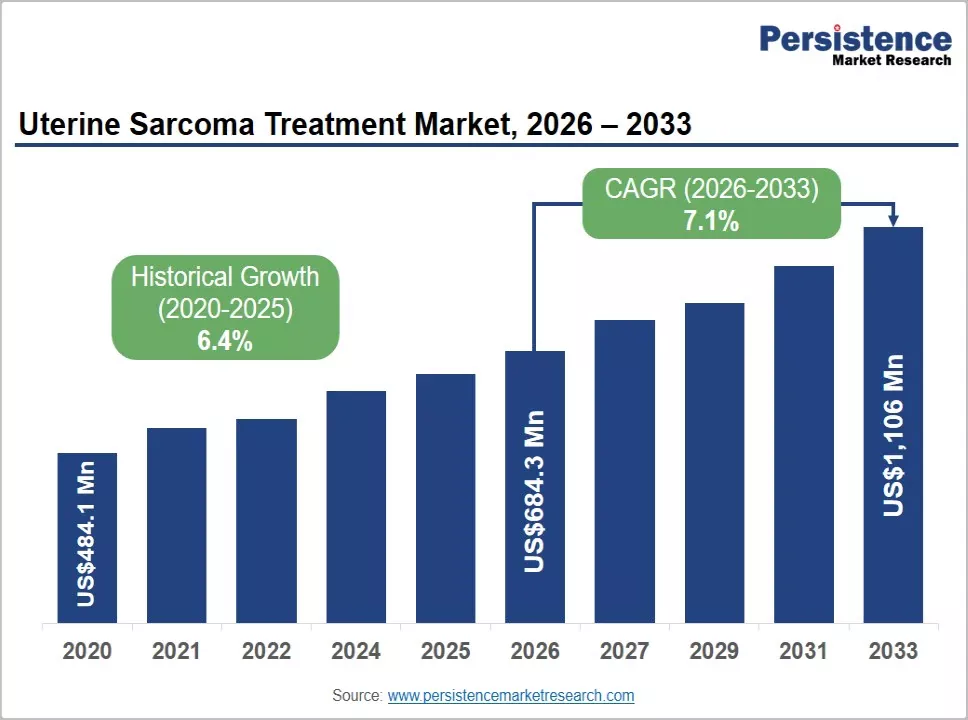
The global uterine sarcoma treatment market size is likely to be valued at US$684.3 million in 2026 and is estimated to reach US$1,106 million by 2033, growing at a CAGR of 7.1% during the forecast period from 2026 to 2033, driven by the rising global burden of uterine cancer and wide use of multi-line systemic therapy in advanced disease. Better molecular diagnosis and surging clinical trial activity are also improving treatment uptake.
Key Industry Highlights:
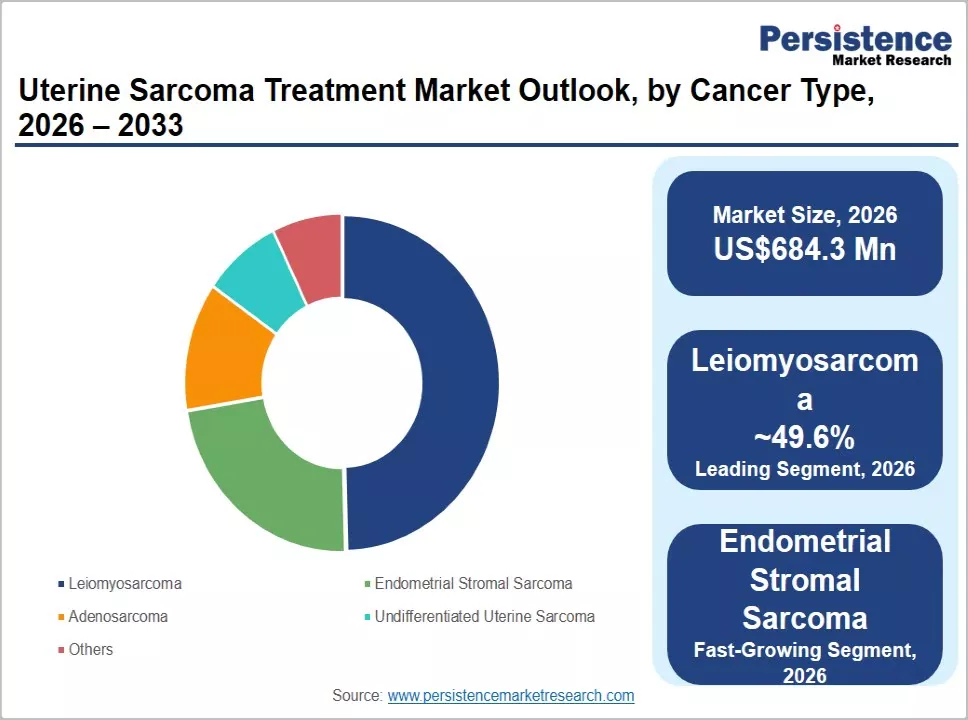
- Leading Cancer Type: Leiomyosarcoma, about 49.6% share in 2026, as it is one of the two most common uterine sarcomas and often needs several lines of systemic therapy.
- Dominant Treatment Type: Surgery, around 47.3% share in 2026, as the National Cancer Institute (NCI) identifies surgery as the primary treatment for all patients with uterine sarcoma.
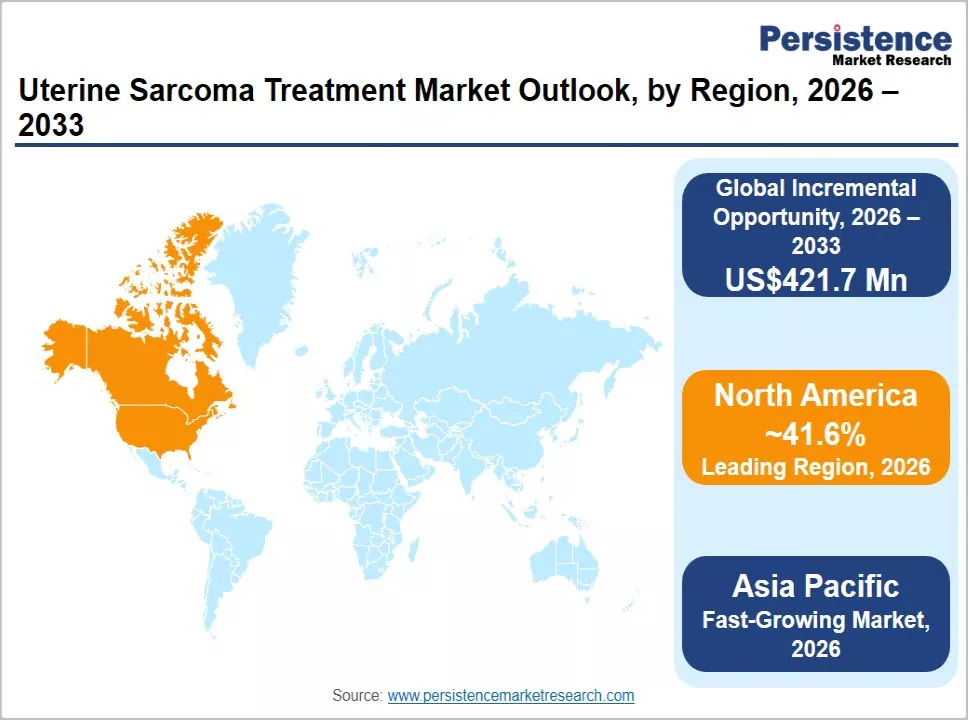
- Leading Region: North America, with about 41.6% share in 2026, as the U.S. combines high diagnostic capacity, broad access to approved sarcoma therapies, and a large clinical trial base.
- Fast-growing Region: Asia Pacific, as large patient populations, a rising uterine cancer burden, and wide access to molecular pathology are expanding treatment demand.
- Latest Study: In May 2026, researchers presented results from the ALBATROSS-SARC-LMS01 Phase II study evaluating pemetrexed plus cisplatin in relapsed or refractory leiomyosarcoma. The leiomyosarcoma cohort reached full enrollment with 40 patients, and among 39 evaluable patients, seven achieved confirmed partial responses while 22 had stable disease, resulting in a 74.3% disease-control rate.
DRO Analysis
Driver - Rising Uterine Cancer Burden to Increase Treatment Demand
Uterine cancer cases keep rising worldwide. GLOBOCAN 2022 estimated 420,368 new cases of uterine corpus cancer globally. The American Cancer Society (ACS) notes that uterine cancer is one of the few cancers with rising mortality in the U.S. Its death rate rose by 1.5% per year from 2013 to 2022.
Uterine sarcomas make up about 2% to 5% of uterine malignancies, according to NCI. The share is small, but the disease is aggressive. Most patients need surgery, and many need systemic therapy after recurrence. This keeps demand steady for surgical care, chemotherapy, and long-term follow-up.
Expanding Systemic Options to Lift Treatment Rates in Advanced Disease
Systemic options for advanced leiomyosarcoma are widening. The U.S. Food and Drug Administration (FDA) approved pazopanib for advanced soft tissue sarcoma in 2012. It approved trabectedin for liposarcoma and leiomyosarcoma on October 23, 2015.
The LMS-04 phase 3 trial tested doxorubicin plus trabectedin as first-line therapy. It was published in the New England Journal of Medicine in September 2024. Median overall survival was 33 months, versus 24 months with doxorubicin alone. Of the 150 patients, 67 had uterine disease. These results support earlier and longer systemic treatment.
Restraint - Rarity and Late-stage Trial Failures May Slow New Drug Approvals
Uterine sarcomas are rare, so large trials are hard to run. Most studies pool several sarcoma types, which weakens uterine-specific evidence. NCI states that no standard therapy exists for recurrent disease.
Late-stage failures add to the challenge. Olaratumab plus doxorubicin gained FDA approval in 2016. The phase 3 ANNOUNCE trial later showed no benefit. Adding bevacizumab to gemcitabine and docetaxel also failed to improve outcomes. The Gynecologic Oncology Group trial GOG-0277 could not enroll its target of 216 patients. These setbacks may slow investment and delay new approvals.
Opportunity - Molecular Profiling to Open Biomarker-matched Treatment Segments
Molecular testing is transforming uterine sarcoma care. A Peking University analysis of 24 uterine leiomyosarcoma cases found frequent TP53 and RB1 alterations. It showed that next-generation sequencing can support diagnosis in difficult cases. In endometrial stromal sarcoma, gene fusions also help confirm the diagnosis.
A subset of uterine leiomyosarcomas shows defective DNA repair. This has led to an NCI-sponsored phase 2 trial of olaparib plus temozolomide in advanced uterine leiomyosarcoma. Validated biomarkers could create targeted treatment segments. They could also move patients beyond standard chemotherapy.
Early-line Combination Trials to Build a High-value Treatment Pipeline
Companies are testing combinations earlier in the treatment course. The PharmaMar SaLuDo phase IIb/III trial compares lurbinectedin plus doxorubicin with doxorubicin alone in first-line metastatic leiomyosarcoma. On May 11, 2026, the company announced that it had completed patient recruitment.
A separate phase 1b/2 trial at Massachusetts General Hospital is testing the same combination. Lurbinectedin is not approved for this use. Positive results are predicted to open a new first-line segment.
Category-wise Analysis
Cancer Type Insights
Leiomyosarcoma is predicted to lead with a share of about 49.6% in 2026, as it is one of the two most common uterine sarcomas and behaves aggressively. ACS reports that Black women develop uterine leiomyosarcoma about twice as often as White women. The Surveillance, Epidemiology, and End Results (SEER) database shows a 5-year relative survival rate of 38% across all stages. The rate drops to 13% for distant disease. Patients therefore often move through doxorubicin, gemcitabine-docetaxel, trabectedin, and pazopanib regimens.
Endometrial stromal sarcoma is estimated to be the fastest-growing type over the forecast period. Low-grade disease has a five-year relative survival rate of 93%, so patients stay in care for many years. NCI notes that high-dose progesterone therapy may help in low-grade stromal sarcoma. Fusion testing is also improving diagnosis and treatment planning.
Treatment Type Insights
Surgery is anticipated to dominate with a share of around 47.3% in 2026. NCI states that surgery is often the principal means of diagnosis and the primary treatment. Hysterectomy is usually performed when a uterine malignancy is suspected. Surgery alone can be curative if the tumor stays within the uterus. The FDA estimated in 2014 that about 1 in 350 women undergoing hysterectomy or myomectomy for fibroids has an unsuspected uterine sarcoma. This keeps surgical volumes and pathology review high.
Targeted therapy and immunotherapy are expected to be the fastest-growing treatment type over the forecast period. Pazopanib is already used in advanced disease. Checkpoint inhibitors have shown limited activity in uterine leiomyosarcoma so far. Researchers are therefore testing DNA repair-targeted drugs such as olaparib. These efforts could shift care toward matched therapy.
Regional Insights
North America Uterine Sarcoma Treatment Market Trends
North America is anticipated to lead worldwide in 2026 with a share of around 41.6%, as it benefits from a combination of advanced diagnostic infrastructure, access to approved oncology drugs, specialized gynecologic oncology centers, and a strong clinical research environment. Uterine sarcoma is primarily diagnosed in older women, with the American Cancer Society (ACS) reporting an average age at diagnosis of about 60 years. This creates a meaningful need for treatment strategies that account for advanced age, comorbidities, tumor stage, and histological subtype.
U.S. Uterine Sarcoma Treatment Market Trends
A share of nearly 78.9% is expected to be held by the U.S. in 2026 in North America. Its dominance is supported by extensive oncology infrastructure, relatively broad availability of specialty drugs, and a large number of academic and cancer centers involved in sarcoma research. The U.S. Food and Drug Administration (FDA) approved trabectedin on October 23, 2015, for patients with unresectable or metastatic liposarcoma or leiomyosarcoma who had previously received an anthracycline-containing regimen. Although the approval covers soft-tissue sarcomas rather than uterine sarcoma specifically, leiomyosarcoma is an important uterine sarcoma subtype for which systemic treatment options are needed in advanced disease. Janssen markets trabectedin in the U.S. under the brand Yondelis.
Asia Pacific Uterine Sarcoma Treatment Market Trends
Asia Pacific will likely be the fastest-growing region over the forecast period with a share of roughly 24.8% in 2026 globally. The region combines a very large population with increasing cancer detection, expanding oncology infrastructure, and a surging need for specialized gynecologic cancer services. GLOBOCAN 2022 identified China as the country reporting the highest number of new uterine corpus cancer cases globally, creating a large underlying population from which uterine sarcoma cases arise. Treatment access, however, remains uneven across countries and between major cities and less-developed areas. Improvements in imaging, histopathology, immunohistochemistry, and molecular testing are helping distinguish uterine sarcomas from more common endometrial cancers and benign or atypical uterine lesions. Easy availability of specialist gynecologic surgeons and multidisciplinary tumor boards is also predicted to improve treatment selection.
China Uterine Sarcoma Treatment Market Trends
China will likely lead in Asia Pacific in 2026 with a share of about 36.2%. GLOBOCAN 2022 estimated 77,722 new uterine corpus cancer cases and 13,511 deaths in China, giving the country one of the largest patient populations requiring uterine cancer services worldwide. Uterine sarcomas represent only a small proportion of these cases, but the country's large population means that the absolute number of patients with rare uterine sarcoma subtypes remains clinically important. Local academic centers are further generating evidence on the molecular characteristics of these tumors. A Peking University analysis involving 24 uterine leiomyosarcoma cases identified frequent alterations involving TP53 and RB1, two genes associated with tumor progression and genomic instability.
India Uterine Sarcoma Treatment Market Trends
In 2026, India is projected to account for a share of just about 15.7% in Asia Pacific, backed by a large population and an expanding network of cancer hospitals. But, treatment patterns remain influenced by differences in access to specialist oncology services and advanced diagnostics. A study from the Gujarat Cancer and Research Institute, published in January 2026, evaluated 85 surgically treated patients and reported a recurrence rate of 56.5%. For uterine leiomyosarcoma, five-year overall survival reached 77.7%, while five-year disease-free survival was considerably lower at 39.9%. The difference indicates that patients may achieve prolonged survival after surgery while still facing a substantial risk of recurrence and requiring long-term monitoring.
Europe Uterine Sarcoma Treatment Market Trends
Europe is predicted to showcase steady growth in 2026 globally with a share of approximately 25.9%. Established healthcare infrastructure, specialist cancer centers, national treatment guidelines, and structured reimbursement mechanisms provide a relatively consistent foundation for managing rare gynecologic cancers. Local treatment pathways commonly involve multidisciplinary assessment because surgery, radiotherapy, and systemic treatment decisions depend heavily on histological subtype and stage. Trabectedin has been approved in the European Union since 2007 for specific advanced soft-tissue sarcoma indications and remains an established treatment option after prior chemotherapy. PharmaMar describes trabectedin as a standard second-line treatment for soft-tissue sarcoma in Europe.
Germany Uterine Sarcoma Treatment Market Trends
A share of nearly 24.3% is predicted to be held by Germany in 2026 in Europe. A registry study from Saxony-Anhalt, published in Cancers in April 2026, covered 155 patients diagnosed between 2000 and October 2025. About 65.2% presented with International Federation of Gynecology and Obstetrics (FIGO) stage I disease. Among patients with known grade, 63.9% had high-grade tumors, and 45.2% of these developed metastases. This mix sustains demand for surgery, surveillance, and systemic therapy.
U.K. Uterine Sarcoma Treatment Market Trends
The U.K. is expected to account for a share of about 16.8% in Europe in 2026. The National Institute for Health and Care Excellence (NICE) recommends trabectedin for advanced soft tissue sarcoma after anthracycline and ifosfamide failure, or when these drugs are unsuitable. The recommendation applies only under a commercial arrangement with a discount. This gives National Health Service (NHS) patients defined access in later lines of therapy.
Competitive Landscape
The global uterine sarcoma treatment market is moderately consolidated among established oncology companies, but remains highly specialized as uterine sarcoma is a rare cancer with limited approved treatment options. Competition is shaped less by the number of companies and more by the ability to provide therapies for different histological subtypes and stages. Key participants include Johnson & Johnson/Janssen, PharmaMar, Bayer, Eisai, Merck & Co., and other oncology-focused companies developing or commercializing chemotherapy, targeted therapies, immunotherapies, and investigational combinations.
Companies are differentiating themselves through clinical evidence, biomarker-based patient selection, combination strategies, and therapies aimed at recurrent or metastatic disease rather than competing solely on established chemotherapy. The competitive environment is further being influenced by precision oncology and clinical research, as the molecular diversity of uterine sarcomas creates opportunities for targeted treatment. Developers are investigating genomic alterations, immune-related biomarkers, antibody-drug conjugates, and combinations of immunotherapy with chemotherapy or targeted agents.
Key Industry Developments:
- In May 2026, researchers reported real-world outcomes for doxorubicin plus trabectedin in uterine and other leiomyosarcomas at the ASCO Annual Meeting. The retrospective MD Anderson analysis included 26 patients with uterine leiomyosarcoma and provided additional clinical evidence on the combination's use in both localized and advanced disease.
- In February 2026, researchers published Phase II results of cabozantinib plus temozolomide in patients with unresectable or metastatic leiomyosarcoma. The multicenter study included both uterine and non-uterine leiomyosarcoma and investigated simultaneous targeting of VEGF and MET pathways, adding another targeted-combination strategy to the treatment-development pipeline.
- In February 2026, a Phase II clinical trial began evaluating elacestrant in patients with locally advanced or metastatic estrogen-receptor-positive uterine sarcomas. The NCI-sponsored study includes uterine leiomyosarcoma, endometrial stromal sarcoma, uterine adenosarcoma, and uterine PEComa, and is investigating whether the oral estrogen-receptor degrader can provide a treatment option for tumors with high ER expression.
Companies Covered in Uterine Sarcoma Treatment Market
- Johnson & Johnson (Janssen)
- PharmaMar
- Novartis
- Eisai
- Pfizer
- Eli Lilly and Company
- Sanofi
- Bayer
- Merck & Co. / MSD
- Roche
- Jazz Pharmaceuticals
- Teva Pharmaceutical
- Fresenius Kabi
- Hikma Pharmaceuticals
- Sandoz
- Others
Frequently Asked Questions
The global uterine sarcoma treatment market is projected to be valued at US$684.3 million in 2026.
The uterine sarcoma treatment market is expected to reach US$1,106 million by 2033.
Key market trends include movement toward molecular profiling and earlier-line combination regimens.
Leiomyosarcoma is expected to be the leading cancer type with a share of around 49.6% in 2026, due to its aggressive course and need for multi-line systemic therapy.
The uterine sarcoma treatment market is expected to grow at a CAGR of 7.1% from 2026 to 2033.
Johnson & Johnson (Janssen), PharmaMar, and Novartis are a few key market players.


