




- Pharmaceuticals
- Schizophrenia Therapeutic Market
Schizophrenia Therapeutic Market Size, Share, and Growth Forecast 2026 - 2033
Schizophrenia Therapeutic Market by Therapeutic Class (First-Generation (Typical) Antipsychotics, Other), Drug Type (Risperidone, Olanzapine), Mechanism of Action (Dopamine D2 Receptor Antagonists), Treatment Type (Monotherapy), and Regional Analysis, 2026 - 2033

Schizophrenia Therapeutic Market Size and Trend Analysis
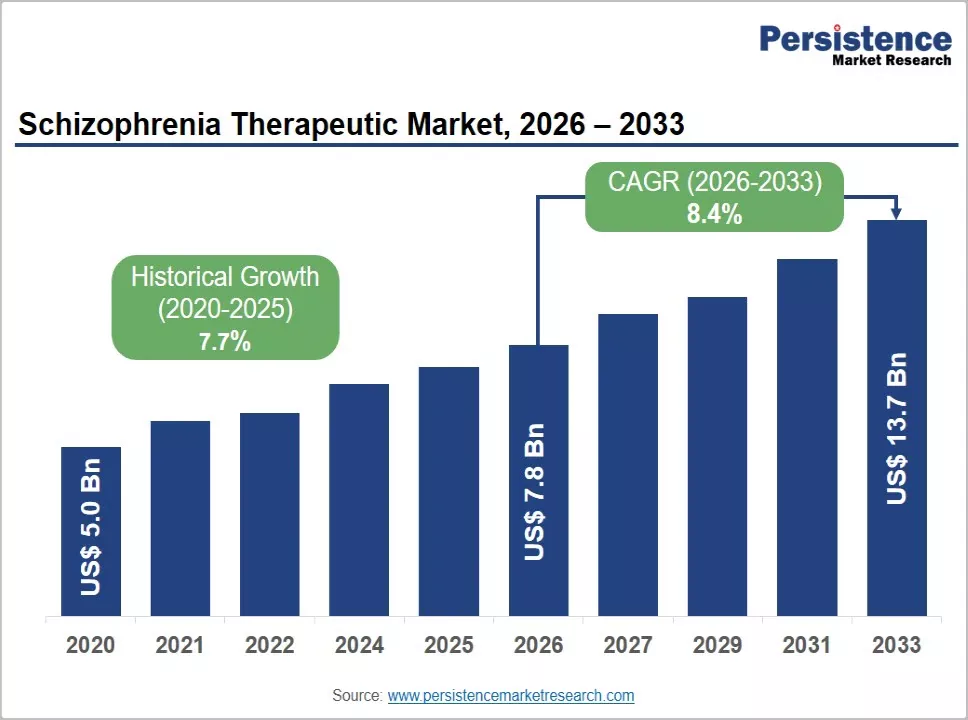
The global schizophrenia therapeutic market size is likely to be valued at US$ 7.80 billion in 2026 and is projected to reach US$ 13.72 billion by 2033, growing at a CAGR of 8.4% during the forecast period between 2026 and 2033.
Psychiatric drug development is undergoing its most consequential structural shift in two decades, as clinical pipelines move beyond dopamine blockade toward multi-receptor modulation and long-acting injectable formulations that meaningfully improve treatment adherence.
This trajectory reflects sustained pressure from the World Health Organization (WHO), which estimates schizophrenia affects approximately 24 million people globally, combined with accelerating regulatory approvals for next-generation antipsychotics across the U.S. Food and Drug Administration (FDA) and the European Medicines Agency (EMA). For institutional investors and pharmaceutical strategists, the schizophrenia therapeutic landscape now presents a rare convergence of unmet clinical need, pipeline depth, and broadening payor coverage.
Key Industry Highlights
- Dominant Region: North America command 41% of market revenue in 2026, anchored by MHPAEA parity mandates and the launch of mechanistically novel agents; the region's value share will be defended through 2033 by sustained branded pipeline activity from Bristol-Myers Squibb and Johnson & Johnson, even as generic competition intensifies on established oral molecules.
- Fastest-growing Region: Growing at 10.8% CAGR the fastest of any region Asia Pacific will almost double its revenue contribution by 2033, driven by China's mental health infrastructure expansion under the 14th Five-Year Plan and India's statutory treatment mandates under the Mental Healthcare Act, 2017, creating a compelling entry opportunity for multinational originators with regional manufacturing capabilities.
- Leading Therapeutic Class: Second-generation (atypical) antipsychotics hold 58% of market, reflecting two decades of entrenched clinical guidelines favoring this class; their dominance is structurally stable, though incremental share will progressively flow to third-generation and mechanistically differentiated agents as pipeline approvals accumulate through 2033.
- Dominant Drug Type: Cariprazine is the fastest-growing individual drug type, with real-world evidence published from 2022 to 2024 establishing its superior efficacy on negative and cognitive symptoms the dimensions most resistant to standard dopamine blockade positioning AbbVie to capture prescribers frustrated with partial responders on existing atypical agents.
- Key Market Opportunity: The FDA's 2024 approval of KarXT (xanomeline-trospium) has opened a premium pricing tier within the schizophrenia therapeutic landscape that generic manufacturers cannot replicate, creating a durable margin opportunity for companies that can advance muscarinic and other non-dopaminergic candidates through late-stage clinical trials before 2030.
DRO Analysis
Driver - Proliferation of Long-Acting Injectable Antipsychotics and Improved Adherence Outcomes
Non-adherence to oral antipsychotic regimens is a defining clinical and commercial challenge; industry estimates suggest up to 50% of patients discontinue oral therapy within the first year. Long-acting injectable (LAI) formulations including paliperidone palmitate (marketed by Janssen Pharmaceuticals, a Johnson & Johnson company, as Invega Sustenna and Invega Trinza) directly address this by extending dosing intervals to one month or three months respectively.
Otsuka Pharmaceutical Co., Ltd. similarly markets aripiprazole lauroxil (Aristada) as a monthly to bimonthly LAI option. Psychiatrists at academic medical centers and community mental health clinics are shifting first-episode patients to LAI formulations earlier in treatment pathways, expanding the addressable market and improving reimbursement outcomes.
Restraint - Adverse Effect Profiles Limiting Patient Uptake and Prescriber Confidence
Metabolic side effects including weight gain, dyslipidaemia, and extrapyramidal symptoms remain a persistent obstacle to full schizophrenia therapeutic market penetration. The American Psychiatric Association (APA) clinical guidelines acknowledge that side effect burden is a primary reason patients self-discontinue antipsychotic therapy. Clozapine, despite its superiority in treatment-resistant schizophrenia, requires mandatory hematological monitoring under FDA Risk Evaluation and Mitigation Strategy (REMS) protocols, restricting its use to specialized settings and limiting its commercial scale relative to its clinical efficacy.
Opportunity - Next-Generation Muscarinic Receptor Agonists Redefining the Treatment Paradigm
The approval of KarXT (xanomeline-trospium) by the FDA in September 2024, developed by Karuna Therapeutics (subsequently acquired by Bristol-Myers Squibb), represents the first genuinely novel mechanism of action approved for schizophrenia in decades. By targeting muscarinic acetylcholine receptors rather than dopamine pathways, KarXT avoids the metabolic and extrapyramidal liabilities that constrain existing agents. This approval signals that the FDA is receptive to mechanistically differentiated candidates, encouraging further pipeline investment and creating a premium pricing tier within the schizophrenia therapeutic landscape.
Category-wise Analysis
Why Do Second-Generation Antipsychotics Command the Majority of the Schizophrenia Therapeutic Market?
Second-generation (atypical) antipsychotics are projected to capture nearly 58% of market share in 2026. Due to prescribers across inpatient psychiatry and community mental health settings consistently favor their superior tolerability profile over first-generation agents. Outpatient psychiatrists managing stable, community-dwelling patients routinely initiate and maintain therapy with atypical agents particularly quetiapine, olanzapine, and risperidone given their reduced risk of tardive dyskinesia and improved secondary symptom coverage. Hospital formulary committees at academic medical centers similarly prioritize second-generation agents as first-line options in acute psychosis management protocols.
Third-generation antipsychotics are likely to be the fastest-growing segment, propelled by the FDA's 2024 approval of KarXT. Patients with treatment-resistant schizophrenia who have failed two or more atypical agents represent a newly addressable buyer group for mechanistically distinct candidates, and Bristol-Myers Squibb's commercial launch of KarXT is catalyzing prescriber trial across specialist psychiatry networks.
Drug Type Insights
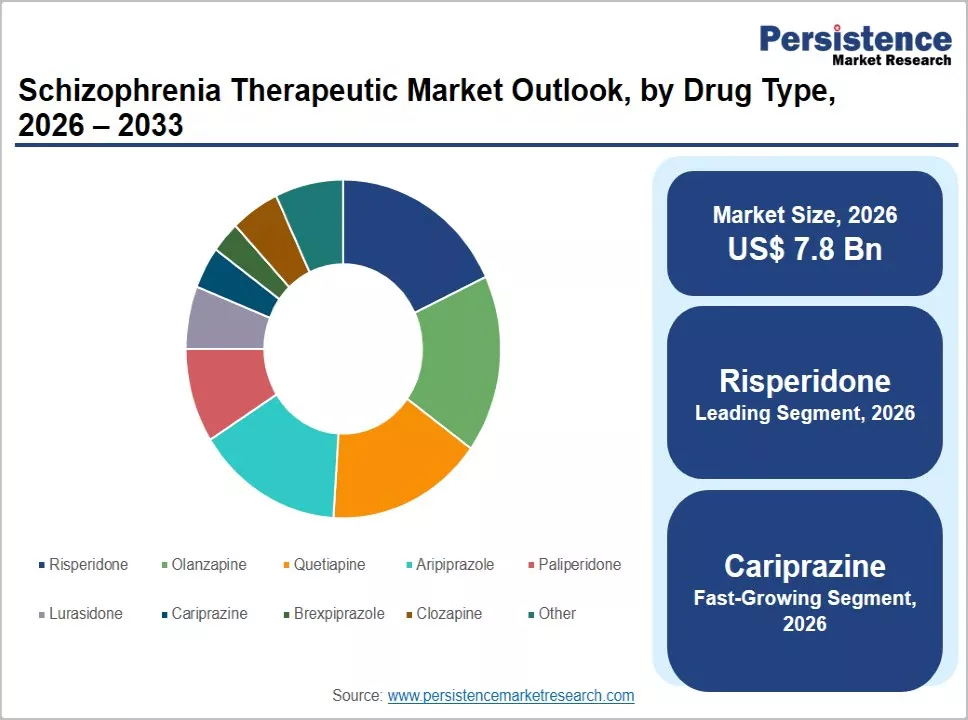
Risperidone is expected to lead the drug type segment command about18% of market share in 2026, retaining leadership due to of its dual availability as a low-cost generic oral tablet and as the branded LAI formulation Risperdal Consta (Johnson & Johnson). Psychiatric emergency departments and correctional health facilities settings that require rapid oral titration before transitioning to injectable maintenance depend heavily on risperidone's flexible dosing formats and predictable pharmacokinetic profile. Formulary placement across Medicaid managed care organizations in the U.S. further entrenches its volume leadership despite branded pricing pressure.
Cariprazine is likely to be the fastest-growing drug type, driven by its differentiated activity on dopamine D3 receptors, which addresses negative and cognitive symptoms that other agents inadequately treat. AbbVie Inc. received EU approval for cariprazine (Reagila) for schizophrenia in 2017, and subsequent real-world evidence published between 2022 and 2024 demonstrating efficacy on negative symptoms is accelerating its adoption among European psychiatrists managing patients with predominantly negative-symptom presentations.
Mechanism of Action Insights
Dopamine D2 receptor antagonists are estimated to hold 35% of market share in 2026. This mechanism underpins most first- and second-generation antipsychotics and benefits from decades of prescriber familiarity, extensive clinical trial data, and established reimbursement pathways across all major markets. Inpatient psychiatric units managing acute agitation use D2 antagonists particularly haloperidol and risperidone as first-response agents, while community mental health programs rely on the same molecules for maintenance therapy. The breadth of approved indications across schizophrenia subtypes sustains formulary dominance.
Dopamine D2/D3 partial agonists are likely to be the fastest-growing mechanism segment. Brexpiprazole (Rexulti, Otsuka/Lundbeck) and cariprazine (Vraylar, AbbVie) are expanding this segment's share as clinical evidence distinguishes partial agonism's functional selectivity from full antagonism. The FDA's 2023 supplemental approval of brexpiprazole for agitation associated with Alzheimer's disease dementia is broadening the prescriber base and cross-selling into neuropsychiatry, pulling additional formulary attention toward D2/D3 partial agonist molecules.
What Is Driving the Dominance of Monotherapy in Schizophrenia Treatment Protocols?
Monotherapy is anticipated to account about 64% of market share in 2026, fueled by international clinical guidelines including those from the APA and the British Association for Psychopharmacology (BAP) explicitly recommend initiating and maintaining patients on a single antipsychotic agent at the lowest effective dose before considering augmentation strategies. First-episode psychosis patients managed by early intervention in psychosis (EIP) teams in the NHS England system, for instance, follow standardized monotherapy pathways that prioritize tolerability optimization before escalation. The administrative simplicity of single-agent prescribing also supports adherence monitoring in both inpatient and outpatient settings.
Adjunctive therapy is likely to be the fastest-growing treatment type, gaining momentum as psychiatrists add agents targeting cognitive and mood symptoms that primary antipsychotics leave unaddressed. Intra-Cellular Therapies' lumateperone (Caplyta), initially approved by the FDA for bipolar depression, is increasingly used adjunctively in schizophrenia patients with comorbid depressive symptoms an expanding clinical practice driving formulary reviews at large integrated health systems through 2024 and 2025.
Regional Insights
North America Schizophrenia Therapeutic Market Trends and Insights
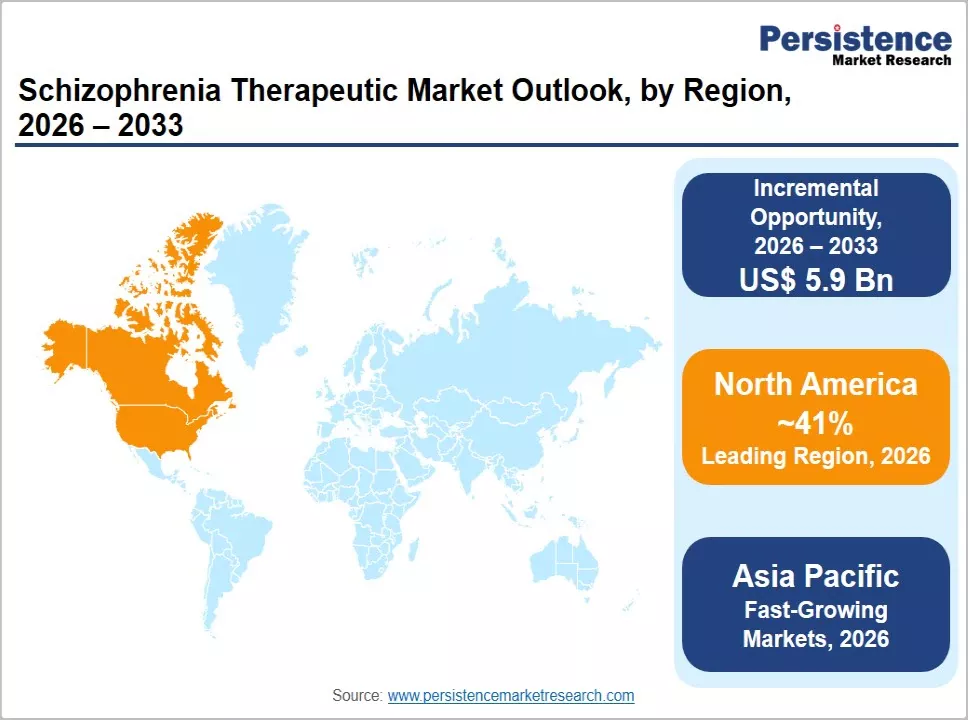
North America is forecast to dominate the regional market capture around 41% of the schizophrenia therapeutic market in 2026, propelled by the U.S. mature managed care infrastructure, favorable branded drug reimbursement, and the highest per-capita spending on antipsychotic medications globally. The Mental Health Parity and Addiction Equity Act (MHPAEA) mandates comparable insurance coverage for mental health conditions, reinforcing commercial access to premium-priced LAI formulations. Launch activity from Bristol-Myers Squibb and pipeline candidates approaching regulatory review will sustain North America's value share through 2033
U.S. Schizophrenia Therapeutic Market Size
The U.S. is estimated to hold about 89% of the North America regional market in 2026. The Assertive Community Treatment (ACT) model, widely adopted by state mental health authorities, drives sustained demand for LAI antipsychotics by embedding medication management within community outreach teams. Pipeline approvals anticipated through 2027 will further concentrate commercial value in the U.S. specialty psychiatry channel.
Canada Schizophrenia Therapeutic Market Size
Canada is expected to capture about 11% of the North America regional market in 2026. Provincial formularies managed by bodies such as the Canadian Drug Review (CDR) under Canada's Drug and Health Technology Agency (CADTH) create reimbursement timelines that delay branded antipsychotic uptake relative to the U.S. Expanded mental health funding commitments under the 2023 Federal Budget's $25 billion bilateral health agreements with provinces signal improving access conditions through the forecast period.
Europe Schizophrenia Therapeutic Market Trends and Insights
Europe is anticipated to command about 18% of schizophrenia therapeutic market in 2026, stimulated by the EMA's centralized approval pathway and national health technology assessment (HTA) processes that heavily influence net pricing. The European Brain Council estimates the annual economic cost of schizophrenia in Europe at over €93 billion, generating sustained government pressure to expand community psychiatric infrastructure. Biosimilar and generic competition is intensifying across Western European markets, redirecting prescriber attention toward differentiated branded agents.
Germany Schizophrenia Therapeutic Market Size
Germany is projected to capture about 22% of the Europe regional market in 2026. The Gemeinsamer Bundesausschuss (G-BA) benefit assessment process under the Arzneimittelmarktneuordnungsgesetz (AMNOG) framework regulates net pricing for newly approved antipsychotics, creating tight commercial windows for manufacturers. Germany's integrated psychiatric hospital network (Psychiatrische Institutsambulanzen) generates consistent demand for LAI formulations, sustaining volume growth even under price compression.
U.K. Schizophrenia Therapeutic Market Size
The U.K. is projected to hold around 20% of the Europe regional market in 2026. NHS England's Long Term Plan commitment to expanding early intervention in psychosis services to treat 60% of eligible patients within two weeks is structurally increasing first-episode antipsychotic prescribing. NICE guideline updates anticipated in 2025 addressing LAI use in first-episode schizophrenia represent a potential formulary catalyst for branded injectable agents.
Which Region Will Drive the Fastest Schizophrenia Therapeutic Growth Through 2033?
Asia Pacific is likely to be the fastest growing during the forecast period between 2026 to 2033. The primary acceleration force is China's large unmet treatment gap the National Health Commission of China estimates that community-based mental health services reach fewer than 30% of people with serious mental illness combined with the government's push under the 14th Five-Year Plan (2021-2025) to expand psychiatric hospital beds and community mental health centers. India's Mental Healthcare Act, 2017 similarly mandates government-funded psychiatric treatment, progressively converting unmet need into active pharmaceutical demand.
China Schizophrenia Therapeutic Market Size
China is anticipated to hold about 34% of the Asia Pacific regional market in 2026. Domestic generic manufacturers dominate current prescribing volumes, but increasing private hospital penetration and rising patient incomes are expanding access to branded atypical agents. Accelerating approvals through the National Medical Products Administration (NMPA) for imported antipsychotics will diversify the competitive base through 2030.
Japan Schizophrenia Therapeutic Market Size
Japan is estimated to account around 23% of the Asia Pacific regional market in 2026. Japan's universal health insurance system under the National Health Insurance (NHI) scheme provides comprehensive coverage for antipsychotic medications, sustaining stable per-patient treatment expenditure. Otsuka Pharmaceutical's domestic leadership anchored by aripiprazole origination and strong psychiatrist relationships positions the company to capture disproportionate share of LAI uptake as long-acting formulations gain clinical traction in Japan through 2033.
Competitive Landscape
The global schizophrenia therapeutic market operates as a moderately concentrated oligopoly at the branded level, with Johnson & Johnson, Otsuka Pharmaceutical Co., Ltd., H. Lundbeck A/S, AbbVie Inc., and Bristol-Myers Squibb controlling the most commercially significant patented assets.
Competitive advantage turns on LAI formulation portfolios, pipeline depth in novel mechanisms, and the ability to navigate HTA processes in Germany, France, and the U.K. Alkermes plc, Sumitomo Pharma Co., Ltd., and Vanda Pharmaceuticals Inc. compete in narrower specialty segments. Generic erosion continues to commoditize the oral atypical tier, pushing branded players to differentiate on delivery technology, digital adherence tools, and companion diagnostics rather than molecular novelty alone.
Key Market Developments
- In October 2026, Click Therapeutics, Inc. announced that the U.S. Food and Drug Administration (FDA) had granted 510(k) clearance to Motivista (CT-155), a prescription digital therapeutic for treating negative symptoms of schizophrenia. The company described Motivista as the first FDA-authorized treatment specifically indicated for these symptoms in the U.S. The therapy was intended for adults aged 18 years and older with clinically stable positive symptoms and was designed to complement clinician-managed outpatient care, including antipsychotic medication.
Companies Covered in Schizophrenia Therapeutic Market
- Johnson & Johnson
- Otsuka Pharmaceutical Co., Ltd.
- H. Lundbeck A/S
- Schizophrenia Therapeutic Market+A13705:A13723
- Sumitomo Pharma Co., Ltd.
- Eli Lilly and Company
- Alkermes plc
- Vanda Pharmaceuticals Inc.
- Pfizer Inc.
- Teva Pharmaceutical Industries Ltd.
Frequently Asked Questions
The global schizophrenia therapeutic market is valued at US$ 7.80 billion in 2026.
Mandatory mental health treatment coverage enacted through legislation such as India's Mental Healthcare Act, 2017, which is converting historically untreated patient populations into active prescription demand; and the clinical shift toward long-acting injectable antipsychotics, which reduce relapse-driven hospitalization costs and improve payor willingness to reimburse at premium price points.
Second-generation (atypical) antipsychotics hold 58% of market share in 2026, commanding dominance because international clinical guidelines from the American Psychiatric Association and the British Association for Psychopharmacology designate them first-line therapy for both acute psychosis and long-term maintenance.
North America lead the market with 41% of market revenue, sustained by comprehensive mental health parity legislation under the Mental Health Parity and Addiction Equity Act, high branded drug reimbursement rates, and a dense specialty psychiatry infrastructure that supports rapid adoption of premium LAI formulations.
Pharmaceutical companies with late-stage candidates targeting acetylcholine, glutamate, or serotonin receptor pathways are best positioned to capture this window, provided they can secure FDA breakthrough therapy designation to accelerate clinical timelines.
Some leading companies include Johnson & Johnson, Otsuka Pharmaceutical Co., Ltd., H. Lundbeck A/S, AbbVie Inc., and Bristol-Myers Squibb as the primary innovator competitors.


